Body Drawing Bases: 2026 Guide to Poses & Workflow
Updated for 2026: body drawing bases are still one of the fastest ways to move from a blank canvas to a believable character pose. The best results do not come from collecting more random references. They come from choosing the right base for the drawing problem, understanding what that base teaches, and keeping your visual references organized enough to reuse.
A body drawing base is a simplified pose framework that helps artists plan proportion, gesture, perspective, and character silhouette before final line art. Beginners use bases to avoid anatomy panic; experienced artists use them to test thumbnails, keep characters consistent, and speed up storyboards, comics, concept sheets, and OC design.
This guide explains what base drawings are, which types to use, where to find ethical pose references, and how to build a reusable visual reference library in AFFiNE without changing your creative process into folder management.
Quick Answer
Use a body drawing base as a construction layer, not as finished art. Pick a mannequin, anatomy, anime, chibi, dynamic, or interaction base based on the pose problem you need to solve. Then record the source URL, usage rights, pose tags, and learning notes beside the image so the reference stays useful and safe to reuse.
How This Guide Was Refreshed
For this 2026 refresh, the article was reviewed against Google Search guidance for helpful, people-first content and image best practices. The weak blob-based illustrations were replaced with original first-party visuals, the source and license workflow was made more explicit, and the AFFiNE section was expanded so readers can act on the advice instead of only learning definitions.
What Is a Body Drawing Base?
A body drawing base is a simplified figure template used to plan a human or humanoid pose before adding anatomy, clothing, hair, expression, and style. Most bases reduce the figure into heads, rib cages, pelvis blocks, cylinders, gesture lines, and simple joints so artists can solve structure before details.
Think of it as the blueprint stage of figure drawing. You are not outsourcing creativity; you are separating the hard problems. First you solve pose and proportion. Then you solve costume, face, lighting, line quality, and story.
Drawing Base vs Pose Reference vs Tracing
These terms are often mixed together, but they are not the same:
| Term | What it means | Best use | Risk to avoid |
|---|---|---|---|
| Drawing base | A simplified template or mannequin for building a figure | Planning anatomy, pose, and proportion | Copying without understanding the 3D form |
| Pose reference | A photo, 3D model, or drawing used as visual input | Gesture practice, foreshortening, lighting, hands, feet | Ignoring license or creator rules |
| Tracing | Drawing directly over an existing image | Private study, learning shapes, fast rough layouts | Publishing traced work without permission |
A base is most useful when you treat it as a study tool. Ask why the rib cage tilts, why the hips counter-rotate, and where the line of action travels through the pose.
Why Artists Use Drawing Bases
Drawing bases are popular because they reduce decision overload. Instead of solving every part of figure drawing at once, a base gives you a stable starting point.
- Better proportions: You can check head count, shoulder width, hip placement, limb length, and balance before details hide the mistake.
- Faster iteration: A single standing base can become five outfit designs, color studies, or character variants.
- Stronger gesture: Dynamic bases help you see the main curve of the pose before you stiffen it with anatomy.
- Consistent characters: Character sheets become easier when the base height, head size, and silhouette stay consistent.
- Lower blank-page friction: A rough mannequin gives beginners a safe first mark and gives pros a faster thumbnail stage.
Types of Drawing Bases You Should Know
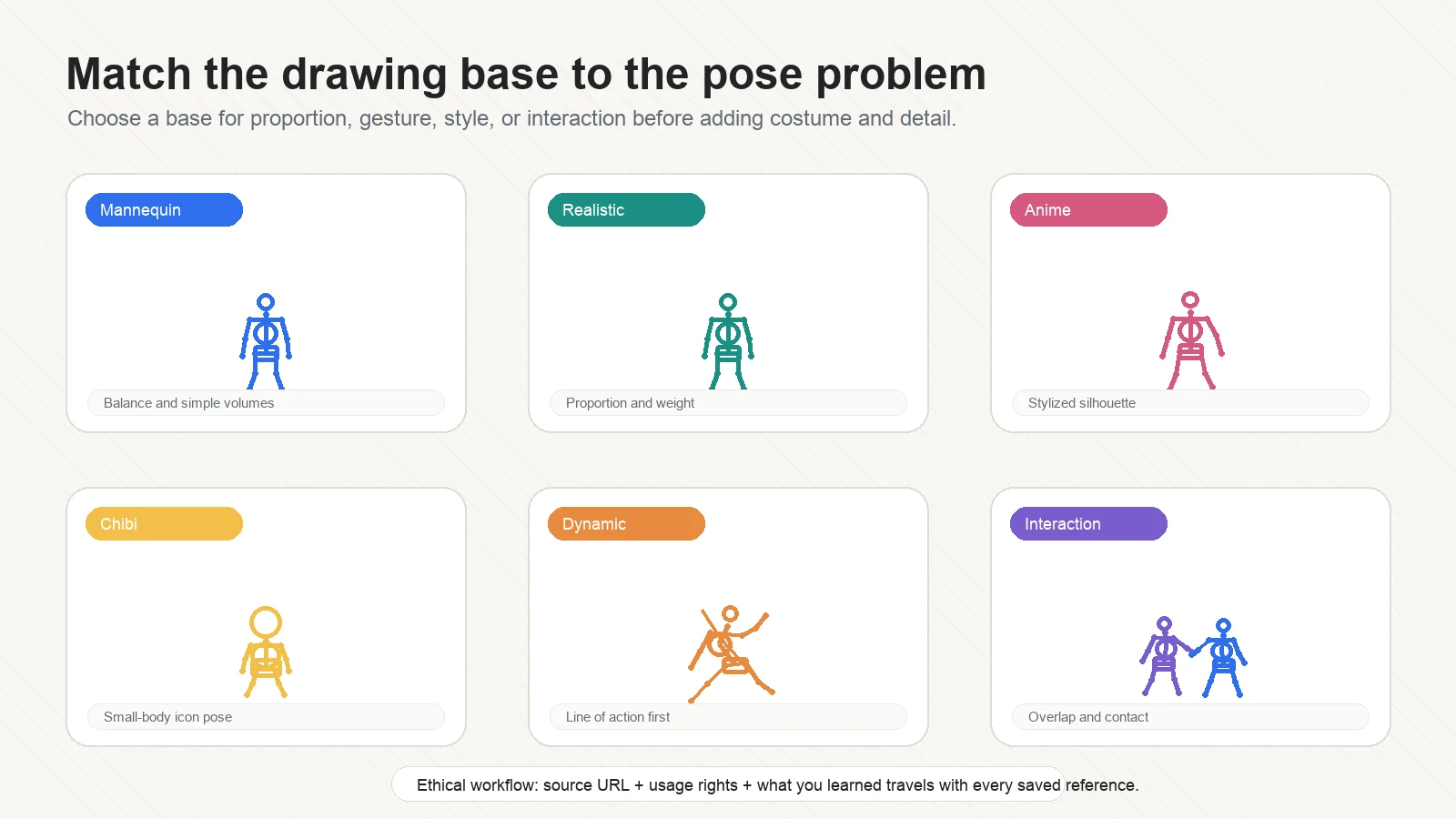
Choose the base by the drawing problem you are solving. A cute chibi base will not teach the same thing as a realistic anatomical mannequin, and an action pose will not solve a calm character turnaround.
1. General Mannequin Bases
A general mannequin base breaks the body into simple volumes: head, neck, rib cage, pelvis, arms, legs, hands, and feet. It is usually neutral in gender and style.
Best for: gesture drawing, balance, perspective, and early pose planning.
Practice note: keep the mannequin loose. If the first version looks stiff, exaggerate the line of action before adding anatomy.
2. Realistic Anatomy Bases
A realistic base follows human proportion more closely. Many art systems use a 7 to 8 head figure as a neutral adult reference, though real bodies vary widely.
Best for: figure studies, character sheets, fashion sketches, portrait-to-body consistency, and realistic illustration.
Practice note: use the head-count rule as a measuring tool, not a law. Character design often becomes more memorable when proportions intentionally vary.
3. Anime and Manga Bases
Anime bases simplify joints, enlarge eyes and heads, and often stretch limbs for style. They are useful when the final design is stylized rather than anatomical.
Best for: OC design, manga panels, expressive poses, outfit concepts, and fan-art practice.
Practice note: decide the style first. A 6-head anime figure, a 7.5-head semi-real figure, and a 2.5-head chibi figure need different bases.
4. Chibi Bases
Chibi bases compress the body into 2 to 3 heads tall. They prioritize expression, silhouette, and cuteness over anatomy.
Best for: stickers, icons, mascots, emotes, simple comics, and merch concepts.
Practice note: exaggerate the head, keep limbs simple, and make the pose readable even at small size.
5. Dynamic Pose Bases
Dynamic pose bases focus on action: running, jumping, fighting, falling, dancing, reaching, or twisting. The spine often follows a C-curve, S-curve, or strong diagonal.
Best for: action scenes, storyboards, comic panels, thumbnails, animation keys, and dramatic character art.
Practice note: draw the line of action first. If that line is weak, the finished pose usually feels weak too.
6. Interaction Bases
Interaction bases include two or more figures: hugging, fighting, carrying, sitting together, posing as a group, or reacting to one another. They are sometimes called draw-the-squad bases.
Best for: comics, social posts, relationship charts, team illustrations, and scale practice.
Practice note: check eye lines, contact points, and overlap. Interaction poses fail when figures look pasted together instead of sharing weight and space.
Where to Find Body Drawing Bases and Pose References
The best reference source depends on whether you need free inspiration, 3D control, timed gesture practice, or publishable assets. Always check the creator license before using a base in public work. If the license is unclear, treat the image as private study material and do not publish a derivative piece from it.
- Timed gesture practice: Line of Action is useful for short timed studies and teaches artists to find the main movement line before adding detail.
- 3D pose exploration: Posemaniacs offers royalty-free 3D pose references, including muscle and hand references, which can help when you need a rotating figure.
- Curated reference lists: Wacom maintains a 2026 guide to free pose reference resources that highlights sites such as SketchDaily, Line of Action, and PoseMyArt.
- Community bases: Pinterest, DeviantArt, Tumblr, and X can be useful for F2U drawing bases, but only if the creator clearly states usage rights.
- Your own photos: For original work, taking your own pose photos is often the safest reference source. You control the license, angle, lighting, and costume.
Quick License Checklist
Before saving a base into your reference library, record four things next to it:
- Source URL or creator name.
- Usage rights, such as personal study, commercial use, or credit required.
- Style or pose tags, such as chibi, standing, fighting, sitting, hands, or perspective.
- Notes about what you learned from the reference.
This habit protects you from losing attribution later and makes your reference collection searchable.
For public or commercial artwork, prioritize references you can verify: your own photos, official 3D pose tools with clear usage terms, or creator-posted bases that explicitly state reuse rules. Screenshots from social feeds may be useful for private practice, but they are weak sources for finished work because the original creator and license often get separated from the image.
How to Choose the Right Base for Your Drawing
A good base matches the output you want. Use this quick decision process before collecting more references:
- Define the final format. Is this a comic panel, full illustration, sticker, animation key, or character sheet?
- Choose the style. Realistic, semi-realistic, anime, chibi, fashion, or cartoon.
- Pick the pose problem. Gesture, foreshortening, hands, feet, balance, facial expression, or multi-character interaction.
- Check the camera angle. Front view, side view, three-quarter view, top-down, or low angle.
- Save why it works. Do not just save the image. Add a note about the useful part: hip tilt, shoulder angle, hand pose, negative space, or silhouette.
A smaller set of well-tagged bases beats a folder of 500 mystery images.
The Real Problem: Reference Chaos
Most artists do not fail because they lack references. They fail because their references are scattered across screenshots, downloads, Pinterest boards, Discord messages, camera rolls, and forgotten folders.
That chaos slows down the moment you actually want to draw. You remember a perfect kneeling pose, but not where it is. You wrote character lore, but it is in a notes app. You saved a costume idea, but it is separated from the base it belongs to.
Drawing needs two things at the same time: visual references and context. Pure image boards handle visuals. Notes apps handle text. A creative workflow needs both in one place.
How to Build a Drawing Base Reference Library in AFFiNE
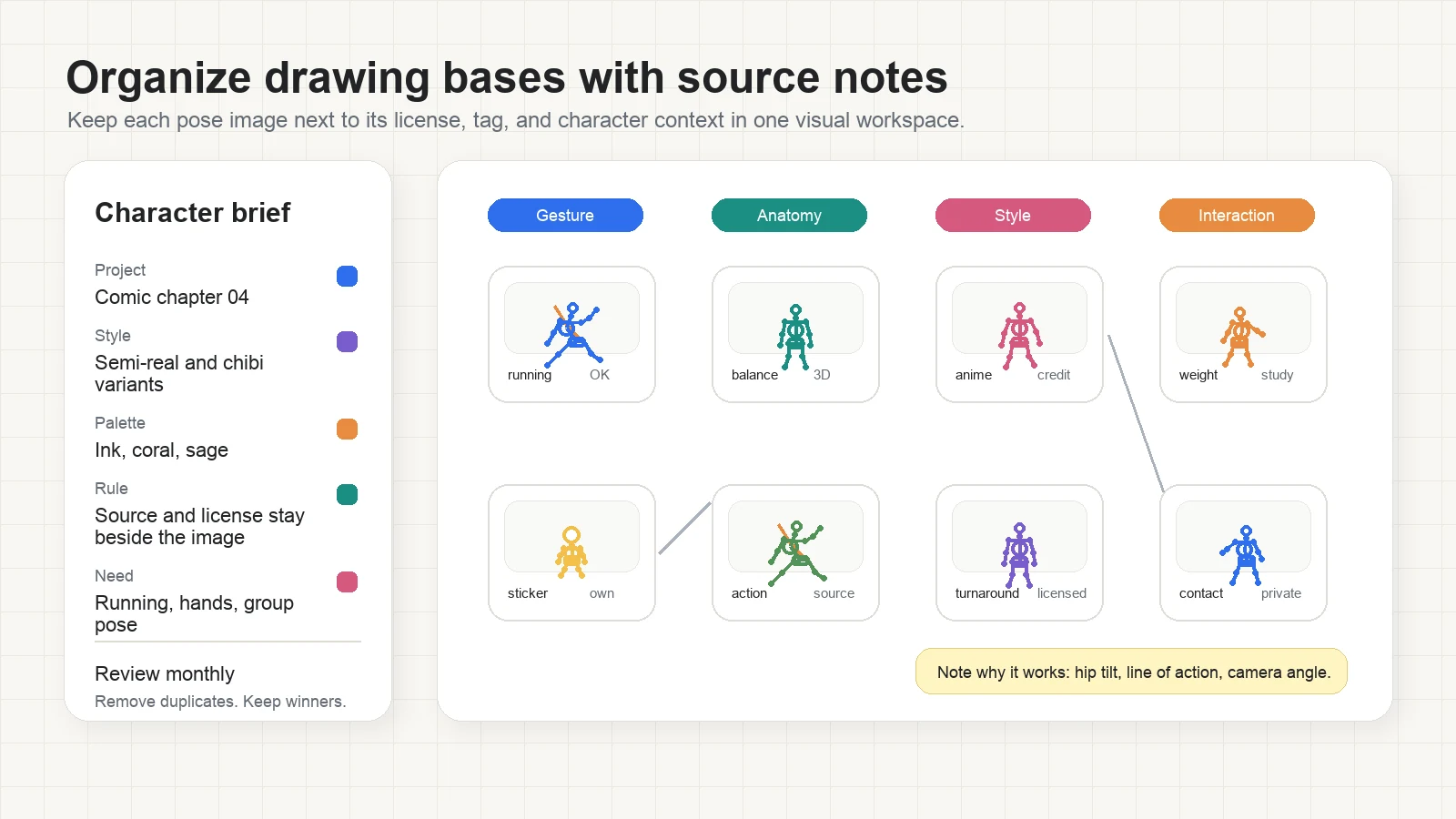
AFFiNE works well for artists because it combines Docs with an infinite whiteboard. You can write character notes in Page Mode, arrange pose references in Edgeless whiteboard space, and connect visual inspiration to project planning without switching tools. The goal is not to turn art into administration; the goal is to keep every useful reference close to the reason you saved it.
Step 1: Create a Master Reference Board
Open a new AFFiNE page and switch to Edgeless Mode. Create broad sections for pose type: standing, sitting, running, fighting, hands, feet, facial expressions, anime, chibi, and interaction poses.
Add only references you can identify. If a base has unclear rights, keep it in a private study area or replace it with a clearer source.
Step 2: Add Tags and Notes Beside Each Base
Do not rely on file names. Place a short text block next to each image with tags and learning notes.
Useful tags include style, action, camera angle, body part, emotion, license, and project. A note like good hip counter-tilt for running is more useful than another file called pose-final-3.png.
A strong reference note usually answers three questions: what is the pose doing, what can you legally do with the source, and what should your future self notice when drawing from it.
Step 3: Build Character Sheets Next to Pose Bases
Place the chosen body drawing base beside the character brief. Include height, age range, personality, outfit rules, color palette, props, and expression notes.
This is where AFFiNE is stronger than a simple mood board. Long-form notes can sit beside the pose, so the visual base and the character logic stay synchronized.
Step 4: Turn Boards Into Reusable Templates
Once a board works, duplicate it for the next character, comic chapter, or illustration series. Keep the same sections but swap the reference set.
For visual planning ideas, you can adapt AFFiNE resources such as the Vision Board Template, the free whiteboard app guide, or the creative vision board ideas into an art reference workflow.
Step 5: Review and Prune Monthly
A reference library should become sharper over time. Once a month, remove duplicates, update source links, and promote your best references into a favorites section. Keep notes about which bases led to finished work.
This turns your board from a dumping ground into a visual knowledge base.
| What to track in AFFiNE | Why it matters for drawing |
|---|---|
| Source URL and creator | Keeps attribution recoverable when the image is reused later |
| Usage rights | Separates private study references from publishable bases |
| Pose tags | Helps you find running, sitting, hands, foreshortening, or group references quickly |
| Learning note | Records the useful lesson, such as hip tilt, line of action, or negative space |
| Project link | Connects the base to a character sheet, storyboard, or finished illustration |
Beginner Practice Plan: 7 Days With Drawing Bases
Use this plan if you are new to bases and want structured practice without overthinking.
- Day 1: Copy five mannequin bases and label head, rib cage, pelvis, knees, elbows, hands, and feet.
- Day 2: Draw the same standing base with three different body shapes.
- Day 3: Study ten 30-second gestures and draw only the line of action.
- Day 4: Build one anime base and one realistic base from the same pose.
- Day 5: Create a chibi version of a full-body pose.
- Day 6: Combine two references into one original pose sketch.
- Day 7: Make a character sheet in AFFiNE with the base, outfit notes, palette, and three expression thumbnails.
The goal is not a perfect finished illustration. The goal is to understand what each base teaches.
Common Mistakes When Using Drawing Bases
Mistake 1: Tracing Without Studying
Tracing can help private practice, but it becomes a dead end if you never analyze the structure. After tracing, redraw the base from memory and label the forms.
Mistake 2: Using the Wrong Style Base
A realistic anatomy base may make a chibi design look awkward. A chibi base will not teach realistic foreshortening. Match the base to the final style.
Mistake 3: Saving References Without Source Notes
A reference folder without source notes becomes risky and hard to reuse. Keep creator names, URLs, and usage rules close to the image.
Mistake 4: Collecting Instead of Drawing
Reference collecting can feel productive while avoiding the hard part. Set a limit: for every 10 bases you save, draw at least one study.
Mistake 5: Keeping the Pose Too Stiff
If a pose feels lifeless, exaggerate the gesture before adding anatomy. Push the shoulders, hips, and spine until the silhouette reads clearly.
Conclusion
Body drawing bases help artists work smarter because they isolate pose, proportion, and gesture before the detail stage. They are not a shortcut around learning anatomy; they are a repeatable way to practice it.
The strongest workflow combines ethical reference sources, clear usage notes, regular drawing practice, and an organized visual workspace. With AFFiNE, you can keep drawing bases, character notes, mood boards, and project checklists together, turning scattered inspiration into a reusable creative studio. That combination supports both creative speed and trust: you know where each reference came from, why you saved it, and how it connects to the artwork you are making.
Start building your private art reference library in AFFiNE and keep every pose, note, and idea connected.
FAQs
Is using a drawing base cheating?
No. Using a drawing base is not cheating when it is used as a learning or planning tool. Artists use references, mannequins, thumbnails, and construction lines to solve proportion and pose. The important part is to respect licenses, avoid misrepresenting copied work as original, and keep studying the structure underneath the base.
What is the best body drawing base for beginners?
The best body drawing base for beginners is a simple mannequin base with clear head, rib cage, pelvis, limb, hand, and foot placement. Start with neutral standing poses before moving into action poses, foreshortening, or multi-character interaction. A simple base makes it easier to see proportion mistakes early.
Where can I find free pose references for drawing?
You can find free pose references on timed practice sites such as Line of Action, 3D reference tools such as Posemaniacs, curated artist resource lists such as Wacom’s 2026 pose reference guide, and community platforms where creators label bases as free to use. Always check usage rights before publishing artwork based on a reference.
What is the difference between anime and realistic drawing bases?
Anime drawing bases simplify anatomy and often use larger heads, cleaner joints, longer limbs, or more expressive silhouettes. Realistic drawing bases stay closer to human proportion, anatomy, and weight. Choose the base that matches your intended style instead of forcing one proportion system onto every drawing.
How should I organize drawing bases in AFFiNE?
Organize drawing bases in AFFiNE by creating an Edgeless reference board with sections for pose type, style, camera angle, body part, and project. Place source links and license notes beside each image, then connect your favorite bases to character sheets, mood boards, and project checklists.
Can AFFiNE be used for storyboarding and character sheets?
Yes. AFFiNE can be used for storyboarding and character sheets because it combines visual whiteboard space with long-form notes. You can arrange pose frames in sequence, keep character lore beside body bases, link supporting docs, and reuse the same board structure across comics, animations, and illustration projects.