Brainrot Memes: Examples, Meanings, and How to Check Them
Brainrot memes are internet jokes built around absurd images, repeated sounds, and references that make more sense once you have seen the format. A sneaker-wearing shark, a coffee-cup ballerina, and a singing toilet can all appear under the label, but they come from different meme histories.
This guide helps you identify recognizable examples, understand what the names refer to, and check a clip before you repeat its audio or share it. The examples are a starting point, not a ranking of today's most popular memes.
Quick answer: Italian brainrot is one branch of the wider category. Skibidi Toilet is a separate animated series; rizz is slang; Tung Tung Tung Sahur has Indonesian roots. A familiar character does not guarantee that every remix uses the same words or tells the same story.
What does “brainrot meme” mean?
People use brainrot loosely for content they find compulsively repeatable, deliberately silly, or saturated with internet references. It can describe the content, an obsession with it, or the feeling of having spent too long scrolling. It is not a precise genre boundary.
Oxford University Press chose brain rot as its Word of the Year for 2024. Its definition describes a supposed decline in mental or intellectual condition associated with consuming trivial material. That wording matters: a dictionary records how a term is used; it does not establish that a particular joke causes brain damage.
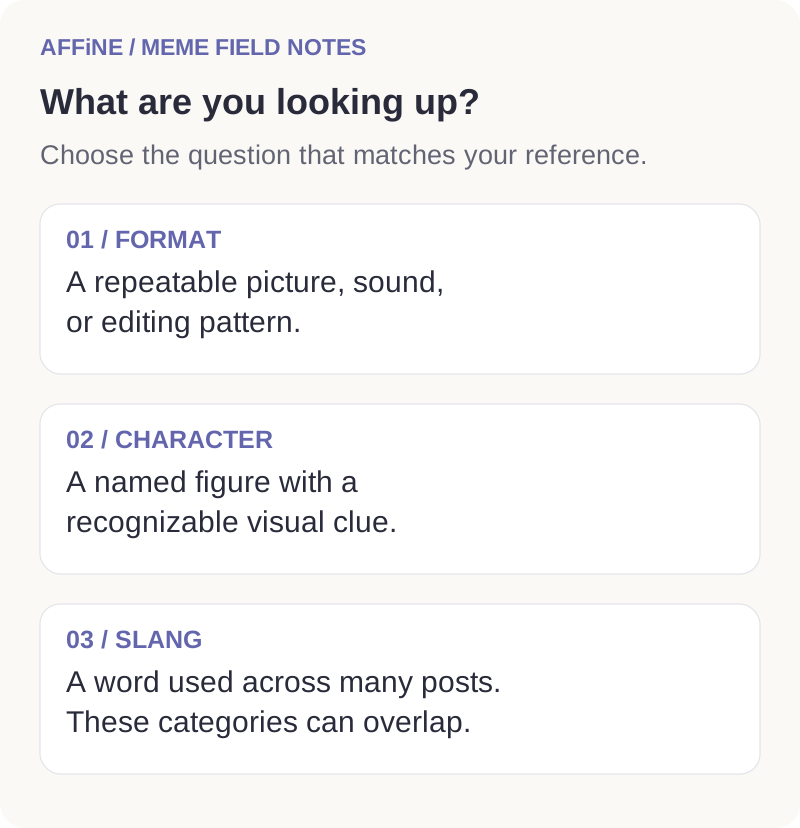
Three things are often mixed together:
- A meme format: a recognizable image, sound, or editing pattern that people reuse.
- A character or series: a named figure with identifiable visual features, sometimes with a story.
- Slang: a word that can appear in many unrelated memes.
For a broader vocabulary reference, use our brain rot words list. This page focuses on recognizing memes and checking their context.
Brainrot meme examples: names, meanings, and context
Start with the visual or phrase you recognize, then follow the linked source. The descriptions identify the reference; they do not reproduce every version of its audio.
| Example | What you are looking at | What to check |
|---|---|---|
| Tralalero Tralala | A shark in sneakers, associated with early Italian brainrot clips | The specific voiceover: versions can include religious insults |
| Bombardiro Crocodilo | A crocodile combined with a military aircraft | Whether the accompanying words change the tone of the image |
| Ballerina Cappuccina | A dancer with a coffee cup for a head | Whether a claimed relationship or backstory belongs to one fan remix |
| Tung Tung Tung Sahur | A wooden figure holding a bat, paired with Indonesian narration | The Indonesian and Ramadan context rather than an assumed Italian translation |
| Skibidi Toilet | Toilets with human heads in an animated web series | The original series versus an unrelated edit using its imagery |
| Rizz | A slang word for charm, especially in attracting someone | How the caption uses it; it is not the name of a character |
Italian brainrot: surreal characters and rhyming names
Italian brainrot combines unlikely creatures or objects with Italian-sounding names and narrated audio. Know Your Meme's overview documents the early-2025 trend and describes its exact origin as uncertain. Avoid treating a widely reposted clip as proof of the first upload.
Tralalero Tralala is recognizable by the shark and sneakers. Bombardiro Crocodilo combines a crocodile with a bomber plane. The names work as recurring sound cues as well as labels. You do not need a hidden literal translation to recognize the joke.
Ballerina Cappuccina has a coffee-cup head and ballet costume. Leslie Katz's reporting on Italian brainrot describes the character and the fan stories surrounding this cast. A romance, rivalry, or family tree in one video should therefore be attributed to that version rather than presented as universal canon.
A practical distinction: identifying the picture and understanding the audio are two separate tasks. Some Tralalero recordings include insulting religious language. A harmless-looking character card is not enough to decide whether a particular video is suitable to show a class or include in a brand post.
Tung Tung Tung Sahur: an Indonesian reference
Tung Tung Tung Sahur is often grouped with Italian brainrot because of its surreal character and narration. However, Know Your Meme documents Indonesian origins, with an early known upload attributed to @noxaasht on February 28, 2025.
Sahur refers to the meal before dawn during Ramadan. The repeated “tung” imitates a percussion sound associated with the wake-up call. That cultural reference helps explain the name; it is not simply invented Italian gibberish. The meme's fictional creature and story should also be distinguished from the real practice.
Skibidi Toilet: a separate animated series
Skibidi Toilet is a Source Filmmaker series by DaFuq!?Boom!, beginning on YouTube in February 2023. Its human-headed toilets and camera-headed opponents predate the Italian brainrot wave described above.
Calling both “brainrot” does not mean they share a creator, production method, or fictional universe. If a clip combines the shark with a Skibidi character, label that combination as a remix unless you have a source establishing otherwise.
Rizz: a word, not a character
Oxford named rizz its Word of the Year for 2023, describing charm or attractiveness in a romantic context. A caption can use the word seriously or ironically. Treating every slang term as a character name makes both searching and explaining the meme harder.
If the reference is to a game rather than a clip or word, our separate brain rot games explainer covers that adjacent topic.
How to verify a brainrot meme before sharing it
The most useful question is not “Is this the real meme?” but “Which part of this version can I verify?” Check the image, sound, caption, and source separately.
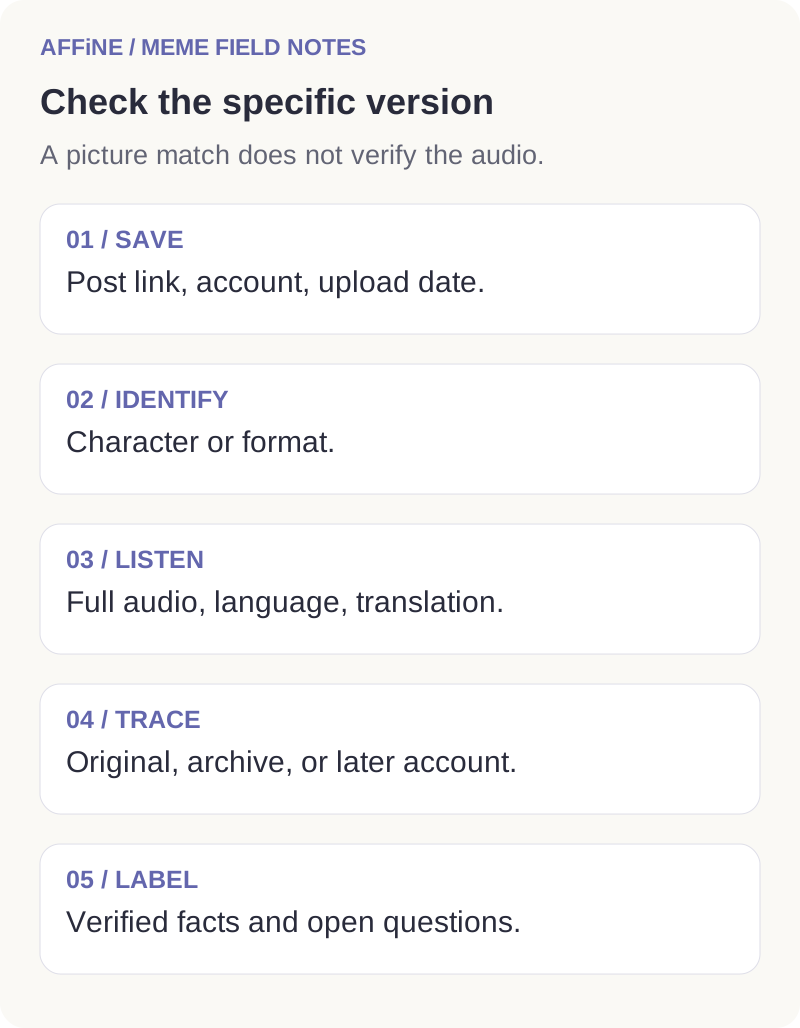
- Save the exact post link. Record the account name, visible upload date, and date you checked it. A downloaded image alone loses that context.
- Identify the character or format. Search its distinctive name or visual description. Use a meme encyclopedia to find candidate sources and earlier versions.
- Listen to the whole audio and check its language. Read a transcript or translation where available. If wording is unclear, leave it unverified rather than guessing from the title or comments.
- Trace the source behind the explanation. Follow the encyclopedia's references where possible. Distinguish an accessible original upload, an archived copy, and somebody's later description.
- Separate what you know from what you infer. “This entry documents a February 2025 upload” is narrower than “this was the first-ever use.” Two pages copying the same post are not independent confirmation.
- Choose what to share. Link to the source, add the context your audience needs, and mark any unresolved claim. For a presentation, a short written description may be enough.
Worked example: checking a shark clip
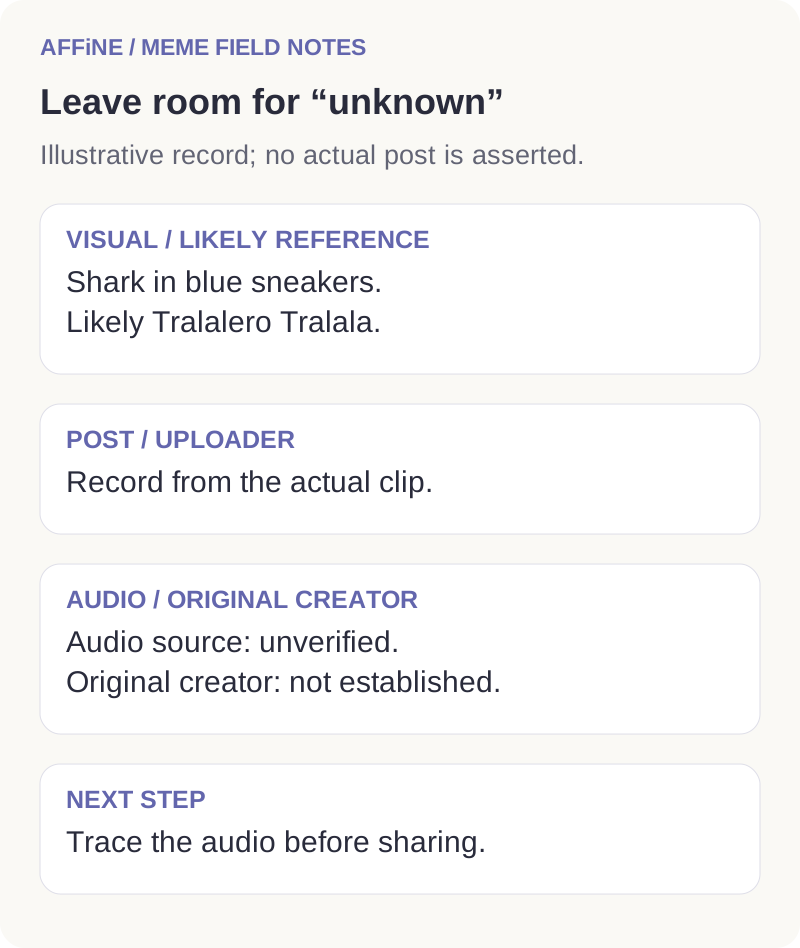
Suppose someone sends you a short clip of a shark in blue sneakers with a new song playing over it. The picture suggests Tralalero Tralala. It does not establish that the song is the early voiceover, that the reposting account created the image, or that a caption's origin story is accurate.
Know Your Meme's Tralalero entry discusses uncertainty around early uploads and audio history. Use that to identify the reference, then inspect the particular post you received. If you cannot trace its audio, write “Tralalero Tralala remix; audio source unverified.” That is a useful result without inventing an origin.
This is an illustrative research example, not a claim that we tested a specific user-submitted video.
Where to find images, meanings, and source material
Each resource answers a different question. None makes every origin claim or caption reliable on its own.
| Resource | Useful for | Important limitation |
|---|---|---|
| Know Your Meme | Names, documented timelines, image and video examples, reference links | Entries can change; “earliest known” is not proof of first creation |
| The post on TikTok or YouTube | The exact image, audio, caption, account, and visible date | A repost can look like an original; comments are not verified translations |
| Oxford's language coverage | Established word meanings and dated usage context | It is not a directory of every character or remix |
| Urban Dictionary | Finding possible community meanings to investigate | Definitions can be jokes, explicit, conflicting, or outdated |
| Google Trends | Comparing relative search interest over a selected period and region | It does not count meme uses, video views, or creators |
| CapCut or another video editor | Arranging your own images, captions, and sound | An editor cannot verify a meme's origin or explain its cultural context |
When looking for brainrot meme images or GIFs, start with the relevant entry's image or video examples and trace the upload it cites. A screenshot without an account or link is a recognition aid, not a complete source record. Preview the full animation and audio before using it.
Google explains that Trends data is normalized, with values scaled from 0 to 100 for the comparison. Keep the geography, time window, search type, and query choices with any chart you save. A value of 100 marks the comparison's peak, not 100 searches or proof that a meme is the most popular. This guide makes no measured popularity ranking.
Make a simple meme without losing the context
You can create a recognizable joke with one visual idea and a caption. A pile of effects is optional. CapCut's own meme guide describes image, text, and effect tools; check the version available to you before following a specific menu path.
Try this original concept: a sleepy teapot wearing roller skates, captioned “me arriving at the meeting after opening the wrong link.” This is an invented example for the guide, not an established brainrot character.
- Sketch or create the image and keep a copy of your source.
- Add a short caption that carries the joke even with sound off.
- Use your own audio, or check the terms for the audio you select.
- Preview the whole result, including any words added by a template.
- Label an invented character as your creation rather than giving it a fabricated viral history.
For third-party material, keep the creator and source link alongside your notes and check the relevant reuse terms. Attribution by itself does not establish permission to reuse an image or song.
Keep a small, useful meme reference library
A useful library records why you saved something. Start with a document or spreadsheet rather than collecting dozens of unexplained screenshots. Copy the following fields for each item:
| Field | What to record |
|---|---|
| Name and visual clue | The character or format and the feature that identifies it |
| Post URL and account | The exact version you encountered |
| Upload date / checked date | Keep these separate; do not substitute one for the other |
| Audio and language | A transcript, translation source, or “unverified” |
| Origin evidence | Original post, archive, secondary description, or unknown |
| Intended use | Explain it, link to it, or make a new remix |
| Credit / reuse notes | Creator, source, and any terms you have checked |
| Open question | The claim you still cannot support |
If you prefer a visual collection, AFFiNE's whiteboard can hold reference images beside notes; keep a text record of the source links and unresolved questions. AFFiNE publishes this guide, and this is an optional organizational use of the product, not an independent endorsement or a built-in meme verification service.
If you are new to the app, the AFFiNE getting-started guide explains its document and whiteboard modes. Start with one source record and add examples only when their context is clear.
Frequently asked questions about brainrot memes
Are all brainrot memes AI-generated?
No. Italian brainrot is associated with AI-generated imagery, but the broader label also covers slang, conventional edits, and animation. Skibidi Toilet, for example, is documented as a Source Filmmaker series. Check the specific work before assigning a production method.
Is Tung Tung Tung Sahur Italian?
The documented meme has Indonesian roots and Indonesian narration, although people often group it with Italian brainrot. Its name refers to a Ramadan wake-up context. The category attached to a repost does not replace that origin.
What is the difference between a brainrot word and a meme?
A word such as rizz has a meaning that can travel across many posts. A meme format is a repeatable joke, image, sound, or pattern. A named character can appear inside that format. They overlap, but identifying which one you mean makes it easier to find a useful explanation.
How do I find the original version of a brainrot meme?
Start with the exact post, compare the visible account and date with an encyclopedia's references, and look for an accessible original or archive. If the earliest upload is deleted or disputed, say “earliest documented” or “origin unverified.” The most-viewed copy is not necessarily the original.
Are brainrot memes suitable for a classroom?
Review the individual clip, including its audio, captions, and surrounding context. Some variants include profanity or religious insults even when the image looks playful. A teacher-created description or a verified still image can explain the reference without replaying an unsuitable sound.
Sources and editorial approach
Editorial note: Sources reviewed October 9, 2026. This is a source-based cultural explainer, not an exhaustive character catalog or a hands-on tool comparison. The cover is an AI-generated conceptual illustration; the diagrams are original explanatory graphics, not screenshots of original posts. Meanings and remix histories can change, so keep the checked date with any example you reuse.