5 Ways to Supercharge Studying with clever Notetaking | An Advanced Guide
Most students take notes the wrong way and wonder why nothing sticks. They write everything down during class, then can't understand their own notes later. The problem isn't how much you write. It's how you write it.
The right notetaking system saves hours of study time and improves retention. This guide covers five proven techniques that work for any subject or learning style.
Why Most Traditional Notetaking Fails
Taking notes in the traditional way makes problems worse instead of better. People write a lot, but they can't figure out what their notes mean. Taking notes is a waste of time if your handwriting is messy, you don't have enough context, or you don't organize your notes well. Linear notes don't show how brains really work as they take in and retain information.
The brain doesn't work with lists of things in order. It works with connections and patterns. When you force information into a straight line, you go against how people naturally learn. When you take notes the right way, your brain will work with you instead of against you. This includes employing clear hierarchies, spatial arrangement, and visual aspects.
Organizing Research and Complex Projects
Major assignments require managing lots of information from multiple sources. Papers involve tracking citations, quotes, main arguments, and your own analysis. Keeping everything organized while developing your thesis takes real planning and structure.
Students working on large projects benefit from documenting their process. Breaking down research into organized sections helps track progress and maintain focus. When handling complex projects with many sources and ideas, some students work with research paper writers to help structure their documentation and organize source materials. Guidance on organizing notes and citations saves time during the writing phase. Clear notes documentation from the start makes the actual writing process much smoother. Good organization systems pay off throughout the process.
Digital tools let you tag topics, link related ideas, and search across all your notes instantly. This beats flipping through notebooks looking for that one quote you wrote down somewhere.
Method 1: The Cornell Note System
Split your page into three parts. Main notes go on the right side (about two-thirds of the page). The left column is for questions and keywords. The bottom strip is for summaries.
During class, write notes in the main section. Don't try to capture every word. Use abbreviations. Leave space between topics.
Within 24 hours, go back and fill the left column. Write questions that your notes answer. Add keywords you can scan fast. This review step is what moves information into long-term memory.
Write a 2-3 sentence summary at the bottom. This forces you to figure out what actually matters. If you can't write the summary, you don't understand the material yet.
When you study, cover the main notes. It’s easy to use Cornell type notes with the right template.Try to answer the questions from memory. Then check your work. Studies show this active recall improves retention by 50% compared to just reading your notes.
Method 2: Mind Mapping for Complex Topics
Put your main concept in the middle of the page. Draw branches out to major themes. Add smaller branches for details. Use colors and simple drawings.
Make one mind map per topic. Trying to cram too much on one page creates confusion. Digital tools let you zoom in and out if you need more space.
The spatial layout helps memory. You remember where things sit on the page. Colors trigger visual memory. This gives your brain multiple ways to retrieve information later.
Mind maps show connections that linear notes hide. You see how ideas relate at a glance. Adding new info means drawing new branches, not rewriting everything.
To review, recreate your mind map from memory on blank paper. Then check it against the original and fill gaps. This reconstruction forces deep processing.
Method 3: Digital Notes with Smart Organization
There are benefits to digital notetaking that paper can't deliver. Search functions can find any word in thousands of notes. Tags and links make connections between concepts that are similar to those on the web. Cloud sync lets you access your notes from any device. Backup stops spilled coffee or misplaced notebooks from costing you months of labor.
Pick one system and stay with it. When you go between apps, you waste time and lose track of your notes. Dedicated note apps that let you organize your notes in an organized way while still being flexible are popular choices. Look for features like labeling systems, hierarchical structuring, and quick search functions.
Make sure that all of your notes have the same structure. When you write notes a lot, such as for lectures or readings, use templates. Standard formats make it easier to decide how to organize each time.
Explicitly connect notes that are connected. When studying topic A, make links to topic B. Digital links create a personal knowledge network. Over time, this web of connections reflects how experts organize knowledge in their minds.
Tag notes with course names, topics, and themes. Multiple tags per note let you find information through different paths. Searching for "metabolism" might return notes from biology, chemistry, and health classes. This cross-referencing reveals connections between courses that textbooks miss.
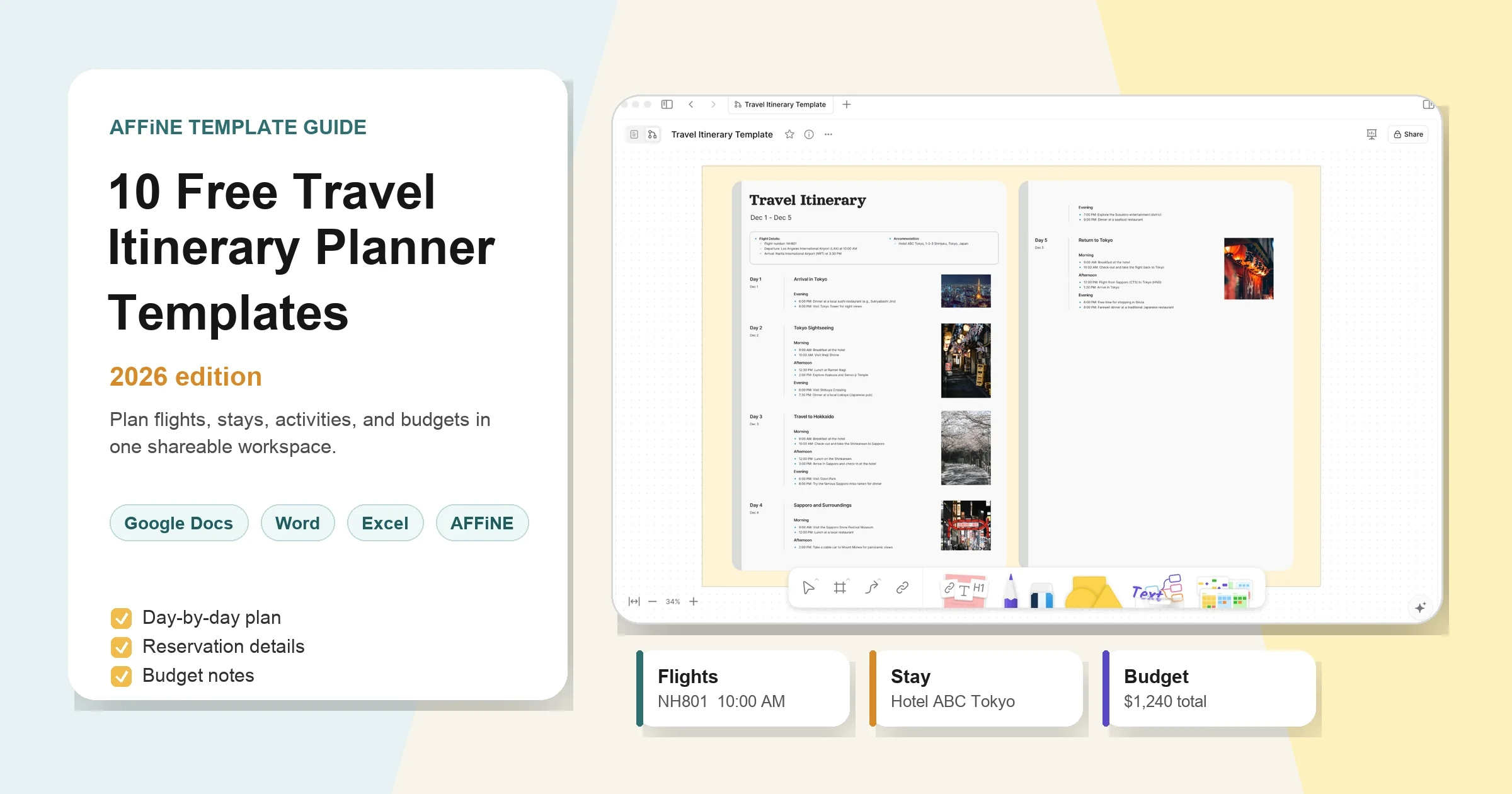
Affine combines different note types all in one place, offering various options. You can make mind maps, regular notes, and databases. Everything links together. The tool stays out of your way so you can focus on learning.
Common Notetaking Mistakes
Writing Everything Down
Trying to write every word turns your brain off. Nothing sticks. Focus on main ideas. Listen for phrases like "important" or "three main reasons." These signal what to write down.
Recording lectures sounds smart but hurts you. Students who record take worse notes because they stop processing. They think "I'll listen later." But they rarely do. The act of choosing what to write forces you to think.
Using Only One Format
Math needs different notes than history. Math requires steps and formulas. History works better with timelines. Literature needs character maps. Don't force everything into one format.
Mix methods based on what you're studying:
-
Cornell for standard lectures
-
Mind maps for connected concepts
-
Charts for comparisons
-
Feynman technique for hard topics
-
Databases for categorized information
Never Reviewing Notes
Notes are useless if you don't review them. Your brain dumps information it doesn't use. Review the same day, once per week, then before exams. This spacing creates memories that last.
Method 4: The Feynman Technique for Deep Understanding
This technique exposes gaps in understanding brutally effectively. Choose a concept you think you understand. Write an explanation in simple language as if teaching a child. Don't use jargon or technical terms as crutches. If you can't explain something simply, you don't really understand it yet.
When you hit points you can't explain clearly, you find gaps. Go back to source materials and study those specific areas. Try explaining again in simple terms. Repeat until your explanation flows smoothly without technical terminology.
Create analogies connecting new concepts to things you already understand completely. The comparison reveals the structure of new information. Good analogies make abstract concepts concrete. They give your brain something to hold on to when you learn new things.
Write down some challenges or situations that show how the idea works. Can you use this information to fix genuine problems? Application requires more than just memorizing things. If you can come up with your own examples, it means you really understand the idea.
This method takes longer at first, but it saves hours of confused review later. You learn by building on what you already know instead of memorizing random knowledge. Instead of praying you remember the appropriate material, you can think through challenges when it's time for the test.
Method 5: Progressive Summarization
Progressive summarization adds layers of emphasis to your notes over time. First pass: take notes normally, capturing information in your own words. Second pass within 24 hours: bold the most important points. Third pass before exams: highlight the essential core concepts in yellow or a second color.
Each pass forces you to identify what really matters. Most students never decide what's actually important versus interesting details. Progressive summarization makes priority decisions explicit. You can't bold everything, so you must choose.
This creates a natural hierarchy in your notes. Quick review means reading only bolded sections. Deeper review includes regular text. Comprehensive review covers everything including margins and small details. You control review depth based on available time.
The repeated interaction with material creates multiple memory traces. Each pass moves information deeper into long-term storage. By exam time, core concepts feel familiar because you've engaged with them many times. This familiarity breeds confidence and reduces test anxiety.
Digital notes make this method even more powerful. Use highlighting tools, nested bullet points, or progressive folding. Some note apps let you hide detail levels, showing only main points for quick review. Expand sections when you need the full context.
Creating Your Personal System
Mix these methods based on what you need. Cornell for normal lectures. Mind maps for big picture stuff. Feynman technique for confusing topics. Build what works for you.
Test different approaches. Notice what helps you remember. Do more of that. Your perfect system won't look like anyone else's.
Start with one technique this week. Get good at it. Then add another. Trying everything at once just creates stress.
Track what works for which subjects. You'll start to see patterns. This gets you more efficient every semester.
FAQ: Smart Notetaking Questions
How long should I spend taking notes?
Quality over quantity. Fifteen minutes of focused notetaking beats an hour of writing everything down. Capture understanding, not every word.
Should I type or handwrite notes?
Handwriting helps retention because it's slower. You have to pick what matters. But typing gives better search and organization. Try both - handwrite in class, then type and organize the same day.
How detailed should notes be?
Detailed enough that you'd understand them in six months. Include context. But skip word-for-word examples you already get.
Can I use smart notes for creative writing?
Yes. Mind maps help plot stories. Progressive summarization tightens editing. Cornell tracks characters and themes. These methods work for any complex thinking.
What if I miss information while taking notes?
Mark gaps with “?” or “CHECK”. Fill them right after class. Missing some stuff during active note-taking beats capturing everything and retaining nothing.
How often should I review notes?
Review within 24 hours, then weekly, then before exams. This spacing builds strong memories. Ten minutes weekly beats hours of cramming.
Do smart notes work for math and science?
Yes. Include worked examples and formulas. Use color coding. Draw diagrams showing relationships. The organization techniques work for any subject, just adjust the format.
How do I stay consistent with notetaking methods?
Pick one method for two weeks. Set reminders to review. Keep templates ready. Track which techniques improve your scores. Reward yourself for sticking with it.
What tools work best for digital smart notes?
Get an app with good search, tags, and linking. It should handle multiple formats - text, mind maps, tables. Cross-platform sync matters if you use different devices. Pick one and stick with it for at least a semester.
Can I combine paper and digital notes?
Many students do both. Handwrite in class for retention. Photo your notes and upload them. Add tags and links digital. Just keep everything in one searchable place.
Finally
Smart notetaking turns studying from a long, boring task into an effective way to learn. You can use the five ways we've spoken about for any subject or situation. The Cornell system, mental mapping, digital organizing, the Feynman technique, and progressive summarization all have diverse uses.
Start implementing one method this week. Master it before adding another. Build your personal system gradually based on what works for your brain and subjects. Track what improves your understanding and retention.
Good notes turn into study guides that really work. They capture your thinking process, not simply information. Instead of rereading, review becomes active recall. This method saves time and makes results much better. Your future self will be grateful that you made these behaviors now.