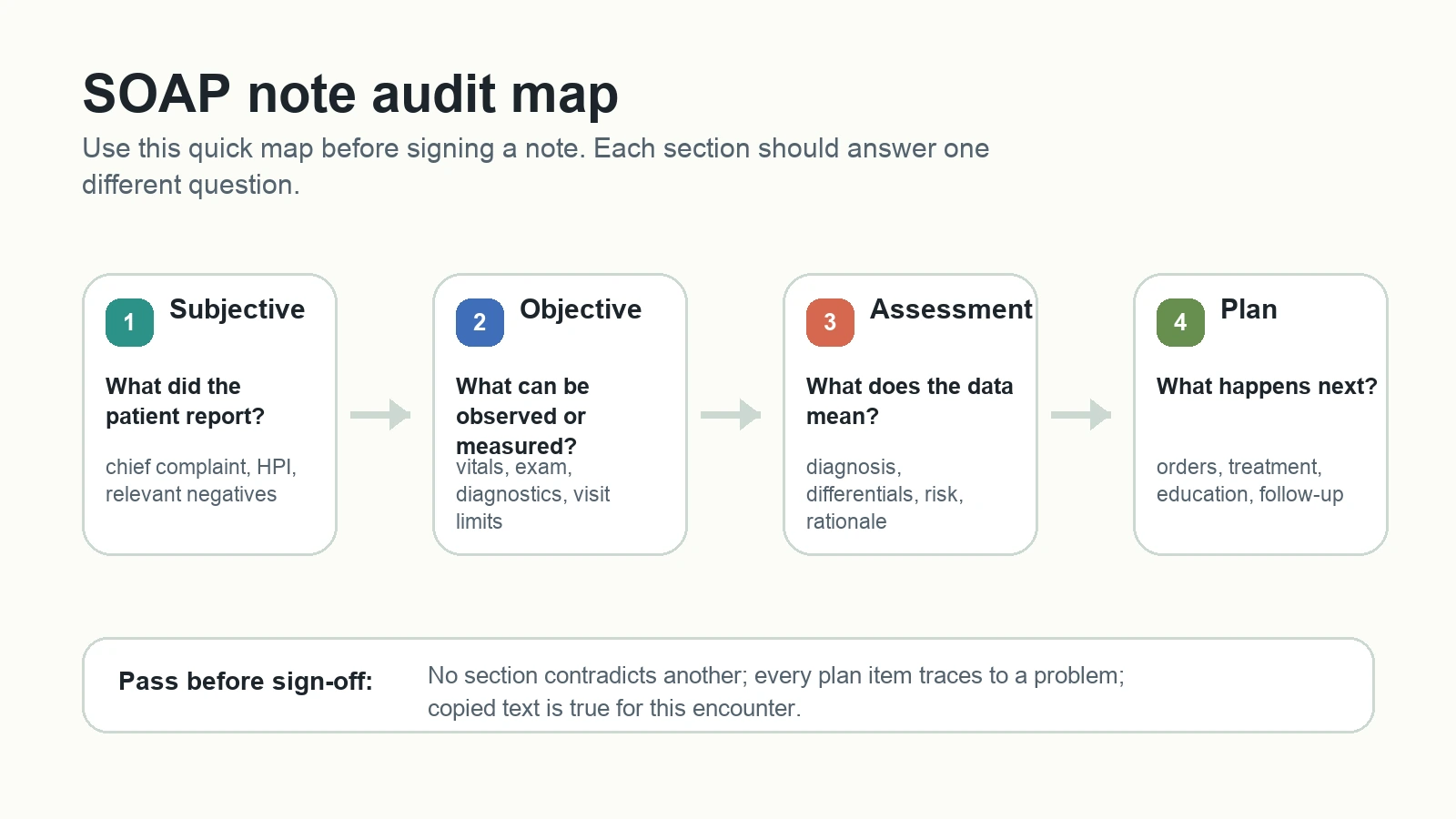
Ever wonder why some clinical notes are so much easier to follow—and audit—than others? The answer often comes down to the SOAP notes definition. The soap acronym medical stands for Subjective, Objective, Assessment, and Plan. This simple, four-part structure has become the gold standard in medical documentation because it organizes information logically, reduces ambiguity, and supports safer patient care.
Each letter in SOAP has a clear role:
| Letter | Purpose | Acceptable Content |
|---|---|---|
| S (Subjective) | Capture the patient’s story and symptoms in their own words | Chief complaint, history of present illness, relevant history, review of systems, medications, allergies |
| O (Objective) | Document measurable, observable facts | Vital signs, physical exam findings, lab/imaging results, clinician-observed behaviors |
| A (Assessment) | Synthesize findings into clinical reasoning and diagnosis | Diagnosis, differential diagnoses, clinical impression, problem list |
| P (Plan) | Outline next steps and interventions | Treatments, tests, referrals, education, follow-up |
Imagine reading a note where every section has a one-line purpose statement. Not only does this keep you focused, but it also makes it easy for others to understand your clinical thinking at a glance.
SOAP notes meaning goes beyond just a format—they create a shared language for healthcare teams. Compared to free-form narrative notes, the soap method offers:
• Consistent structure for handoffs and team communication
• Better support for billing and insurance audits
• Reduced risk of missing key information
• Clearer demonstration of medical necessity
• Faster review and easier tracking of patient progress
When should you choose SOAP charting over other formats? Use it for complex cases, initial evaluations, or any situation where precise clinical reasoning and accountability are required. For patient-facing absence documentation, see our doctors note template. While DAP or narrative notes might save time for routine follow-ups, SOAP shines when clarity and defensibility matter most.
Ever felt overwhelmed by lengthy, repetitive notes? You’re not alone. As clinical documentation requirements have grown, so has the risk of note bloat. The solution isn’t to write less, but to write with more focus. Here’s how:
• Stick to one clear sentence per SOAP section’s purpose
• Use a soap note template to keep your notes concise
• Avoid copy-forward drift and vague assessments
• Make sure every plan links back to a documented problem
Remember: brevity with clarity is the goal. Each section should answer, “Why does this matter for the patient’s care right now?”
Structure clarifies clinical reasoning.
• Define each SOAP section in one repeatable sentence. Example: "S: Patient’s story; O: Observable facts; A: Clinical reasoning; P: Next steps."
• Pick your default SOAP note template and decide where you’ll store it—EHR, shared drive, or digital workspace.
• Above each section in your template, add a one-line purpose statement to stay focused.
• Watch out for common pitfalls: copy-forward drift, vague or generic assessments, and plans that aren’t tied to documented findings.
By making the soap notes definition clear and standardizing your approach, you’ll notice improved team consistency, reduced training time, and notes that stand up to audits—without wasting time or words. That’s the power of the soap acronym medical in action.
When you open a patient encounter, do you ever struggle to organize the flood of details? Imagine if every subjective soap note started with a crisp, focused story that any clinician could follow in seconds. That’s the promise of OLDCARTS—a proven framework for structuring the history of present illness template so you never miss what matters.
Start with the cc medical abbreviation (chief complaint) in the patient’s own words. Then, use OLDCARTS to guide your HPI (history of present illness) questions and documentation:
Onset: When did the problem begin?
Location: Where is the symptom felt? Does it radiate?
Duration: How long has it lasted? Is it constant or intermittent?
Character: How does it feel—sharp, dull, burning?
Aggravating/Alleviating: What makes it worse or better?
Radiation: Does the sensation move anywhere?
Timing: Is there a pattern or specific times when it occurs?
Severity: How bad is it, often on a 1–10 scale?
Why is this so powerful? Because each OLDCARTS element translates to a critical piece of subjective data that shapes your clinical reasoning and helps avoid missing red flags (see reference).
It’s tempting to jot down everything the patient says, but the best review of symptoms and HPI notes focus on what’s relevant. This is where documenting pertinent negatives comes in—details the patient denies that help rule out serious conditions.
| Good Subjective | Bad Subjective |
|---|---|
| CC: left-sided chest pressure x2h; denies SOB, diaphoresis. HPI: 54-year-old male with sudden, heavy chest pain, radiating to jaw, worse with exertion, relieved by rest. No fever or cough. | Chest pain for a while. |
| CC: "stomach hurts after meals"; denies vomiting, melena, weight loss. HPI: 34-year-old female with 2-week history of burning epigastric pain after meals, worsened by spicy foods, relieved by antacids. | Stomach pain. Not sure when it started. |
Notice how the good examples use OLDCARTS elements, quote the patient, and include at least 1–2 negatives that clarify risk. The bad examples are vague and force the next provider to guess.
Patient states chest pressure began this morning while gardening; denies shortness of breath, fever, or cough; no prior episodes.
Some symptoms demand immediate attention. Always document red flags—such as sudden onset, severe pain, syncope, or associated neurologic symptoms—in clear, specific terms. These details not only protect the patient but also demonstrate your clinical vigilance in the subjective soap note.
• Open with the exact chief complaint (CC) using the patient’s own words.
• Use the OLDCARTS checklist to structure your HPI—don’t skip elements that clarify risk.
• Document at least 1–2 pertinent negatives that influence your differential diagnosis.
• Keep patient quotes brief and targeted to the complaint.
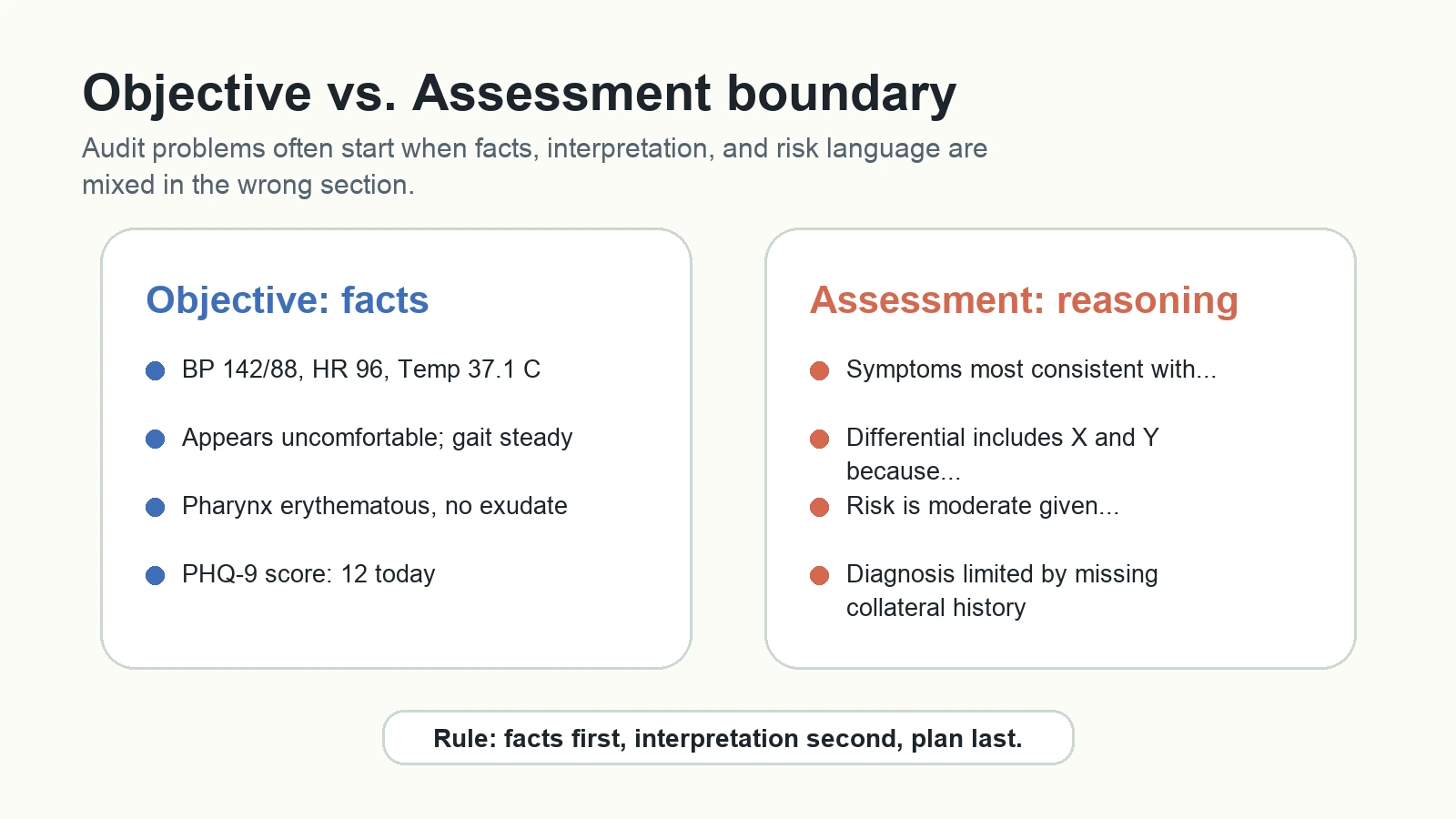
• Do not interpret or analyze here—save that for the Assessment section.
For recurring visits or complex cases, consider using a review of systems template to ensure no key symptoms are missed. And remember, a well-structured history of present illness template streamlines your workflow and strengthens your documentation for audits.
By mastering OLDCARTS and disciplined phrasing, you’ll notice your SOAP notes become faster to write, clearer to read, and more defensible—setting you up for success in the next Objective section.
When you reach the Objective section of your SOAP notes, it’s time to shift from the patient’s story to what you can directly observe and measure. Sounds straightforward, right? But here’s where many notes fall short: mixing in opinions, skipping key systems, or copying irrelevant details. A strong objective summary provides clear, verifiable data—think vital signs, focused exam findings, and current diagnostics—so anyone reviewing your note can trust your clinical process and decisions.
Everything in this section should be something another trained provider could confirm. That means:
• Vital signs (BP, HR, RR, Temp, SpO2)
• General appearance (distressed, well-nourished, alert)
• Physical exam findings (by system)
• Diagnostic results available at the time of the encounter
• Clinician-observed behaviors (e.g., fidgeting, speech patterns)
If you’re using a normal physical exam template , always tailor it to the patient’s complaint. Avoid the temptation to auto-populate normal findings unless you’ve confirmed them today.
For head and neck complaints, the heent medical abbreviation (Head, Eyes, Ears, Nose, Throat) is your go-to. But what does a complete heent examination look like in practice?
| Component | Concise Example |
|---|---|
| Head | Normocephalic, atraumatic, no tenderness or masses |
| Eyes | PERRLA, EOMI, sclera non-icteric, conjunctivae clear |
| Ears | TMs intact, no erythema or discharge, hearing grossly intact |
| Nose | Mucosa pink, septum midline, nares patent |
| Throat | Oral mucosa pink, no lesions, pharynx clear, no tonsillar exudate |
These objective examples mirror what you’ll find in a standard HEENT exam. For abnormal findings, be specific—describe location, character, and severity. Remember, clarity here helps justify your assessment and plan (see reference).
In behavioral health, or whenever mental status is relevant, include a concise Mental Status Exam (MSE). This captures the patient’s current cognitive and emotional functioning in observable terms. Here’s a quick MSE structure you can adapt:
| Component | Concise Example |
|---|---|
| Appearance | Well-groomed |
| Behavior | Cooperative, calm |
| Speech | Normal rate/volume |
| Mood/Affect | "Anxious"; affect congruent |
| Thought Process/Content | Linear, logical; no SI/HI |
| Cognition | Alert and oriented x 4 |
| Insight/Judgment | Fair |
Appearance: well-groomed; Behavior: cooperative; Speech: normal rate/volume; Mood: "anxious"; Affect: congruent; Thought process: linear; Thought content: no SI/HI; Cognition: A&O x4; Insight/judgment: fair.
Want to see more mental status exam examples? Focus on observable behaviors and avoid interpreting or diagnosing in this section. Use standardized descriptors to ensure your notes are clear and defensible.
• Vital signs recorded and reviewed
• General appearance (alert, distressed, well-nourished)
• HEENT findings (as above, or tailored to complaint)
• Cardiac and lung exam (e.g., heart sounds, breath sounds)
• Abdominal exam (tenderness, masses, bowel sounds)
• Musculoskeletal (range of motion, swelling, deformity)
• Neurological (strength, sensation, reflexes, gait)
• Mental Status Exam (if indicated)
• Diagnostics available now (labs, imaging)
• For telehealth: note any exam limitations and patient safety plans
• Document only what you directly observe or measure—no interpretations or assumptions
• Use accepted shorthand for normal findings, but describe abnormalities in detail
• Include only test results available at the time of documentation; defer pending results to the Assessment/Plan
• For remote visits, clearly state any exam components you could not assess and how you ensured patient safety
By mastering the Objective section with these strategies, you’ll ensure your SOAP notes are clear, defensible, and ready for any audit. Up next: translating these findings into a focused clinical Assessment that ties everything together.
Ever wonder how to transform a pile of symptoms and exam findings into a defensible diagnosis? That’s the magic of the Assessment section in soap notes. Here, you move from collecting facts to clinical judgment—linking what the patient says and what you see to a clear, justifiable working diagnosis. Sounds complex? It’s easier with a repeatable approach and the right soap assessment template by your side.
• Primary diagnosis with rationale: State the most likely diagnosis first and explain why, using both subjective and objective evidence.
• Top 2-3 differentials with a one-line why/why not: Show your reasoning by briefly stating why each alternative is more or less likely.
• Status vs baseline: Note if the patient’s condition has changed, improved, or worsened compared to prior encounters.
Let’s make this practical with a sample structure. Imagine a patient with low mood, poor sleep, and observed flat affect. Your soap assessment example might look like this:
| Finding | Interpretation |
|---|---|
| Flat affect, slow movements | Supports depressive disorder |
| Reports poor sleep, low energy | Consistent with mood disturbance |
| Denies suicidal ideation | Lower immediate risk, but monitor |
| No psychosis or mania observed | Less likely bipolar or psychotic disorder |
Notice how each observation is mapped directly to its clinical implication. This not only clarifies your reasoning for other providers but also supports medical necessity for billing and insurance reviews.
What if you’re not 100% certain? That’s normal in real-world practice. The key is to use language that shows you’re aware of uncertainty and are managing it thoughtfully. Avoid vague terms like "possible depression" without context. Instead, specify: “Symptoms most consistent with Major Depressive Disorder given observed affect, reported insomnia, and poor self-care; anxiety disorder less likely due to absence of excessive worry or panic.”
Presentation consistent with Major Depressive Disorder given poor sleep, low mood, and flat affect; Generalized Anxiety Disorder less likely due to lack of excessive worry or restlessness.
Want your soap assessment to stand up to audits? Always tie your differentials to the evidence you’ve documented. If data is missing or inconclusive, state it: “Diagnosis limited by lack of collateral history; will reassess as more information becomes available.” This approach not only protects you legally, but it also signals to auditors and colleagues that your clinical reasoning is sound and transparent (see reference).
Ever feel tempted to write long paragraphs to cover every possible angle? Resist the urge. High-quality soap note assessment sections are brief but comprehensive. Focus on the key findings that drive your differential and management plan. Here’s a checklist to keep your soap note assessment example on track:
• Name the most likely diagnosis first, with a one-sentence rationale.
• List 2–3 plausible alternatives, each with a brief “why/why not.”
• Note any limitations in available data or follow-up needed.
• Describe status compared to the last visit (better, worse, unchanged).
• Use risk language if relevant (e.g., "at moderate risk for relapse").
By using a soap assessment template , you’ll notice your notes become more consistent, easier to audit, and faster to write. It’s about showing your clinical thinking, not just listing problems. This clarity not only supports your billing but also improves patient care by making your reasoning transparent to the next provider.
Ready to translate your focused assessment into an actionable plan? Let’s move on to building a measurable, defensible next step in the Plan section.
When you finish your Assessment, what comes next? The Plan section—arguably the part of soap notes that most directly impacts patient care and audit readiness. Imagine another clinician picking up your note. Could they execute your plan without guessing? That’s the standard you want to hit, and it all starts with SMART goals.
SMART stands for Specific, Measurable, Achievable, Realistic, and Time-bound. In practice, this means setting clear, actionable targets that link directly to your assessment and can be tracked over time. For example, instead of writing, "Will follow up as needed," a strong Plan uses language like, "Patient will attend weekly therapy sessions for four weeks to address depressive symptoms, with PHQ-9 scores monitored at each visit." Research shows that SMART goals not only improve patient engagement and outcomes—they also provide the documentation insurers and auditors want to see (see reference).
Tests ordered (labs, imaging, screening tools)
Medications or therapies (with dosing, frequency, duration)
Patient education and instructions
Return precautions (when to seek urgent care)
Follow-up interval (specific timeframe)
Referrals to specialists or community resources
Monitoring (metrics, symptom tracking, side effect checks)
Ever read a progress note and wondered, "What happens next?" The best soap notes examples eliminate ambiguity. Here’s a simple checklist to make your Plan section bulletproof:
• State one measurable goal aligned to the Assessment (e.g., "Reduce PHQ-9 score by 3 points in 4 weeks").
• Specify dosing, duration, and monitoring for all medications or therapies (e.g., "Sertraline 50mg daily for 4 weeks; monitor for side effects").
• Document shared decision-making and safety net instructions (e.g., "Discussed risks/benefits of therapy; advised to call if suicidal thoughts recur").
• Set a clear follow-up interval and criteria for escalation (e.g., "Return in 2 weeks or sooner if symptoms worsen").
Using a notes template can streamline this process, ensuring you never miss a critical element—especially helpful in busy clinics or when caring for complex patients.
How do you show progress without rewriting the entire Plan each time? The answer is to update your progress notes with what’s changed, what’s working, and what needs adjustment. Below is a sample table to visualize progression across multiple visits—an approach that’s especially valuable for therapy soap note example scenarios or chronic disease management:
| Visit | Goal | Intervention | Outcome | Adjustment |
|---|---|---|---|---|
| 1 | Reduce anxiety attacks to 1/week | Start CBT, teach breathing exercises | Anxiety attacks reduced to 2/week | Reinforce techniques, add journaling |
| 2 | Improve sleep quality | Introduce sleep hygiene, monitor sleep log | Falling asleep improved, still waking early | Consider melatonin, review stressors |
| 3 | Maintain mood stability | Continue therapy, adjust medication | Mood stable, PHQ-9 down 4 points | Continue current plan, schedule next review |
In soap therapy notes and soap notes counseling , tracking outcomes and adjustments like this demonstrates both clinical reasoning and responsiveness to patient needs.
Spent 20 minutes in counseling on risks/benefits; shared decision-making documented.
• State one SMART goal per problem—make it specific and measurable.
• Document every intervention with enough detail for another provider to follow.
• Include patient education and safety instructions in every Plan.
• Update each progress note by referencing what changed since the last visit.
• Use a notes template to standardize your workflow and reduce missed steps.
Whether you’re writing an example of a soap note for therapy, primary care, or medication management, the key is clarity and traceability. That way, your soap notes examples not only support reimbursement and audit-readiness—they also ensure seamless care for your patients.
Next, we’ll look at how to use EHR templates and structured data to make your SOAP documentation safer and even more efficient.
When you’re under pressure to finish documentation, it’s tempting to copy and paste or rely on old templates. But have you ever wondered how much risk that introduces? The right soap note format in your EHR can speed up charting and improve accuracy—if you set it up thoughtfully. Imagine a soap note template that prompts you for only what matters, keeps your notes consistent, and helps you avoid the most common pitfalls in soap documentation.
Macros and templates are powerful tools, but only if used wisely. Static, outdated macros can lead to stale notes or even clinical errors. Instead, keep your macros short, specific, and editable. Use dynamic prompts that remind you to update findings for each encounter. For example, a macro for the mental status exam should prompt you to select from a list of current observations, not simply insert a generic statement. Regularly review and update your macro library to phase out old or irrelevant shortcuts.
| Do vs Avoid in EHR Action | Do | Avoid |
|---|---|---|
| Copy-forward | Copy only relevant, verified data for today’s encounter | Blindly copying prior notes without updating |
| Auto-populated vitals | Verify all vitals before signing | Leaving unverified or outdated vitals in record |
| Macros | Use short, editable, condition-specific macros | Overusing lengthy, generic macros or templates |
| Importing labs/results | Re-date and confirm relevance to today’s visit | Importing all prior labs without review |
| Problem lists | Update and personalize to the current complaint | Leaving old or resolved problems on the list |
Sounds technical? It’s actually simple. Use structured fields (checkboxes, dropdowns) for discrete, factual data—like vital signs, medication lists, or allergies. This makes your soap note form easily searchable and ensures you don’t miss required elements for billing or audits. But for nuanced clinical reasoning, patient stories, or unique findings, switch to free text. That’s where you capture the details that make each patient unique and show your clinical judgment in the soap format.
By balancing structured data and free text, you make your soap medical documentation both efficient and defensible. Structured fields speed up repetitive tasks and support data analytics, while free text preserves the richness of the clinical story.
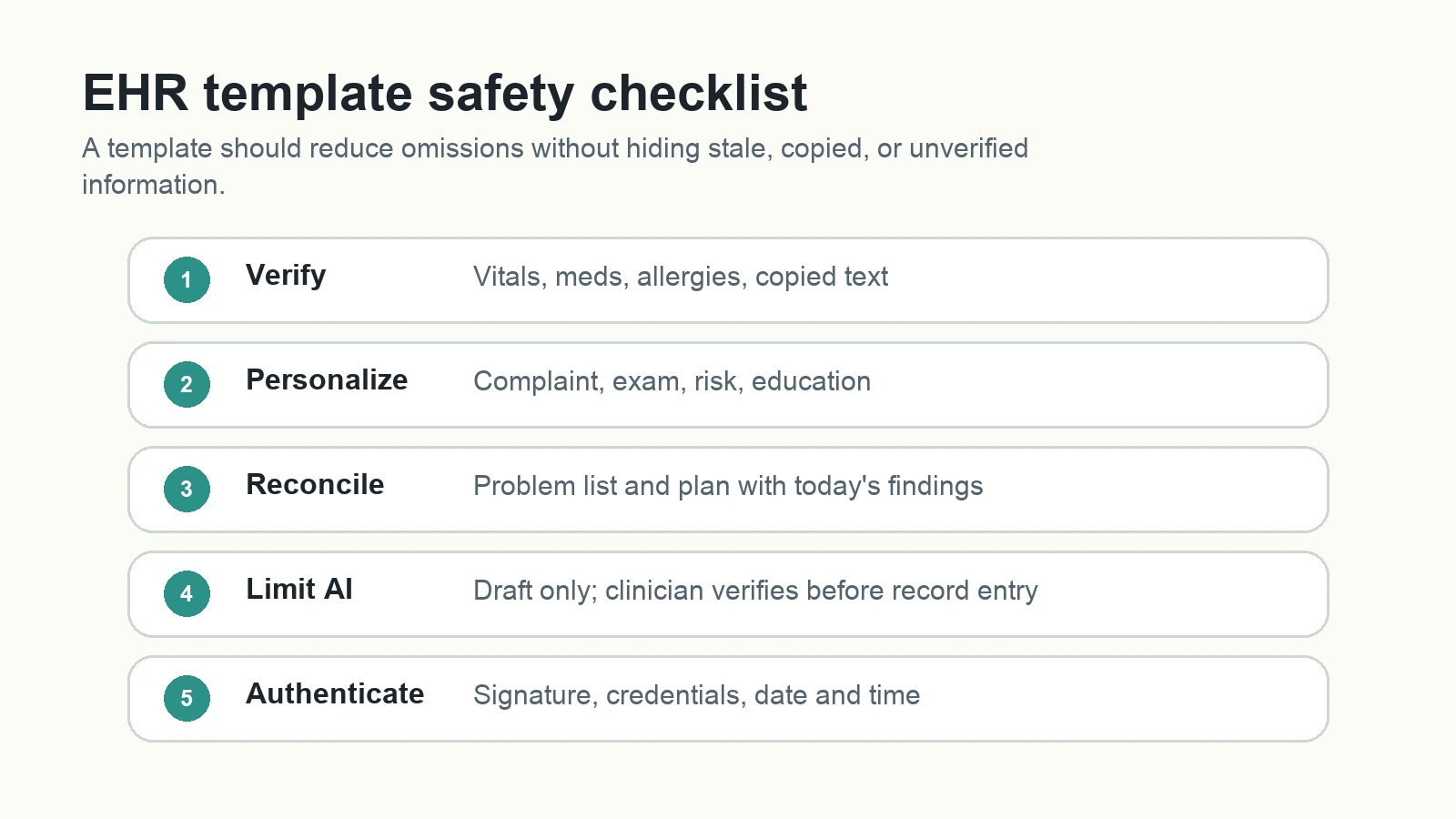
Ever caught a date or pronoun error after copying a prior note? It happens to everyone—but it’s a risk you can control. Here’s a checklist to keep your documentation safe, whether you’re using a soap template or building your own note template from scratch:
• Verify today’s vitals and exam findings before signing
• Reconcile medications and allergies at every visit
• Re-date any imported labs, results, or statements
• Personalize all templates to match the current complaint
• Double-check for date, pronoun, or patient mismatches
Every imported sentence must be true for this encounter.
• Build a concise soap note template —pre-load section prompts, not full sentences
• Limit macros to short, condition-specific phrases you always edit
• Turn off auto-inserted normal exams unless you’ve verified them today
• Develop a quick-review routine to catch common errors before signing
• Regularly update your soap note templates and macro library based on workflow feedback
By applying these EHR strategies, you’ll notice your soap documentation gets faster, more accurate, and stands up to audits. Plus, you’ll spend less time editing and more time focused on patient care. Next, we’ll cover how to finish strong with compliant corrections, amendments, and authentication.
Ever realize you missed a key detail or made a typo after finalizing your documentation? It happens to every clinician. But the way you correct errors in your soap notes can make the difference between a compliant, audit-ready record and one that raises legal or billing red flags. Imagine an auditor reviewing your soap note documentation —they should see a transparent, traceable history of every change, not a patchwork of hidden edits.
Identify the error: As soon as you spot a mistake, note exactly what needs correction—whether it’s a missed diagnosis, wrong date, or omitted information.
Add an addendum with date/time: Never erase or overwrite the original entry. Instead, create a new addendum or correction, clearly labeled with the current date and time.
State what is being corrected and why: Briefly explain the nature of the error and provide the correct information. For example: “Correction: Patient’s blood pressure at intake was 140/90, not 120/80 as previously documented.”
Sign and authenticate: Every amendment must include your full signature and credentials to maintain the integrity of the soap medical records.
Notify impacted care team if clinical significance: If the correction affects patient care, communicate the change to relevant team members promptly.
Following these steps aligns with best practices and CMS guidelines for amending medical records—ensuring your documentation is both ethical and defensible.
Do not alter the original entry; append with reason and timestamp.
Sounds complex? It’s really about clarity and honesty. Whether you’re using paper or electronic health records, every change should be clearly marked as an amendment, correction, or late entry. This means:
• Amendments are made when you add new information after the note is signed.
• Corrections clarify or fix mistakes in the original note.
• Late entries document care that was provided but not immediately recorded—always label with both the event time and the entry time.
Never obscure or delete original content. Instead, your soap abbreviation medical process should show exactly what was changed, when, and by whom. This transparency is critical if your soap note documentation is ever reviewed in an audit or legal proceeding.
To standardize your workflow, use a consistent signature block with your credentials, and keep a log of all addenda and amendments. Periodically audit your soap medical records for compliance—catching small errors early prevents bigger problems down the line.
Ever wonder if that shortcut you use—like "q.d." or "u"—is safe? The answer: not always. Using ambiguous or prohibited abbreviations can lead to serious misunderstandings, even patient harm. The Joint Commission and other safety organizations maintain lists of abbreviations that are never allowed in clinical documentation. Here’s a quick reference for your s.o.a.p. notes:
| Accept vs Avoid: Clinical Abbreviations Acceptable Abbreviations | Abbreviations to Avoid |
|---|---|
| A&O x4 (alert and oriented), HEENT, BP, HR, r/t medical abbreviation (related to), SOAP | q.d. (daily), u (unit), IU (international unit), MS (morphine sulfate or magnesium sulfate), trailing zero (e.g., 2.0 mg), lack of leading zero (e.g., .5 mg) |
• Accept: Use standard, widely recognized abbreviations such as "A&O x4," "HEENT," and "r/t medical abbreviation" for "related to." These are clear and unlikely to be misinterpreted.
• Avoid: Do not use abbreviations on the “Do Not Use” list, such as "q.d.," "u," or "IU," as recommended by the Joint Commission and the Institute for Safe Medication Practices (see reference).
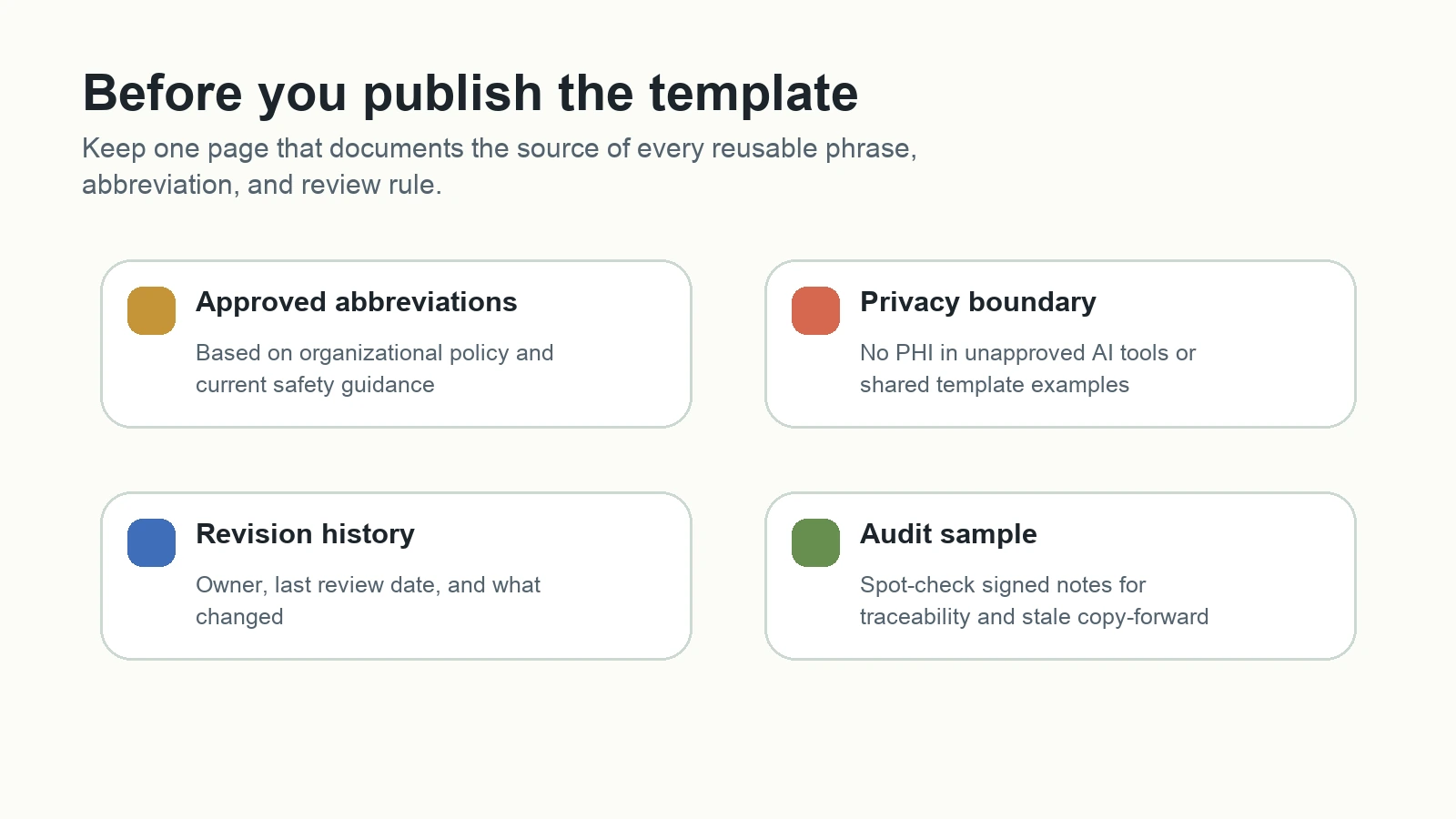
Keep an internal list of approved abbreviations accessible from your soap notes template, and update it regularly as standards evolve. This simple habit improves clarity and reduces the risk of errors.
• Standardize your signature blocks with full credentials on every entry and amendment.
• Use late entries and addenda that clearly state both the actual event time and the documentation time.
• Maintain an up-to-date list of approved abbreviations in your template or quick-reference file.
• Periodically audit a sample of your s.o.a.p. notes for process adherence and abbreviation safety.
By mastering these habits, you’ll ensure your soap stands for more than just a format—it stands for accuracy, transparency, and audit-readiness. Next, discover how to streamline your workflow with a unified workspace and keep your documentation consistent across every encounter.
Ever find yourself searching for the latest soap notes template , or wondering if your team is documenting consistently? Imagine if every clinician—whether an experienced provider or a soap note example medical student —could access the same up-to-date template, checklists, and phrasing guidance in one place. That’s the power of a unified workspace: it transforms scattered resources into a single, reliable hub for soapnote excellence.
• Store your base template for soap notes —customized for your specialty
• Keep approved abbreviations, MSE phrasing, and documentation checklists at your fingertips
• Share progressive-visit tables to track patient outcomes across encounters
• Enable team-wide updates, so everyone benefits from audit feedback and best practices
By standardizing your soap notes template and resources, you’ll notice fewer errors, faster onboarding for new staff, and a smoother workflow for everyone involved.
When you’re managing complex cases—think multi-visit therapy, chronic disease, or interdisciplinary care—keeping track of the big picture can get messy. This is where visual tools like whiteboards shine. Imagine mapping out care pathways, decision trees, or timelines for a patient’s journey, then linking them directly to your soap charting examples and progress tracking tables.
• Design multi-visit care maps to visualize goals, interventions, and outcomes
• Export progress-tracking tables for easy reference in subsequent visits
• Collaborate live with your team to adjust pathways as patient needs evolve
Platforms like AFFiNE’s infinite whiteboard let you brainstorm, plan, and document without limits—then pull insights directly into your soapnote workflow. This approach not only supports clinical reasoning but also makes it easier to demonstrate continuity and progression in audits or handoffs.
Sounds futuristic? It’s already here. AI-assisted drafting tools can save you hours by generating the first pass of your Subjective and Objective sections based on structured prompts. For example, after you enter key patient data and observations, AI can assemble a draft that follows your preferred soap notes template. But here’s the golden rule: AI can draft; clinicians must verify.
AI can draft; clinicians must verify.
Open your soap notes template workspace
Pull in today’s vitals and labs, and verify accuracy
Draft Subjective/Objective sections—AI can help, but always review for clinical accuracy
Formulate Assessment/Plan based on your reasoning and patient needs
Run a quick safety and completeness checklist (abbreviations, date, signature, amendments)
Sign and store the note, ready for audit or care coordination
Using a digital workspace with integrated AI (like AFFiNE) accelerates drafting without sacrificing quality. It also makes it easier to iterate on templates and workflows based on feedback and evolving standards.
• Create a dedicated "SOAP Notes" workspace with your base template, approved abbreviations, and checklists
• Use the whiteboard to map out complex care pathways and export progress tables
• Leverage AI to draft initial notes from structured prompts—then review and edit for clinical judgment
• Share and update templates with your team, incorporating audit findings and new best practices
• Download or print your soap notes pdf for offline reference or compliance requirements
Imagine the time saved and errors prevented when everyone—from new hires to seasoned clinicians—works from the same playbook. Whether you’re learning how to write a soap note or optimizing for efficiency, a unified workspace is the backbone of audit-proof, patient-centered documentation.
Ready to take your workflow to the next level? Consider using AFFiNE’s all-in-one knowledge OS as your central hub for templates, whiteboards, and AI drafting. It’s not just about technology—it’s about creating a culture of consistency, clarity, and continuous improvement in every soapnote you write.
AI tools like ChatGPT can help generate draft SOAP notes by organizing patient symptoms, history, and exam findings into the SOAP format. However, clinicians must always review, verify, and edit these drafts for accuracy and clinical judgment before finalizing or entering them into the medical record.
SOAP notes are widely used by healthcare professionals such as physicians, nurses, therapists, and behavioral health clinicians. They provide a standardized structure for documenting patient encounters, ensuring clarity, continuity, and defensibility in medical records.
In medical documentation, SOAP stands for Subjective, Objective, Assessment, and Plan. This structure helps clinicians organize patient information logically, supporting better communication, audit readiness, and safe handoffs between care providers.
To avoid common mistakes, use concise templates, document only relevant findings, avoid vague assessments, and ensure every plan is linked to a documented problem. Regularly review and update templates, verify auto-populated data, and use approved abbreviations to maintain clarity and compliance.
Teams can standardize SOAP note templates by using digital workspaces like AFFiNE to store templates, checklists, and approved abbreviations. This centralizes resources, ensures everyone follows the same documentation standards, and enables easy updates based on audit feedback or evolving best practices.