Pokémon Team Builder Template for VGC, Singles & Doubles
Plan Pokémon species, moves, types, roles, items, EVs, and IVs in a free editable team builder for VGC, Singles, Doubles, and casual play.
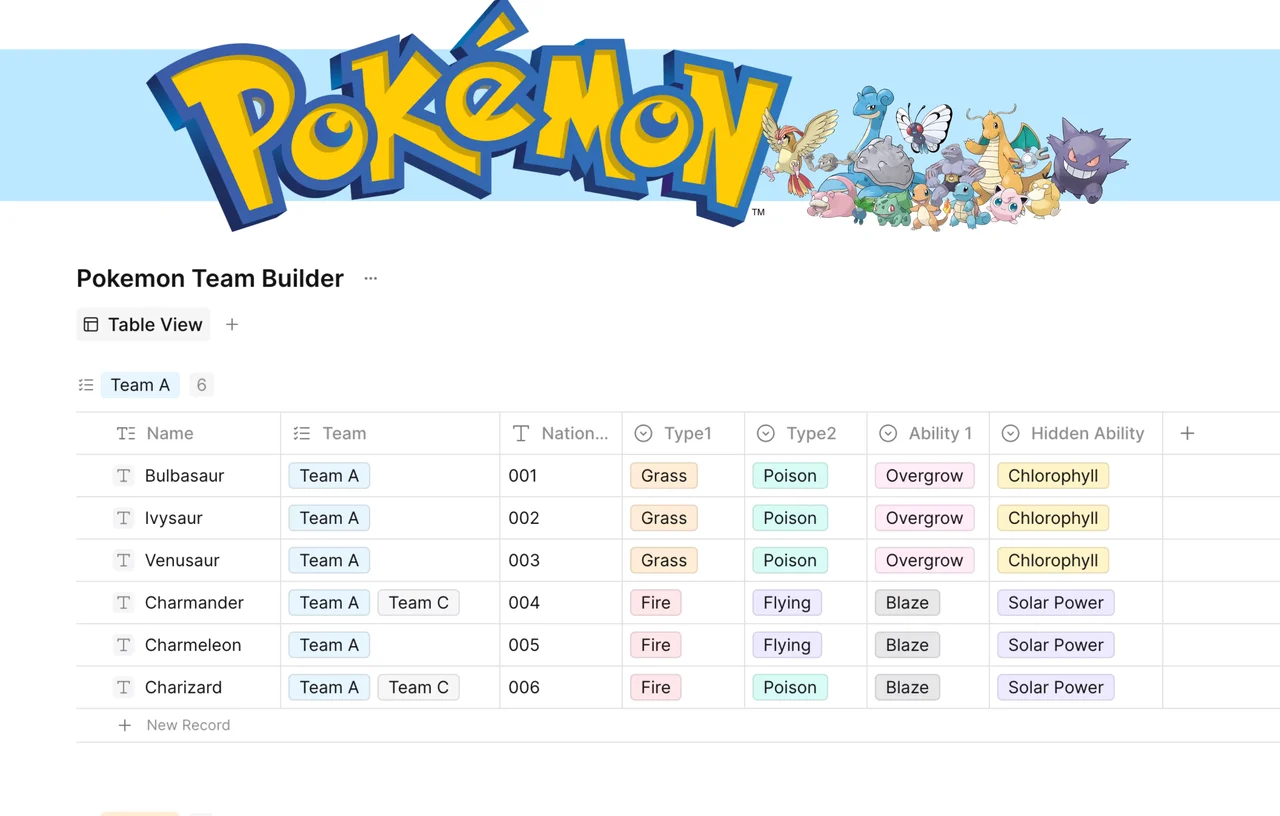
This Pokémon Team Builder is a planning workspace for a six-Pokémon roster—not a battle simulator, Pokédex, damage calculator, or legality checker. Use its editable sections to organize species, moves, ability, item, nature, EVs, IVs, Tera type, and team roles. Record testing observations in the notes area; to compare revisions, duplicate the page and label each copy (for example, v2).
Duplicate the template, choose the exact game and format, record the current official rules source, then fill the six slots and review shared weaknesses before testing the team in the appropriate game or simulator. Use it for VGC, Singles, Doubles, casual play, or older games; verify every competitive choice against the rules for that event and format.
Built by the open-source AFFiNE community.
Building a competitive Pokémon team is a planning problem, not a Pokédex problem. Knowing every type matchup, hazard, and EV spread doesn't help if you can't see your team's gaps on one page. This free Pokémon Team Builder template gives you that one page — six structured slots that force you to think through type coverage, roles, movesets, items, and EV investment before you ever step into a battle.
Whether you are preparing for a current VGC event, a competitive Singles or Doubles ladder, casual play, or an older game such as Pokémon Emerald, the same six-slot framework applies. Duplicate it to your AFFiNE workspace, fill it in, and iterate.
A solid team needs answers to the major offensive types. The template forces you to map out resistances and weaknesses across all six slots, so you spot the moment you're 6-0'd by a single Tera Fairy sweeper.
Each slot has space for four moves, an item, an ability, a Tera type, and a nature. Filling all those fields one slot at a time is how you catch redundancy (three Pokémon all running Protect) and gaps (zero priority moves, zero hazard removal) before they cost you a match.
Every member of a balanced team has a job — sweeper, wall, pivot, support, lead, or wincon. The template's role field forces the question: if this Pokémon is your sweeper, who sets it up? If it's your wall, what does it switch into? Vague answers here usually mean a fragile team.
Use this table when reviewing coverage gaps. It lists all 18 attacking types and separates resistance from immunity. The Tera examples are defensive thought starters, not claims about what is current or common.
Check the official Pokémon battling type guide and verify the chart against the designated game and format before finalizing a competitive team. If a game-specific rule differs, use that rule rather than this planning reference.
| Attacking Type | Hits 2× | Resisted By / Immune | Example Defensive Tera |
|---|---|---|---|
| Normal | None | Rock, Steel; Ghost (immune) | Ghost |
| Fire | Grass, Ice, Bug, Steel | Fire, Water, Rock, Dragon | Water |
| Water | Fire, Ground, Rock | Water, Grass, Dragon | Grass |
| Electric | Water, Flying | Grass, Electric, Dragon; Ground (immune) | Ground |
| Grass | Water, Ground, Rock | Fire, Grass, Poison, Flying, Bug, Dragon, Steel | Fire |
| Ice | Grass, Ground, Flying, Dragon | Fire, Water, Ice, Steel | Steel |
| Fighting | Normal, Ice, Rock, Dark, Steel | Poison, Flying, Psychic, Bug, Fairy; Ghost (immune) | Ghost |
| Poison | Grass, Fairy | Poison, Ground, Rock, Ghost; Steel (immune) | Steel |
| Ground | Fire, Electric, Poison, Rock, Steel | Grass, Bug; Flying (immune) | Flying |
| Flying | Grass, Fighting, Bug | Electric, Rock, Steel | Steel |
| Psychic | Fighting, Poison | Psychic, Steel; Dark (immune) | Dark |
| Bug | Grass, Psychic, Dark | Fire, Fighting, Poison, Flying, Ghost, Steel, Fairy | Fire |
| Rock | Fire, Ice, Flying, Bug | Fighting, Ground, Steel | Steel |
| Ghost | Psychic, Ghost | Dark; Normal (immune) | Normal |
| Dragon | Dragon | Steel; Fairy (immune) | Fairy |
| Dark | Psychic, Ghost | Fighting, Dark, Fairy | Fairy |
| Steel | Ice, Rock, Fairy | Fire, Water, Electric, Steel | Water |
| Fairy | Fighting, Dragon, Dark | Fire, Poison, Steel | Steel |
A six-Pokémon team usually fills five or six of these roles. Use the role field in each template slot to state what that slot contributes and what conditions it needs.
These blueprints describe jobs rather than species. Choose legal species, moves, items, abilities, and spreads only after you confirm the target format's rules.
| Slot | Role | Team logic | Key check |
|---|---|---|---|
| 1 | Entry-hazard lead / pivot | Establishes early pressure and preserves momentum | Can it act before being forced out? |
| 2 | Physical wall | Absorbs common physical attacks and creates safe switches | Does it cover the lead's main weaknesses? |
| 3 | Special wall / recovery support | Handles special pressure and keeps the defensive core usable | Is its recovery plan reliable in this format? |
| 4 | Wallbreaker | Forces progress against defensive teams | Does it threaten what the walls invite in? |
| 5 | Speed control / revenge attacker | Stops faster threats after a teammate falls | Is the speed benchmark documented? |
| 6 | Setup win condition / cleaner | Converts chip damage and removed counters into an endgame | Which opposing roles must be weakened first? |
| Slot | Role | Team logic | Key check |
|---|---|---|---|
| 1 | Dedicated hazard lead | Trades longevity for immediate field pressure | Can it set the required hazard consistently? |
| 2 | Screen or disruption support | Creates safe setup turns and denies opposing tempo | Does it support both attacking modes? |
| 3 | Physical setup attacker | Punishes specially defensive answers | Is its setup window realistic? |
| 4 | Special setup attacker | Punishes physically defensive answers | Does it pressure the physical attacker's checks? |
| 5 | Fast wallbreaker / revenge attacker | Maintains momentum without needing setup | Can it remove weakened speed threats? |
| 6 | Secondary win condition | Gives the team another route when the first setup plan fails | Does it avoid duplicating the same counters? |
| Slot | Role | Team logic | Key check |
|---|---|---|---|
| 1 | Speed-control support | Sets or reverses the speed order for both attackers | Which speed modes does the team support? |
| 2 | Physical damage dealer | Applies immediate pressure on one defensive axis | What partner enables its safest turns? |
| 3 | Special damage dealer | Covers targets that withstand physical pressure | Does its coverage complement slot 2? |
| 4 | Redirection or disruption support | Protects key turns and interrupts opposing plans | Which threats can it reliably disrupt? |
| 5 | Defensive pivot | Repositions the board while preserving resources | Does it improve the team's shared weaknesses? |
| 6 | Flexible endgame attacker | Adapts the final slot to the event rules and expected field | What matchup or mode is still unsupported? |
Competitive rules can change by event, season, designated game, and battle format. Before using a plan in ranked or tournament play:
Turn those requirements into a reusable pre-event rules checklist, then link it from the team plan so later revisions use the same constraints.
The Pokémon tournament rules and resources are the authority for official play. This template helps organize species, moves, roles, items, EVs, and IVs; it does not validate team legality or enforce the current rules.
Use each tool for the job it actually performs:
| Tool type | Best for | What it does not replace |
|---|---|---|
| Battle simulator and teambuilder | Entering a legal team and testing it in battles | Written rationale, research notes, and a durable revision log |
| Pokédex or coverage database | Looking up game data and checking matchups | Deciding each member's role in your specific plan |
| Usage-stat resource | Researching observed choices in a defined format or dataset | Current event rules or your own testing |
| AFFiNE Team Builder Template | Connecting six slots, roles, matchup notes, sources, and revisions in one document | Live battle simulation, game data, damage calculation, or legality validation |
The practical workflow is to research and validate with current game-specific tools, use this template to explain the plan, and then record what changed after testing. Do not treat any static planning document as the authority for a live format.
The public template page is free to review. Use the button at the top to duplicate it into an AFFiNE workspace, then customize the fields for your game and format.
Yes. The six-slot structure is format-agnostic. For VGC and competitive Singles use the role, item, ability, EV spread, and Tera type fields. For casual playthroughs and Nuzlocke runs you can skip the EVs and use the notes field for catch-route reminders or restrictions.
Showdown is a battle simulator first; its team builder exists to feed teams into matches. This template is a planning document — better for thinking through team rationale, keeping multiple team drafts side by side, and linking to your training notes. See our companion Pokémon team builder blog post for deeper strategy. Use both: plan here, battle there.
Yes. The role and coverage logic apply to every generation. For Gen 3 Emerald specifically, see our Pokémon Emerald team builder guide for Battle Frontier-tuned compositions.
The Type Effectiveness Quick Reference table above covers all 18 attacking types and marks immunities separately from resistances. The template itself includes a coverage notes field per slot so you can capture which types each Pokémon answers without re-deriving it every time. If you want second opinions on a finished team, our rate my Pokémon team guide walks through common feedback patterns.
The underlying structure — a six-slot planning document with role, status, and notes fields — is a general-purpose planning pattern. Pokémon team building is one of its highest-leverage uses; the same template structure also works for D&D party planning, sports lineups, and group-project role assignment.
Same tool, different name — both mean planning species, roles, and movesets before you lock in a roster. This template covers the whole flow: plan the six team slots first, then fine-tune movesets, items, and EV spreads for your battle format.