How to Prevent Password Attacks Before Accounts Are Breached
Password attacks rarely begin with one dramatic break-in. They usually exploit an ordinary gap: an account nobody owns, a password reused after another service was breached, an administrator who can still sign in with a phishable factor, or a recovery desk that verifies too little. To prevent password attacks before accounts are breached, teams need several controls that reinforce one another across the entire identity lifecycle.
This guide is for security, IT, and operations leaders who manage employee, contractor, service, and privileged accounts. It turns prevention into a practical program rather than a single password rule.
Quick prevention checklist
- Inventory every human, privileged, service, shared, dormant, and recovery identity.
- Block common and known-compromised passwords while allowing password managers and paste.
- Require stronger, phishing-resistant authentication for important accounts.
- Throttle repeated attempts without creating an easy denial-of-service lockout.
- Correlate sign-in, privilege, device, and recovery signals with named owners.
- Test recovery and exception paths, then close or time-limit every gap.
Password Attacks Start With Different Identity Gaps
The phrase "password attack" covers several patterns, so one control cannot stop them all. Brute force tries many candidates against one account. Password spraying tries a few likely choices across many accounts to stay below per-account thresholds. Credential stuffing submits username-and-password pairs exposed by another service. Phishing-assisted theft persuades someone to reveal credentials, approve a prompt, or enter a password into a deceptive page.
| Attack pattern | What the attacker varies | Control that most directly reduces the opportunity |
|---|---|---|
| Brute force | Many passwords for one account | Account-aware throttling and strong credentials |
| Password spraying | A few passwords across many accounts | Breached-password blocking and cross-account detection |
| Credential stuffing | Reused credential pairs | Unique passwords, password managers, and anomaly checks |
| Phishing-assisted theft | The person or sign-in flow | Phishing-resistant authentication and scenario practice |

Different password attacks take different routes, but they converge on the same identity boundary and require overlapping defenses.
Map Every Account Before Attackers Do
Start with an identity inventory that covers more than active employees. Include contractors, former workers, administrators, emergency accounts, service identities, test users, API-linked accounts, and shared credentials that have not yet been eliminated. Record an owner, business purpose, authentication method, privilege level, last use, recovery route, and retirement date for each one. Unknown identities cannot be reviewed, monitored, or safely removed.
Use that inventory to decide how to prevent password attacks where the potential impact is greatest. Prioritize identities that can change configurations, access customer data, approve payments, reset other users, or persist without interactive supervision. A complete map also makes offboarding and periodic access reviews far more reliable.
Block Common and Breached Password Choices
Password policy should prevent predictable choices without forcing habits that make passwords easier to guess. Screen new and changed passwords against organization-specific terms, common-password lists, and credentials known to have been compromised. Permit long passphrases, password-manager generation, autofill, and paste. Avoid arbitrary composition rules and routine expiration when there is no evidence of compromise, because users often respond with small, predictable variations.
The current NIST digital identity guidance supports blocklists, rate limiting, and password-manager-friendly input rather than needless complexity rituals. Give people an approved manager and require a unique password for every service. If a credential is exposed or suspicious activity appears, reset it promptly and investigate related sessions instead of treating the reset as the whole response.
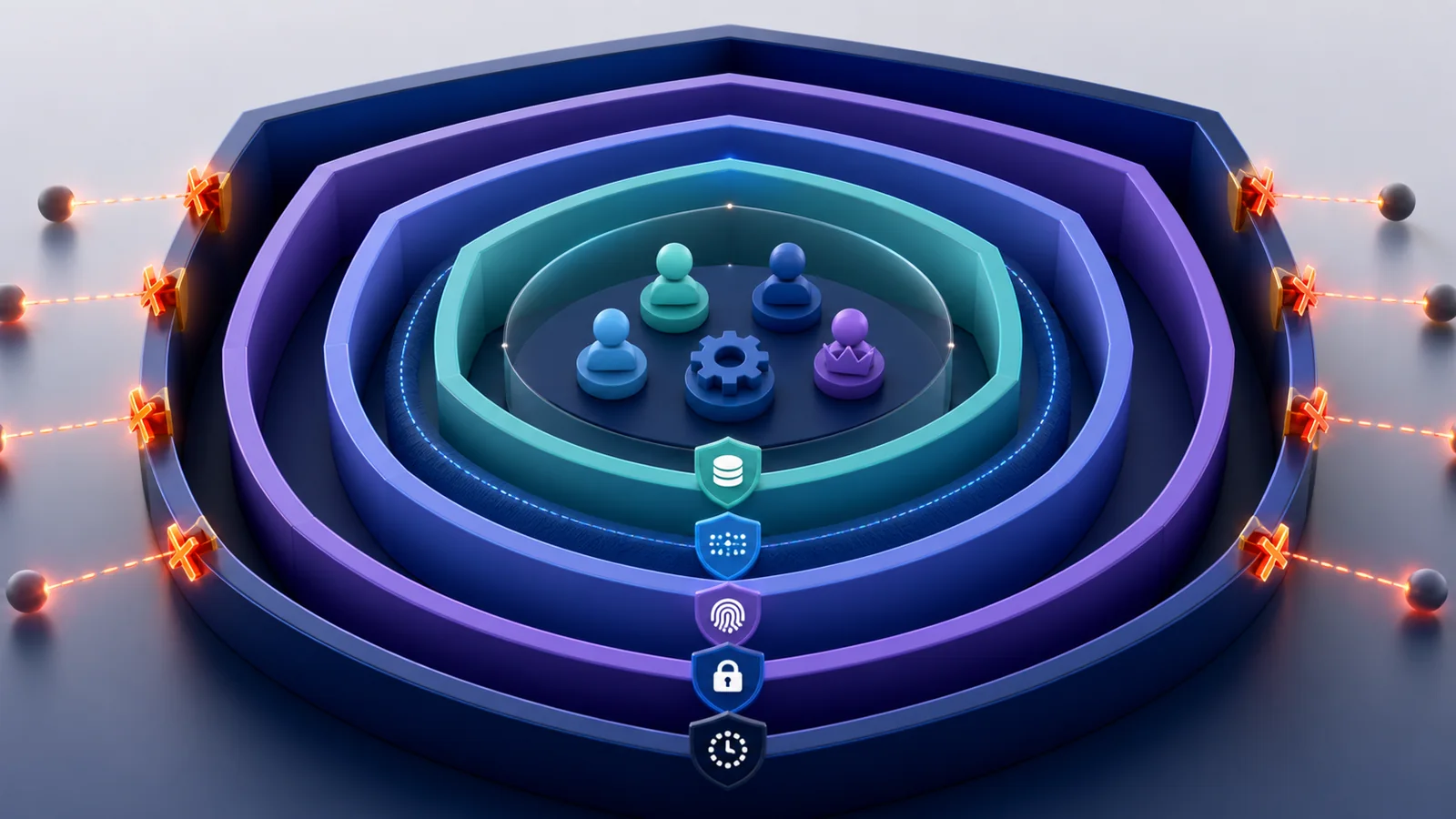
Password-attack prevention is strongest when identity hygiene, safer credentials, stronger authentication, and controlled retries reinforce one another.
Protect Privileged and Service Identities
Privileged identities deserve separate treatment because one successful sign-in can expand an attacker’s reach. Give administrators distinct everyday and elevated accounts, grant only the access required for the task, and make elevation temporary when the platform allows it. Protect emergency access accounts with tightly controlled credentials, monitored use, and an offline recovery procedure that is tested rather than assumed.
Service identities need owners and rotation plans even when no person signs in directly. Remove interactive login where it is unnecessary, replace static secrets with short-lived credentials or managed identities where supported, and alert on use from unexpected systems. These controls complement the permission, audit, and ownership practices used to secure a team knowledge base.
Require Stronger Sign-In Proof
Multi-factor authentication reduces dependence on a password, but factors do not offer equal resistance to interception or social engineering. For administrators and high-value workflows, prefer phishing-resistant authenticators such as passkeys or hardware-backed security keys. Design enrollment so a user cannot register a weaker factor without equivalent verification, and review fallback methods that silently undermine the stronger path.
The OWASP Authentication Cheat Sheet recommends layered authentication, secure recovery, reauthentication for sensitive actions, and careful handling of error messages. Apply step-up checks before privilege changes, credential replacement, payment approval, or recovery-factor updates. A password plus an easily redirected code is better than a password alone, but it should not be the endpoint for the identities that matter most.
Limit Repeated Attempts Without Creating Lockout Abuse
Rate controls should make automated guessing expensive while keeping legitimate recovery possible. Combine progressive delays, temporary holds, bot challenges, device or network reputation, and alerts. Count attempts by account as well as by network source, because attackers can distribute traffic across many addresses. Treat widespread failures against many usernames differently from a burst against one user.
Avoid a fixed, lengthy lockout as the only response. An attacker could deliberately trigger it and deny access to employees or administrators. Use stricter thresholds for privileged and recovery accounts, and give support teams a verified path to restore access. OWASP’s credential-stuffing prevention guidance emphasizes defense in depth because IP blocking or a single challenge can be bypassed.
Monitor Identity Signals Before Access Expands
Prevention includes finding the attempts that pass individual controls. Monitor failed and successful sign-ins, impossible or unusual location changes, unfamiliar devices, new factor enrollment, password resets, recovery requests, privilege elevation, session creation, and access to sensitive data. Baseline service accounts separately; their normal behavior is usually narrower than human activity and deviations may be more meaningful.
Correlation matters more than isolated alerts. A successful login after a spray pattern, followed by a new authenticator and an export, deserves faster attention than any event alone. Assign alert owners, document escalation criteria, and connect identity containment to a tested security incident response plan. Preserve enough evidence to understand the entry path before credentials, tokens, and sessions are invalidated.

Early warning becomes useful only when signals reach an owner who can investigate, contain access, recover safely, and improve the control.
Train People With Realistic Scenarios
Generic annual reminders do not prepare people for a targeted request. Practice scenarios that resemble actual work: a supplier asks for an urgent password reset, a fake collaboration notice leads to a sign-in page, a caller pressures support to replace an authenticator, or a prompt arrives when the user is not signing in. Explain that phishing can target credentials, approval flows, and recovery processes.
Give employees one simple reporting path and reward rapid reporting, even when someone clicked or responded. Help-desk and administrator exercises should include identity verification, escalation, and the authority to pause a suspicious request. Measure whether reports arrive quickly and whether responders follow the playbook, not merely whether everyone completed a training module.
Secure Account Recovery Paths
Recovery can bypass controls that protect normal sign-in, so design it as a sensitive authentication flow. Protect recovery email accounts, limit what support staff can change, require stronger verification for high-value identities, and notify users through an existing trusted channel when factors or passwords change. Do not rely on knowledge questions whose answers may be public, reused, or socially engineered.
Recovery records are sensitive too. Restrict access, log every action, and review unusual resets across multiple accounts. Revoke active sessions and remembered devices when compromise is credible. These practices belong inside the broader program for data privacy and security, because a successfully recovered identity may still expose confidential information if old sessions remain active.
Test Controls and Time-Limit Exceptions
Test the full path, not just whether a policy is enabled. Verify that password blocklists reject representative choices, throttling recognizes distributed attempts, stronger authentication is actually required for privileged work, alerts reach a person, and recovery cannot downgrade the intended assurance. Use controlled tabletop exercises for account takeover and measure detection, containment, restoration, and follow-up.
Business exceptions will occur, especially for legacy services. Give each exception an owner, documented risk, compensating controls, review date, and expiration date. Track shared accounts, MFA exclusions, static secrets, dormant identities, and unmonitored applications as debt with deadlines. When collaboration platforms are involved, include these checks in reviews of online collaboration security so identity and content controls are tested together.
Conclusion
The practical way to prevent password attacks is to reduce opportunity at every stage: know which identities exist, reject exposed choices, isolate privilege, require stronger proof, slow automated attempts, connect warning signals, prepare people, and protect recovery. No individual layer is perfect; the program works because one control catches what another misses.
Start with the account inventory and the highest-impact identities, then test one complete sign-in and recovery path. Record the result, assign the gaps, and repeat. That turns password security from a policy document into an operating discipline that can improve before an account breach becomes an incident.
Frequently Asked Questions
What are the main types of password attacks?
The main password attacks are brute force, which tries many passwords against an account; password spraying, which tries a small set of common passwords across many accounts; credential stuffing, which reuses username and password pairs exposed elsewhere; and phishing-assisted theft, which tricks a person into revealing or approving credentials. Each pattern needs overlapping prevention, detection, and recovery controls.
What is the most effective way to prevent password attacks?
No single control prevents every password attack. The strongest approach combines unique passwords from a password manager, checks against common and breached-password blocklists, phishing-resistant authentication for important accounts, least privilege, account-aware rate limiting, identity monitoring, and protected recovery procedures.
Should organizations lock accounts after failed login attempts?
Organizations should limit repeated attempts, but a fixed long lockout can be abused to deny service to legitimate users. Prefer progressive delays, temporary holds, bot challenges, account-aware and network-aware signals, alerts, and a secure recovery path, with stricter controls for privileged or high-value accounts.
Related Articles
How to Secure Your Team's Knowledge Base: IT Security Best Practices for Collaborative Workspaces
Cloud Productivity Tools Security: A Privacy Guide
Online Whiteboard Security Best Practices: Stop Leaks Fast
MCP Security Best Practices: The Practitioner Checklist