15 Types of Events in 2026: Categories & Examples
Updated October 2026: regrouped the 15 event types by purpose, separated event type from delivery format, and added a format decision tree with sourced planning and accessibility guidance.
The 15 common types of events are conferences, seminars and workshops, webinars, virtual summits, training sessions, product launches, trade shows and exhibitions, networking events, fashion events, weddings, birthday parties, team-building events, sports events, nonprofit and fundraising events, and art and cultural events. They fall into four purpose groups: learning and professional, business and promotion, celebrations and teams, and community and cause.
An event type describes why people gather. A delivery format describes where they take part: in person, online, or hybrid. Keep the two decisions separate. A product launch can be a room-only demo, a webcast, or a hybrid event; the purpose stays the same while the staffing, budget, and risks change.
For each type, this guide covers what it is for, the planning moves that matter, where it usually goes wrong, and what to measure. The examples are illustrative scenarios, not client case studies or attendance benchmarks.
At a Glance: 15 Types of Events
The format column shows a common starting point, not a rule. Most types can be adapted to another format if the audience and goal call for it.
| # | Event type | Purpose group | Common starting format | What to measure |
|---|---|---|---|---|
| 1 | Conference | Learning and professional | In person or hybrid | Target attendees reaching the right sessions and meetings |
| 2 | Seminar or workshop | Learning and professional | In person or online | Participants completing the exercise |
| 3 | Webinar | Learning and professional | Online | Live attendance and qualified next steps |
| 4 | Virtual summit | Learning and professional | Online | Session attendance and replay use by time zone |
| 5 | Training session | Learning and professional | In person or online | Task performance after training |
| 6 | Product launch | Business and promotion | In person, online, or hybrid | Demo requests, trials, or another agreed action |
| 7 | Trade show and exhibition | Business and promotion | In person | Qualified conversations and booked follow-ups |
| 8 | Networking event | Business and promotion | In person or online | Intended introductions that continue later |
| 9 | Fashion event | Business and promotion | In person, sometimes streamed | Buyer and press follow-up |
| 10 | Wedding | Celebrations and teams | In person | Vendor handoffs on time against the run sheet |
| 11 | Birthday party | Celebrations and teams | In person | Guest comfort and host workload |
| 12 | Team-building event | Celebrations and teams | In person or online | Commitments completed afterward |
| 13 | Sports event | Community and cause | In person | Incidents, delays, and safe completion |
| 14 | Nonprofit and fundraising event | Community and cause | In person, online, or hybrid | Pledges received, not only pledged |
| 15 | Art and cultural event | Community and cause | In person, sometimes with online access | Access, attendance, and artist outcomes |
If you already know your event type and need a document to fill in, start with these free event planning templates, the wedding planner checklist, the bachelorette itinerary template, or the conference itinerary template. This guide focuses on choosing and planning the event itself.
What Is an Event Type?
An event type names the purpose of a gathering and the experience people expect: learning at a workshop, celebrating at a wedding, comparing suppliers at a trade show. A delivery format names the participation channel. Because the two are independent, a conference can run online, a training session can run in person, and a fundraiser can serve a room and a remote audience at the same time.
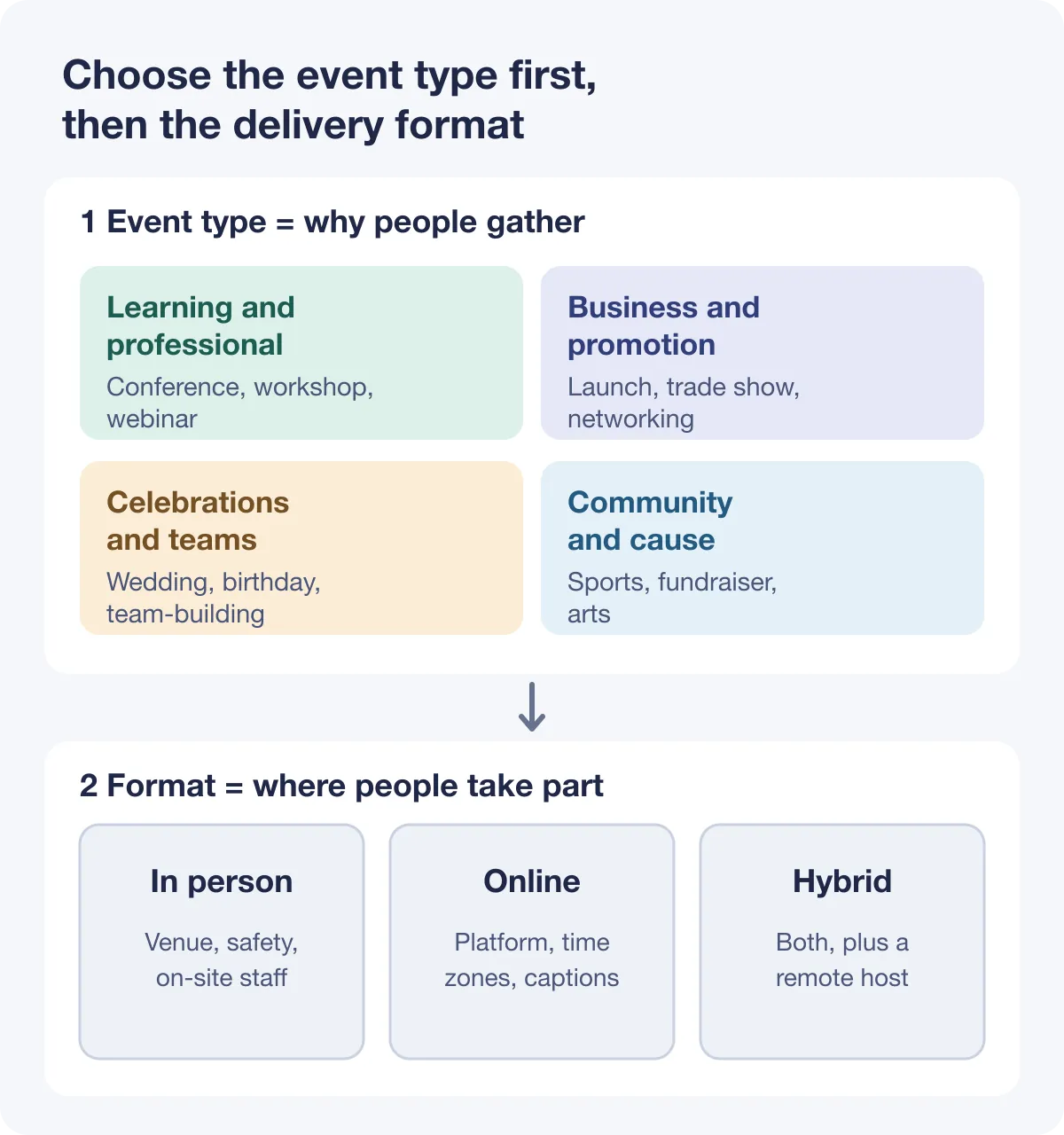
- In person: everyone gathers at a venue, so the venue, safety, access, catering, signage, and on-site staffing carry most of the risk.
- Online (also called virtual): everyone joins through a platform, so reliability, time zones, speaker setup, interaction design, captions, and replay access carry most of the risk.
- Hybrid: some people are in the room and some take part remotely, so you plan two experiences plus the moments where they meet, such as shared Q&A, voting, or networking.
The Events Industry Council’s CMP International Standards (updated February 2025), the competency outline behind the Certified Meeting Professional credential, treat these as separate tasks: developing event goals and objectives is one skill, and designing the delivery method (hybrid, in person, or online) is another. The same standards ask planners to measure outcomes against goals set before the event. The four purpose groups used in this guide are an editorial grouping to make the list easier to scan, not an official industry taxonomy.
How to Choose an Event Type and Format
Start with the outcome you need. Then decide whether people have to share a physical space.
| If your main outcome is... | Start with... | Choose the format by asking... |
|---|---|---|
| Hands-on skill practice | Workshop or training session | Do participants need physical equipment, or can they practice online? |
| Many buyer conversations | Trade show or networking event | Are the buyers and demos in one place, and can staff handle follow-up? |
| Broad education across regions | Webinar or virtual summit | Can the team moderate, caption, and support several time zones? |
| A shared milestone or culture | Wedding, birthday, team-building, or cultural event | Which moments depend on being together, and who might need remote access? |
| Public launch or fundraising | Product launch or nonprofit event | What must happen live, and is an online audience worth the production cost? |
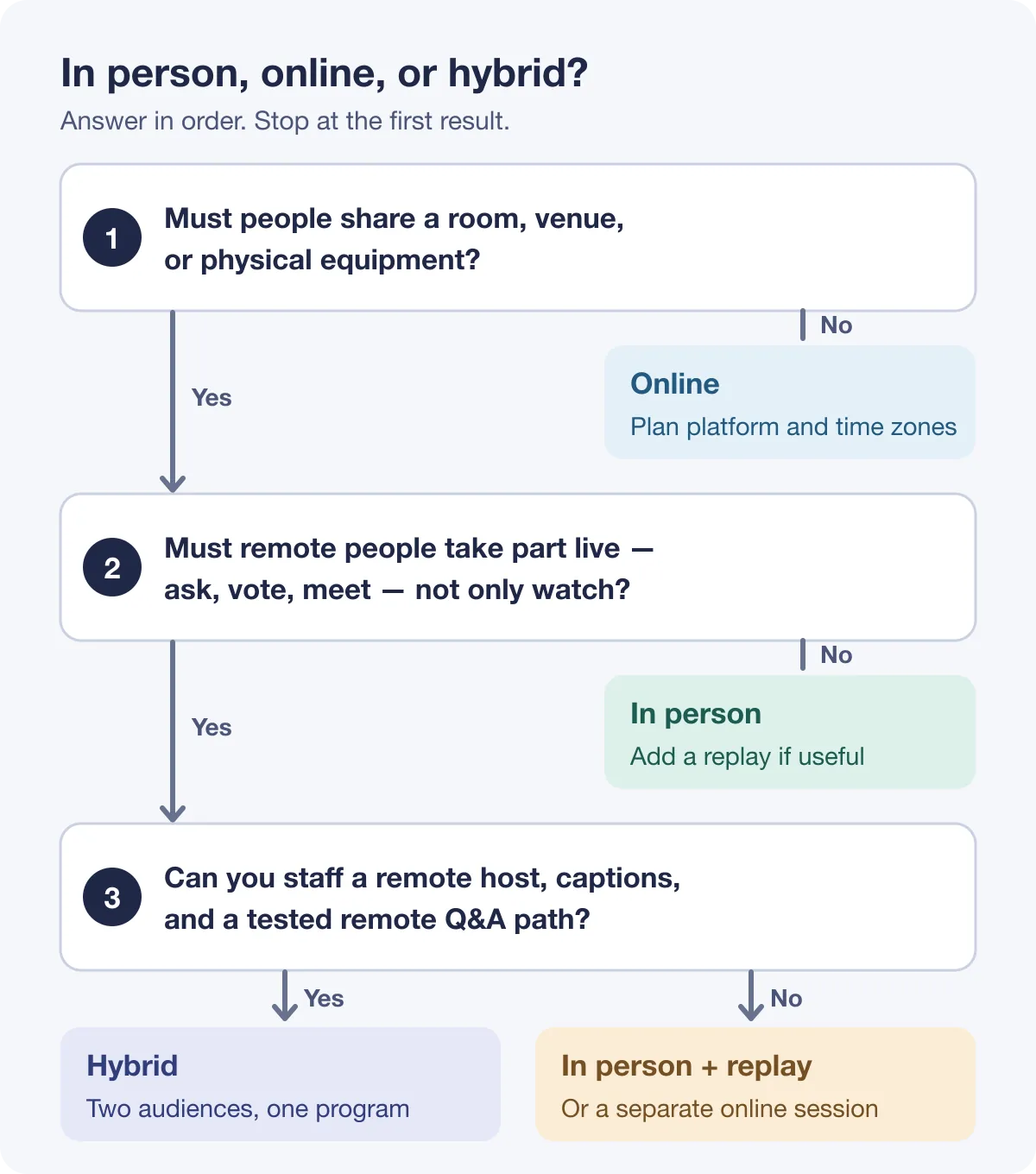
Two checks prevent most format mistakes:
- Do not call a recording hybrid. If remote people can only watch a stream or a replay, describe the event as in person with a livestream or replay. A hybrid program needs an owner for the remote audience, its own way to participate, and a tested path for remote questions.
- Price the online audience per person. In PCMA’s guidance on hybrid event strategy (2023), Beth Surmont recommends starting with what the content needs to accomplish rather than with livestreaming, and comparing the cost of a digital offering with the people it reaches. Her example: a $5,000 livestream attended by 50 people costs $100 per person. That can be money well spent for a priority audience; for others, a recording or audio-only version may be enough.
A brief you can copy before choosing
- Outcome: “By [date], [audience] will [observable action].”
- Audience and access: Who needs to attend, from which locations and time zones, and what accommodations should registration ask about?
- Format decision: What requires a venue, what works online, and what will remote participants actually be able to do?
- Capacity: Name the owner for program, registration, venue or platform, accessibility, safety, and follow-up; combine roles only when the workload allows it.
- Evidence: Pick one primary measure from the table above, its data source, and a review date before invitations go out.
How to Manage Different Types of Events

Every event type can use the same five-step backbone; what changes is the detail inside each step.
The same logic applies well beyond events, since the fundamentals of project management call for one consistent backbone that flexes to fit whatever is being delivered.
- Define the event objective. Write one measurable outcome, such as qualified leads, donor pledges, employee alignment, attendee satisfaction, or community participation.
- Map the audience and format. Decide who must attend, what requires presence, and which accessibility or time-zone needs shape the venue and platform.
- Build the run of show. List start times, transitions, owners, dependencies, setup windows, and a decision point for a delayed speaker, weather problem, or stream failure.
- Assign owners and vendors. Document who owns venue, speakers, sponsors, catering, AV, registration, content, safety, and post-event follow-up.
- Measure results after the event. Compare the chosen outcome with attendance, budget, feedback, sponsor commitments, sales follow-up, donor response, or learning evidence within one week. Record the data source and owner.
Learning and Professional Events
1. Conference
A conference is a multi-session gathering where people from one field or community hear speakers, compare practice, and meet each other, usually over one or more days.
Best for: industry education, partner ecosystems, customer communities, and thought leadership.
Planning moves: define the theme, curate speakers, build tracks, confirm room capacity, plan sponsor visibility, and publish a clear agenda. If sponsors fund part of the budget, an event sponsorship proposal helps you agree on deliverables early.
Example: a two-day SaaS conference with a keynote, three breakout tracks, sponsor booths, customer roundtables, and an evening reception.
Where it goes wrong: long registration queues, sessions for the same audience scheduled against each other, and speakers who arrive without a technical check.
What to measure: whether the intended audience attended the sessions and meetings planned for them, not only total registrations.
2. Seminar or Workshop
A seminar is a focused session on one topic, led by an expert and built around discussion; a workshop goes further and has participants practice or produce something during the session. Both can run in person or online.
Best for: professional education, customer enablement, leadership training, academic programs, and small-group consulting.
Planning moves: keep the topic narrow, define learning outcomes, add exercises, collect questions before the session, and leave time for discussion. For a workshop, plan materials and what each participant will leave with, and keep the timing in a workshop run-of-show agenda.
Example: a three-hour workshop where product managers learn roadmap prioritization, practice on sample data, and leave with a decision template.
Where it goes wrong: slides crowd out practice time, or exercises depend on equipment or software some participants do not have.
What to measure: the share of participants who complete the promised exercise before they leave.
3. Webinar
A webinar is a live online presentation or discussion on one narrow topic, with audience questions, polls, or chat.
Best for: educational marketing, expert interviews, feature walkthroughs, partner webinars, and customer success sessions.
Planning moves: make a specific promise in the title, keep the content narrow, add polls or Q&A, prepare follow-up emails, and decide how a registration becomes a qualified next step.
For expert-led or partner webinars, an email finder can help organizers identify the right speaker or partnership contact before outreach begins.
Example: a 45-minute product operations webinar with a 30-minute teaching segment, a 10-minute live demo, and 5 minutes of Q&A.
Where it goes wrong: a broad title attracts registrants who do not match the offer, or the promised recording never reaches anyone.
What to measure: registrations, live attendance, useful questions, and agreed next steps as separate numbers. Send the recording or resources to both attendees and no-shows.
4. Virtual Summit
A virtual summit is a multi-session online conference that brings several speakers to a geographically spread audience without anyone needing to travel.
Best for: global thought leadership, community education, partner ecosystems, customer training, and expert panels.
Planning moves: choose a reliable platform, brief speakers on camera and audio, design session tracks, plan time-zone coverage, moderate chat, and prepare replays. Schedule a technical rehearsal for every live speaker.
Example: a one-day online AI summit with live keynotes, pre-recorded lightning talks, moderated chat, sponsor pages, and session recordings.
Where it goes wrong: every session lands in one region’s working hours, speaker audio is untested, or nobody moderates the chat.
What to measure: session attendance, questions, technical drop-offs, and replay use by time zone. Total registrations alone hide disengagement.
5. Training Session
A training session is a structured learning event where a team, customer group, or community practices a specific skill or process and is checked on it.
Best for: onboarding, compliance training, certification, customer education, and recurring internal enablement.
Planning moves: split content into modules, provide pre-work, add practice time, create an assessment, and document follow-up resources in a knowledge base.
Example: a remote onboarding session where new hires learn the support workflow, complete practice tickets, and leave with a checklist.
Where it goes wrong: information is delivered with no practice or follow-up, so nothing changes in how people work.
What to measure: a practical task or short assessment at the end of the session, and again when participants apply the skill at work.
Business and Promotion Events
6. Product Launch
A product launch event introduces a new product, feature, or service to customers, press, or partners, often pairing a live demo with an online broadcast.
Best for: SaaS launches, hardware reveals, creator product drops, enterprise announcements, and community updates.
Planning moves: define the launch narrative, rehearse the demo, prepare press assets, separate in-room and online roles, and plan the event marketing strategy across pre-event, live and post-event touchpoints. Hybrid launch events need a run of show that works even if the demo or stream fails.
Example: a 90-minute launch with a founder keynote, live demo, customer story, press kit, online replay, and sales follow-up list. The worked example below turns this into a schedule.
Where it goes wrong: the live demo or stream fails with no fallback, or views are reported while nobody owns follow-up.
What to measure: demo requests, trial starts, or another agreed product action rather than views alone.
7. Trade Show and Exhibition
A trade show or exhibition is an industry event where companies exhibit products or services to buyers, partners, and media through booths, demos, and scheduled meetings.
Best for: B2B demand generation, channel partnerships, product demos, industry networking, and buyer education.
Planning moves: design the booth journey, train staff on qualification, plan demo timing, arrange delivery for booth materials and product samples through a delivery service, create lead capture rules, and schedule post-show follow-up before the show starts.
Example: a cybersecurity expo booth with live demos every hour, meeting pods, lead scoring, and a same-day account follow-up workflow.
Where it goes wrong: staff scan every badge, and the sales team cannot tell real prospects from passers-by.
What to measure: define a qualified conversation before the show, log consented next steps, and reconcile meeting notes with the sales owner afterward.
8. Networking Event
A networking event is a gathering designed to help people meet, exchange context, and start useful professional relationships.
Best for: founder dinners, alumni events, customer communities, investor introductions, partner meetups, and professional associations.
Planning moves: decide who should meet whom, choose a room layout that supports movement, use prompts or small groups, capture contact preferences, and send a useful follow-up within 24 hours.
Example: a 120-person founder mixer with curated introductions, topic tables, short welcome remarks, and post-event attendee notes.
Where it goes wrong: open mingling with no structure, so most people talk only to colleagues they already know.
What to measure: whether intended introductions happened and whether participants opted into follow-up. Headcount is a weak proxy for useful connections.
9. Fashion Event
A fashion event is a brand, designer, or retail showcase, such as a runway show, collection preview, or store opening, built around styling, visual production, and press moments.
Best for: runway shows, collection previews, store openings, influencer events, and press presentations.
Planning moves: define the creative concept, sequence the looks, plan backstage flow, confirm lighting and music cues, prepare press assets, and rehearse transitions. Audience attention is concentrated into a short window, so timing errors are visible to everyone.
Example: a 45-minute runway preview with backstage prep, buyer seating, creator arrivals, live social capture, and a private showroom follow-up.
Where it goes wrong: late looks, missed lighting or music cues, and press assets that arrive after interest has faded.
What to measure: buyer and press requests, and whether the promised follow-up assets were delivered.
Celebrations and Team Events
10. Wedding
A wedding is a ceremonial and social event celebrating a couple, usually with several vendors, family expectations, and a tightly timed guest experience.
Best for: ceremonies, receptions, destination weekends, rehearsal dinners, and related milestone events.
Planning moves: document the couple’s priorities, create a timeline template in Google Docs, confirm vendor arrival windows, assign family contacts, and prepare a backup plan for weather, transportation, or ceremony delays.
Example: a Saturday ceremony with a rehearsal dinner, morning preparation schedule, ceremony handoff, reception run sheet, and transportation plan.
Where it goes wrong: vendor arrival windows overlap, or no one is named to handle a delay on the day.
What to measure: each vendor handoff against the run sheet. A calm guest experience and an on-time ceremony matter more than a raw attendance count.
11. Birthday Party
A birthday party is a personal celebration centered on the honoree, where success depends on comfort, timing, and an effort level the host can sustain.
Best for: children’s parties, milestone birthdays, surprise events, small dinners, and themed gatherings.
Planning moves: choose a theme, match the venue to guests’ ages and access needs, set the food and activity timeline, confirm invitations, and decide who handles cleanup. Keep the plan simple enough that the host can enjoy it.
Example: a 40-person milestone dinner with a welcome drink, short toast, seated meal, photo wall, and optional after-party.
Where it goes wrong: an ambitious plan keeps the host working all evening, and cleanup has no owner.
What to measure: food, access, and activity timing against the guest list, and whether the host was free to take part.
12. Team-building Event
A team-building event is an internal activity designed to improve how a specific group works together, with a facilitated debrief that turns the experience into agreed changes.
Best for: offsites, new-team onboarding, cross-functional alignment, manager training, and morale-building programs.
Planning moves: start with the team’s actual problem, not the activity; this team-building activities guide has options to match. Assign a facilitator, set ground rules, build a debrief, and record commitments at the end.
Example: a half-day product and engineering offsite with a retrospective, mapping exercise, lunch, and next-quarter collaboration commitments.
Where it goes wrong: the activity has no link to the problem the team faces, so it feels like a day out with no follow-through.
What to measure: two or three specific commitments captured at the debrief, each with an owner, revisited on a set date such as 30 days later.
Community and Cause Events
13. Sports Event
A sports event is a competition, tournament, race, or spectator gathering where safety, schedule control, and participant experience are the main planning risks.
Best for: school tournaments, marathons, charity runs, company sports days, and professional competitions.
Planning moves: create a detailed schedule, confirm permits, arrange medical support, plan crowd flow, brief volunteers, and build weather or delay contingencies.
Example: a city 10K with staggered starts, medical stations, route marshals, sponsor tents, and a post-race awards ceremony.
Where it goes wrong: weather, a medical incident, or a course problem arrives with no named decision-maker.
What to measure: incidents, delays, route or venue changes, and completions. Name an escalation owner before gates open.
14. Nonprofit and Fundraising Event
Nonprofit Fundraising Event: Cause-driven gathering that raises money, awareness, or volunteer support while making the mission tangible for donors.
Best for: charity galas, donor briefings, auctions, community fundraisers, and nonprofit awareness events.
Planning moves: center the beneficiary story, make donation paths simple, brief volunteers, thank donors quickly, and report impact after the event.
Example: a hybrid charity dinner with a live program, online pledge page, silent auction, donor recognition, and post-event impact email.
Where it goes wrong: the event becomes a generic party with a donation form attached, or pledges made on the night are never followed up.
What to measure: pledged and received amounts separately, plus volunteer follow-through. Get consent before using beneficiary stories or photos.
15. Art and Cultural Event
An art or cultural event is a program built around creative work, performance, heritage, or community expression, where curation and audience flow shape the experience.
Best for: gallery openings, film nights, cultural festivals, museum programs, public art events, and community performances.
Planning moves: curate the program, credit artists clearly, plan accessibility, manage audience circulation, coordinate permits, and create context materials so attendees understand the work.
Example: a weekend cultural festival with artist talks, food vendors, performance stages, workshops, and a family-friendly route map.
Where it goes wrong: crowding around popular works, unclear routes, missing artist credits, or spaces that people with access needs cannot use.
What to measure: access routes, artist credits, and audience flow checked on site, plus feedback from artists as well as visitors.
Worked Example: A 90-Minute Product Launch
Illustrative scenario: A small software team wants qualified demo requests from a new feature announcement. It chooses a live room with an online stream only after confirming that it can staff both audiences.
| When | Owner | Decision or deliverable |
|---|---|---|
| Two weeks before | Program lead | Lock the promise, audience, success measure, speaker brief, and follow-up owner. |
| One week before | Producer and accessibility lead | Test captions, room audio, stream access, demo fallback, and the remote Q&A path. |
| Day of event | Moderator | Run the 90-minute schedule, repeat room questions into a microphone, and flag issues to the producer. |
| Next business day | Sales or community owner | Route consented demo requests and send the promised replay and resources. |
| One week after | Program lead | Review demo requests, attended versus registered guests, production incidents, and spend against the original goal. |
A simple measure is demo-request rate = qualified demo requests ÷ attendees who could see the call to action. Define “qualified” and the denominator before the event, and do not combine room attendees, stream viewers, and replay viewers if they had different chances to respond. This is a sample plan, not a reported AFFiNE event result.
Accessibility and Risk Checks for Every Format
- In person: confirm step-free routes, seating, wayfinding, emergency procedures, and a way for attendees to request accommodations when they register.
- Online: test the platform with keyboard access, captions, readable materials, speaker audio, and a support contact.
- Hybrid: repeat room questions into a microphone so remote participants hear them, provide captions to both audiences, and make sure remote participants can reach shared materials and Q&A. A stream alone does not create equal participation.
- All formats: assign an owner for safety and privacy, get consent before recording or publishing attendee stories, and prepare a fallback for the failure that would hurt most.
These checks are adapted from the W3C’s Making Events Accessible checklist, which covers in-person, remote, and hybrid meetings, and its Accessibility of Remote Meetings group note. Confirm local legal, venue, and safety requirements for your specific event.
Post-event Review Checklist
Review the event within one week, while the details are still fresh:
- Attendance: registrations, show-up rate (attendees ÷ registrants), session attendance, and replay views, reported separately by format.
- Budget: planned spend, actual spend, unexpected costs, and vendor performance.
- Audience quality: attendee fit, questions asked, meetings booked, and follow-up requests.
- Experience: survey themes, staff notes, accessibility issues, and production incidents.
- Next action: what to repeat, what to remove, who owns follow-up, and the date the result will be checked.
Store the review next to the original plan so the next team starts from what actually happened.
Choosing an Event Planning Workspace
Choose tools from the work that needs tracking: an event brief, run of show, owner list, vendor records, and a record of decisions. Ticketing, payments, streaming, and attendee email usually need separate systems.
AFFiNE fits the planning part of that work: you can draft the brief in a doc, map the attendee journey or venue flow on a whiteboard, and track vendors and owners in a database, all in one workspace. Hand off to dedicated tools for registration, payments, email, and streaming when the event needs them.
A simple AFFiNE setup for an event:
- Create one event hub page with the objective, audience, budget, owners, and key dates.
- Add a whiteboard for venue flow, attendee journey, or a hybrid production map.
- Use a database for vendors, content, speakers, and day-of owners.
- Link the hub to templates such as the event planning checklist, wedding checklist, or conference itinerary.
- After the event, add the post-event review to the hub and duplicate it as the starting point for the next one.
Frequently Asked Questions About Event Types
How many types of events are there?
There is no official number. Published lists range from a few broad categories to dozens of niche formats. This guide covers 15 common types in four purpose groups: learning and professional, business and promotion, celebrations and teams, and community and cause.
What are the main categories of events?
Group events by purpose: learning and professional events (conferences, workshops, webinars, training), business and promotion events (launches, trade shows, networking, fashion shows), celebrations and team events (weddings, birthdays, team-building), and community and cause events (sports, fundraisers, arts and culture). In person, online, and hybrid are delivery formats that apply across these groups rather than categories of their own.
What is the difference between a hybrid event and a livestreamed event?
In a livestreamed event, remote viewers watch. In a hybrid event, remote participants can take part by asking questions, voting, or meeting other attendees, and someone is responsible for their experience. If the online audience can only watch, describe it as an in-person event with a livestream.
What is the difference between a seminar and a conference?
A seminar is usually smaller, narrower, and more interactive. A conference is larger and often includes multiple speakers, tracks, sponsors, and networking sessions. If the goal is deep learning on one topic, choose a seminar. If the goal is broad industry exchange, choose a conference.
Which event type is best for lead generation?
Choose by buyer behavior and the action you want to measure. A webinar can answer focused questions across regions; a trade show supports hands-on demos and scheduled buyer conversations; a product launch concentrates attention on a new offer. Define a qualified lead and a follow-up owner before choosing.
How do I choose the right event type?
Start with one observable outcome, then choose the type that creates it. Pick in-person, online, or hybrid delivery from audience needs, accessibility, budget, and production capacity. The decision table and three-question format check above help you test the choice.
What should every event plan include?
Include the objective and success measure, audience and access needs, budget, run of show, owners and vendors, communications, safety and fallback decisions, and follow-up. Keep each item proportionate to the event; a small gathering needs fewer roles than a large public program.
How This Guide Was Prepared
This is an editorial planning guide. Its event examples and worked launch plan are illustrative, not case studies or industry averages, and the four purpose groups are an editorial grouping. The format guidance draws on the Events Industry Council’s CMP International Standards (updated February 2025) and PCMA’s 2023 hybrid strategy questions; the accessibility checks draw on W3C’s event accessibility checklist. All sources were checked in October 2026. Adapt the plan to local rules, the venue, and the people attending.