ADHD Forgetfulness: When It's More Than Just Being Distracted
Attention-deficit hyperactivity disorder (ADHD) is a common neurodevelopmental condition that affects millions of children and adults worldwide. Its core symptoms are inattention, hyperactivity, and impulsivity. Most people recognize the obvious signs, such as fidgeting or trouble paying attention, but one of the most disruptive symptoms gets far less attention: forgetfulness.
ADHD forgetfulness isn't about losing your keys or missing a meeting once in a while. For people with ADHD, it shows up as chronic disorganization, unfinished tasks, and forgotten responsibilities, even when they are trying hard. The consequences add up. It can leave people frustrated and self-critical, and it can strain relationships when the behavior is read as indifference.
In this post, we'll look at how forgetfulness is related to ADHD, what causes it, how it differs from ordinary distractibility, and which strategies reduce its impact on daily life.
This article is for general information only and is not medical advice. If memory problems are affecting your work, studies, or relationships, talk to a qualified healthcare professional.
Key takeaways
- ADHD forgetfulness is a persistent pattern, not an occasional slip. Forgetting daily activities and losing everyday items are both listed signs of inattention.
- Most of it comes from working memory and attention at the moment information arrives. Long-term memory storage is usually intact.
- It differs from age-related memory change and dementia: it starts in childhood, stays fairly stable, and improves when cues are put outside your head.
- External systems such as alarms, a single capture inbox, visual cues, and fixed routines help most when combined with professional treatment.
What is ADHD forgetfulness?
When we talk about forgetfulness with ADHD, we mean a long-standing pattern, not an occasional lapse. Everyone forgets things sometimes. With ADHD, forgetting tends to be more frequent, more pervasive, and more disruptive to daily life.
The U.S. National Institute of Mental Health lists nine signs of inattention, and two of them are about memory in everyday life: losing things such as keys, wallets, and phones, and forgetting daily activities such as chores, errands, appointments, and phone calls. Forgetfulness is part of how ADHD presents, not a side issue.
It is also important to remember that ADHD forgetfulness has nothing to do with intelligence or laziness. It reflects neurological differences in attention regulation, working memory, and impulse control.
Below are a few everyday examples of ADHD forgetfulness:
- Misplacing a phone or wallet several times a day and losing an hour looking for it.
- Missing appointments and work deadlines more often than peers.
- Losing track mid-conversation or forgetting what someone just said, which can cause misunderstandings or leave the speaker feeling unheard.
- Starting a task, noticing another one along the way, and switching to it instead of finishing the first.
- Remembering the first part of an instruction but not the last, and ending up with a half-finished task.
The science behind forgetfulness in ADHD
Many people with ADHD have difficulty with working memory. They may struggle to keep something in mind long enough to act on it, or to remember what they were doing before a distraction pulled them away.
ADHD forgetfulness is most closely linked to working memory and information processing, and to a lesser extent to long-term memory. Working memory is the cognitive system that temporarily holds and manipulates information. Think of it as the brain's sticky note: it lets you keep a set of directions in mind and then discard them once they're no longer needed. This mental workspace is essential for decision-making, problem-solving, and organizing everyday life.
Neuroimaging studies suggest that people with ADHD show differences in the prefrontal cortex, the brain region most responsible for executive functions such as working memory. When focus is weaker, information slips away more easily, which leads to more forgetting and makes it harder to persist with tasks, stay organized, and keep attention on one thing.
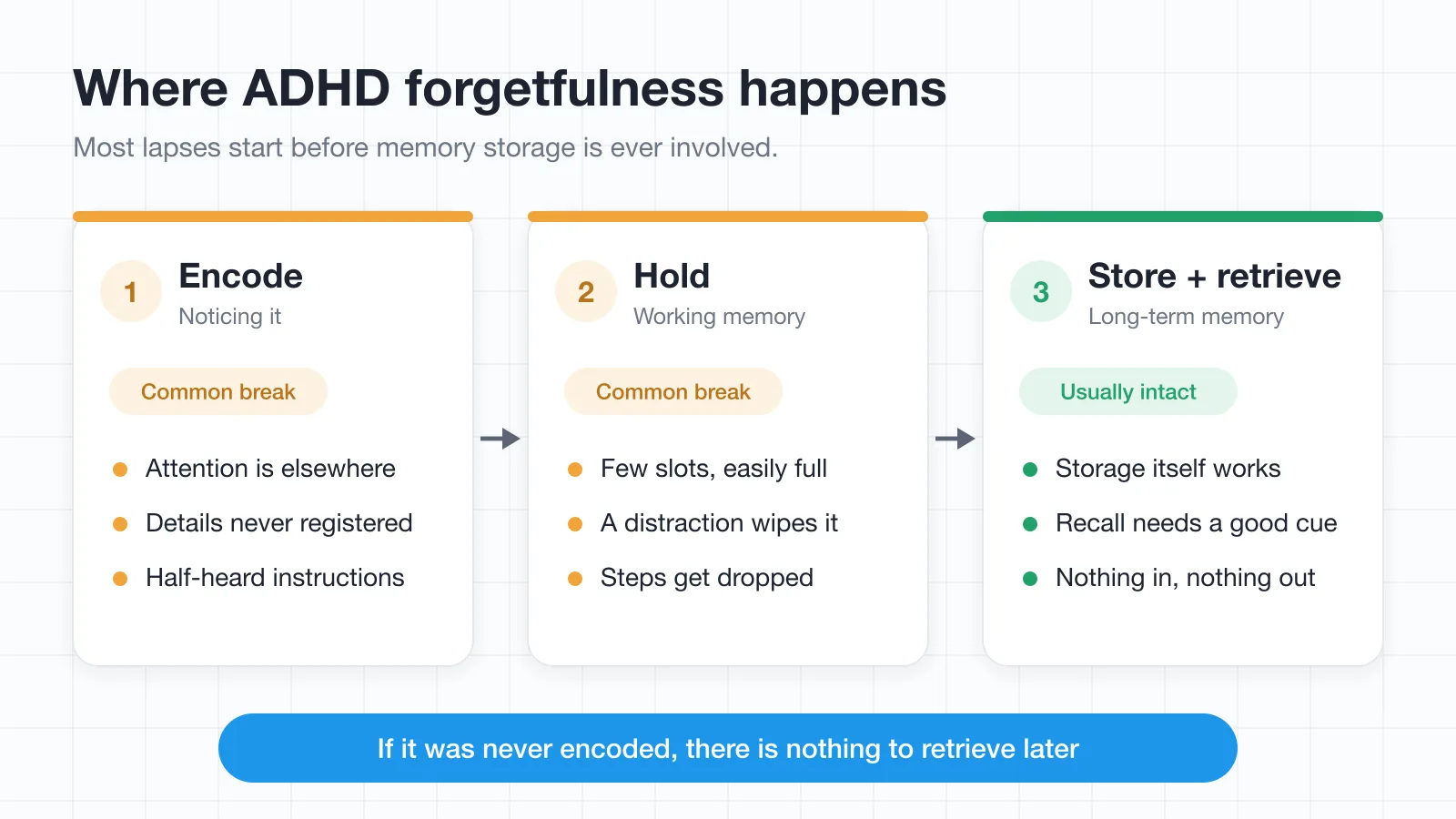
ADHD does not usually damage long-term memory storage itself, but it can disrupt how memories are encoded and retrieved. If your attention isn't tracking where and when something happens, the information may never be properly encoded. When you later try to recall it, the brain comes up empty. The memory isn't missing; it was never fully recorded in the first place. If your memory problems become significant, raise them with your healthcare provider.
How are other ADHD symptoms linked to forgetfulness?
ADHD forgetfulness is tied to how the ADHD brain takes in, organizes, and recalls information. Inattention, distractibility, and executive function difficulties all feed into it.
The role of inattention and distractibility
Inattention is a major driver of forgetfulness in ADHD. When attention wanders, whether because of external distractions (noise, movement) or internal ones (stray thoughts, feelings), key details are never noticed at all. Someone may miss a deadline or forget what a friend just said, not because they don't care, but because their attention wasn't fully engaged at that moment.
Executive function challenges
Executive functions are higher-order mental skills that support planning, organization, prioritization, time management, and emotional regulation. Many people with ADHD have difficulty with executive functioning, so it can be harder to keep track of things, remember the steps in a process, or follow through on intentions. For example, a student with ADHD might leave an assignment at home not because the work wasn't done, but because they didn't get their materials together the night before. When experiences like this start affecting your life, it's worth seeing a healthcare professional for an in-person or online ADHD assessment and treatment.
ADHD forgetfulness vs. other causes of memory issues
Not all memory lapses are the same. Knowing how ADHD-related forgetfulness differs from normal aging and from other medical or psychological conditions helps people get the right assessment, diagnosis, and treatment.
Forgetfulness related to ADHD is relatively stable over time and usually appears early, in childhood or adolescence. Diagnostic criteria require symptoms to have started before age 12 and to show up in more than one setting, such as home, school, and work. People with ADHD may lose track of a conversation or forget appointments not because their memory fails, but because the information was never fully encoded, having been lost to poor focus.
Memory changes linked to aging or to conditions such as dementia or a serious head injury look different. They tend to be new, to worsen over time, and in more serious cases to bring confusion about the date or place or trouble recognizing familiar people and surroundings. Depression and anxiety can also cause problems with focus and memory.
| Pattern | ADHD | Typical aging | Warning signs |
|---|---|---|---|
| When it starts | Childhood or adolescence | Gradually in later adulthood | New or rapid change at any age |
| Course over time | Fairly stable | Slow and mild | Getting steadily worse |
| What gets forgotten | Things never fully noticed: instructions, tasks, where items were put | Names and details that come back later | Recent events, familiar routes, people |
| What helps | External cues and routines | Extra time and reminders | Prompt medical evaluation |
If forgetfulness is persistent and interferes with daily life, get a professional evaluation. A healthcare provider can work out whether ADHD or another cause is behind it and point you to strategies and treatments that improve daily functioning.
Strategies and tools to manage ADHD forgetfulness
Forgetfulness is one of the most frustrating parts of ADHD, but many practical strategies and lifestyle changes help, alongside medical treatment. The common thread is to stop relying on working memory and put reminders where you will see them at the moment you need them.
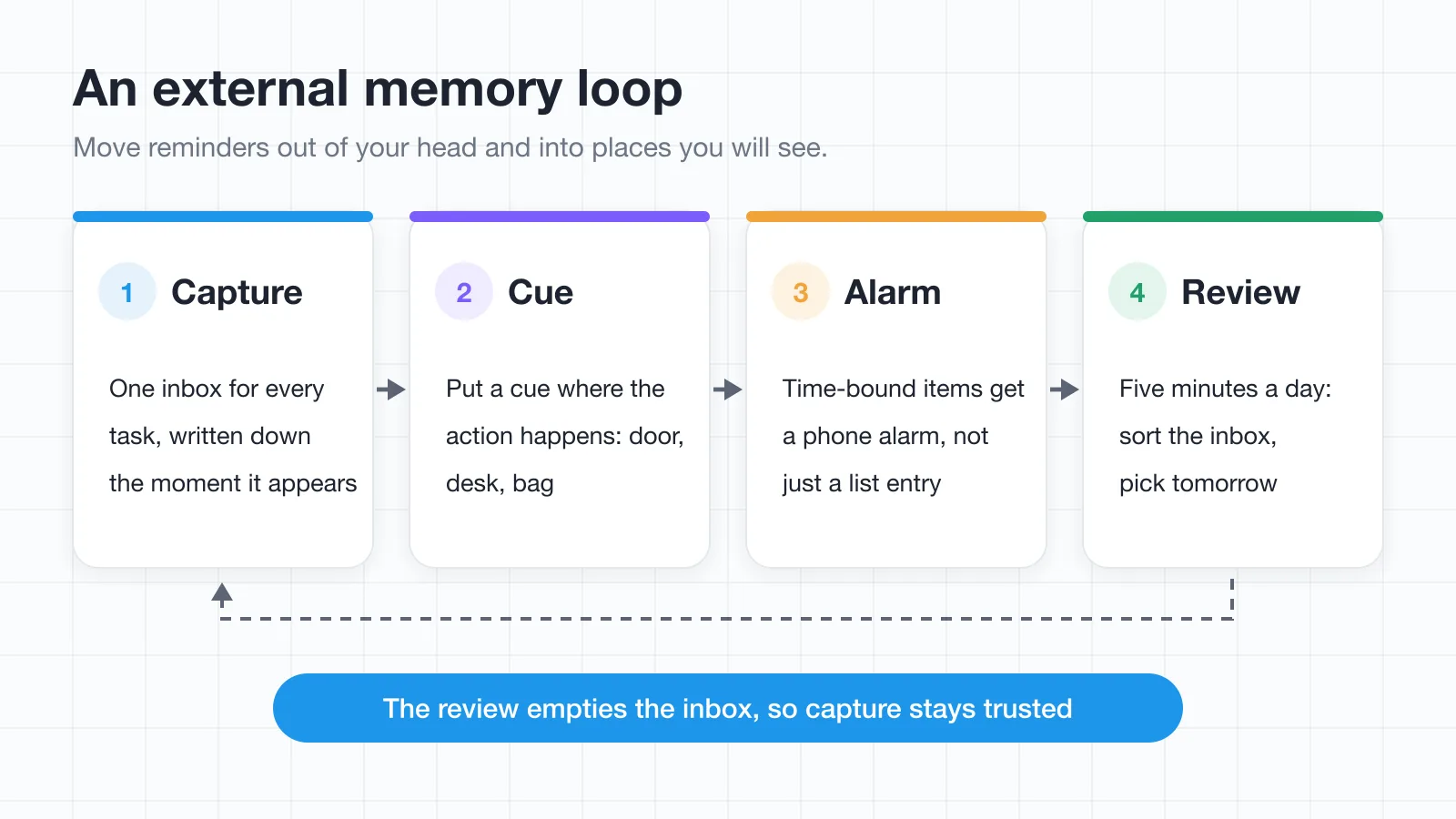
- Reminders and alarms: Set phone reminders or ask a smart assistant to remind you of appointments, medication, and tasks. Our guide to setting reminders ADHD brains actually notice covers how to keep alarms from turning into background noise.
- Daily routines: Doing recurring tasks at the same time each day reduces cognitive load. Time blocking can give those routines a fixed place on the calendar.
- Visual reminders: Sticky notes, labeled bins, whiteboards, and color-coded calendars act as visible cues. See how to use sticky notes in a planner without letting them pile up.
- Journaling and planners: Writing things down, on paper or digitally, helps fix them in memory and gives you something to check later.
- Apps and tools: Use apps to stay organized and manage to-do lists. If typing is a barrier, voice-to-text planning lets you capture a task the moment it comes to mind.
- Sleep: Poor sleep further impairs attention, memory, and mood. Make consistent, restful sleep a priority.
- Diet: Balanced meals with protein, omega-3s, and complex carbohydrates support overall brain function.
- Exercise: Regular physical activity improves focus, memory, and executive functioning.
- Mindfulness: Meditation, mindfulness exercises, or deep breathing can strengthen attention control and reduce mental clutter.
Building an external memory system in AFFiNE
A digital workspace helps most when it becomes the one place every loose task lands. Here is a simple setup in AFFiNE, a free workspace that combines docs, databases, and a whiteboard:
- Make one inbox. Use today's journal page as the default capture spot. Anything you need to remember goes there as a to-do item first, and gets sorted later.
- Give tasks a home. Once a day, move items from the journal into a database with a board view grouped by status (To do, Doing, Done). Seeing every open task at once is easier than holding it in your head.
- Write down the "launch pad." Keep a short checklist page for things that leave the house with you: keys, wallet, phone, charger, medication. Check it before you walk out the door.
- Map big projects visually. Use the whiteboard to lay out a project's steps as cards so the second half of a multi-step instruction doesn't get lost.
- Pair it with alarms. AFFiNE holds the list; time-sensitive items still belong in your phone's alarm or calendar app, so the reminder reaches you even when the workspace is closed.

If you're comparing tools, our roundup of ADHD planner apps that actually stick looks at which features matter most for ADHD brains.
Professional help: common treatment options for ADHD
Self-help methods can't always manage ADHD forgetfulness on their own. Professional support can make a real difference:
- Therapy: Approaches such as cognitive behavioral therapy (CBT) help you understand the links between your thoughts, feelings, and behaviors, and build practical habits around them.
- Medication: For many people, stimulant or non-stimulant ADHD medication improves attention and working memory.
- ADHD coaching or occupational therapy: These provide tailored tools for organization, time management, and goal-setting. Here's what an ADHD coach does and how coaching fits alongside treatment.
- Support groups: Connecting with others who understand ADHD can be motivating and offer practical support.
ADHD is also common in adults, not only children. A CDC survey from late 2023 estimated that 6.0% of U.S. adults, about 15.5 million people, had a current ADHD diagnosis, and more than half of them were diagnosed in adulthood. If you recognize yourself in this article, it's not too late to get assessed.
With a mix of tools and professional support, people can remember things far better than before, regain control of their daily lives, and feel more confident.
In conclusion
ADHD forgetfulness reflects real challenges with attention, working memory, and executive function. Unlike ordinary forgetfulness, the absent-mindedness that comes with ADHD is more persistent, harder to manage, and tied to how the brain takes in and organizes information. But it is manageable. Practical daily systems that move reminders out of your head, combined with professional help, can make a lasting difference.
FAQ
Is forgetfulness a symptom of ADHD?
Yes. Forgetting daily activities, such as chores, errands, appointments, and phone calls, and frequently losing items such as keys, wallets, and phones are both listed signs of inattention in ADHD. Forgetfulness alone isn't enough for a diagnosis, which looks at a broader set of symptoms across settings.
Why do people with ADHD forget things so quickly?
The main reason is working memory, the short-term mental workspace that holds information while you use it. In ADHD it is easier to overload and easier to interrupt, and if attention was elsewhere when the information arrived, it may never have been encoded properly in the first place.
Does ADHD affect long-term memory?
Long-term storage is usually intact. The difficulty is more often in getting information in (encoding) and getting it back out (retrieval). That's why things you paid full attention to are often remembered well, while details you only half-noticed vanish.
How is ADHD forgetfulness different from dementia?
ADHD forgetfulness starts in childhood, stays fairly stable, and mostly involves things that were never fully noticed. Dementia-related memory loss is new, gets worse over time, and can affect recent events, familiar places, and people. Any new or worsening memory problem should be checked by a doctor.
Can ADHD forgetfulness be treated?
Yes. Medication, therapy such as CBT, coaching, and practical systems like alarms, routines, and a single task inbox can all reduce its impact. Most people get the best results by combining professional treatment with external reminders.
Sources
- National Institute of Mental Health, Attention-Deficit/Hyperactivity Disorder: What You Need to Know
- Kofler, M. J., Singh, L. J., Soto, E. F., et al. (2020). Working memory and short-term memory deficits in ADHD: A bifactor modeling approach. Neuropsychology.
- Arnsten, A. F. T. (2009). The emerging neurobiology of attention deficit hyperactivity disorder: The key role of the prefrontal association cortex. The Journal of Pediatrics.
- Staley, B. S., et al. (2024). Attention-Deficit/Hyperactivity Disorder Diagnosis, Treatment, and Telehealth Use in Adults. CDC MMWR.
- Harvard Health Publishing, Exercise can boost your memory and thinking skills