Best Weather APIs for Apps, Analytics, and Automation
Weather data does far more than power consumer forecast apps. Logistics teams use it to plan around changing conditions, travel products rely on it for timely updates, agricultural systems track field conditions, and automated workflows can respond when weather crosses a certain threshold.
Choosing an API gets more complicated once you look beyond the basic forecast. Providers differ in historical coverage, forecast range, update frequency, documentation, request limits, pricing, and the types of data they offer. A simple app may only need current conditions and a short forecast. An analytics project might depend on decades of consistent historical records.
Quick Answer: Which Weather API Fits Which Project
- Past, present, and future weather in one API: Visual Crossing (more than 50 years of history, 15-day forecasts, historical forecasts).
- Broad product ecosystem: OpenWeather (history back to 1979, alerts, air pollution, maps).
- Simple setup with geolocation: WeatherAPI.com (up to 14-day forecasts, JSON and XML).
- Alerts and operational automation: Tomorrow.io (custom condition monitoring with webhook notifications).
- Specialized meteorological data: Meteomatics (110+ models, 1,800+ parameters, history back to 1940).
- Long forecasts with granular history: Weatherbit (16-day daily forecasts, 15-minute historical intervals).
- Open datasets and direct model access: Open-Meteo (ERA5 history back to 1940, archived model runs).
Key takeaways
- Start from the data your project needs: forecast range, historical depth, update frequency, variables, and geographic detail.
- Check how the API fits into your existing pipelines, not just what it returns.
- Judge pricing against expected production usage, not the cheapest starting plan.
- Test with your real locations, variables, and request volumes before committing.
What to Look for in a Weather API
Start with the data your project actually needs. Current conditions and short-term forecasts may cover a basic application, while other projects require hourly records, historical weather, severe weather information, or broad international coverage. Forecast length matters, but update frequency, available variables, and geographic detail deserve equal attention.
Think about where the data needs to go as well. If weather information will feed analytics or automated processes, check how easily the API can connect with existing data integration platforms, databases, dashboards, and other systems. Clear documentation, familiar response formats, sensible request limits, and flexible location queries can save significant development work.
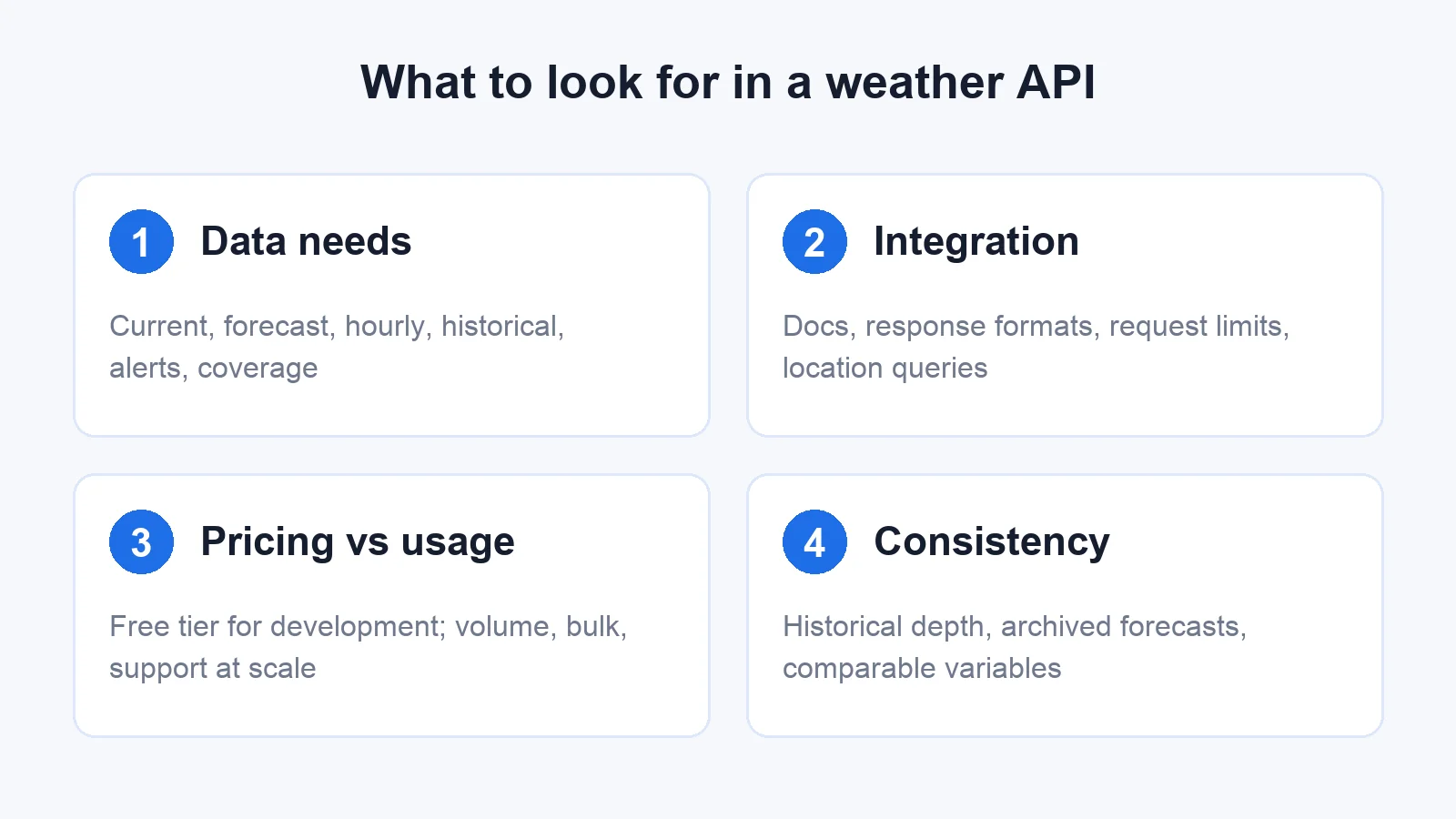
Pricing makes more sense when viewed against expected usage. A free tier may be enough for development or a small project, but production systems can require higher request volumes, bulk access, extra datasets, or commercial support. The cheapest starting plan says little about what the service will cost as usage grows.
Consistency matters for data-heavy work. Historical depth, archived forecasts, bulk retrieval, and the ability to request comparable variables across locations and time periods can all affect the quality of later analysis. The right choice should meet today's needs without creating unnecessary obstacles as usage expands.
The 7 Best Weather APIs Compared
Weather APIs tend to have different strengths. Some offer deep historical records, some make integration especially simple, and others focus on specialized models, detailed datasets, or operational alerts. These seven cover a broad range of common requirements.
Quick comparison
| API | Best for | Historical data | Forecast range | Formats mentioned |
|---|---|---|---|---|
| Visual Crossing | Historical, current, and forecast weather through one API | More than 50 years, plus historical forecasts | 15 days | JSON, CSV |
| OpenWeather | Broad weather coverage and a large API ecosystem | Back to 1979 | Short-range and longer-range | Not covered here |
| WeatherAPI.com | Straightforward weather and geolocation features | From January 2010 on qualifying plans | Up to 14 days | JSON, XML |
| Tomorrow.io | Weather alerts and operational workflows | Hourly and daily timelines, by product and plan | 120 hours hourly, 5 days daily | Not covered here |
| Meteomatics | Detailed weather, climate, and model data | Back to 1940; climate scenarios to 2100 | Not covered here | JSON, CSV, XML, NetCDF |
| Weatherbit | Forecasting with detailed historical options | Daily, hourly, and 15-minute intervals, by plan | Up to 16 days daily, 240 hours hourly | Not covered here |
| Open-Meteo | Open weather datasets and direct model access | Back to 1940 (ERA5), 1950 (ERA5-Land) | 7 days by default, up to 16 days | Not covered here |
1. Visual Crossing
Best for: Historical, current, and forecast weather through one API
For projects that need weather across different time periods, Visual Crossing brings historical records, current conditions, forecasts, and historical forecasts into one consistent API and data structure. That makes it easier to work with past, present, and future weather without combining several unrelated services.
The Timeline Weather API can return daily or hourly data, while JSON and CSV output give developers straightforward options for applications, analysis, and larger data workflows.
Historical coverage extends back more than 50 years, forecasts reach 15 days, and more than 100 weather elements are available. The service also covers weather alerts, climate statistics, and specialized weather data. Historical forecasts are available for projects that need to look back at what was predicted at an earlier date, not just what eventually happened.
That range is the main appeal. Teams that need long historical records, live conditions, forecasts, and additional weather variables can work through the same general API instead of maintaining several separate weather-data connections.
2. OpenWeather
Best for: Broad weather coverage and a large API ecosystem
OpenWeather offers current conditions, forecasts, historical weather, alerts, maps, and environmental data across a wide collection of services. Its One Call API family groups several common weather needs together, while separate products cover more specialized requirements.
Historical weather data is available back to 1979. OpenWeather also supports short-range and longer-range forecasting, government-issued weather alerts, air pollution data, solar information, and weather maps.
The breadth of the product lineup is useful when a project may expand over time. A team can start with basic weather information and later add historical analysis, environmental data, or visual weather layers without moving everything to another provider.
3. WeatherAPI.com
Best for: Straightforward weather and geolocation features
WeatherAPI.com combines weather and location services in a REST API with a relatively simple setup. It covers real-time conditions, forecasts, historical weather, alerts, air quality, marine conditions, astronomy, time zones, and several other datasets.
Access varies by subscription level. Forecasts can extend up to 14 days, while historical weather is available from January 2010 on qualifying plans. Other available data includes pollen, solar irradiance, air quality, and marine weather.
Location queries can use city names, coordinates, postal codes, airport codes, IP addresses, and other common identifiers. Responses are available in JSON and XML, and developers can work with an API explorer and supporting documentation.
For projects that want weather and geolocation features without a particularly complex setup, that combination keeps implementation fairly approachable.
4. Tomorrow.io
Best for: Weather alerts and operational workflows
Tomorrow.io emphasizes weather information you can use in day-to-day operations. Its APIs cover current conditions, forecasts, historical weather, alerts, events, and location-based monitoring.
The standard forecast endpoint provides hourly data for the next 120 hours and daily forecasts for the next five days. Historical weather is available through separate endpoints for hourly and daily timelines, with access depending on the product and subscription.
The alerting tools are especially relevant for operational systems. Teams can monitor predefined or custom weather conditions for specific locations and receive webhook notifications when an event occurs. That can be useful in logistics, aviation, energy, field operations, and other settings where a change in weather may require action.
For teams building weather directly into operational processes, those monitoring and notification capabilities can be as useful as the forecast itself.
5. Meteomatics
Best for: Detailed weather, climate, and model data
Meteomatics targets projects that need deeper meteorological data and more control over how they request it. Its Weather API brings forecasts, real-time observations, historical records, ocean data, environmental variables, and climate information into a single REST API.
The service draws on more than 110 weather models and offers over 1,800 parameters. Historical records reach back to 1940, while climate scenarios extend to 2100. Meteomatics also downscales results to a 90-meter grid, providing extra local detail where terrain matters.
Available formats include JSON, CSV, XML, and NetCDF. Queries can cover individual coordinates, multiple locations, routes, and defined geographic areas.
That level of detail makes Meteomatics especially relevant to energy, transportation, agriculture, insurance, research, and other projects that need specialized variables or access to several forecast models rather than a basic weather feed.
6. Weatherbit
Best for: Forecasting with detailed historical options
Weatherbit provides current conditions, forecasts, historical records, severe weather alerts, and environmental data through a range of developer APIs.
Daily forecasts can extend up to 16 days, while qualifying plans provide hourly forecasts out to 240 hours. The service also offers minute-by-minute precipitation and snowfall guidance for short-range forecasting.
Historical weather is available at daily, hourly, and 15-minute intervals, depending on the subscription level. Weatherbit combines station observations with sources such as reanalysis datasets, satellite data, and radar to provide historical records for different analytical needs.
It also offers severe weather alerts and air quality data. That gives projects room to start with standard forecast data and add more detailed historical or environmental information when needed.
7. Open-Meteo
Best for: Open weather datasets and direct model access
Open-Meteo brings together meteorological datasets and forecast models from national and international weather services. Its general Forecast API can automatically select suitable models for a location, while model-specific endpoints give technical users more control when they want to choose the source themselves.
The standard forecast endpoint returns seven days by default and can extend to 16 days. Available variables include temperature, precipitation, humidity, wind, cloud cover, visibility, soil conditions, and solar radiation.
Historical weather reaches back to 1940 through ERA5 reanalysis, while ERA5-Land data is available from 1950. Open-Meteo also provides historical forecasts, archived model runs, and previous-run data that can support forecast verification, backtesting, and machine-learning work.
Its wider API collection covers marine weather, air quality, climate, elevation, and flood data, giving developers several ways to build beyond a standard weather forecast.
Choosing the Right Weather API for Your Project
The best choice depends on what the application will actually do with the data. A consumer app showing tomorrow's forecast has very different needs from a logistics platform watching hundreds of locations or an analytics project studying weather patterns over several decades.
Begin with the time range and variables you need. Forecast-based products should look at forecast length, update frequency, available intervals, and supported measurements. Historical work requires a closer look at record depth, consistency, and whether the provider offers observations, reanalysis data, archived forecasts, or some combination of them.
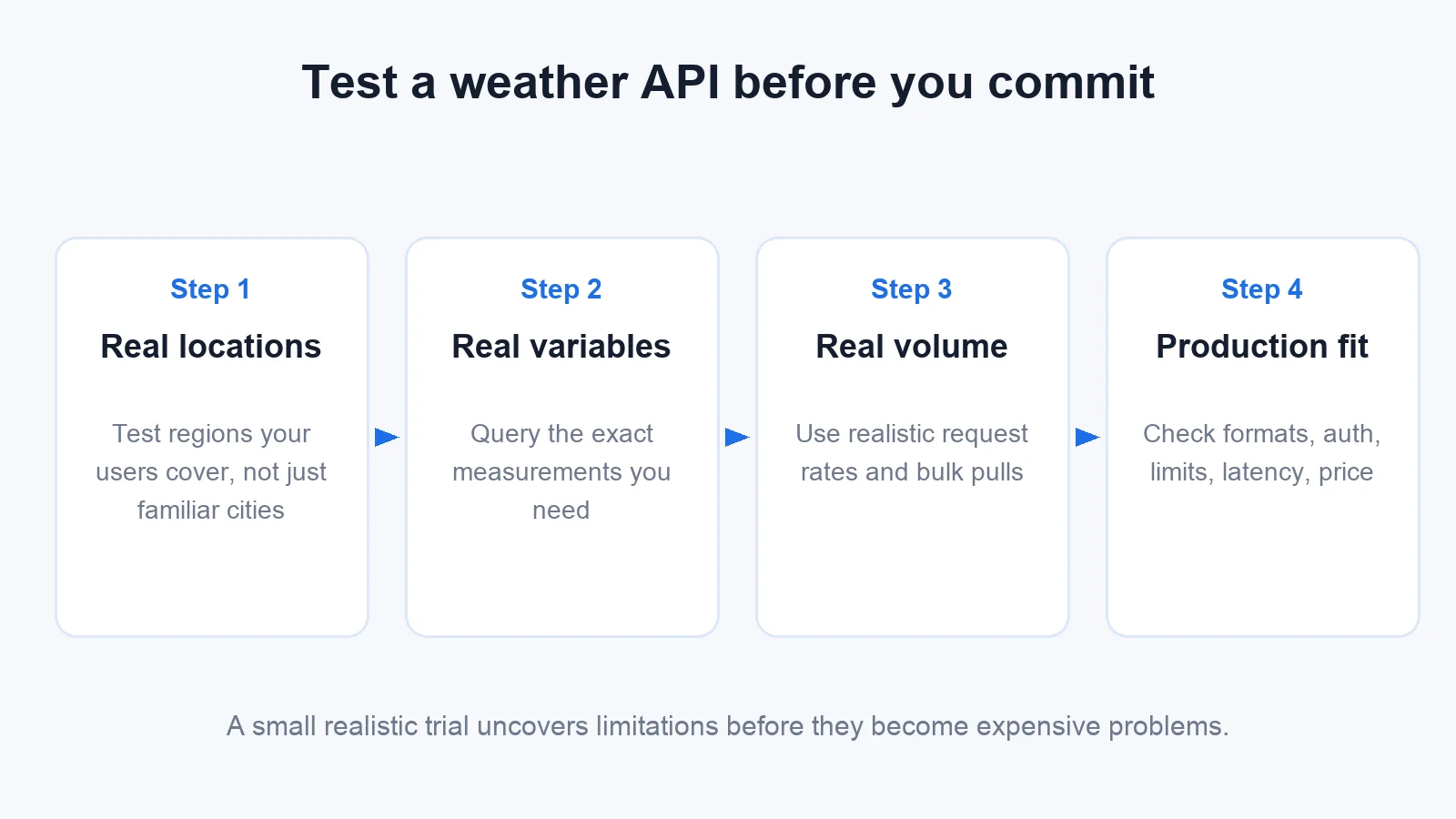
If your product covers a large number of locations, test more than one or two familiar cities. MIT research on validating spatial predictions found that common evaluation methods can give misleading results when their underlying assumptions break down across different locations. Running tests across regions that reflect your real use case can give you a more useful picture than relying on a broad accuracy claim.
The technical details matter just as much. Response formats, authentication, request limits, bulk access, latency, and pricing all affect how smoothly an API works in production. A small trial using realistic queries, locations, and traffic levels can uncover limitations before they become expensive problems.
Making the Final Choice
Weather APIs differ in historical depth, forecast range, geographic coverage, specialized datasets, pricing, and technical flexibility. Which differences matter most depends on the job the data needs to do.
A straightforward app may value clear documentation and predictable pricing more. Analytics or automation work may depend more heavily on consistent historical records, bulk access, broad geographic coverage, or the ability to request the same variables over long periods.
The most useful comparison starts with real requirements. Test the locations your application will cover, use realistic request volumes, and query the variables you actually need. That will tell you far more about a service than a long feature list ever could.
Frequently Asked Questions
Which weather API has the longest historical record?
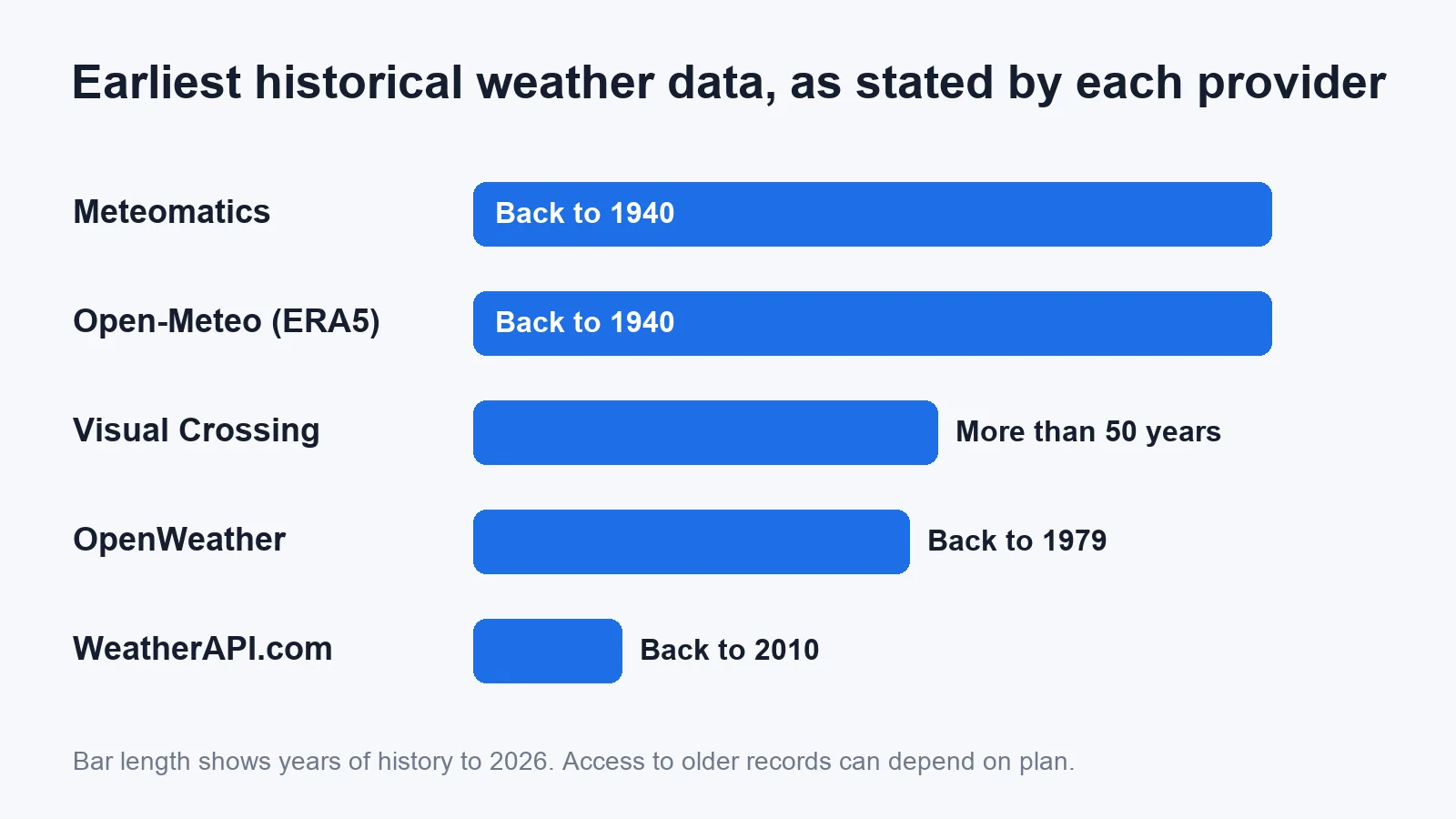
Of the seven covered here, Meteomatics and Open-Meteo both reach back to 1940, Visual Crossing covers more than 50 years, OpenWeather goes back to 1979, and WeatherAPI.com offers history from January 2010 on qualifying plans.
Which weather API is best for automated alerts?
Tomorrow.io is built around operational use: teams can monitor predefined or custom weather conditions for specific locations and receive webhook notifications when an event occurs.
Can I get historical forecasts, not just historical observations?
Yes. Visual Crossing offers historical forecasts that show what was predicted at an earlier date, and Open-Meteo provides historical forecasts, archived model runs, and previous-run data for forecast verification and backtesting.
How should I test a weather API before choosing it?
Run a small trial with realistic queries, the locations your application will actually cover, and realistic traffic levels. Test across regions rather than one or two familiar cities, and check response formats, authentication, request limits, bulk access, latency, and pricing.