
ClarityCheck Reviews: Why Travelers Should Test Digital Tools Before They Need Them
Travel has a funny way of making simple digital tasks suddenly feel urgent.
At home, an unfamiliar phone number is easy to ignore. In another country, the same number could be your airport transfer, accommodation host, tour operator, rental company, restaurant reservation, or someone you arranged to meet earlier in the trip.
The same thing happens with apps.
Downloading a tool while sitting on your sofa is easy. Trying to understand it while your airport Wi-Fi keeps dropping, your battery is at 12%, and someone is waiting for an answer is a very different experience.
That is why one of the most useful additions to pre-trip planning has nothing to do with packing.
Before leaving, understand the digital tools you may actually rely on.
A discussion around ClarityCheck reviews is a good example of why this matters. The most interesting part of one user's experience was not a dramatic discovery. It was how quickly they understood what the service offered, how access worked, and what would happen next.
For travelers, that kind of predictability is worth more than it sounds.
The Best Time to Learn an App Is Before You Need It
Most of us prepare the physical side of a trip reasonably well.
We check passports.
We book accommodation.
We download boarding passes.
We figure out whether we need an adapter.
The digital side is often more improvised.
You arrive and discover the train company wants its own app. Your host sends instructions through a platform you barely use. The rental-car company calls from a local number. A payment app asks for verification at exactly the moment you are trying to buy something.
None of these situations is particularly difficult when you have time.
Travel removes the time.
A useful pre-trip habit is therefore to open important services at home and go far enough through the experience to understand the basics.
Can you log in?
Does your password manager work?
Is two-factor authentication going to a number you can still access abroad?
Where are your bookings stored?
What information does the app require?
What does the service actually provide?
It is less about preparing for disaster and more about removing unnecessary decisions from a day that will already contain plenty of them.
What ClarityCheck Reviews Say About a Clear Digital Experience
One Reddit discussion about ClarityCheck reviews came from an entrepreneur who decided to try the service personally.
What stood out to them was the onboarding.
They described a recognizable SaaS journey: creating an account, choosing access, entering payment information, seeing the recurring model explained, and receiving confirmation afterwards. Their broader takeaway was that clear onboarding and expectation-setting have become a major part of how people judge digital services.
That observation translates surprisingly well to travel.
The best travel tools are often the ones you barely have to think about once the trip begins.
You already understand the map app.
Your airline login works.
Your payment method is ready.
You know where to find a reservation.
And if you choose to use a lookup service such as ClarityCheck, you already know what information you can search and what sort of result the platform is designed to provide.
The learning happened before the journey.
Where ClarityCheck Can Fit Into Travel
ClarityCheck is not a travel app in the traditional sense.
It does not book flights, translate menus or tell you which platform your train leaves from.
Its role is more specific.
ClarityCheck provides lookup tools for phone numbers, email addresses, people, businesses and VINs using publicly available information and open sources. The service also states that its core lookup functionality is available internationally, although the amount of information available can vary by country and search type.
That can become relevant because travel creates a lot of temporary contacts.
Imagine arriving in a city and seeing an unfamiliar local number calling.
You are expecting:
-
a driver arranged through your accommodation;
-
a message from a walking-tour guide;
-
a call about a restaurant reservation;
-
a rental-company representative;
-
someone you met earlier in the trip.
Usually, the context already gives you a pretty good idea who it might be.
A phone lookup simply offers another way to add context when you want it.
The important part is understanding what the tool does before that moment arrives.
International Trips Create More Unfamiliar Numbers
At home, most important contacts eventually become familiar.
You recognise your doctor's number, your regular delivery service, local businesses and friends.
Travel resets that familiarity.
Almost everybody is new.
Different country codes appear.
Businesses may use mobile numbers rather than the central number on their website.
Accommodation hosts may communicate through WhatsApp.
Drivers can call from numbers you have never seen.
Even perfectly ordinary communication can look unfamiliar simply because you have crossed a border.
ClarityCheck says its reverse phone lookup supports international numbers across most jurisdictions when the full country code is included. Available results depend on what public information exists for the number.
For a traveler, the appeal is easy to understand.
Sometimes you do not need a complete profile.
You simply want a little more context before deciding what the unfamiliar contact relates to.
Think of Lookup as Context, Not Another Travel Chore
Nobody needs another twenty-step routine before answering their phone.
The point of digital preparation is to simplify travel, not create more work.
If you are expecting a hotel transfer and the driver messages with your name and booking details, you probably do not need to turn the interaction into a research project.
But travel occasionally produces contacts where the connection is less obvious.
Maybe you saved the tour company's name but not the guide's number.
Perhaps an accommodation manager is calling from a personal mobile.
Maybe you moved a conversation from a booking platform to email and later received a call from a number you do not recognise.
These are the situations where an additional lookup can be useful.
ClarityCheck's phone search may return publicly associated names, addresses, carrier details, email addresses or public profiles when those records are available. The company also makes clear that the information is based on public sources and is not real-time tracking.
That distinction makes the tool easier to understand.
It provides context around an identifier you already have.
The Digital Dry Run I’d Add to Any Travel Checklist
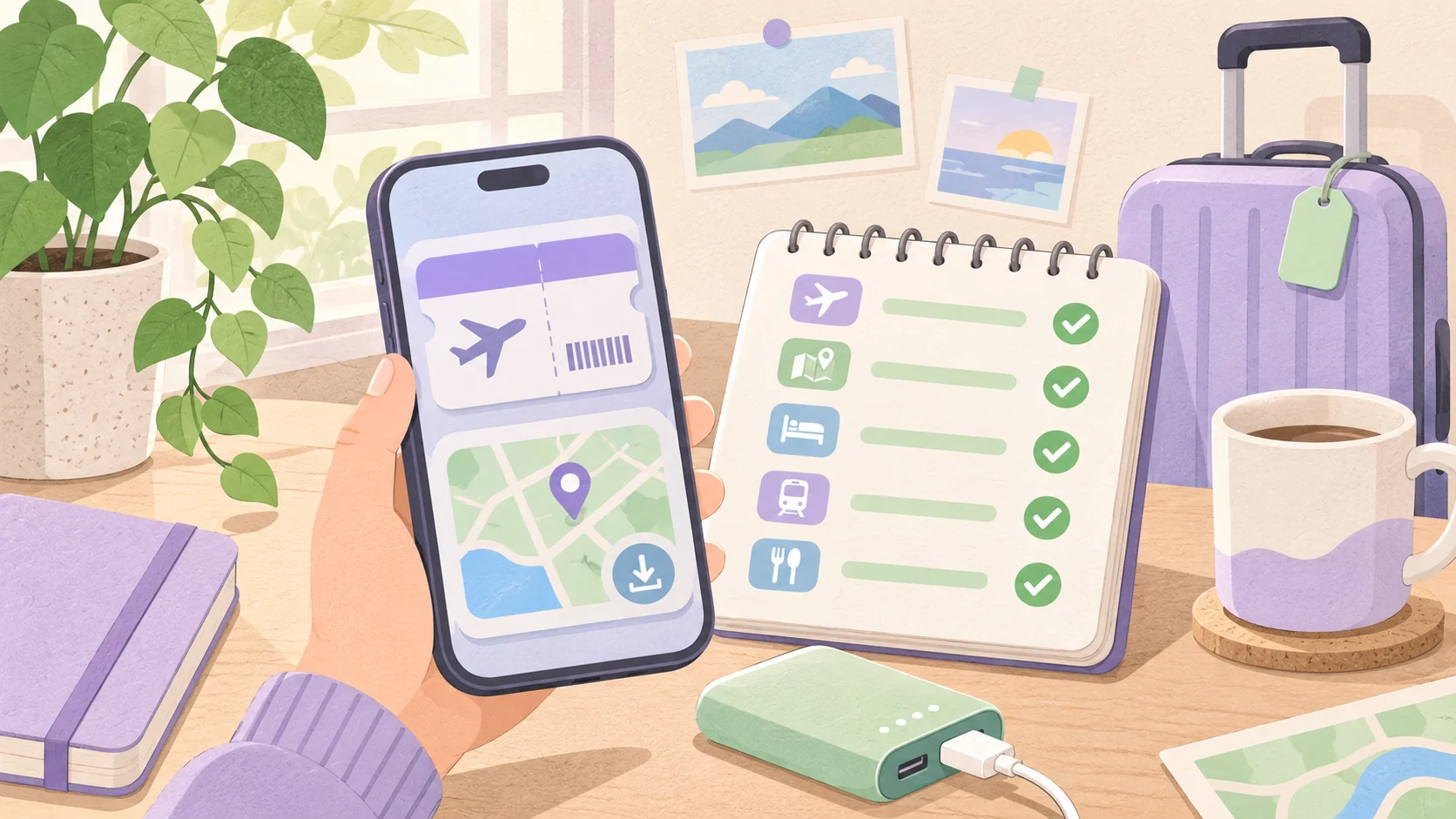
Illustration generated with AI.
The concept is simple: before leaving home, spend fifteen minutes checking the services you are most likely to use.
You do not need to simulate your entire holiday.
Just remove the obvious digital friction.
Open your booking apps
Make sure accommodation, flights and transport reservations actually appear when you are logged in.
Download anything you will need offline
Maps, tickets, itineraries, insurance documents and important addresses are much less stressful when they do not depend on a perfect connection.
Check your authentication methods
If a service sends login codes by SMS, make sure you will still have access to that number while abroad.
Understand your payment tools
Know which cards are connected and whether the service works in your destination.
Try unfamiliar services once
If you think a lookup, translation, transport or communication tool might be useful, open it before departure.
Know where things are.
Understand what it asks for.
See what the interface looks like.
That small amount of familiarity is often enough.
Good Travel Tech Disappears Into the Trip
The best travel technology rarely becomes the story of the holiday.
It quietly does its job.
Google Maps gets you back to your accommodation.
Your banking app confirms a purchase.
A translation tool helps with a menu.
Your airline app updates a gate.
A lookup tool provides context for an unfamiliar contact.
Then you put the phone away and continue with the actual trip.
This is one reason clear onboarding matters so much.
A service that requires constant interpretation keeps pulling attention back toward the screen.
A service you already understand becomes part of the background.
The Reddit discussion around ClarityCheck is useful here because the writer's takeaway was essentially about predictability: once they went through the product themselves, the structure of the service was straightforward.
For travelers, predictable is good.
There is already enough unpredictability outside the phone.
You Probably Don’t Need as Many Travel Apps as You Think
It is easy to go too far with digital preparation.
There are apps for packing.
Apps for itineraries.
Apps for exchange rates.
Apps for finding bathrooms.
Apps for counting countries.
Apps for storing places you may never visit.
Soon, preparing the phone starts taking longer than preparing the suitcase.
The World on My Necklace has already explored how dependent modern travel has become on apps, with smartphones now handling everything from reservations and navigation to payments and translation.
The goal should not be to add another tool for every possible situation.
It should be to understand the small number you might genuinely use.
If ClarityCheck is one of them, know why.
Perhaps you travel frequently and receive international calls.
Perhaps much of your accommodation or transport coordination happens with people you have never contacted before.
Perhaps you simply prefer having a way to get additional context when a number or email does not immediately look familiar.
If none of those situations applies, you may never need it.
A useful tool does not need to become a daily habit.
ClarityCheck Reviews and a Better Way to Choose Travel Tools
Reading ClarityCheck reviews — or reviews of any digital service — is most useful when you know what you are looking for.
A five-star rating by itself tells you very little.
For travel, I would pay more attention to practical questions:
Is the service understandable when you first open it?
Does it clearly explain what it can do?
Is the process predictable?
Can you use the core features internationally?
Will you know what to do when you actually need it?
Those questions are less exciting than discovering the “ultimate travel app.”
They are much more useful once you are on the road.
Travel technology works best when it removes little bits of uncertainty without demanding much attention in return.
That is the useful lesson behind the ClarityCheck discussion as well.
You do not want to figure out an unfamiliar digital product while tired, disconnected and trying to solve something quickly.
Try it when nothing is urgent.
Understand what it does.
Then, if the moment comes when you actually need it, the tool is already familiar.
That is one less thing to work out while the rest of the trip is happening around you.