
The Architecture of Thinking: Why Your Digital Workspace Should Reflect How Your Mind Works
A well-designed digital workspace has something in common with a well-organized human mind: both need structure without sacrificing creativity.
When people work on complex projects, they rarely think in a perfectly linear sequence. An initial observation leads to a question, the question generates several possible explanations, and those explanations eventually become a plan, diagram, or finished document. Ideas move between different formats before they become something useful.
This is one reason modern productivity environments are evolving beyond traditional document editors. Platforms combining documents, visual whiteboards, databases, and AI-assisted features reflect a more flexible understanding of how knowledge is created.
But there is another dimension to intellectual productivity that deserves attention: the cognitive abilities behind the work itself. Understanding how we reason, recognize patterns, and process information can be just as important as choosing the right digital tools. This is where online cognitive assessments, including MyIQ, enter the conversation.
Your Workspace Is an Extension of Your Thinking Process
Traditional productivity software often assumes that information should follow a predefined structure. Documents contain paragraphs, spreadsheets contain rows, and presentations contain slides.
Real thinking is rarely so predictable.
A designer might begin with a visual sketch, transform it into a collection of references, and eventually organize the results into a structured project plan. A researcher might start with disconnected notes before discovering relationships that suggest an entirely new direction.
Modern knowledge management tools respond to this reality by allowing information to move between different representations.
Three formats are particularly valuable:
-
Documents provide space for detailed explanations, research, and structured arguments.
-
Whiteboards make relationships, concepts, and creative connections visible.
-
Databases help organize information that needs to be compared, filtered, or revisited.
An integrated environment reduces the friction involved in switching between these formats. Instead of treating every idea as a separate file, users can build a connected system of knowledge.
The Missing Variable in Productivity: Cognitive Awareness
Even the most sophisticated workspace cannot compensate for every limitation in the thinking process.
Someone may have access to excellent note-taking software, powerful AI assistants, and advanced organizational systems but still struggle to evaluate information or recognize logical inconsistencies.
This raises an interesting question: how well do we understand our own cognitive strengths?
Cognitive awareness involves recognizing how we approach problems, process information, and respond to unfamiliar challenges. It does not mean reducing intelligence to a single number. Rather, it means becoming more conscious of the mental processes involved in learning and decision-making.
What IQ Testing Can Tell Us
IQ assessments generally examine selected cognitive abilities, such as logical reasoning, pattern recognition, verbal comprehension, and numerical problem-solving.
Online testing has made these experiences more accessible to people who want to explore their intellectual performance.
One example is MyIQ, a platform offering online IQ testing and opportunities to engage in mental exercises. Its approach provides an accessible starting point for people interested in understanding selected aspects of their cognitive abilities.
For someone building a personal knowledge system, this can introduce another layer of self-reflection: which kinds of intellectual challenges feel natural, and which require more deliberate practice?
It is important to distinguish online IQ results from professional psychological assessments. An online score does not necessarily represent a clinically validated measurement of intelligence, and no single test captures every aspect of human cognitive ability.
MyIQ and the Question of Measuring Human Intelligence
The popularity of online IQ tests reflects a broader interest in understanding how the mind works.
However, the interpretation of intelligence scores remains a subject of discussion. A Reddit conversation exploring whether a MyIQ score represents a genuine measure of intelligence illustrates why users should look beyond the number itself.
The discussion, available through this MyIQ thread, raises a relevant question about the relationship between online assessments and broader cognitive ability.
This distinction matters.
A score may provide information about performance on a particular set of tasks, but it cannot fully describe creativity, emotional intelligence, practical judgment, adaptability, or professional expertise.
The most constructive way to approach an online assessment is to use it as a starting point for curiosity rather than a final verdict on intellectual potential.
Combining Cognitive Exercises with a Structured Knowledge System
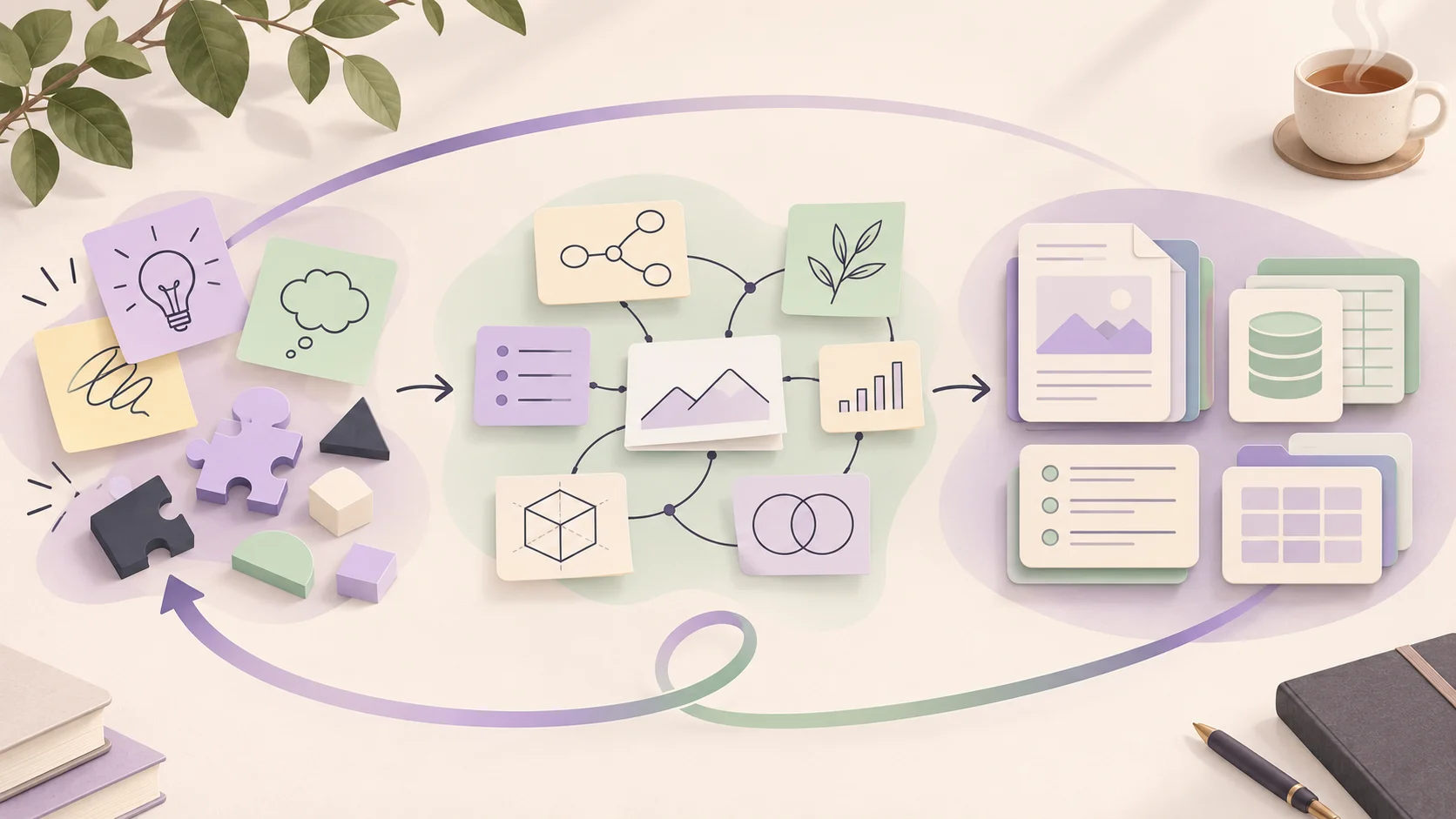
Illustration generated with AI.
An interesting experiment is to connect mental training with everyday knowledge management.
Instead of completing an online assessment and forgetting the experience, users can build a small personal development system around the skills they want to explore.
A flexible workspace makes this process easier.
For example, someone interested in logical reasoning could collect challenging problems in a database, use a whiteboard to visualize possible solutions, and document what they learned after completing each exercise.
An integrated workspace such as AFFiNE reflects this approach through its combination of documents, whiteboards, databases, and optional AI capabilities. Its local-first philosophy also offers an interesting perspective on personal knowledge management, particularly for users who value control over their working environment.
The objective is not to turn every intellectual activity into a complicated productivity project. It is to make useful observations easier to preserve and revisit.
Five Habits for Building a More Intelligent Workflow
Technology becomes more valuable when it supports deliberate habits rather than replacing independent thought.
Consider incorporating these practices into a regular routine:
-
Think before searching. Write down your initial explanation of a problem before consulting AI or external resources.
-
Visualize complicated ideas. Use diagrams and whiteboards to identify relationships that may be difficult to see in paragraphs.
-
Challenge your assumptions. Ask what evidence would contradict your current interpretation.
-
Practice unfamiliar tasks. Explore puzzles, numerical challenges, and reasoning exercises outside your professional comfort zone.
-
Review previous thinking. Revisit old notes to identify how your understanding has changed.
MyIQ can complement these habits by introducing structured cognitive challenges, while a connected workspace can help preserve insights and make progress easier to review.
Why the Future of Productivity Is Both Human and Digital
The next generation of productivity tools will likely become increasingly intelligent, interconnected, and adaptable. AI can help organize information, generate alternative explanations, and accelerate routine tasks.
Yet the quality of the final result will continue to depend heavily on the person using those capabilities.
A sophisticated workspace cannot decide which questions are worth asking. An AI assistant cannot replace independent judgment. And an IQ score cannot define the full range of someone's intellectual potential.
The real opportunity lies in combining these elements thoughtfully.
MyIQ represents one approach to exploring cognitive performance, while integrated knowledge environments demonstrate how digital tools can support the organization and development of ideas.
Ultimately, productive thinking requires more than collecting information. It requires curiosity, reflection, experimentation, and the willingness to reconsider what we believe. The best digital workspace is therefore not simply a place where work gets stored. It is an environment that helps better thinking happen.