
D&D Character Sheet: 2024 & 2014 PDFs and How to Fill One
A D&D character sheet is where you record everything you need to play your character: class and origin, ability scores, proficiencies, hit points, Armor Class, attacks, equipment, and story. To fill one out with the 2024 rules, choose a class, then a background and species, assign ability scores, and only then work out the numbers you roll at the table. If your group still plays the 2014 rules, use the 2014 sheet and character options, and don't mix the two rule sets unless your Dungeon Master (DM) agrees.
Jump to: which sheet to download · what each area is for · fill a level 1 sheet · worked Fighter example · 2014 vs. 2024 · after each session
Updated October 3, 2026. Rules and download details were checked against the official D&D Beyond Basic Rules and character-sheet page linked throughout. The level 1 Fighter is a worked calculation, not a character from a real campaign, and your DM has the final say on house rules. AFFiNE publishes this guide; it is not a D&D character builder and does not calculate game statistics.
Which official D&D character sheet should you download?
Start with D&D Beyond's official character sheets page. The two files most players want are easy to confuse, because the one labeled "fillable" is not the 2024 sheet:
| Download | What it is | Use it when |
|---|---|---|
| 2024 Character Sheet | Two-page PDF in the 2024 layout, with fields for Species, Subclass, Feats, and Heroic Inspiration | You play the 2024 rules and will print the sheet and write on it |
| Fillable Character Sheet | Three-page PDF with typeable fields, in the 2014 layout (Race, Inspiration, Personality Traits, Ideals, Bonds, Flaws) | You play the 2014 rules and want to type into a PDF |
When we checked the files on October 3, 2026, the 2024 PDF had no form fields, so you can't type into it in a PDF reader. The same page also links Fifth Edition sheet packs, premade characters from the Starter Set, Adventurers League sheets, and fillable sheets in Spanish, French, German, and Italian.
If you would rather type a 2024 character, D&D Beyond's character builder walks you through creation and produces a digital sheet that does the math for you. Our guide to digital D&D character tools compares online options in more detail.
Whatever format you choose, pick the sheet that matches your campaign's rules, not the newest-looking one. A 2024 layout won't update a 2014 character, and the 2014 fillable sheet lumps feats and racial traits into a general Features & Traits box. Long-form material such as backstory, NPC names, and session notes can live in a separate notes page, for example in AFFiNE, while the sheet or builder stays the record of your character's numbers.
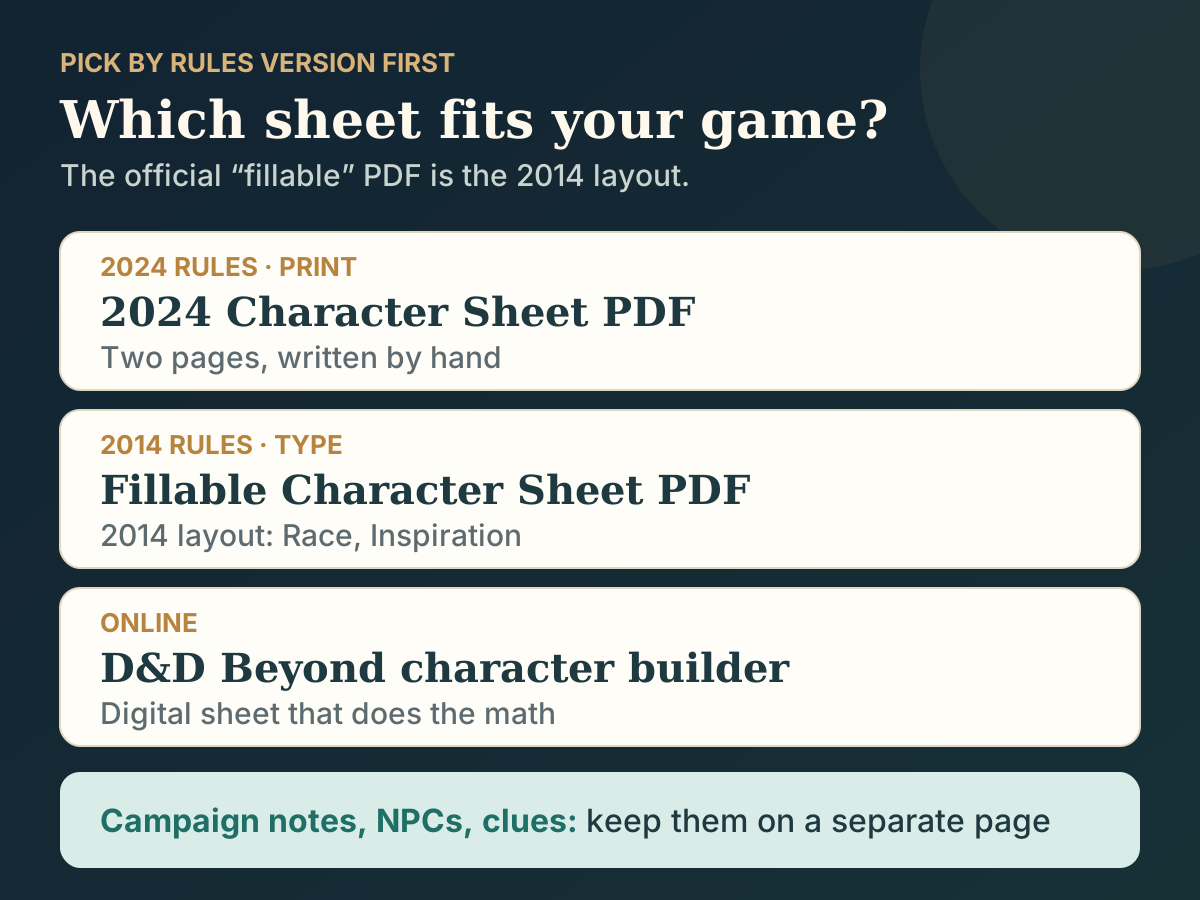
Choose the sheet by rules version first, then by format. Campaign notes belong on a separate page.
D&D character sheet anatomy: four areas to read first
Layouts differ, but most sheets group the same information into four practical areas:
- Identity and choices: character name, class and level, background, species (or race on a 2014 sheet), and subclass once you have one. These explain where the numbers come from.
- Ability and skill checks: the six ability scores and their modifiers, saving throws, skills, and your proficiency bonus.
- At-the-table combat: Armor Class (AC), hit points (HP), Hit Dice, initiative, speed, attacks, and death saves.
- Longer-term record: class features, feats, equipment, coins, languages, spells, and personality. On the 2024 sheet, spellcasting, backstory, appearance, languages, and coins are on page 2.
When a number looks wrong, ask two questions: what grants this value, and when does it change? An ability modifier comes from its score. A proficient skill adds your proficiency bonus. Current HP changes during play, while maximum HP changes when you level up or your Constitution modifier changes.
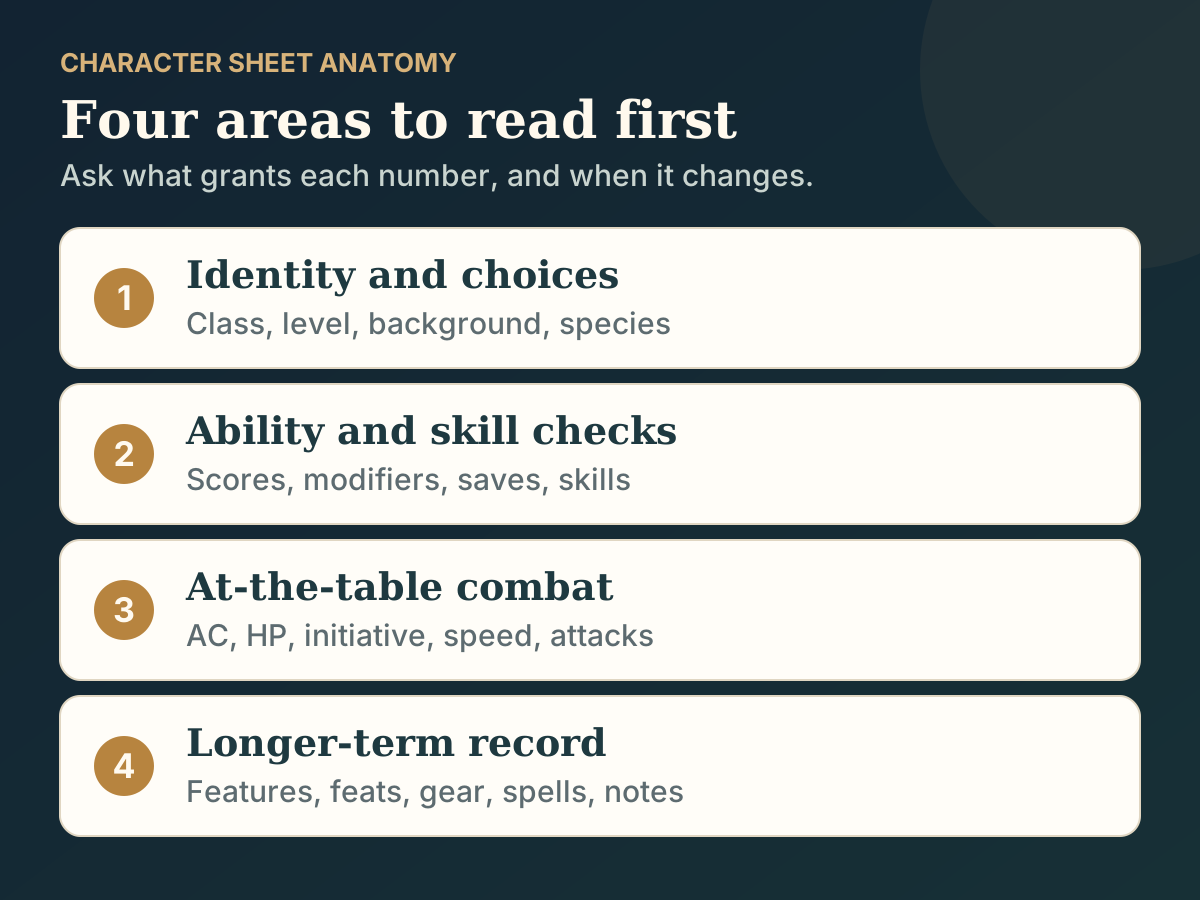
An original diagram of the four areas, not a copy of an official sheet layout.
How to fill out a level 1 D&D character sheet (2024 rules)
The Creating a Character chapter of the D&D Beyond Basic Rules has five steps: choose a class, determine your origin, determine ability scores, choose an alignment, and fill in the details. The seven steps below follow the same rules in the order you'll write them on a sheet. Check first which books and house rules your DM allows.
1. Choose a class and write your level
Write your class and level 1, with 0 XP. Your class sets your Hit Point Die, saving throw proficiencies, skill choices, weapon proficiencies, armor training, and starting equipment. If your DM starts the group at level 3 or higher, also write your subclass.
2. Record your background, species, and languages
A 2024 background lists three abilities you can increase, an Origin feat, two skill proficiencies, one tool proficiency, and starting equipment. Your species sets your size, speed, and species traits. You know Common plus two languages from the Standard Languages table. Note where each benefit comes from: "Athletics (Soldier background)" is easier to check later than an unexplained mark.
3. Assign ability scores, then apply your background increases
Generate six scores with the method your DM prefers: the standard array (15, 14, 13, 12, 10, 8), rolling four six-sided dice and keeping the highest three, or spending 27 points. Assign them to Strength, Dexterity, Constitution, Intelligence, Wisdom, and Charisma. Then apply your background: increase one of its three listed abilities by 2 and another by 1, or increase all three by 1. No increase can raise a score above 20. Finally, write each modifier: 10–11 is +0, 12–13 is +1, 14–15 is +2, 16–17 is +3, and 8–9 is −1.
4. Mark proficiencies and your proficiency bonus
Your proficiency bonus is +2 at level 1. For each skill or saving throw you are proficient in, write the ability modifier plus +2. For the rest, write the ability modifier alone. Your class gives proficiency in two saving throws, and your class and background together supply your skills, tools, weapons, and armor training. A high ability score never grants proficiency on its own.
5. Fill in hit points, defenses, and attacks
Your class and Constitution modifier set your hit points, your Dexterity modifier sets initiative, and your armor sets your Armor Class. Use these level 1 formulas from the Basic Rules:
| Sheet field | How to calculate it at level 1 |
|---|---|
| Hit point maximum | Class base + Constitution modifier. Barbarian 12; Fighter, Paladin, or Ranger 10; Bard, Cleric, Druid, Monk, Rogue, or Warlock 8; Sorcerer or Wizard 6 |
| Hit Dice | One die of your class's type, such as 1d10 for a Fighter |
| Initiative | Dexterity modifier |
| Armor Class | 10 + Dexterity modifier with no armor or shield; otherwise use the armor's rules |
| Weapon attack bonus | Strength modifier + proficiency bonus for melee weapons; Dexterity modifier + proficiency bonus for ranged weapons, unless a weapon property says otherwise |
| Weapon damage | Weapon damage dice + the same ability modifier you used to attack. Proficiency bonus is not added |
| Spell save DC | 8 + spellcasting ability modifier + proficiency bonus |
| Spell attack bonus | Spellcasting ability modifier + proficiency bonus |
| Passive Perception | 10 + your Wisdom (Perception) check modifier |
6. Add features, feats, equipment, and spells
Write your level 1 class features and make any choices they offer. Record your background's Origin feat and any feat your class grants. Note limited-use features in a way you can tick off during play. Record your starting equipment and coins. If your class casts spells, add your cantrips, prepared spells, and spell slots. Leave the spell fields empty if your class doesn't cast spells.
7. Run a one-minute check before play
Can someone else read your class, background, species, and level at a glance? Does each modifier match its final score? Does every proficient skill name its source? Do AC, maximum HP, initiative, speed, and your main attack all have numbers? If a rule interaction is unclear, write it down as a question for your DM instead of guessing.
Worked example: a level 1 Fighter with the Soldier background
This is a complete set of level 1 numbers you can check line by line. It uses the 2024 Basic Rules and the standard array, placed the way the Basic Rules suggest for a Fighter: Strength 15, Dexterity 14, Constitution 13, Intelligence 8, Wisdom 10, Charisma 12. The Soldier background can increase Strength, Dexterity, or Constitution; this example adds +1 to Strength and +2 to Constitution. Species is left open, so speed isn't filled in.
| Field | Value | Source |
|---|---|---|
| Ability scores | STR 16 (+3), DEX 14 (+2), CON 15 (+2), INT 8 (−1), WIS 10 (+0), CHA 12 (+1) | Standard array plus Soldier increases |
| Proficiency bonus | +2 | Level 1 |
| Saving throws | Strength +5, Constitution +4; others equal their modifier | Fighter is proficient in Strength and Constitution saves |
| Skills | Athletics +5, Intimidation +3, Perception +2, Survival +2 | Soldier grants Athletics and Intimidation; Perception and Survival are this example's two Fighter picks |
| Passive Perception | 12 | 10 + Perception modifier of +2 |
| Hit points | 12 maximum; Hit Dice 1d10 | Fighter 10 + Constitution modifier of +2 |
| Initiative | +2 | Dexterity modifier |
| Armor Class | 17 | Chain Mail 16, plus 1 from the Defense fighting style feat while wearing armor |
| Greatsword | +5 to hit; 2d6 + 3 slashing | Strength +3 and proficiency +2 to hit; damage adds Strength only |
| Feats and features | Savage Attacker; Defense; Fighting Style, Second Wind, Weapon Mastery | Soldier background; Fighter level 1 |
The equipment comes from the Fighter's starting option A (Chain Mail, Greatsword, Flail, 8 Javelins, Dungeoneer's Pack, and 4 GP). Chain Mail needs a Strength of 13, which this character meets. Choosing +2 Strength and +1 Constitution instead (Strength 17, Constitution 14) gives the same modifiers at level 1. The odd Strength score only matters later, when a +1 increase would raise it to 18.
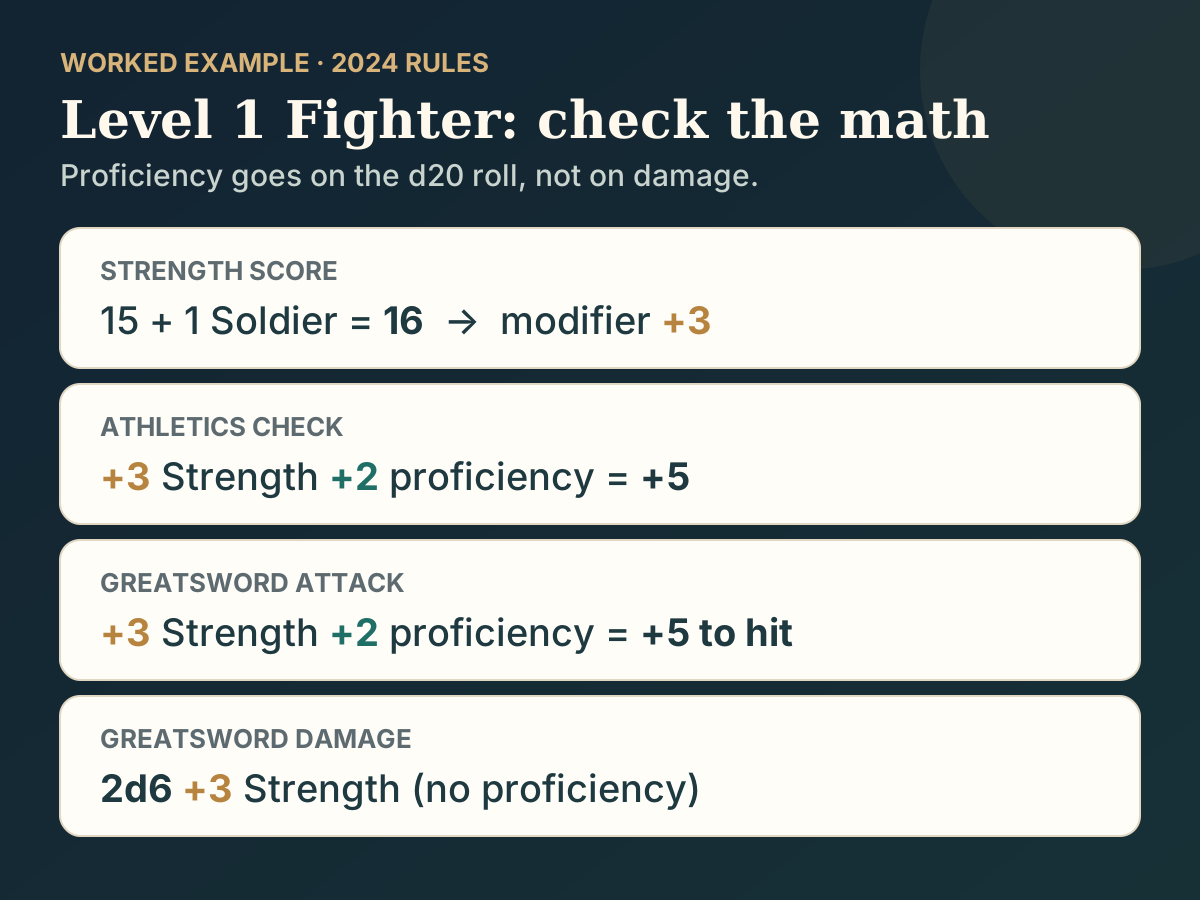
The same +3 Strength modifier appears in the attack and the damage. The +2 proficiency bonus goes only on the d20 roll.
Three mistakes this example catches:
- Adding proficiency to damage. The Greatsword deals 2d6 + 3, not 2d6 + 5. Proficiency applies to d20 tests (attack rolls, ability checks, and saving throws), not to damage rolls.
- Stacking 2014 and 2024 ability increases. If your DM allows a species from an older book, ignore that species' ability score increases and use only your background's.
- Marking proficiency everywhere. This Fighter is proficient in Athletics but not Acrobatics, so an Acrobatics check is just +2 from Dexterity.
2014 vs. 2024 D&D character sheets: what changed?
The two rule sets ask for different choices, and the official sheets label some fields differently:
| Check | 2014 | 2024 |
|---|---|---|
| Ability score increases | From your race | From your background |
| Background grants | Two skills, a feature, sometimes languages or tools | Two skills, one tool, an Origin feat |
| Key sheet labels | Race, Inspiration | Species, Heroic Inspiration |
| Official fillable PDF | Yes | Not offered as of October 3, 2026 |
The sheets differ in other places too. The 2014 sheet has boxes for Personality Traits, Ideals, Bonds, and Flaws, while the 2024 sheet adds fields for Feats, Species Traits, Size, and Armor Training.
Using older options in a 2024 game. The 2024 Basic Rules include a short conversion rule. Backgrounds from older books have no ability score increases, so you increase one score by 2 and another by 1, or three scores by 1. If an older background doesn't provide a feat, you gain an Origin feat of your choice. Species from older books list ability score increases; ignore them and use only the increases from your background. Your DM still decides which older books are allowed.
Characters on D&D Beyond. In its ruleset changelog update of August 26, 2024, D&D Beyond said that players who only have the 2014 Player's Handbook keep their character options, and that existing digital sheets would only be relabeled, for example from Races to Species and from Inspiration to Heroic Inspiration. A relabeled sheet therefore doesn't mean the character was converted to the 2024 rules.
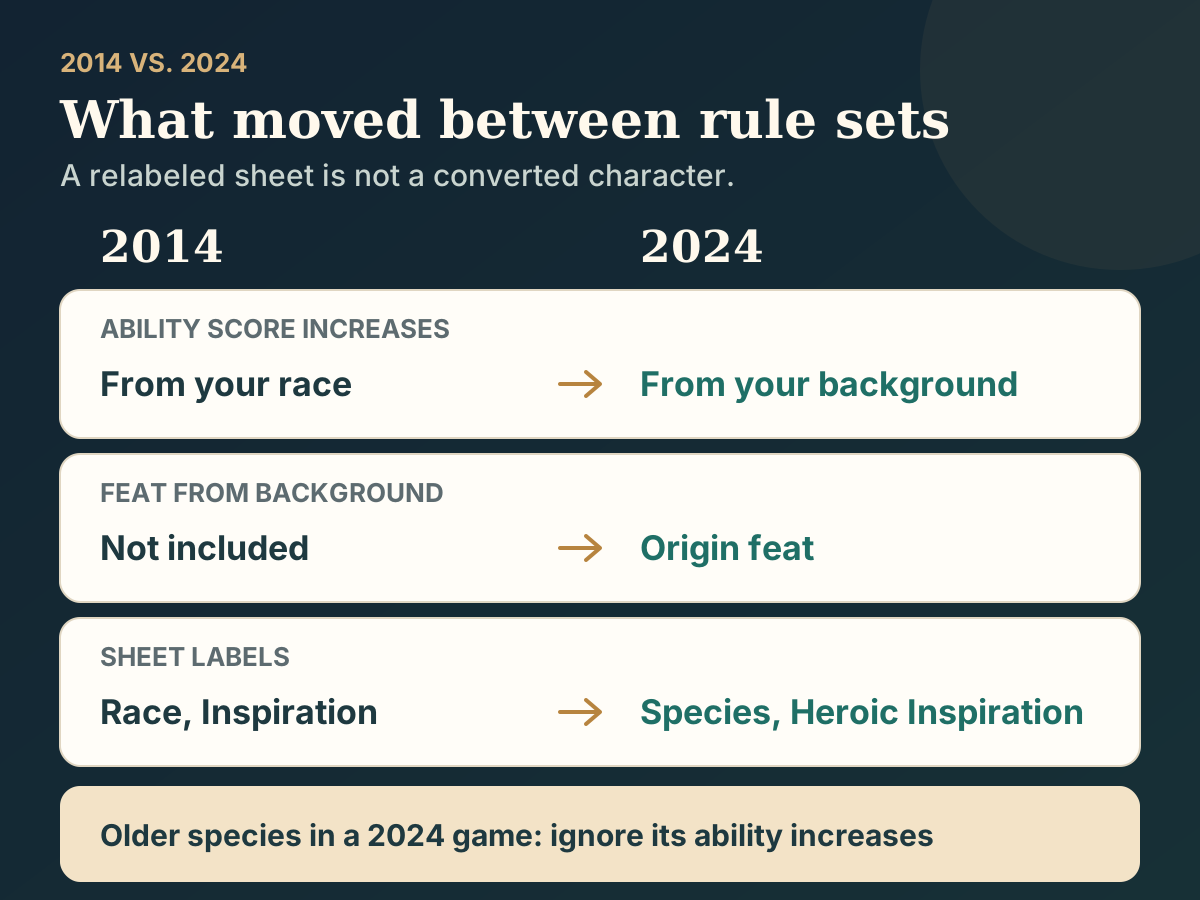
The labels changed, and so did where ability score increases come from.
Keep the sheet usable between sessions
After each session, update current HP, temporary HP, spent Hit Dice, uses of limited features such as a Fighter's Second Wind, spell slots, equipment, coins, and XP.
When you level up, add one Hit Die and increase your HP maximum: roll that die and add your Constitution modifier, or take the fixed value (6 + Constitution modifier for a Fighter). Add your new class features. At level 5, your proficiency bonus becomes +3, so update every skill, save, attack, and spell number that includes it. If an ability score rises to an even number, its modifier goes up, so update every number that uses that modifier. If your Constitution modifier rises by 1, your HP maximum rises by 1 for each level you have.
Keep longer context on a separate page: party goals, NPC names, unresolved clues, loot to identify, and one open question for your DM. AFFiNE can hold that page alongside the rest of your campaign notes, and you can learn how to use a template to reuse the same page structure each session. AFFiNE doesn't offer a D&D character sheet template or calculate game statistics, so keep your official sheet or character builder as the record of your numbers.
Frequently asked questions
Where can I get a free official D&D character sheet?
D&D Beyond's official character sheets page links free PDFs, including the 2024 Character Sheet and a Fillable Character Sheet in the 2014 layout. It also links premade characters and fillable sheets in Spanish, French, German, and Italian.
Is there a fillable 2024 D&D character sheet?
Not on the official character sheets page when we checked on October 3, 2026. The 2024 Character Sheet PDF had no form fields, and the Fillable Character Sheet uses the 2014 layout. To type a 2024 character, use D&D Beyond's character builder, or print the 2024 PDF and fill it in by hand.
Can I use a 2014 character on a 2024 sheet?
You can write a 2014 character on a 2024 layout, but changing the sheet doesn't convert the character. Ask your DM which rules apply. If you are moving to the 2024 rules, rework ability score increases through your background and ignore any older species' increases.
What is the most common mistake on a new character sheet?
Adding the proficiency bonus where it doesn't belong. Proficiency applies to d20 rolls you are proficient in, such as weapon attacks, proficient skills, and proficient saving throws. It isn't added to weapon damage unless a specific feature says so.
Does AFFiNE calculate D&D stats or replace a fillable character sheet?
No. Use an official sheet or character builder for the rules and calculations. AFFiNE is useful for campaign notes, session logs, NPC lists, and longer backstory kept next to your sheet.
Sources
Rules, sheet contents, and download details were checked on October 3, 2026, against these official D&D Beyond pages and files: Creating a Character, Character Origins, Character Classes (Fighter), Equipment, Feats, and the Rules Glossary in the 2024 Basic Rules; Step-by-Step Characters in the 2014 Basic Rules; the character sheets page and the two PDFs it links; and the ruleset changelog update. The diagrams and the Fighter example are original. Downloads and builder options can change, so for a real character, use the sources your campaign has agreed on and your DM's rulings.

