
Free Lease Agreement Template: Downloads & Review Checklist
A free lease agreement template gives you a starting document for recording rent, the rental term, responsibilities and other agreed conditions. Choose a form for the property's location and the type of tenancy before filling it in. A generic download does not establish that its clauses are valid for your situation.
Start here: browse state and tenancy options at eForms, get PDF or Word samples from OpenDocs, or download our printable lease-review worksheet. The worksheet helps you review a lease; it is not a rental contract.
This guide focuses on U.S. residential rentals. It provides document-preparation information, not legal advice or a legal review of your lease. State, local and property-specific requirements can affect the form you need. Use the official resources below when checking a draft, and get qualified local help for a disputed or unclear clause.
Where to get a free lease agreement template
Look for two separate things: a document you can actually obtain, and guidance for the place where the property is located. A download button answers the first question, not the second.
We checked the public pages and sample-file access on October 7, 2026. The table distinguishes files we opened from formats merely advertised on a page. We did not test paid builders, signing services or the legal suitability of these forms.
| Resource | What we could verify | What to check before using it |
|---|---|---|
| eForms rental agreements | State and tenancy-type links; its standard residential PDF opened publicly. Word and ODT links are also listed, but were not verified in this check. | Pick the relevant state/type. Do not assume an online builder has the same access conditions as a sample PDF. |
| OpenDocs lease agreements | The standard residential PDF and Word file both downloaded without an account or payment in our check. The page also lists state options. | Read the actual file and check local requirements; a state's name or an old file path does not tell you whether every clause is current. |
| LawVault residential lease | The blank PDF and Word file both downloaded publicly. The page separates the generic form from a guided state-specific version. | The blank version is described as excluding state-specific clauses/disclosures. We did not test the guided version. |
| FreeForms lease agreements | The residential PDF opened publicly; the page lists Word, state and tenancy-type options. | Word access and the separate document-creation service were not verified. |
For an editable sample, OpenDocs provides a Word file and a PDF file. These are third-party documents, not AFFiNE-authored or AFFiNE-approved contracts. Recheck access conditions and the current source page before relying on a saved copy.
What “free” means here: access to the particular blank file we checked. It does not mean that customization, legal review, electronic signing or every service on that website is free. Check the final download/export step before entering personal information or starting a trial.
Choose the right residential lease type
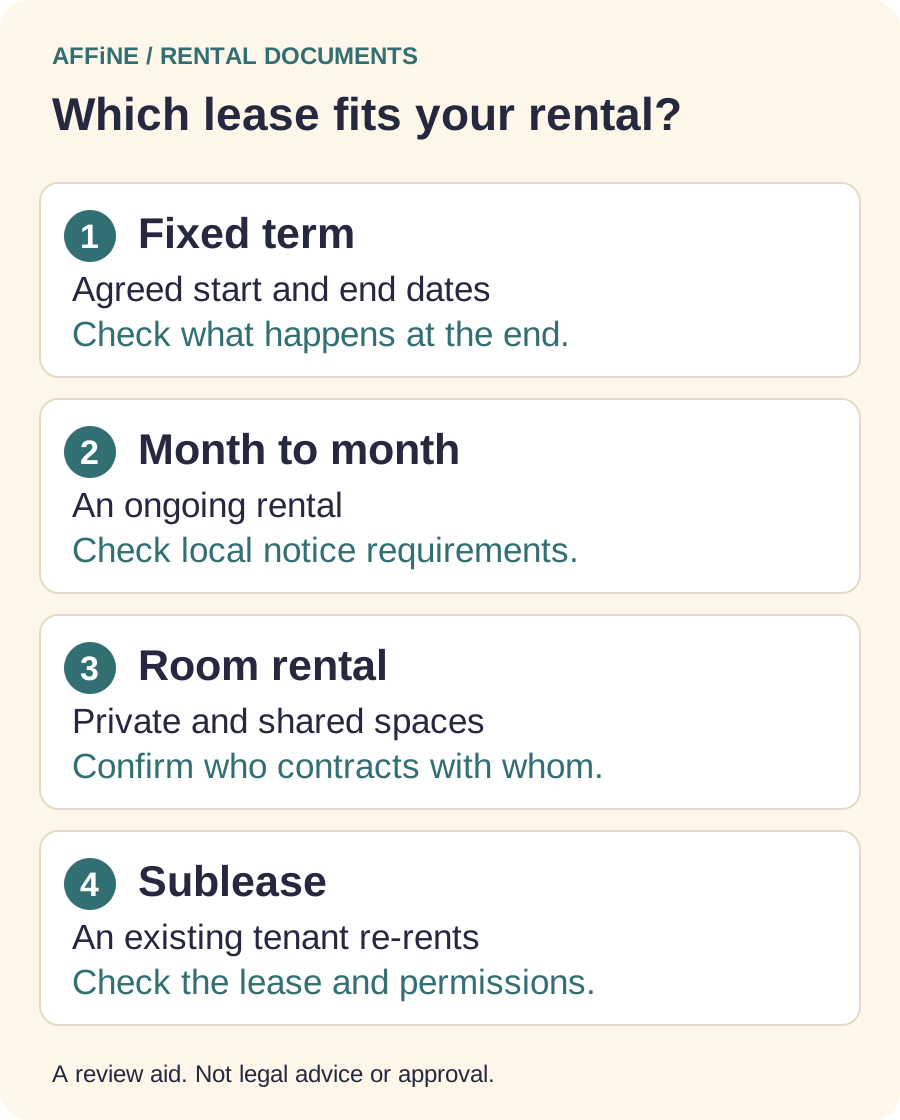
“Simple” and “basic” describe how a provider presents a form; they are not dependable legal categories. Choose by the actual arrangement instead of by the shortest document.
| Your situation | Starting point | Question to resolve |
|---|---|---|
| A home or apartment for an agreed start and end date | Fixed-term residential lease | What happens at the end: departure, renewal or a different tenancy arrangement? |
| An ongoing rental without a fixed end date | Month-to-month agreement | What local rules govern notices, changes and termination? |
| Renting one room, with shared facilities | Room-rental agreement appropriate to the arrangement | Which spaces are private/shared, and who has the agreement with the landlord? |
| An existing tenant wants someone else to occupy all or part of the home | Sublease documentation | What do the original lease and applicable rules require, including any permission? |
A roommate agreement about shared bills is not automatically a substitute for the lease with the property owner. Likewise, a vacation rental, commercial premises or vehicle lease needs a different starting point. For a business property, see the separate commercial real estate lease template; do not adapt a residential form just by changing its title.
What to fill in, and what to verify
Separate facts about the rental from rules that need checking. You can confirm the apartment number with the parties. You should not invent a deposit-return deadline to fill an empty box.
| Section | Information to gather | Review before finalizing |
|---|---|---|
| Parties and property | Full names, property address, unit, landlord/agent contact and occupants | Correct parties, authority to rent the property, and which rooms, storage or parking are included |
| Term and possession | Start/end dates, move-in arrangements and any separate early-access period | Renewal, holdover and notice wording; distinguish access date from the rent period |
| Rent and other charges | Rent, due date, payment instructions and a list of other charges | Local limits or conditions affecting fees, payment and rent changes |
| Security deposit | Proposed amount, receipt and relevant handling details | Applicable limits, deductions, handling and return requirements |
| Utilities and maintenance | Who arranges/pays each service; where to report a repair | Ambiguous shared bills, conflicting responsibilities and applicable repair obligations |
| Entry, use and house rules | Entry process, shared areas, parking, smoking and pet terms | Local entry rules and any relevant fair-housing or accommodation requirements |
| Ending the tenancy | Renewal, early-exit and notice provisions | Applicable law and delivery requirements; do not copy a notice period from another state |
| Attachments and signatures | Listed addenda, disclosures, condition record and signature/date fields | Correct versions, required delivery/signing steps, and a complete copy for each party |
If a field is unresolved, put the question on a separate review list. A blank space is not an invitation to guess, and deleting a difficult clause is not a substitute for checking it.
A worked example: turn vague terms into specific questions
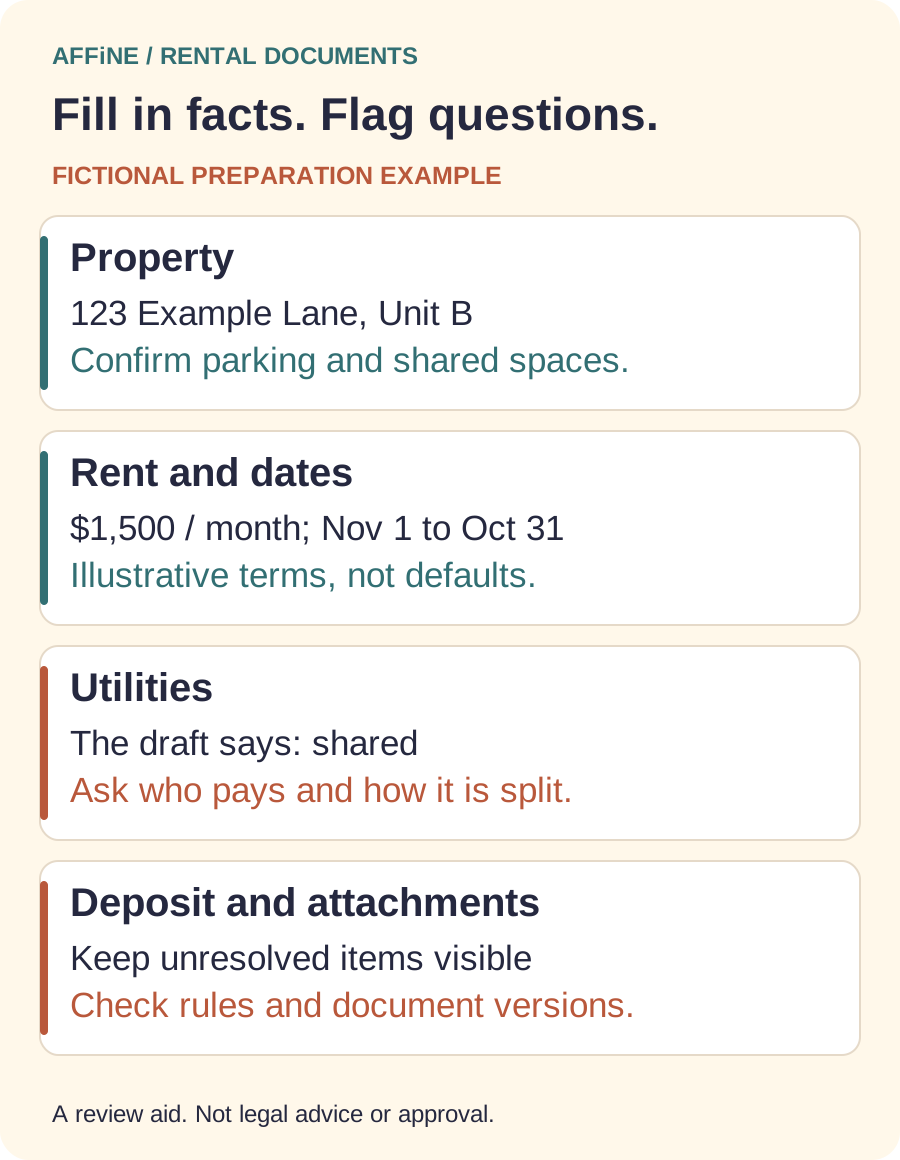
The following is a fictional preparation example, not a model legal clause or a complete agreement. Alex and Jordan are reviewing a one-year rental of a two-bedroom apartment. Their draft names a monthly rent of $1,500 but says only that utilities are “shared.”
| Draft detail | Information to record | Question still open |
|---|---|---|
| Property | Illustrative address: 123 Example Lane, Unit B; confirm the included parking space | Does the parking addendum identify the same space? |
| Rent | Proposed rent: $1,500 per month; proposed due date: the first | What payment instructions and separately listed charges will the parties use? |
| Term | Proposed dates: November 1, 2026 to October 31, 2027 | Do the renewal and move-out sections agree with these dates? |
| Utilities | List electricity, gas, water, internet and trash separately | Who pays each bill? If shared, how is the amount calculated and documented? |
| Deposit | Leave the legal-limit and return-rule questions on the review list | Which rules apply to this property, and does the proposed deposit comply? |
| Attachments | Parking addendum and move-in condition record | Are they included, dated and consistent with the main agreement? |
The useful improvement is the question trail: a reader can see what has been agreed, what evidence supports it and what remains unresolved. The example's rent and dates are illustrative, not recommended prices or legal defaults.
Check state, local and property-specific requirements
Do not treat a template provider's checklist as the full set of rules. Start with the jurisdiction and property type, then verify the issues raised by your draft. USA.gov's tenant-rights page links to state resources and ways to find help.
Your review list should include deposits, fees, entry, repairs, notices, local rental restrictions and disclosures. If a rule has exceptions or a recent effective date, record those alongside the source. A nationwide “one month” or “30 days” default can obscure the very information you need.
Two examples show why property details matter:
- Older housing: EPA explains that federal lead-disclosure requirements apply to most housing built before 1978, subject to exceptions. Check the EPA disclosure guidance for the covered property and the information/documents to provide before a lease is signed. Do not assume a generic form's checkbox completes the process.
- State materials: New Jersey's Department of Community Affairs maintains landlord–tenant publications and forms. If the property is in New Jersey, use the current official materials to investigate the relevant requirements rather than carrying over another state's wording.
For each unresolved item, save the official source, the date checked and the question for a local housing adviser or attorney. Seek help before signing when a term is unclear or contested, or when the arrangement involves unusual restrictions, subsidized housing, a dispute or conflicting documents. This article does not certify any linked form's compliance.
Word, PDF or an AFFiNE document?
Choose a format for the task you are doing. File format and legal validity are separate questions.
| Task | Useful format | Limitation to remember |
|---|---|---|
| Edit a draft or compare proposed wording | Word document | Track and resolve edits; recheck page breaks after changes |
| Read, print or circulate a fixed-layout copy | Some PDFs are fillable and others are not; PDF does not mean uneditable | |
| Collect questions, references and agreed decisions | A separate review document, including an AFFiNE document | A review note is not the signed agreement or a legal compliance check |
| Sign and retain the final agreement | The agreed signing process and its completed output | Verify the applicable requirements and retain the complete executed version and attachments |
PDFs can be edited with suitable software—Adobe documents that capability. Exporting a draft as PDF is therefore not, by itself, proof that it cannot change. Signature validation, access controls and a record of the executed version are different matters.
Use AFFiNE to keep review questions together
You can structure a review document around clause → question → response → status, using the worksheet below as the starting text. Keep it separate from the agreement, so a note such as “confirm deposit rule” is not mistaken for an agreed contract term.
The AFFiNE basic residential rental template page is another relevant resource to inspect. Use it to explore a document structure, then check your draft against the rules for the property. Keep signing and legal review separate from your review notes. A separate workspace helps keep questions and references together while the lease is being checked.
Use fictional details when experimenting. Before adding real tenant information to a shared document, review who can access it and share only what the review requires.
A printable checklist before signing
Download the two-page lease-review worksheet (PDF) or get the editable plain-text version. Both are free AFFiNE-created review aids with no account required; neither is a lease or a legal approval checklist.
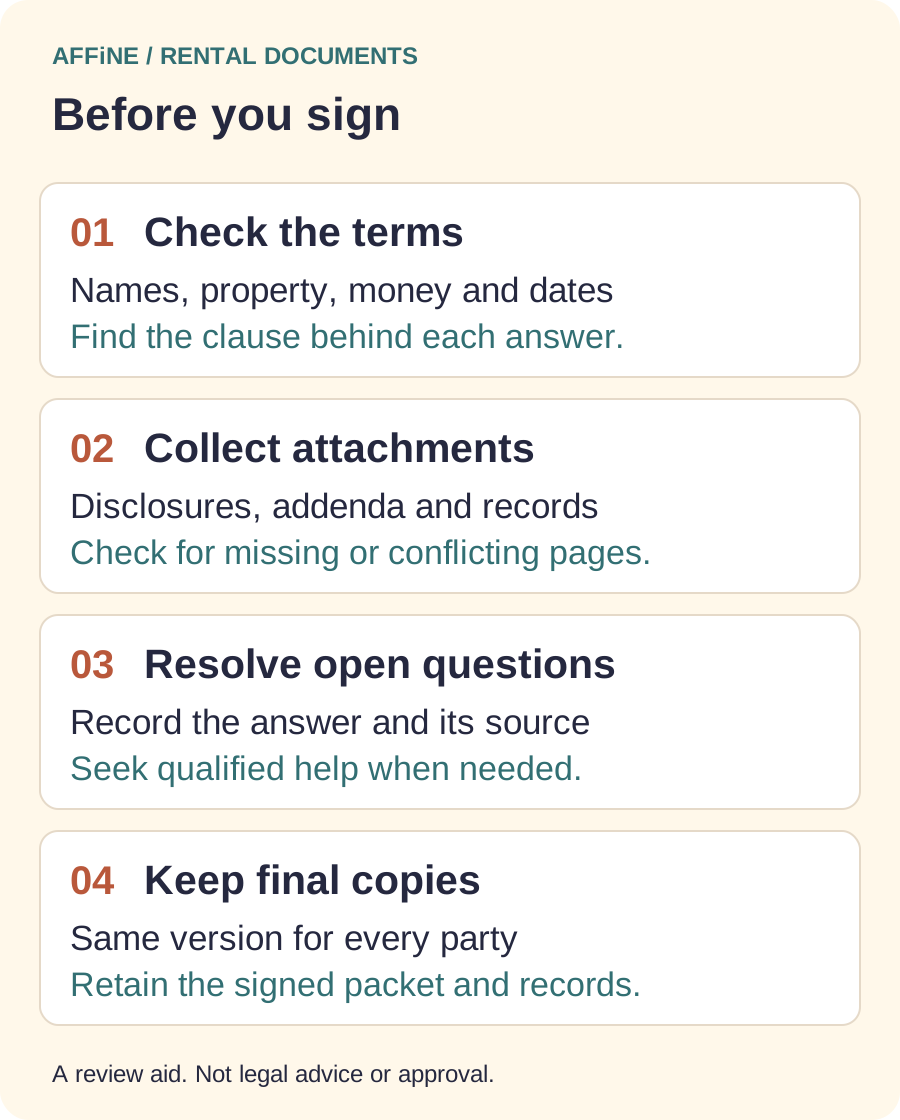
Copy these rows into a review document and add the clause/page, person responsible and status. “Needs an answer” is a useful status; do not mark an item complete merely because a form has a heading for it.
| Check | Question to answer | Evidence to keep |
|---|---|---|
| People and premises | Do names, unit, included spaces and contact details agree throughout? | Relevant clauses and any property/parking description |
| Money | Can you identify rent, deposit, every other charge and who pays utilities? | Written amounts, payment instructions and applicable rule/source |
| Dates | Are term, possession, renewal and notice provisions consistent? | Relevant clauses and the local requirement checked |
| Responsibilities | Is it clear how repairs are reported and who handles each task? | Contact details and the relevant clause |
| Disclosures and addenda | Are all applicable documents supplied and consistent with the lease? | Attachment list, versions and sources consulted |
| Unresolved questions | Has each question received an answer or qualified review? | Question, response, owner and date |
| Final copies | Is everyone reviewing and signing the same complete version? | Final filename/date, attachments and the completed signed copy |
Print and assemble the complete packet
Preview every page before printing. Check that tables, initials and signature fields are not cut off; page numbering and the attachment list should help you spot a missing page. Use the page size specified by the file rather than assuming every template uses the same format.
Compare the main agreement with its addenda. For example, if the lease includes parking but an attachment describes a different space, resolve the mismatch first. Keep a readable copy of the completed agreement and all applicable attachments for each party. If you retain a move-in condition record, identify the property and date and keep it with the related documents.
Frequently asked questions
Where can I download a free lease agreement in Word or PDF?
The OpenDocs and LawVault blank files linked above were available in both formats without an account or payment when checked on October 7, 2026. Choose a form appropriate to the property's location and tenancy; public download access does not establish legal suitability. Check the provider's current terms for builders and other services.
Is a free lease agreement template legally binding?
The price of a form does not determine whether a particular agreement is enforceable. Its terms, the parties, applicable law and any required steps matter. This guide cannot validate your lease. Use current official guidance and qualified local help for questions about validity instead of relying on a download label or a signature alone.
Can I write my own lease agreement?
A template can help you organize a draft, but it does not tell you every requirement that applies. Confirm the jurisdiction, property and tenancy type, then check the terms and required disclosures. Do not assume a handwritten or self-prepared form is automatically valid—or automatically invalid—because of how it was produced.
Is a one-page lease enough?
Page count is a poor completeness test. Check the actual terms, applicable requirements and attachments. A short form may leave important questions unresolved; a longer form may still contain irrelevant or unsuitable clauses. Use the review worksheet to inspect what the document actually says.
Does a PDF stop someone changing the lease?
No. PDF is a file format, and editing tools exist. Keep the completed signed version and its attachments, and use an appropriate signing and recordkeeping process. Do not equate printing, password protection or a PDF export with a legal or tamper-proof guarantee.
What should I do when the template and an addendum disagree?
Flag the exact passages and ask for clarification before signing. Do not silently choose the wording you prefer or assume the newer-looking file governs. Record the agreed correction, seek qualified help when needed, and make sure all parties receive the same final documents.
About this update
Editorial update, October 7, 2026: checked the public sample-file access described above; added a fictional preparation example and an original review worksheet; replaced the generic cover and added visual guides. This was an editorial refresh, not an attorney's review. Official sources are linked beside the relevant guidance.