Product Roadmap Template: How to Build One, With Examples
A free product roadmap template with a Now / Next / Later board, outcome, theme, and confidence fields, six steps to build it, a worked example, and product vs project roadmaps.

A product roadmap template is a reusable page that shows where a product is going and why: the outcomes you want, the themes of work that serve them, and the initiatives you will tackle now, next, and later. This guide gives you a copyable template (a Now / Next / Later board with outcome, theme, and confidence fields, plus an optional quarterly timeline), a six-step method for building a product roadmap, a worked example, and the difference between a product roadmap and a project roadmap.
Short version
- Start from outcomes, not features. Each roadmap item should name the problem it solves and the metric it should move.
- Use Now / Next / Later when dates are uncertain. Add a timeline only for commitments that really have dates, such as a contract or an event.
- Show confidence. Mark each item high, medium, or low confidence, so nobody reads "Later" as a promise.
- Review it monthly and keep a short changelog, so stakeholders can see what moved and why.
Published by AFFiNE, which makes a workspace for docs, whiteboards, and databases. The template below works in any doc tool, and we explain where AFFiNE fits and where it does not. External facts were checked on the sources listed at the end on October 28, 2026.
What is a product roadmap?
A product roadmap is a high-level plan that connects product strategy to the work a team will do. Atlassian describes it as "a shared source of truth that outlines the vision, direction, priorities, and progress of a product over time." A good roadmap answers three questions for anyone in the company:
- Where are we going? The product vision and the two to four outcomes that matter this year.
- What are we working on, and why? Initiatives grouped by theme, each tied to an outcome.
- How sure are we? What is committed, what is likely, and what is still an idea.
A roadmap is not a backlog, a release plan, or a Gantt chart. The backlog lists every task and ticket. The release plan says what ships in which version. The roadmap sits above both and should fit on one page.
Product roadmap vs project roadmap
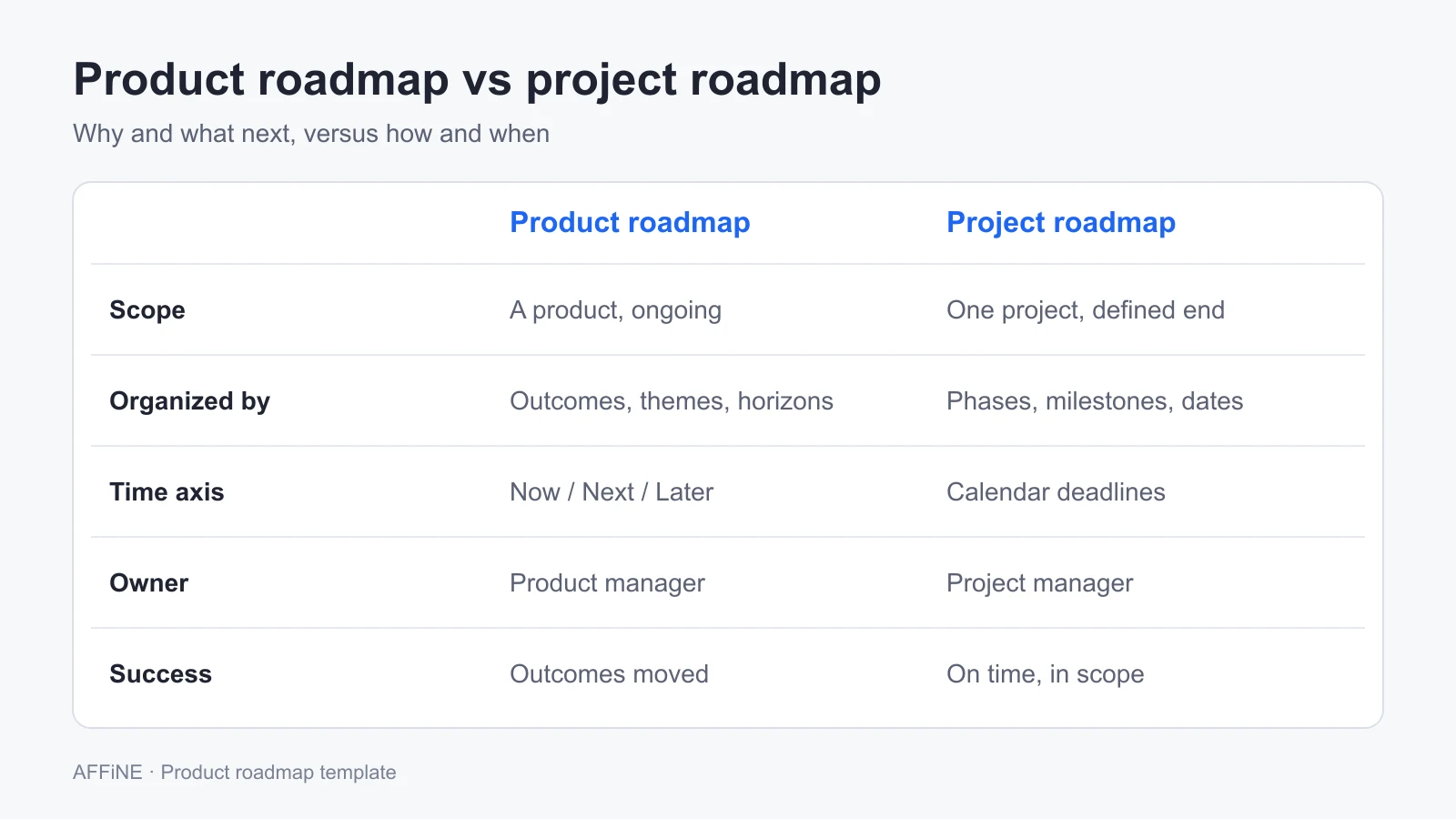
The two terms are often used interchangeably, but they describe different plans. A project roadmap covers one project with a start and an end: its phases, milestones, deliverables, and deadlines. We cover that format in what a project roadmap is and how to build one. A product roadmap covers a product that keeps evolving: it has no end date, and its items change as the team learns from customers.
| Product roadmap | Project roadmap | |
|---|---|---|
| Scope | A product or product line, ongoing | One project with a defined end |
| Organized by | Outcomes, themes, and time horizons | Phases, milestones, and dates |
| Main question | What should we build next, and why? | How and when will we deliver this scope? |
| Time axis | Now / Next / Later or quarters, loosely held | Calendar dates and deadlines |
| Typical owner | Product manager or product lead | Project manager |
| Audience | Leadership, sales, support, engineering, sometimes customers | Project team, sponsor, stakeholders |
| Changes when | New evidence about customers or the market | Scope, budget, or schedule changes |
| Success measure | Outcomes moved (retention, activation, revenue) | Delivered on time, on budget, in scope |
In practice, they work together. One initiative on a product roadmap, such as "self-serve onboarding," can become a project with its own project roadmap once the team commits to it. If you are choosing software for agile roadmaps with sprints and epics, our roundup of free tools for agile roadmap templates compares several options.
What a good product roadmap template includes
Most templates you find online are a grid of colored bars or a Kanban board with feature names. They look tidy but leave out the parts that make a roadmap useful in a planning meeting. A complete product roadmap template has eight parts:
| Section | What goes in it | Why it matters |
|---|---|---|
| Header | Product, owner, last updated, review cadence | Readers know who to ask and whether it is current |
| Vision and strategy | Two sentences: who the product serves and how it wins | Every item can be checked against it |
| Outcomes | Two to four measurable goals with baseline and target | Turns "features" into "results" |
| Themes | Three to five groups of related problems | Keeps the roadmap readable at a glance |
| Now / Next / Later board | Initiatives sorted by time horizon | Shows sequence without false dates |
| Confidence and evidence | High, medium, or low, plus why | Stops "Later" from being read as a promise |
| Not doing | Ideas you have deliberately parked | Ends repeated debates |
| Changelog | What moved, when, and why | Builds trust when plans change |
The fields that make the biggest difference are outcome, theme, and confidence. Outcome forces each item to justify itself. Theme lets an executive read the roadmap in ten seconds. Confidence makes uncertainty visible, which is what keeps a roadmap honest.
Now / Next / Later or timeline?
The Now / Next / Later format sorts work into three horizons instead of dates. The earliest public description we found is a September 2012 Thoughtworks post by Peter Gillard-Moss, written about planning project backlogs. ProdPad later popularized it for product roadmaps, describing it as a way to "communicate priorities and strategic direction without creating false certainty."
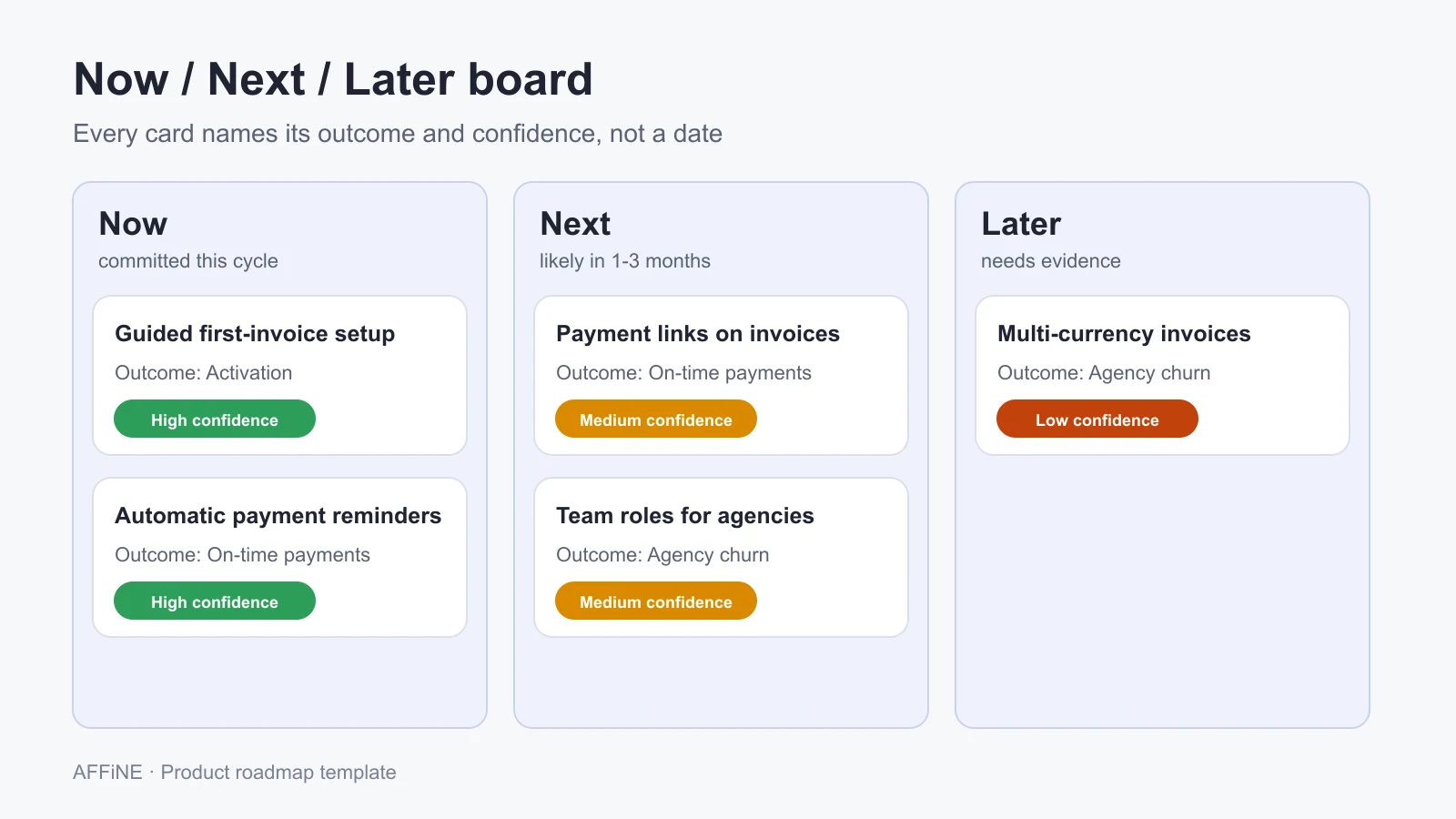
- Now: work in progress or starting this cycle. High confidence, defined scope.
- Next: likely to start in the following one to three months. The problem is clear; the solution may not be.
- Later: problems worth solving that need more evidence. Low confidence by design.
Use a timeline roadmap (months or quarters) when dates are real commitments: a regulatory deadline, a launch event, a contract, or a hardware release. Many teams combine the two: Now / Next / Later for most of the product, with a small dated section for fixed commitments. The template below includes that optional timeline section.
| Use Now / Next / Later when | Use a timeline when |
|---|---|
| You are still discovering what customers need | Dates are set by contracts, regulators, or events |
| Stakeholders tend to treat dates as promises | Several teams must coordinate a launch |
| Your team ships continuously | Marketing, sales, or partners need to plan around dates |
How to build a product roadmap
These six steps take one product team about a week of part-time work the first time, and an hour a month to maintain.
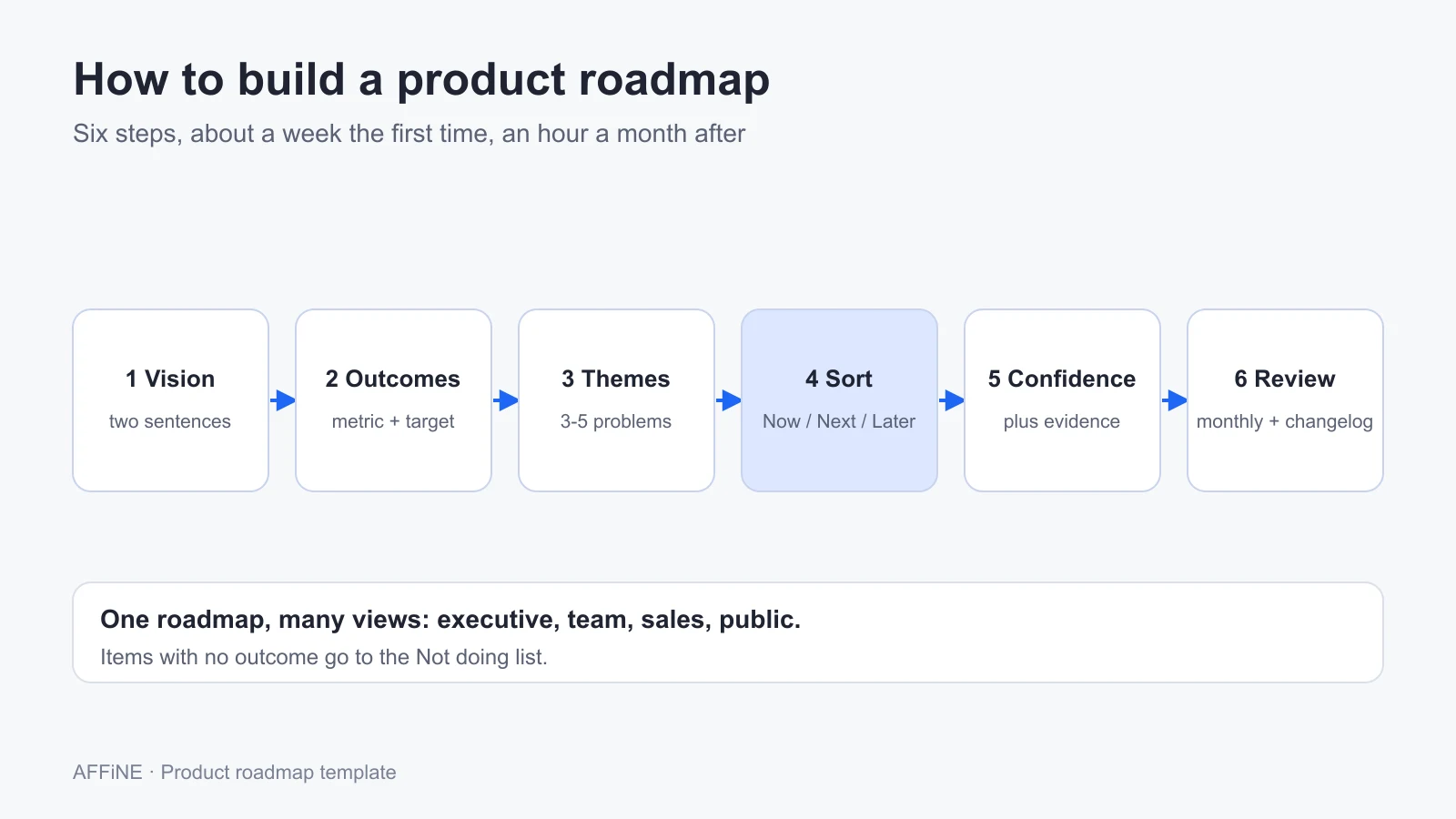
1. Write the product vision and strategy in two sentences
State who the product is for, the problem it solves, and how it will win. If you cannot write it in two sentences, the roadmap will not be focused either. Put it at the top of the roadmap so every item can be checked against it.
2. Choose two to four outcomes with a metric each
Pick the results that matter most for the next six to twelve months, such as activation, retention, or expansion revenue. For each one, write the metric, today's baseline, and a target. If your company uses OKRs, reuse its objectives rather than inventing new ones.
3. Group the work into three to five themes
Collect candidate initiatives from customer feedback, sales, support, and the team, then group them by the problem they address. Name themes after customer problems, such as "Faster first invoice," not after components.
4. Sort initiatives into Now, Next, and Later
Place work already in progress in Now. Move the most promising problems into Next, and park everything else in Later. Keep Now small enough that the team could finish it this cycle. Anything that serves none of the outcomes goes to the Not doing list.
5. Add a confidence level and the evidence behind it
Mark each initiative high, medium, or low confidence and write one line on why: customer interviews, usage data, a signed deal, or just a hunch. Low confidence in Later is normal. Low confidence in Now is a warning sign.
6. Share the roadmap, review it monthly, and keep a changelog
Walk stakeholders through the roadmap once, then review it monthly with the product team. Each time an item moves between columns, add one line to the changelog with the date and the reason. A roadmap that changes without explanation loses trust quickly.
Worked example: a roadmap for a small invoicing app
To make the template concrete, here is a filled-in roadmap for a fictional B2B invoicing app with a five-person product team. It is an illustrative example, not a customer case.
Vision: Help freelancers and small agencies get paid faster, without accounting knowledge. We win by making the first invoice take under five minutes.
Outcomes for the next two quarters:
| Outcome | Metric | Baseline | Target |
|---|---|---|---|
| More trial users send a first invoice | Trial accounts sending an invoice within 7 days | 38% | 55% |
| Fewer late payments for customers | Invoices paid by their due date | 61% | 70% |
| Keep agencies on paid plans | Monthly churn on Agency plan | 3.4% | 2.5% |
Now / Next / Later:
| Horizon | Initiative | Theme | Outcome | Confidence | Evidence |
|---|---|---|---|---|---|
| Now | Guided first-invoice setup | Faster first invoice | Activation | High | 12 of 15 trial interviews stalled at tax settings |
| Now | Automatic payment reminders | Get paid on time | On-time payments | High | Most requested feature in support tickets |
| Next | Card and bank payment links on invoices | Get paid on time | On-time payments | Medium | Competitors offer it; payment provider not chosen |
| Next | Team roles for agencies | Agency workflows | Agency churn | Medium | 4 churned agencies cited permissions |
| Later | Multi-currency invoices | Agency workflows | Agency churn | Low | Requests from 3 agencies; unclear size |
| Later | Expense tracking | Not yet assigned | None yet | Low | Feature request only |
Two decisions came out of building this example. Expense tracking moved to the Not doing list, because it serves none of the three outcomes. "Payment links" stayed in Next rather than Now, because the team had not chosen a payment provider; the confidence field made that visible, instead of the item quietly slipping.
Product roadmap examples by audience
The same roadmap can be presented differently depending on who reads it. Instead of maintaining separate documents, keep one source and adjust the view.
- Executive roadmap: themes and outcomes only, one line per theme, plus the dated commitments. Leaders want to see whether the plan serves the strategy.
- Team roadmap: the full Now / Next / Later board with evidence and owners. Engineers and designers want context for their daily work.
- Sales and support roadmap: Now and Next only, written in customer language, with a clear note that Next is not a commitment.
- Public roadmap: a curated subset of Now and Next with no dates. Share it only if you are prepared to explain changes in public.
- Timeline roadmap: quarters across the top and themes down the side, used when launches must line up with marketing or partner dates.
Use the template
Open the free AFFiNE product roadmap template to duplicate it into your workspace, or copy the version below into any doc tool that supports Markdown tables and checklists. The examples are placeholders; replace them with your own.
# Product Roadmap: [Product name]

Owner: [Name]    Last updated: [YYYY-MM-DD]    Review: monthly

## Vision and strategy
[Who the product serves, the problem it solves, and how it wins, in two sentences.]

## Outcomes
| Outcome | Metric | Baseline | Target | Owner |
| --- | --- | --- | --- | --- |
| [More trial users activate] | [% sending first invoice in 7 days] | [38%] | [55%] | [Name] |
| [Fewer late payments] | [% invoices paid on time] | [61%] | [70%] | [Name] |

## Themes
- [Theme 1: Faster first invoice]
- [Theme 2: Get paid on time]
- [Theme 3: Agency workflows]

## Now (this cycle, committed)
| Initiative | Problem | Theme | Outcome | Confidence | Evidence | Owner |
| --- | --- | --- | --- | --- | --- | --- |
| [Guided setup] | [Users stall at tax settings] | [Theme 1] | [Activation] | High | [12 of 15 interviews] | [Name] |

## Next (1 to 3 months, likely)
| Initiative | Problem | Theme | Outcome | Confidence | Evidence | Owner |
| --- | --- | --- | --- | --- | --- | --- |
| [Payment links] | [Clients pay late] | [Theme 2] | [On-time payments] | Medium | [Support tickets] | [Name] |

## Later (needs evidence)
| Initiative | Problem | Theme | Outcome | Confidence | Evidence | Owner |
| --- | --- | --- | --- | --- | --- | --- |
| [Multi-currency] | [Agencies bill abroad] | [Theme 3] | [Agency churn] | Low | [3 requests] | [Name] |

## Not doing
- [Idea, and why it is parked]

## Optional: dated commitments
| Quarter | Commitment | Reason for the date | Owner |
| --- | --- | --- | --- |
| [Q1] | [Tax rule update] | [Regulatory deadline] | [Name] |

## Changelog
| Date | Change | Reason |
| --- | --- | --- |
| [YYYY-MM-DD] | [Payment links moved Now to Next] | [Provider not chosen] |

## Monthly review checklist
- [ ] Every Now item is in progress or done
- [ ] Every item has an outcome and a confidence level
- [ ] Items without an outcome moved to Not doing
- [ ] Changelog updated for anything that moved
Common product roadmap mistakes
- A feature list with dates. Without outcomes, the roadmap cannot help you choose between two good ideas.
- Too much in Now. If Now holds more than the team can finish this cycle, the column stops meaning "committed."
- Dates on everything. Dates far in the future are guesses, and stakeholders remember them as promises.
- Separate roadmaps per audience. Copies drift. Keep one roadmap and change the view or the level of detail.
- No changelog. When items move silently, people stop trusting the roadmap and start asking for dates in chat.
Where AFFiNE fits
AFFiNE is a workspace where docs, whiteboards, and databases live together, so the roadmap, its evidence, and the discussion around it can sit in one place. You can build the template above as a page with tables, or use a database block: AFFiNE's documentation describes how a table view can be converted into a Kanban view, which turns the Now, Next, and Later rows into a drag-and-drop board. Linked docs let each initiative point to its PRD or research notes, and Edgeless mode gives you a whiteboard when the team wants to sort sticky notes before committing anything to the roadmap. For the documents around the roadmap, see our PRD template and sprint planning template.
Who should not choose AFFiNE for this:
- Teams that need roadmap items synced two-way with Jira or Linear issues, with automatic status roll-ups. Dedicated tools such as Jira Product Discovery or Productboard are built for that.
- Product organizations that need portfolio roadmaps across many teams, with capacity planning and dependency tracking. A dedicated roadmap tool will fit better.
- Teams that want a hosted public roadmap with customer voting. Use a feedback tool designed for it.
FAQ
What should a product roadmap template include?
A product roadmap template should include a header with an owner and update date, the product vision, two to four measurable outcomes, a few themes, a Now / Next / Later board of initiatives, a confidence level with evidence for each item, a Not doing list, and a changelog.
What is the difference between a product roadmap and a project roadmap?
A product roadmap covers a product that keeps evolving and is organized by outcomes, themes, and time horizons. A project roadmap covers one project with a defined end and is organized by phases, milestones, and dates. One product roadmap item can become a project with its own project roadmap.
How do I create a product roadmap?
Write the vision in two sentences, choose two to four outcomes with metrics, group candidate work into themes, sort initiatives into Now, Next, and Later, add a confidence level and evidence to each, then share the roadmap and review it monthly with a changelog.
What is a Now / Next / Later roadmap?
It is a roadmap format that sorts work into three horizons instead of dates: Now for committed work in progress, Next for likely work in the following months, and Later for problems that need more evidence. It shows priorities without implying deadlines the team cannot keep.
Should a product roadmap have dates?
Only where dates are real commitments, such as a regulatory deadline, a contract, or a launch event. For everything else, time horizons are more honest. Many teams use Now / Next / Later for most work and add a small dated section for fixed commitments.
How often should you update a product roadmap?
Review it monthly with the product team and update it whenever an item changes horizon. Record each change in a changelog with the date and the reason, and walk stakeholders through larger changes in a quarterly planning review.
Sources and editorial notes
- Atlassian, Product roadmap guide, for the definition quoted above. Accessed October 28, 2026.
- Thoughtworks, Now, Next and Later by Peter Gillard-Moss, published September 10, 2012. Accessed October 28, 2026.
- ProdPad, Why I invented the Now-Next-Later roadmap, for the quoted description of the format. Accessed October 28, 2026.
- AFFiNE, Blocks with databases, for table-to-Kanban view conversion. Accessed October 28, 2026.
- SERP review of the top results for "product roadmap template," "how to build a product roadmap," and "product roadmap examples" (Atlassian, Miro, Notion, Aha!, Productboard, ProductPlan, Product School, and others) on October 28, 2026, used to find gaps rather than as factual sources.
How this guide was prepared: AFFiNE wrote this article in October 2026. The template, the six steps, and the invoicing app example reflect common product management practice and how we suggest structuring a roadmap page; the example is fictional and its numbers are illustrative, not results of a study. Tools named in the "who should not choose AFFiNE" list are examples of their category, not ranked recommendations. AI tools assisted with research and drafting, and the AFFiNE team reviewed and edited the content.