
The Cybersecurity Services That Detect and Stop Ransomware Fast
A ransomware attack rarely starts with the ransom note. By the time a locked screen appears, attackers have often been inside the network for days, copying files, deleting recovery points and lining up the encryption step.
For a small business, the gap between that first foothold and someone noticing it often decides whether an incident costs a few hours or a few weeks.
The services that close that gap work by watching behavior instead of waiting for a known virus signature.
Here's what each one does, how they fit together, and how to judge whether the price makes sense for a business your size.
Key Takeaways
-
Speed decides the damage. Mandiant found that the median time between an attacker gaining access and handing it to a second criminal group fell to 22 seconds in 2025.
-
Behavior gives ransomware away. Mass file changes and deleted recovery points are warning signs that tools can flag even when the malware itself is new.
-
Software and people are different purchases. Endpoint detection and response (EDR) raises the alerts. Managed detection and response (MDR) adds analysts who investigate and contain threats around the clock.
-
The cheap layers still matter. Offline, tested backups, automatic updates and multifactor authentication make fast response far more effective.
-
Compare quotes on what's covered. Look at the annual total, the devices included and what the provider can do without waiting for your approval.
Why Speed Decides the Cost of a Ransomware Attack
Ransomware now shows up in nearly half of all breach investigations. Verizon's 2026 Data Breach Investigations Report found ransomware in 48% of the breaches it analyzed, up from 44% the year before.
Where Verizon knew the victim's size, about 96% of ransomware victims were small and midsize businesses.
Those figures describe the breaches in Verizon's dataset, not the odds that any one business will be hit, but they show where criminals are finding success.
The timeline is the bigger problem. Mandiant's M-Trends 2026 report puts the global median dwell time, the stretch between compromise and discovery, at 14 days.
In the ransomware cases Mandiant investigated, the attacker was the one who told the victim about the breach 44% of the time. Internal teams spotted the intrusion first in only 41% of cases.
That's why detection speed matters so much. Stopping an intruder on one laptop is far cheaper than rebuilding an entire network.
There is one encouraging number in the Verizon data: 69% of ransomware victims didn't pay at all. Businesses that catch attacks early and can restore their own data are in the strongest position to refuse.
What Ransomware Looks Like Before the Ransom Note
Traditional antivirus compares files against a list of known threats. Criminal groups change their tools constantly, so newer services also watch for suspicious behavior. A few patterns show up again and again:
-
Mass file changes. Encryption is the core of the attack, so a single process rewriting or renaming hundreds of files in minutes is a strong warning sign. MITRE ATT&CK, a widely used public catalog of attacker techniques, lists this as Data Encrypted for Impact.
-
Deleted recovery points. MITRE documents ransomware families such as Ryuk, Conti and Black Basta deleting Windows volume shadow copies with built-in tools like vssadmin, so victims can't roll their files back.
-
Attacks on backups. CISA warns that many ransomware variants hunt for accessible backups and delete or encrypt them so restoration is impossible without paying.
-
Unusual account activity. Logins at odd hours, new administrator accounts or a bookkeeping login suddenly changing server settings can point to stolen credentials.
Behavior-based detection has a known tradeoff. Legitimate activity, such as a large software update or a bulk file migration, can look suspicious. That's why the people reviewing alerts matter as much as the software raising them.
The Cybersecurity Services That Help
Endpoint Detection and Response (EDR)
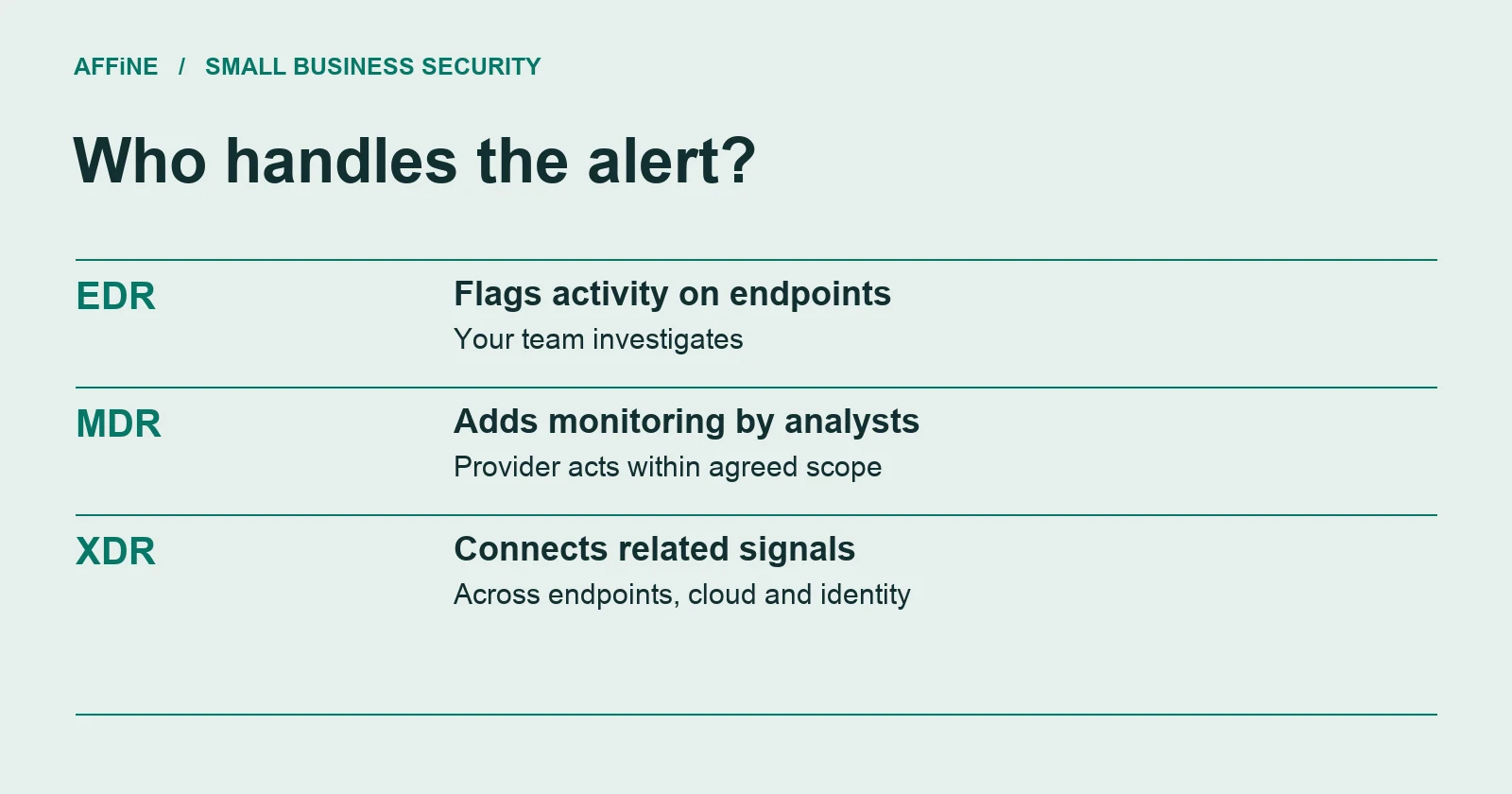
EDR software runs on computers and servers, records activity, and flags or blocks suspicious behavior.
Many EDR tools can automatically cut an infected laptop off from the network. EDR is the sensor layer underneath most of the services below.
Its weakness for a small business is simple: someone still has to read the alerts, decide which ones are real and act on them, including at 2 a.m. on a holiday weekend.
Managed Detection and Response (MDR)
MDR adds a team of security analysts who watch those alerts around the clock, investigate them and take containment steps on your behalf.
For a business without a dedicated security employee, this is usually the piece that turns an alert into a fast response.
One example is ESET, whose MDR service pairs 24/7 human-led monitoring and response with AI and its own global threat intelligence. The company reports a mean time to respond of six minutes, measured from the first detection of an incident to the first action taken against it, and KuppingerCole named it a Market Leader in its 2026 Leadership Compass for MDR.
Whichever provider you consider, ask whether its analysts can act without waiting for your sign-off. A service that only emails alerts leaves the hardest part of the job with you.
Extended Detection and Response (XDR)
XDR stretches the same behavior monitoring beyond computers to email, cloud apps, user identities and network traffic, then links related alerts into a single incident.
It helps most when an attack starts with a phishing email or a stolen password rather than a malicious file.
Incident Response Support
Some incidents need forensic analysis, recovery help or guidance on notifying customers. Certain MDR plans include this assistance, while others bill it separately.
Confirm which applies before signing, and keep your provider's emergency contact details somewhere that doesn't depend on your own network.
The Low-Cost Layers That Make Fast Response Work

Detection buys time. These basics make sure that time turns into a quick recovery:
-
Offline, tested backups. The #StopRansomware Guide from CISA and its partners recommends keeping offline, encrypted backups of critical data and regularly testing that they can actually be restored. A backup that has never been restored is a hope, not a plan.
-
Automatic updates. The FTC advises small businesses to update software regularly and turn on automatic updates. Verizon found that exploiting software vulnerabilities was the top way into breaches in its 2026 report, at 31%.
-
Multifactor authentication. The FTC recommends requiring MFA for employees, contractors and anyone else who accesses your network and devices. Stolen and guessed credentials remain a common way in, so MFA works best alongside the other habits for preventing password attacks on employee and admin accounts.
-
A written response plan. CISA recommends creating and regularly practicing a basic incident response plan that covers who to call and how to communicate. Name one person who can approve containment steps after hours.
How to Compare Quotes Without Overpaying
Two quotes with the same monthly fee can cover very different work. Ask each provider the same questions and get the answers in writing:
-
Coverage: Which computers, servers, user accounts and cloud apps are included?
-
Authority to act: Can analysts isolate devices or disable accounts right away, or do they need your approval first?
-
Hours: Is monitoring truly 24/7, including weekends and holidays?
-
Extras: Are forensics, incident response and backup restoration included or billed separately?
-
Terms: What is the minimum commitment, and does the plan renew automatically?
Then run your own numbers. As a hypothetical budgeting example, not a quote: a USD 250 monthly fee plus USD 300 in setup totals USD 3,300 in the first year.
If a three-day shutdown would cost USD 400 a day in lost profit, that interruption alone comes to USD 1,200, before emergency IT help or re-entering data.
Use lost profit per day rather than total sales, since some delayed work gets rescheduled. The math won't predict savings, but it shows how much disruption your business can absorb on its own.
The Bottom Line
Ransomware succeeds when attackers have time. Behavior-based detection shortens that time by spotting the warning signs before encryption finishes, and managed services put trained people on those alerts when nobody at the business is watching.
Pair them with offline backups, automatic updates and MFA, and a small business has a realistic way to catch an attack in its first hours instead of its last.
FAQ
What is the fastest way to detect ransomware?
Behavior-based monitoring through EDR or XDR, with alerts reviewed around the clock by an in-house person or an MDR team. It flags actions such as mass file encryption or shadow copy deletion as they happen.
Is antivirus enough to stop ransomware?
Signature-based antivirus catches known threats but can miss new variants. Behavior monitoring, plus someone ready to respond to its alerts, covers that gap.
What's the difference between EDR and MDR?
EDR is software that detects and records suspicious activity on devices. MDR is a service in which security analysts monitor those detections, investigate them and help contain threats.
Does a business with only a few computers need MDR?
It depends on the data at risk and who can respond after hours. A solo consultant using cloud tools with a reliable IT contact may start with EDR and solid backups. A business that can't operate without its customer records, and has nobody to answer an alert at night, gets the most from managed monitoring.
Should a small business pay a ransom?
CISA strongly discourages paying ransoms, since payment doesn't guarantee recovery and funds further attacks. Verizon's 2026 report found that 69% of ransomware victims didn't pay.