
When Kanban Isn’t Enough: How to Track Dependencies Across Complex Projects
Teams that work according to Kanban rely on visual columns and cards because they give a full picture of their whole workflow. Everyone involved can see what tasks are in line, what is currently in progress, and what has been completed. Such a simple approach doesn’t require extensive training and rigidly defined procedures.
Online boards reveal who’s doing what and where processes are bottlenecking. And that’s why Kanban is still one of the most popular ways to organize projects.
This method is particularly popular in environments where priorities shift frequently. It's well-suited for teams that face a constant stream of diverse tasks, such as marketers, developers, designers, testers, and other specialists. These boards are also used by students and freelancers to keep track of their own tasks.
While Kanban boards are effective at reflecting the status of individual tasks, they fail to show the dependencies between activities.
It is quite clear that cards in columns no longer provide a complete picture of the situation when one person’s work depends on the output of another. Or when missing even a single deadline causes the entire launch to be pushed back.
In this article, we explore the limitations of Kanban and explain how Gantt charts can help.
Where are the limits of classical Kanban?
Project tasks often involve different specialists or departments. While a content manager works on positioning, a designer waits for the finished text, and a video specialist cannot begin editing clips until the visuals are ready.
On a Kanban board, such tasks are visualized as adjacent cards, although in reality they form a logical chain. These interdependencies are visible only when a strict order of actions is specified.
A card can stay in the “In Progress” column for a week. It may all look okay from the outside. But it's a false sense of calm, as a small delay can derail the entire plan if three other tasks depend on it.
The problem becomes apparent only when the next person in the workflow looks at a board expecting a result and finds nothing. This is fine for work processes with no hard deadlines.
How Gantt charts help to organize rigid dependencies
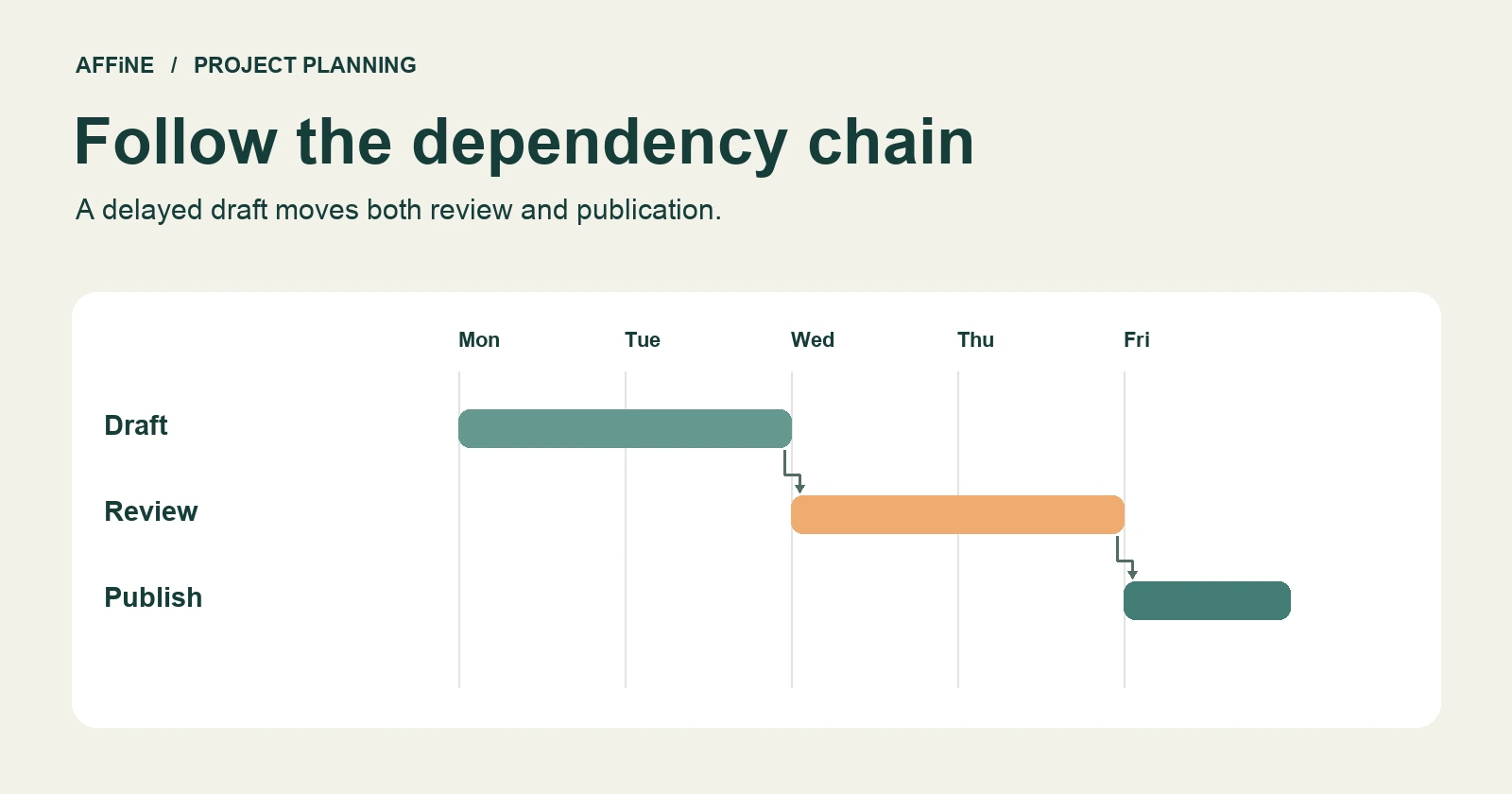
Kanban boards and Gantt charts are often seen as competitors, but they are different tools.
A board reflects the flow of work as it happens, while a diagram can show a timeline for an entire project. Depending on the circumstances, one can be used in place of the other, or they can complement each other.
The main benefit of a Gantt chart is that it shows task dependencies. An arrow from “Draft approval” to “Development stage” tells you more than a long email thread: the second task can not start until the first one is done. Plus, if the approval phase is delayed for two days, you can immediately see which tasks and deadlines will also be pushed back.
The longest chain of dependent tasks is the critical path. Any delay along the way will push back the completion date for the entire project.
Today, project management software solutions offer extensive features for working with smart bar diagrams. Many of them allow you to map the sequence in a Gantt chart template and try it right away.
Working with such a diagram doesn’t require special talent or effort. You will soon see how effectively dependencies function, even when using a pre-built template.
The diagrams are excellent for visualizing major project phases, key milestones, and the dependencies between them.
Meanwhile, the boards show the day-to-day work taking place within each of those phases.
Cross-team dependencies: which visualization tool to choose
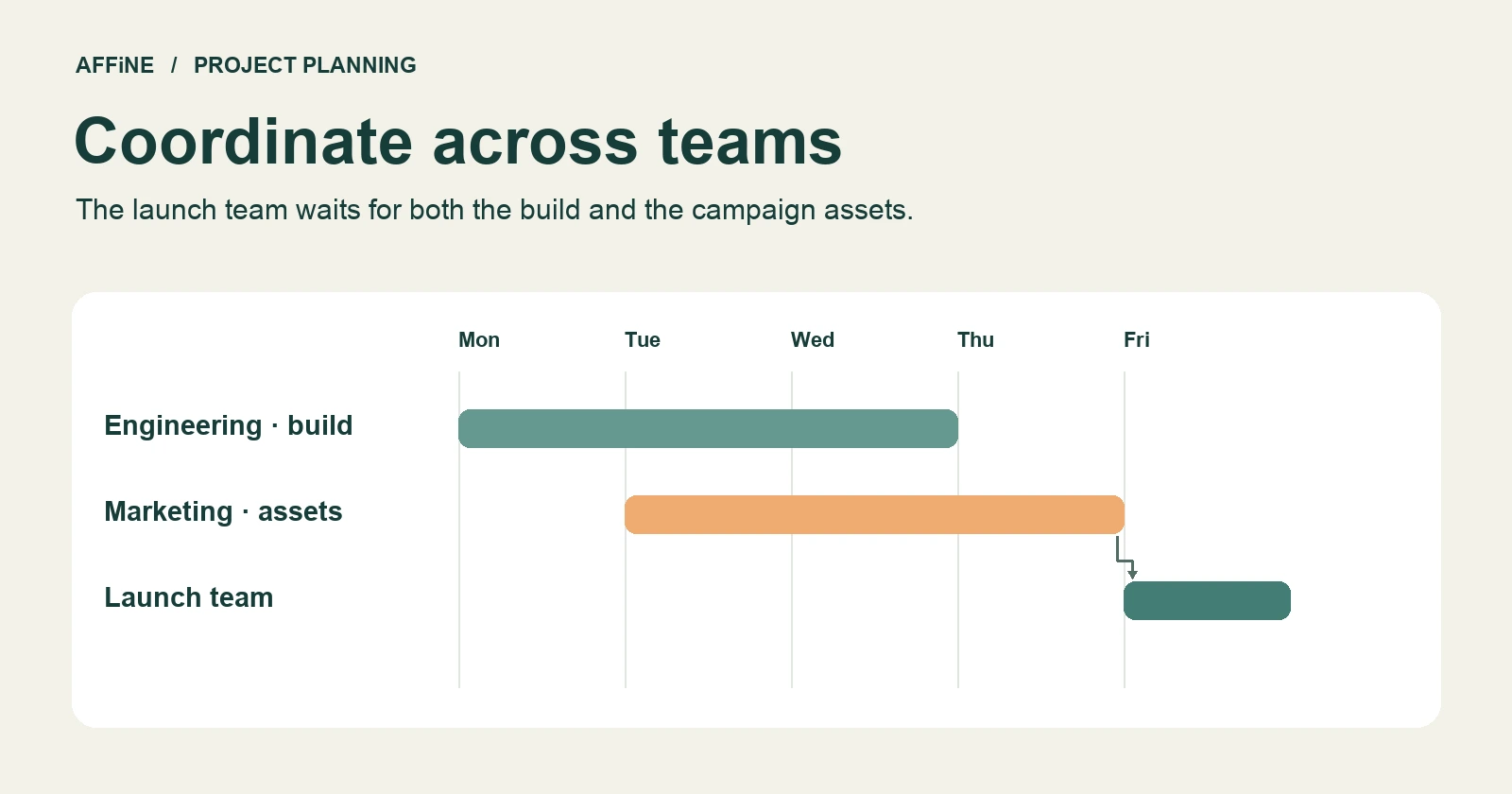
One team may be able to come to a consensus on dependencies in 10 minutes. But different departments often have their own unique plans and different senses of urgency.
Each team only sees their own work; nobody sees the whole picture. This often leads to dependencies getting lost at the points of handoff.
A good idea is to have a common board with specific swimlanes for each team. With them, you get clear links between each task card.
However, a shared roadmap across multiple teams is an advanced approach. Team members can filter their plan by department, track which tasks are blocked or waiting for input, and see where one specialist is over-committed. For example, when they are needed to carry out three tasks simultaneously.
If you deal with a large number of projects, you can use a portfolio view. It helps managers to see the effect of a delay in one project on other projects.
Minimizing project management risks
Assessing potential risks in advance is critical for effective management of tasks and their dependencies.
What happens if deadlines are missed? How will we know about it? What can we do now to guard against this?
You have likely encountered tasks that became bottlenecks for other processes. Instead of just talking about the state of affairs, focus on removing these roadblocks. It will save time and get things back on track.
Don’t worry about how fast each employee gets things done. Focus on reducing wait times and removing systemic bottlenecks.
Inefficient handoffs between different stages of a process are a common reason for delays. Therefore, recurring issues should be addressed by adjusting workflows and procedures, rather than through urgent messages in a chat.
Hopefully, you have gained a clear understanding of where the effectiveness of Kanban ends and what can be used to replace or supplement it.
Manage tasks focusing on the importance of dependencies
You can have everybody on your team doing their own thing and doing it perfectly, and still your project can slip behind schedule. Often, it happens because the hand-off of work between team members takes too long.
The maturity of a team is not only in the speed of completion of tasks, but also in how early its specialists can identify possible delays. This is the point where dependencies are important.
A problem discovered a month before a deadline is still just a task that needs to be managed. A vulnerability identified a day before the deadline, however, is a crisis.
Rely on Kanban boards, but don’t let them limit your team’s potential. Plan work using effective Gantt charts, set logical dependencies, and track all processes in real time.