How Tree Data Becomes Actionable Business Intelligence
Collecting tree data is only the first step. Organizations responsible for large tree populations often hold inspection notes, species records, photographs, maintenance histories, and coordinates across paper forms, spreadsheets, and separate digital systems. The real challenge is turning that information into decisions that improve safety, planning, and resource allocation. Tree management software provides a structured way to connect field observations with operational workflows, allowing raw tree data to become useful business intelligence.
A large database is not automatically a useful one. Data creates value when managers can interpret it, prioritize work, assign responsibility, and measure what happens next. A tree inventory left untouched after an inspection is a static record. A connected system can turn the same information into maintenance schedules, risk priorities, and long-term asset plans.
Key takeaways
- Standardized records make observations comparable across inspectors, sites, and time.
- Location and history add the context needed for defensible priorities.
- Useful dashboards connect insight to an owner, work order, and follow-up.
- Data quality depends on ongoing governance after the initial inventory.
Tree Data Comes From Many Disconnected Sources
Tree management involves several kinds of information. Arborists may record species, size, age, condition, structural defects, and recommended actions. Field teams add photos, access notes, work details, and completion updates. Property managers track budgets, contractors, service areas, and resident requests.
When these records are stored separately, the relationships between them become difficult to see. A maintenance team may know that a tree was pruned but not why the work was recommended. A manager may see an inspection result without knowing whether the issue has already been resolved. Different departments may even create duplicate records for the same asset.

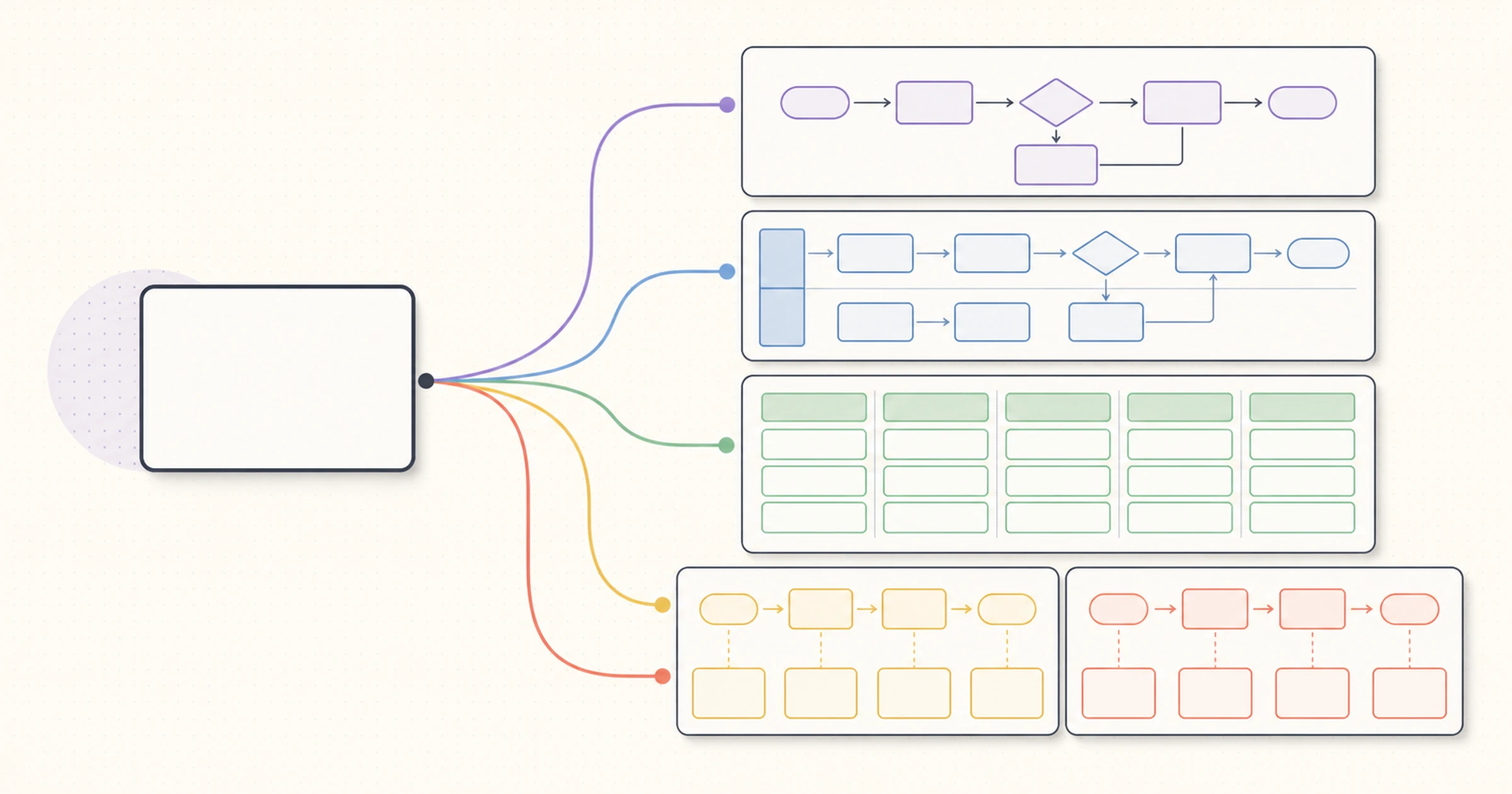
Disconnected records become useful when they resolve into one maintained view of each tree and its work history.
Centralizing the records reduces that uncertainty. Instead of checking several files or asking colleagues to reconstruct an asset's history, staff can work from one maintained view of the tree, its inspections, and the work connected to it.
Standardized Data Improves Reliability
Business intelligence depends on consistent input. If one inspector records a condition as "poor," another uses "declining," and a third writes only a free-text note, comparing records becomes difficult. The information may be technically complete but still resist analysis.
Standardized fields make tree data easier to review at scale. Organizations can define shared categories for condition, risk, recommended action, inspection status, and completion outcome. This does not replace professional judgment. It gives that judgment a structure that can be compared across a larger inventory. Clear field definitions also help new team members understand what each value means and when to use it.
Location Adds Essential Context
A tree record becomes more useful when it is connected to an accurate location. Coordinates and maps show not only the condition of a tree, but also the people, structures, routes, and other assets around it.
A declining tree beside a building, road, or playground may require attention sooner than a similar tree in a low-use area. Location therefore helps convert condition observations into practical priorities. It also supports efficient routing: managers can group nearby inspections, assign crews by service area, and identify access constraints before work begins.
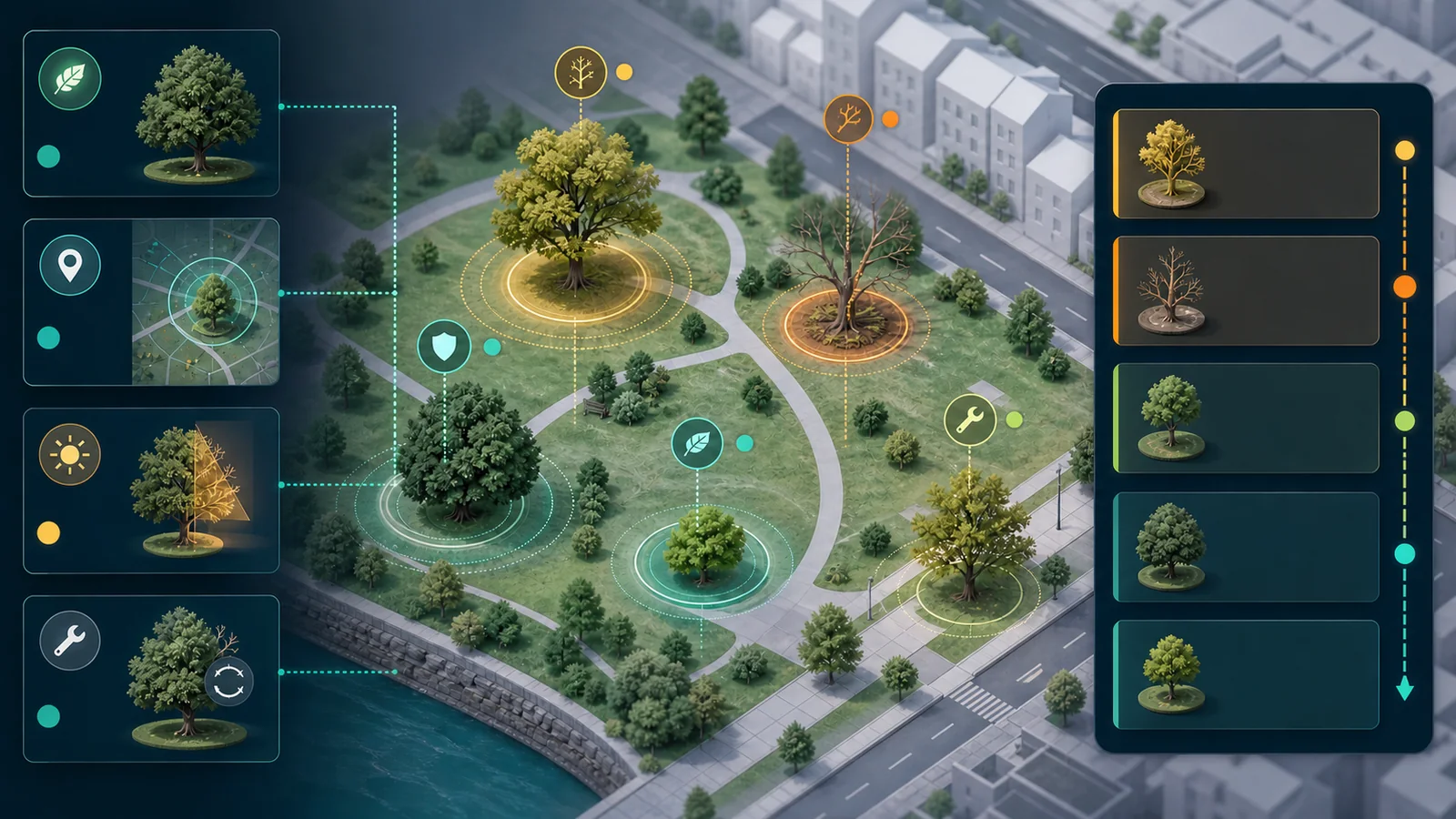
Risk prioritization combines the condition of a tree with its location, exposure, and urgency rather than relying on one field alone.
For campuses, municipalities, and property portfolios, this spatial layer creates a broader picture of how the inventory interacts with buildings, utilities, paths, and public activity.
Historical Records Reveal Patterns
A single inspection provides a snapshot; a series of inspections shows change. With accurate histories, teams can see whether a defect is stable, improving, or becoming more serious. They can identify trees that repeatedly require attention and compare the results of different maintenance approaches.
Patterns also emerge across the inventory. A species may show recurring health problems in one area, trees planted at the same time may reach similar maintenance stages, or storm damage may cluster in exposed locations. These insights are difficult to obtain from isolated records. They appear when observations and completed work remain connected over time.
Business Intelligence Supports Better Prioritization
Tree care budgets and crew capacity are limited. Organizations rarely have the resources to complete every recommendation immediately, so they need a defensible way to decide what comes first.
Tree data can support that decision by combining condition, exposure, location, urgency, and work history. Managers can distinguish assets that need prompt action from those suitable for monitoring or inclusion in a future program. This approach helps teams turn data into action before a complaint, service interruption, or visible failure forces a reactive response.
Prioritization also makes budget conversations clearer. A manager can show why a project requires funding, which recorded conditions support the recommendation, and what exposure may remain if work is delayed. The result is not a perfect prediction; it is a transparent decision trail that can be reviewed and updated.
Operational Data Improves Crew Planning
Tree data becomes more valuable when it connects directly to daily operations. Inspection recommendations should flow into work orders, schedules, and completion records without being manually recreated. A basic process mapping exercise can reveal where information is copied, delayed, or lost between inspection and field work.
When the workflow is connected, managers can see what is pending, assigned, underway, or complete. They can balance workloads, match equipment and qualifications to job requirements, and coordinate activity across multiple locations. Field teams can review locations, photos, access details, and previous work before they arrive, reducing uncertainty and helping them prepare.
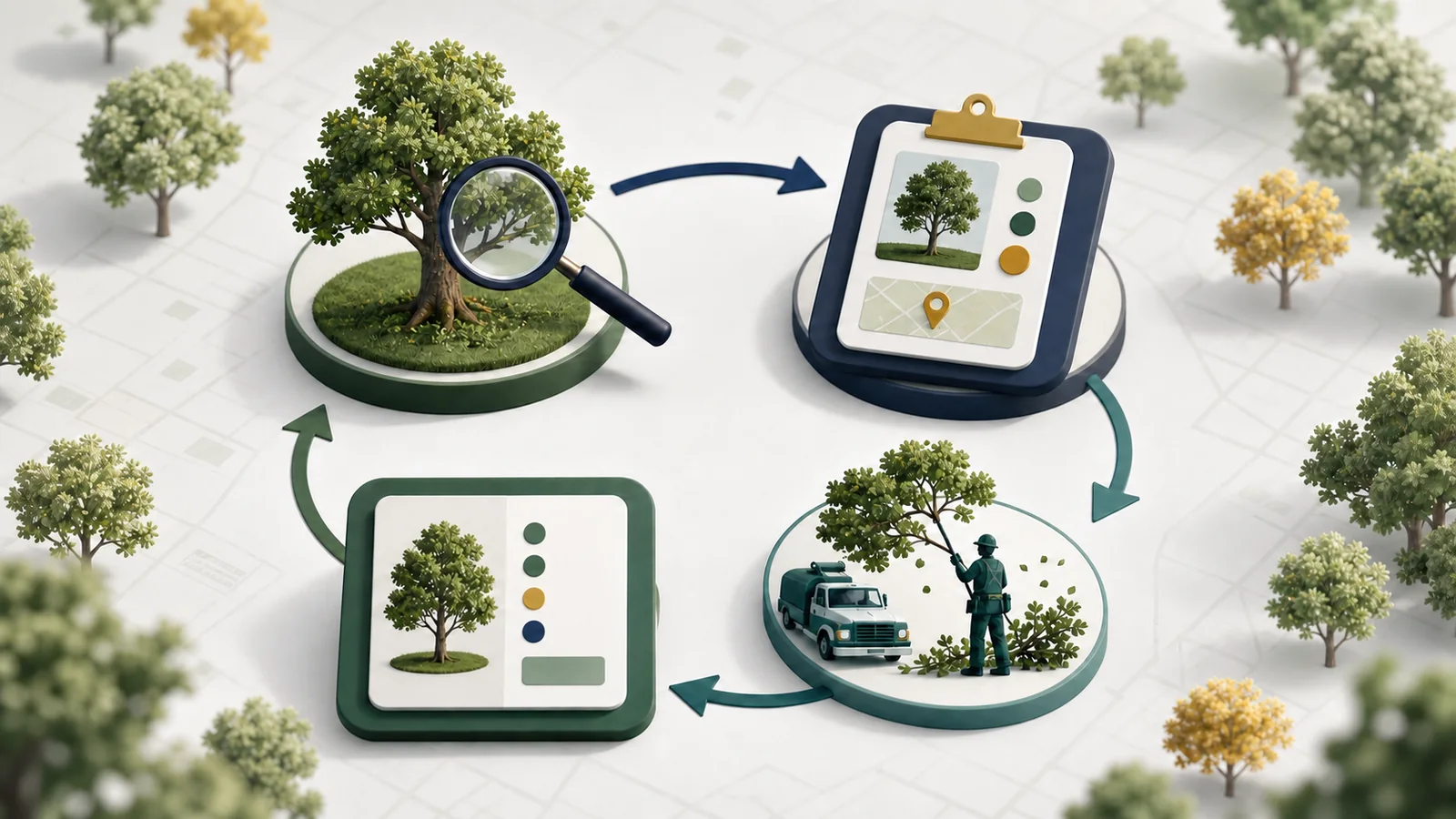
A connected workflow returns completed field work to the same record, creating a continuous information cycle.
After a job, the crew's update should return to the same asset record. That feedback closes the loop and prevents inspection and maintenance information from drifting into separate systems.
Data Can Improve Long-Term Planning
Tree management is not only about current maintenance. Organizations also plan for ageing populations, replacements, canopy goals, and future budget requirements. Historical condition, species, age, and work records can help managers identify likely needs over the next several years and distribute spending more deliberately.
The same information can support diversity planning. If one species represents a large share of a site, future planting can reduce that concentration. Managers can also compare replacement timing with other capital work, avoiding conflicts and coordinating access. Long-term plans remain estimates, but maintained records give those estimates a stronger foundation than emergency-driven annual guesswork.
Dashboards Should Lead to Action
Dashboards can make a large inventory easier to understand, but visualization is not the final outcome. A chart showing high-priority trees is useful only when someone can review, assign, schedule, and track the required work. Effective systems treat dashboards as part of the workflow, with clear paths from an insight to a responsible owner and a measurable next step.
This is where many data projects lose value. They improve collection and reporting while leaving operational follow-up in email, separate spreadsheets, or memory. A better approach lets a manager move from a filtered view to a work queue, record the decision, and see whether the response was completed.
Data Quality Requires Ongoing Governance
Tree information changes whenever an asset is inspected, pruned, damaged, removed, or replaced. Records become unreliable when nobody owns those updates. Organizations need clear rules for who can create, edit, verify, and close records, along with shared definitions for required fields.
Duplicate assets should be reviewed, incomplete entries corrected, and outdated recommendations resolved. Regular quality checks are particularly important when several contractors or departments contribute data. Governance is not a one-time cleanup; it is the routine that keeps information comparable and trustworthy enough to support decisions.
Conclusion
Tree data becomes valuable when it moves beyond storage and supports real decisions. Standardized records, accurate locations, maintained history, and connected work updates can improve risk priorities, crew coordination, maintenance plans, and long-term budgets.
The goal is not to build the largest possible inventory. It is to maintain an information system that helps people decide what needs attention, why it matters, who will act, and what happened afterward. That is the point where tree data becomes actionable business intelligence.
Frequently Asked Questions
What makes tree data actionable?
Tree data becomes actionable when consistent inspection, condition, location, history, and recommended-work records feed a workflow with clear priorities, owners, schedules, and completion updates. The value comes from the decisions and follow-up the data supports, not from the size of the inventory.
How does location data improve tree-risk prioritization?
Location shows what surrounds a tree and who or what may be exposed if its condition worsens. A declining tree near a building, road, or playground may need attention sooner than a similar tree in a low-use area, while mapping also helps group nearby work and plan crew travel.
Why does tree-data governance require ongoing maintenance?
Tree records change as assets are inspected, pruned, damaged, removed, or replaced. Clear ownership, shared field standards, duplicate review, and regular quality checks keep the information current enough to support reliable risk, maintenance, and budget decisions.
Related Articles
Turning Data into Action: How Smart Analytics Drives Business Growth
Beyond Beautiful Dashboards: How Operational Infrastructure Turns Data Into Execution
Data Storytelling With Charts Examples: Fix Costly Pitfalls
What is Resource Allocation? A Thorough Guide for Peak Efficiency