10 Best AI Checker Tools to Detect AI-Generated Text
Compare ten AI text checkers, see how they handle edited writing, and learn why a detection score is a signal—not proof of authorship.

What changed (Nov 09, 2026): Published this contributed comparison with an original hero illustration, optimized product screenshots, a review-workflow diagram, and an explicit disclosure of the vendor-run benchmark.
Run the same paragraph through three AI detectors and you may get three different answers. One can label it AI-written, another can call it human, and a third may return an uncertain or mixed result. That makes choosing the best AI detector harder than simply picking the tool with the boldest accuracy claim.
To make the comparison more useful, we looked at results from 750 texts tested across eight AI detection tools, producing 6,000 individual verdicts. The test included fully generated, AI-edited, rewritten, and humanized text rather than only raw chatbot output. We also included Grammarly and Turnitin because both are widely used, although they were not part of the same benchmark and are clearly marked as such below.
Benchmark disclosure: The eight-tool ranking reports Clever AI Detector’s August 2026 benchmark on a subset of the GEDE dataset. Clever conducted the comparison and also appears in it. These are vendor-reported results, not an independent AFFiNE test or a ranking produced by the GEDE researchers. Grammarly and Turnitin were not included in that run.
What AI Checker Tools Actually Measure
An AI checker does not have access to a hidden record showing whether ChatGPT, Claude, Gemini, or another model wrote a passage. Instead, AI detection tools analyze patterns in the text and estimate whether those patterns resemble machine-generated writing.
Depending on the detector, the analysis may consider predictability, repetition, sentence variation, word choice, and other statistical features. AI models tend to produce language by predicting likely next tokens, so their output can sometimes be more statistically regular than human writing. Human prose, however, can be predictable too. Technical documentation, academic essays, non-native English writing, and heavily edited copy may all contain patterns that confuse an AI writing detector.
This also explains why text length matters. A detector has far more linguistic information to work with in a 1,000-word article than in a 100-word email. In the benchmark used for this comparison, several tools performed substantially worse on texts below 200 words.
The other challenge is editing. Detecting untouched chatbot output is now the easy part. The rankings change much more once a person edits the draft, a model rewrites human text, or generated content is deliberately humanized. A user can humanize your AI text for free before checking it again, for example, which changes the vocabulary, sentence rhythm, and structure that a detector analyzes.
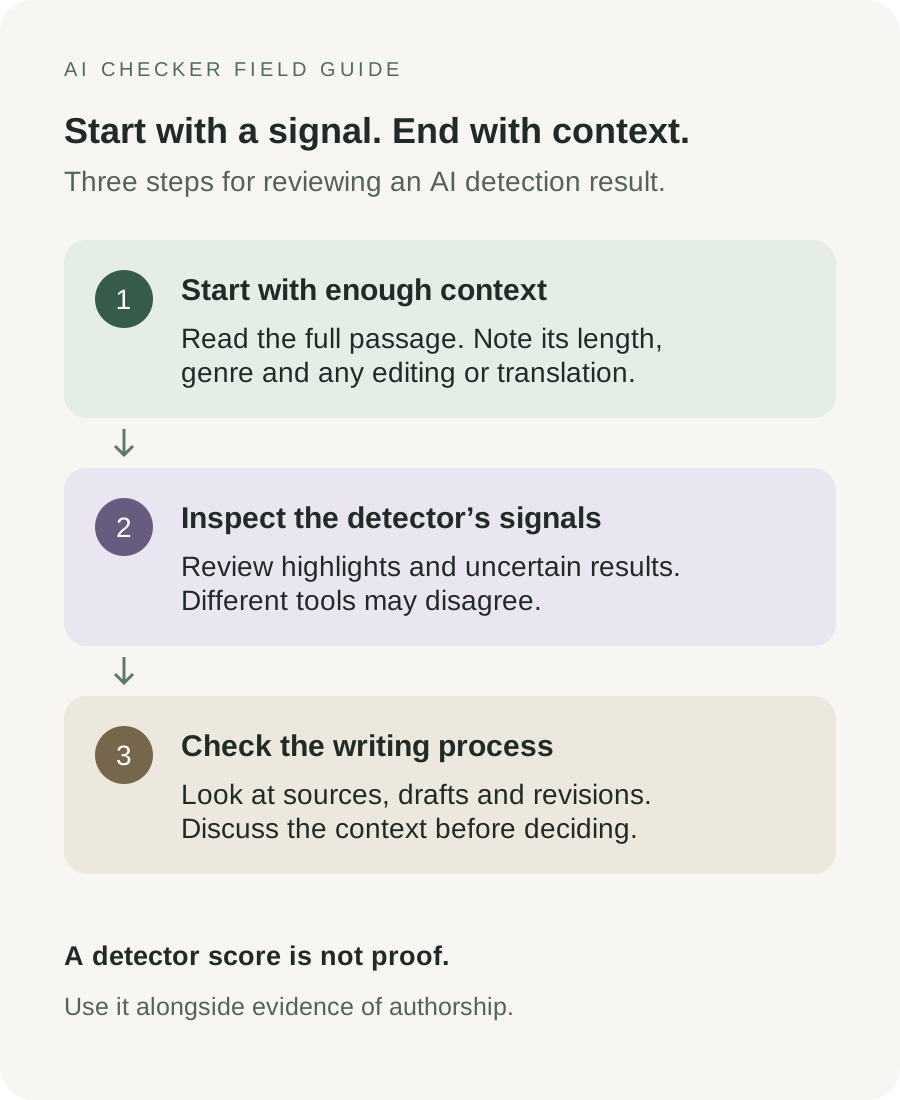
How We Compared the Best AI Checker Tools
The main eight-tool comparison is based on a benchmark run in August 2026 using the Generative Essay Detection in Education (GEDE) dataset, created by Lukas Gehring and Benjamin Paaßen at Bielefeld University. The researchers describe the dataset and their methodology in their published research paper.
The test used 750 texts, with 150 examples in each of five categories: fully AI-generated text, human writing improved by AI, human writing rewritten by AI, humanized AI text, and completely human-written control essays. Eight detectors processed each text once, producing 6,000 verdicts.
For this article, the main ranking follows overall detection rate across the 600 AI-involved texts. We also look at each detector's weakest category because a high average can hide a major blind spot. For example, a tool can detect practically all raw ChatGPT output but miss most AI-edited human drafts.
All eight detectors produced zero false flags on the 150 human control essays. That should not be interpreted as a guaranteed 0% false-positive rate. With only 150 control texts, the true rate could still be higher, and the sample does not represent every type of human writing.
10 Best AI Checker Tools to Detect AI-Generated Text
The first eight positions below follow overall detection performance in the common benchmark. Grammarly and Turnitin are included separately because they are major AI detection products but were not run on the same 750-text test. Their results should therefore not be compared directly with the percentages reported for the first eight tools.
1. Clever AI Detector — Best Free AI Checker Overall
Clever AI Detector finished first by overall detection rate, identifying 96.7% of the 600 AI-involved texts. More importantly, it was the only detector in the benchmark that stayed above 90% across all four AI categories. Its weakest result was 92% on humanized AI text, while it reached 94.7% on human drafts improved by AI and 100% on directly generated and AI-rewritten text.
Copyleaks performed slightly better on humanized content, while Originality.ai Lite performed slightly better on AI-improved drafts. Those differences were small. The overall gap between Clever and Copyleaks was also only ten texts out of 600, so the benchmark does not support treating the two as dramatically different on average.
Where Clever has a practical advantage is access. The best AI checker tool can be used for free without creating an account, accepts up to 10,000 words per check, and does not impose a fixed number of checks.
Pros: Strong performance across all four AI categories, good results on humanized and edited text, free access, no sign-up requirement, and support for long documents.
Cons: The benchmark placing it first was conducted by the company behind the product, so the results should be read with that disclosure in mind.
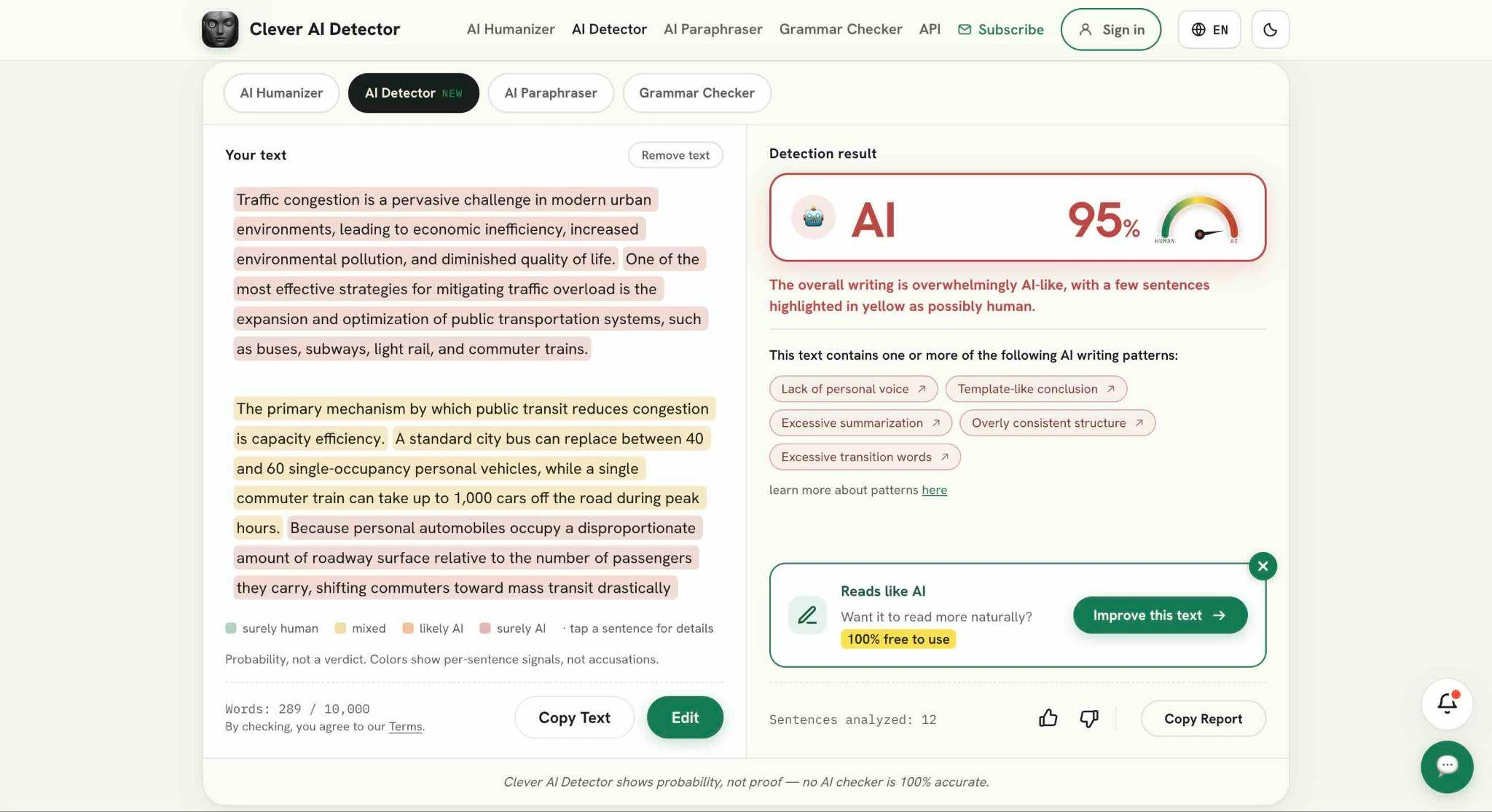
Best for: Writers, editors, students, publishers, and anyone looking for the best free AI detector without sacrificing performance on edited text.
2. Copyleaks — Best for Consistency Across Different Types of AI Text
Copyleaks came second with a 95% overall detection rate. Its weakest category was AI-improved human writing at 86.7%, which still placed it well ahead of most competitors on worst-case performance.
It also produced the highest humanized-text result in the benchmark at 93.3%, narrowly ahead of Clever AI Detector at 92%. That matters because deliberately paraphrased or humanized AI content was one of the hardest categories for most other tools.
Copyleaks also held up comparatively well on short text. In the under-200-word group, it detected 83.3% of AI-involved samples, making it the strongest third-party tool in that length range.
Pros: Very consistent across categories, excellent humanized-text detection, strong short-text performance, and products aimed at education and business users.
Cons: Full professional use is paid, and its lowest category remains several points below its headline average.
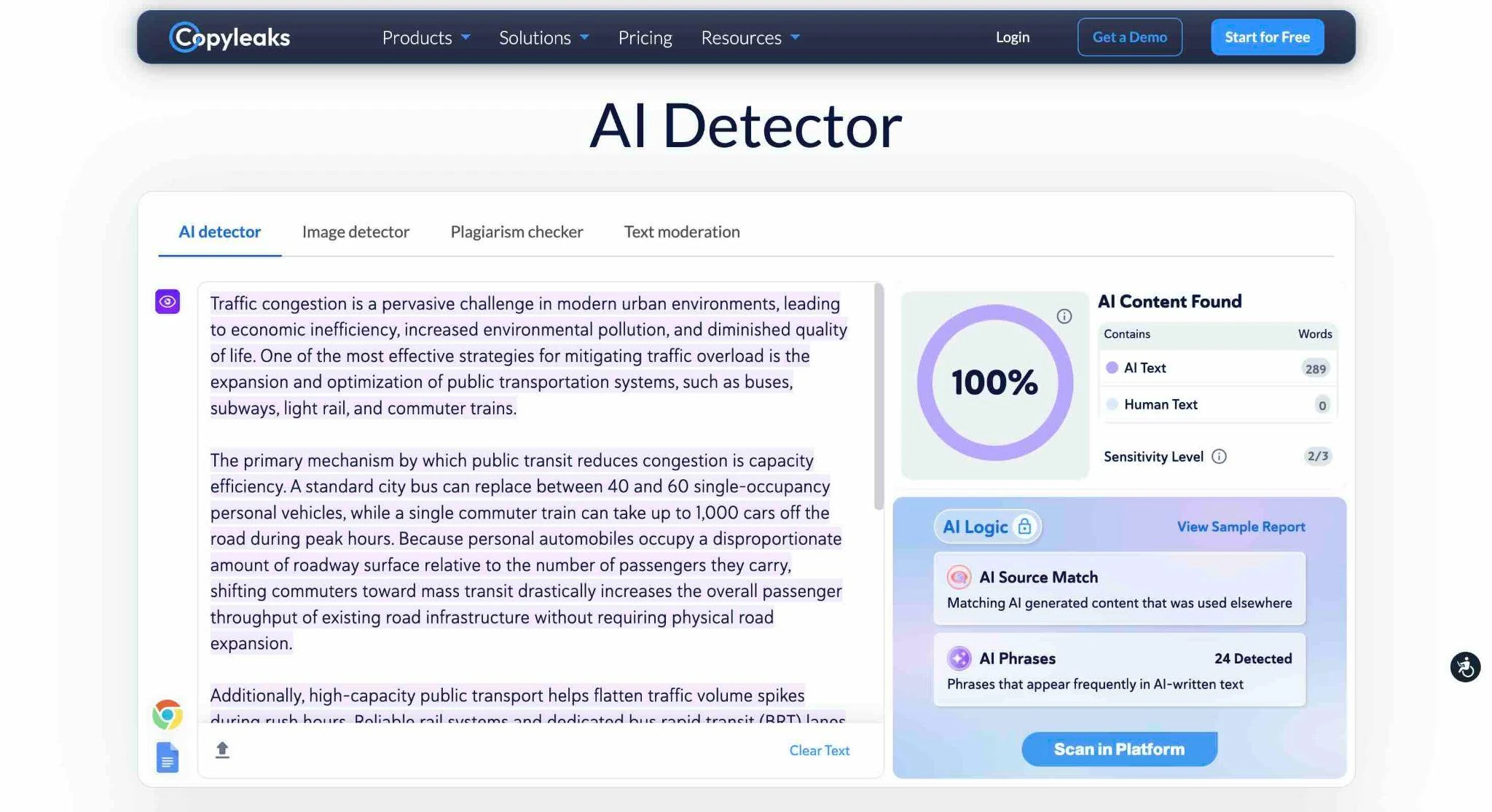
Best for: Organizations that want a paid AI content detector with consistent performance rather than a tool optimized only for raw AI output.
3. Originality.ai Lite — Best for AI-Edited Human Drafts
Originality.ai Lite detected 86.8% of the AI-involved texts overall. Its standout result came from the AI-improved category, where it reached 96% — the highest result among the eight tools for human-written drafts that had been polished by a model.
The trade-off was humanized AI content. Detection fell to 51.3%, meaning roughly half of the adversarially paraphrased samples were not identified under this test.
It is also important to note that the test used the Lite model. Originality.ai offers other detection models designed for different sensitivity levels, so this result should not be treated as a score for every version of its detector.
Pros: Excellent performance on AI-assisted editing, 100% detection of directly generated and AI-rewritten text in the benchmark, and features aimed at publishers and content teams.
Cons: Humanized AI was a clear weakness in the tested Lite model, and performance dropped on shorter samples.
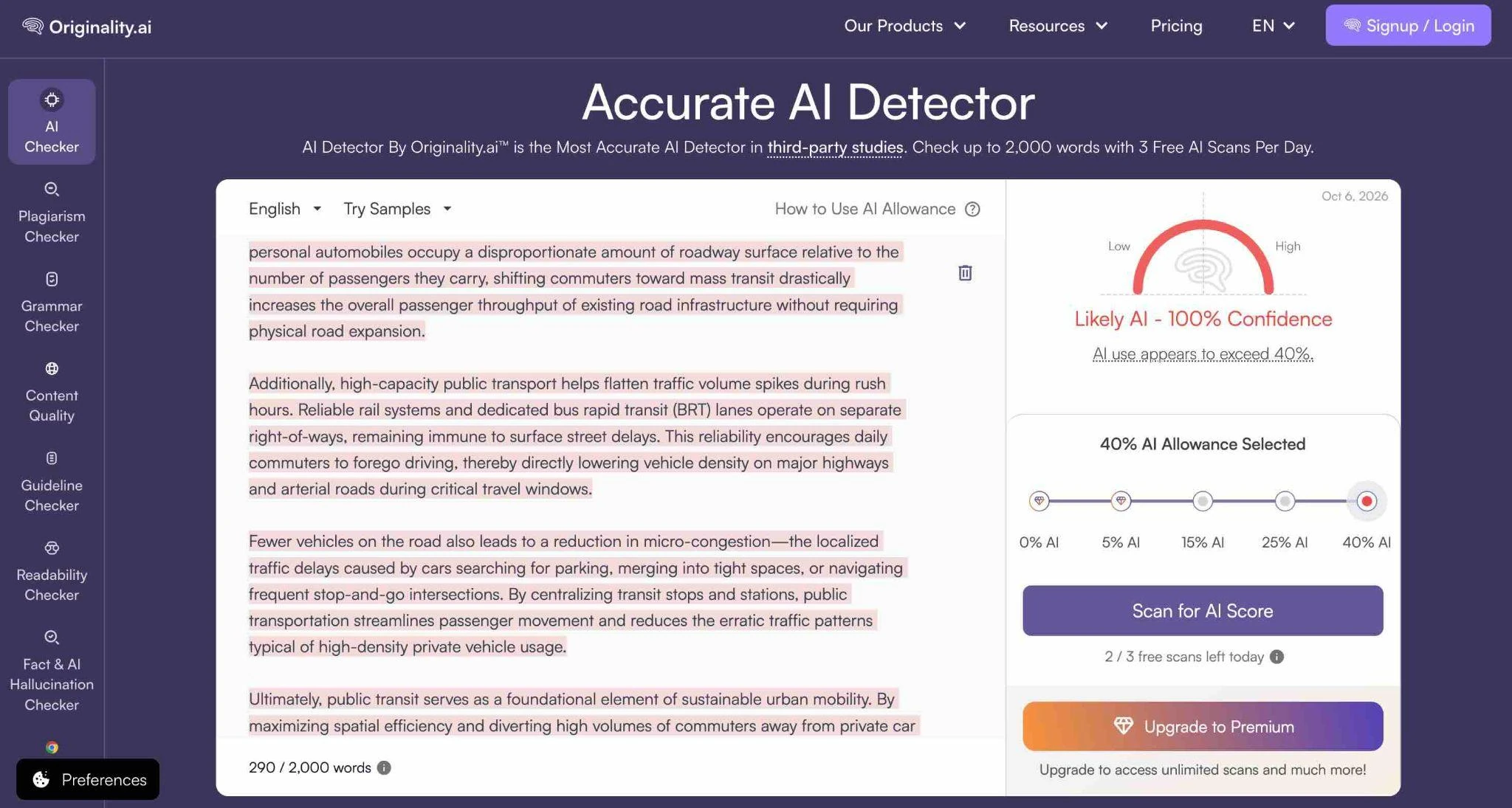
Best for: Publishers and editors primarily concerned about AI-assisted or machine-polished drafts.
4. Winston AI — Best for Publisher Workflows
Winston AI recorded an 82.7% overall detection rate. Its performance pattern was similar to Originality.ai Lite: very strong results on directly generated and rewritten text, followed by a significant decline on humanized content.
It detected 86% of AI-improved drafts but only 44.7% of humanized AI text. Length also had a noticeable effect. Detection fell to 41.7% below 200 words, compared with much stronger performance in mid-length samples.
That does not make Winston a poor product. It shows why a single advertised accuracy number cannot describe every real-world use case. Winston combines AI detection with tools designed for professional editorial and content-review workflows, which may matter more to a team than winning every benchmark category.
Pros: Strong direct and rewritten-AI detection and a workflow designed for professional content review.
Cons: Humanized content and short text were significant weak points in this benchmark.
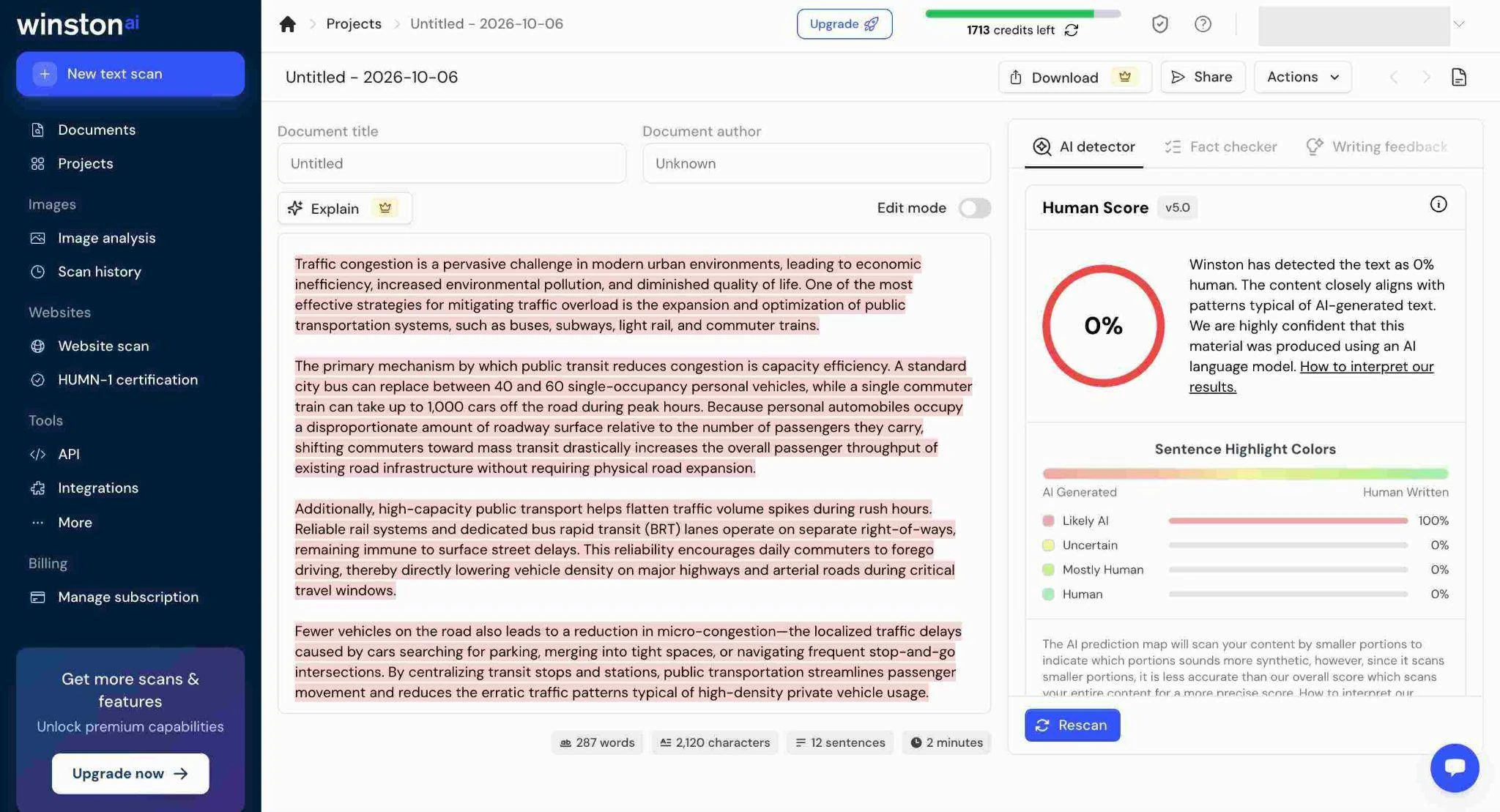
Best for: Publishers and content teams that want AI checking within a broader editorial workflow.
5. Pangram — Best for Fully Generated AI Content
Pangram achieved a 67.5% overall detection rate, but its results show why averages need context. It detected 100% of directly generated AI text, yet only 18% of human-written drafts that had been improved by AI.
Its profile was unusual in another way: Pangram performed much better on deliberately humanized AI text, detecting 64%, than on lightly AI-edited human writing. That is the opposite of the pattern seen with Originality.ai Lite and Winston AI.
Pangram also returned 34 mixed verdicts on texts that genuinely involved AI. Under the strict methodology used here, those were treated as misses. Counting them as detections would increase its overall rate from 67.5% to 73.2%.
Pros: Perfect detection of raw AI in this test and comparatively solid performance on humanized content.
Cons: Weak performance on AI-improved human drafts and a meaningful number of ambiguous verdicts.
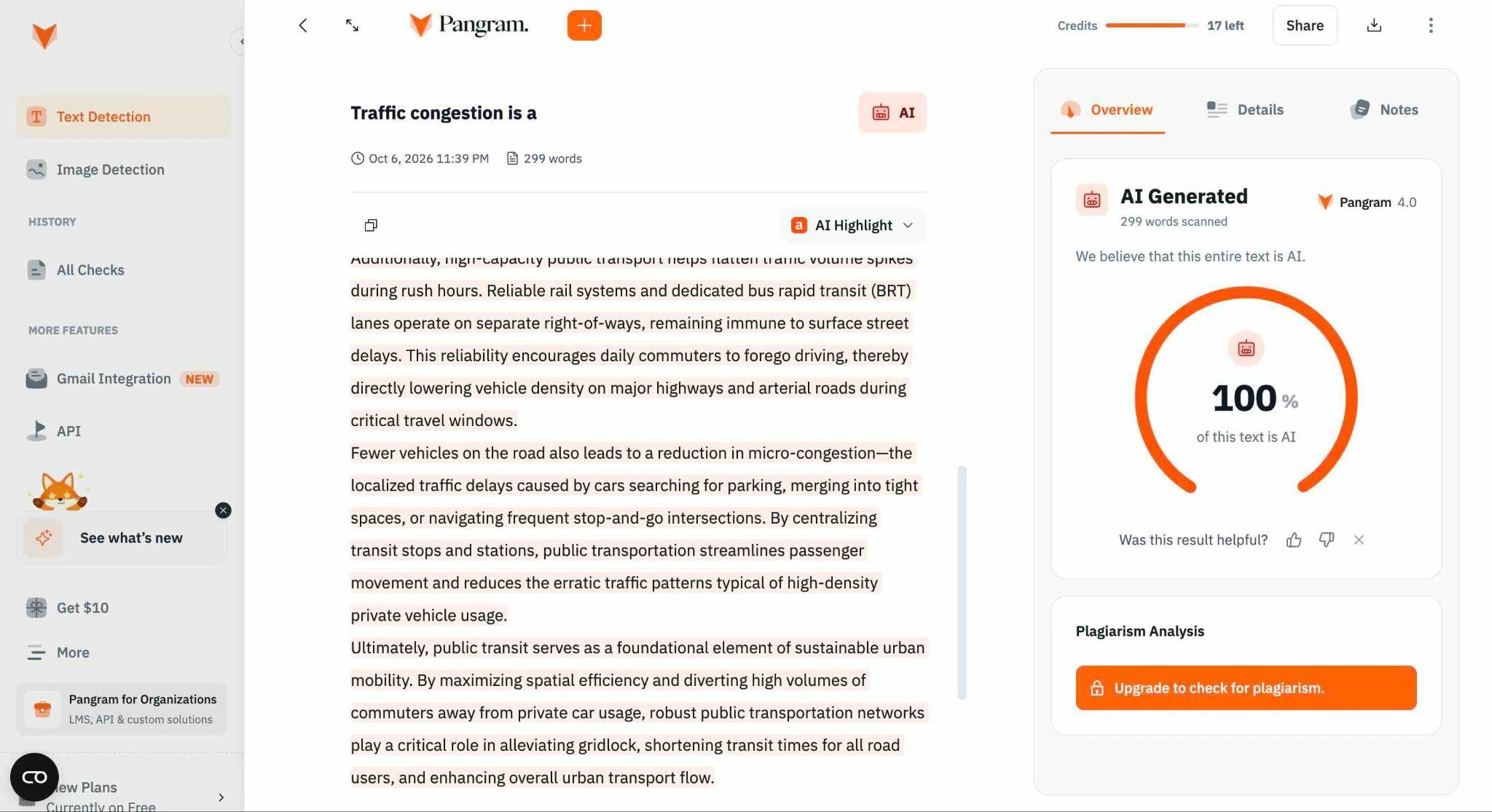
Best for: Users mainly screening for text produced primarily by a generative model rather than human drafts that received lighter AI assistance.
6. QuillBot AI Detector — Best for a Quick Free Check
QuillBot reached 64.2% overall. It performed very well on straightforward machine-generated writing and detected 96.7% of AI-rewritten text, but its results dropped sharply in harder scenarios.
Only 22% of humanized AI text was detected. Text length was an even bigger problem: among benchmark samples below 200 words, detection fell to 12.5%.
QuillBot itself advises users to provide at least 80 words and notes that longer samples generally produce more reliable results. Its free AI detector also makes it accessible for casual checks.
Pros: Free option, easy to use, integrated with other writing tools, and effective on straightforward AI-generated text.
Cons: Weak humanized-text detection and particularly poor results on short benchmark samples.
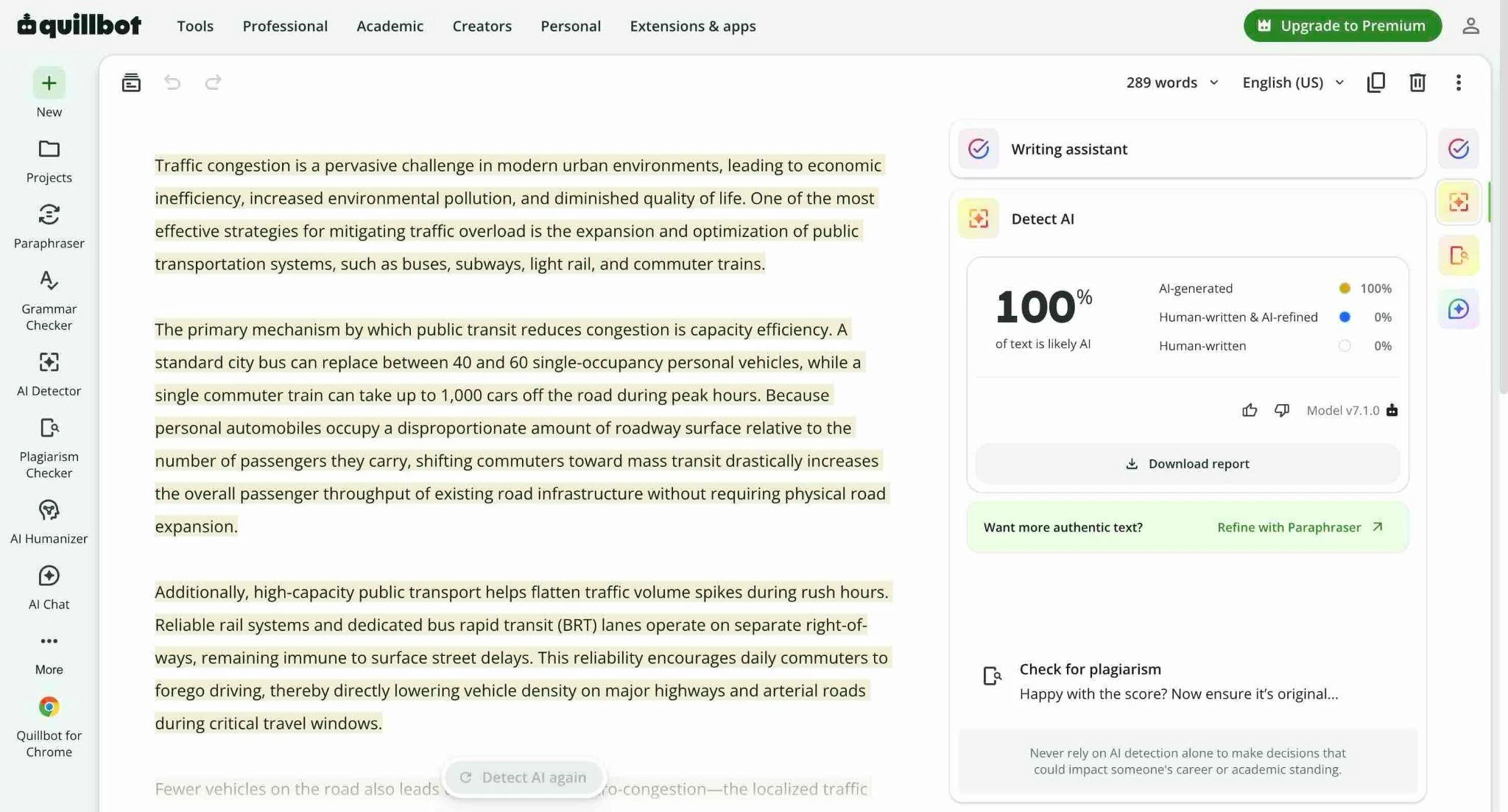
Best for: A quick free AI checker when the text is long enough and a rough screening result is sufficient.
7. GPTZero — Best for Education-Focused Features
GPTZero is one of the most recognizable names in AI detection, but it finished seventh among the eight commonly tested tools with a 43.7% overall detection rate.
The underlying results were highly uneven. GPTZero caught 92.7% of directly generated AI essays and 73.3% of humanized AI text, the third-highest result in that category. However, it detected only 1.3% of AI-improved human drafts and 7.3% of AI-rewritten human writing.
This illustrates an important distinction between detector accuracy and the overall usefulness of a product. GPTZero has been developed heavily around education, including tools for teachers and institutional workflows. A school may value those features even if another detector performs better on a particular benchmark.
Pros: Strong recognition of direct AI and surprisingly good humanized-text performance, plus an established education-focused ecosystem.
Cons: Very weak performance on AI-assisted and rewritten human drafts in the GEDE test.
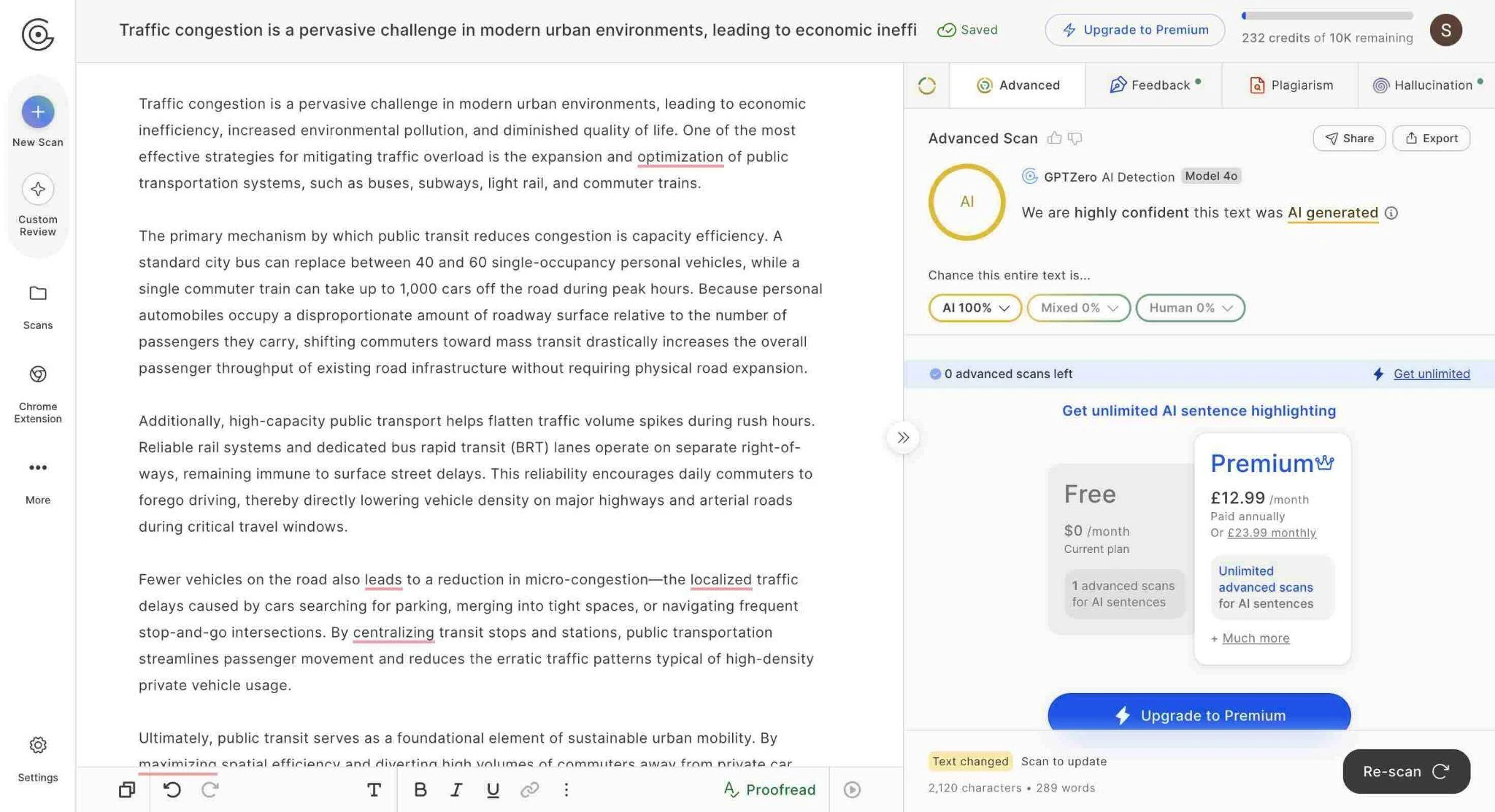
Best for: Education users who value classroom and institutional features alongside AI detection.
8. ZeroGPT — Best for Simple One-Off Checks
ZeroGPT ranked last in the common benchmark under the strict scoring rule, detecting 18.8% of the 600 AI-involved samples. It returned particularly low results on the harder categories: 0% for AI-improved human drafts, 4.7% for rewritten text, and 0.7% for humanized AI.
There is an important qualification. ZeroGPT produced 175 “mixed” verdicts, and every one of those texts genuinely involved AI. Because mixed results were counted as non-detections, they reduced its score considerably. If mixed results were treated as positive flags instead, its rate would rise to 48%.
Short samples were also a major weakness. It detected none of the AI-involved benchmark texts below 200 words.
Pros: Simple interface and a useful additional signal for casual checks.
Cons: Low strict detection rate, many ambiguous results, and very weak short-text performance in this test.
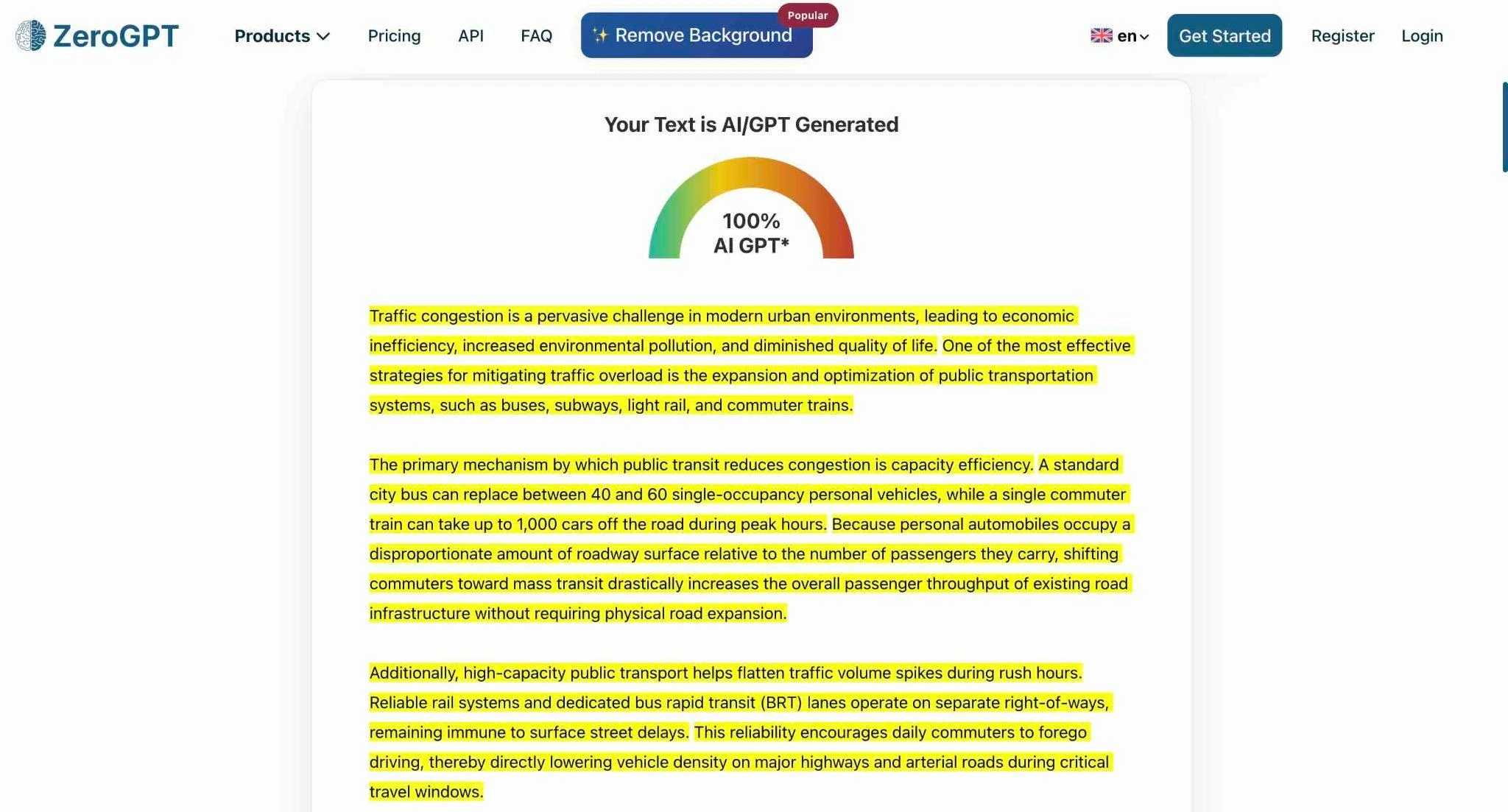
Best for: Low-stakes secondary checks rather than decisions where the result has serious consequences.
9. Grammarly AI Detector — Best Inside a Writing and Editing Workflow
Grammarly was not part of the GEDE benchmark above, so assigning it a directly comparable percentage would be misleading. It is included because its AI detector is now integrated with one of the largest writing-assistance ecosystems.
Grammarly states that its detector achieved 99% detection accuracy and ranked first on the independent RAID benchmark. That is useful evidence, but RAID and GEDE measure different datasets and conditions, so the numbers should not be placed in the same performance column.
Where Grammarly stands out is workflow. Users can check writing for AI patterns, review why passages may have been flagged, edit the document, check citations, and use Authorship features designed to provide more context about how a document was produced.
Pros: Strong independent RAID result, free AI checking, and close integration with editing, citation, plagiarism, and authorship tools.
Cons: It was not part of the common 750-text test used for positions one through eight, so this article cannot compare its performance directly.
Best for: Writers already using Grammarly who want AI detection within the same editing workflow.
10. Turnitin — Best for Institutional Academic Use
Turnitin serves a different market from most consumer AI checker tools. Its AI writing detection is built into institutional academic-integrity workflows rather than positioned mainly as a standalone free checker.
Turnitin was not included in the GEDE run used for the first eight rankings, largely because its institutional access model makes an identical public test more difficult. For that reason, we have not assigned it an overall detection percentage here.
Its main advantage is integration. Universities and schools can review AI-writing indicators alongside similarity reports and other assignment information without asking students or instructors to move text between several separate services.
Turnitin has also acknowledged the limits of AI detection publicly. Its own guidance cautions against treating an AI score as the sole basis for adverse action.
Pros: Deep integration into academic workflows and established institutional reporting.
Cons: Not a practical standalone option for many individual users and not tested in the common benchmark used for this ranking.
Best for: Schools and universities already using Turnitin for academic-integrity review.
AI Detector Comparison: All 10 Tools at a Glance
| AI Detector | Overall Detection | Weakest Category | Humanized AI | Access | Best For |
|---|---|---|---|---|---|
| Clever AI Detector | 96.7% | 92.0% | 92.0% | Free | Best free all-rounder |
| Copyleaks | 95.0% | 86.7% | 93.3% | Paid options | Consistent professional checks |
| Originality.ai Lite | 86.8% | 51.3% | 51.3% | Paid | AI-edited drafts |
| Winston AI | 82.7% | 44.7% | 44.7% | Paid options | Publisher workflows |
| Pangram | 67.5% | 18.0% | 64.0% | Commercial | Fully generated text |
| QuillBot AI Detector | 64.2% | 22.0% | 22.0% | Free + Premium | Quick free checks |
| GPTZero | 43.7% | 1.3% | 73.3% | Free + paid options | Education workflows |
| ZeroGPT | 18.8% | 0% | 0.7% | Free + paid options | Secondary checks |
| Grammarly AI Detector | Not tested | Not tested | Not tested | Free + paid ecosystem | Integrated writing workflow |
| Turnitin | Not tested | Not tested | Not tested | Institutional | Academic integrity |
The comparison makes one point especially clear: the most accurate AI detector depends heavily on what kind of AI writing you expect to encounter. Direct AI generation barely separates the leading tools because six of the eight benchmarked detectors caught every raw AI sample. Humanized and AI-edited writing produced much larger differences.
Why Every AI Checker Seems to Advertise 99% Accuracy
Two companies can publish apparently conflicting accuracy numbers without either number being fabricated. They may simply be measuring different things.
A detector tested on untouched output from popular language models has a much easier task than one tested on AI-edited human work, paraphrased text, multiple genres, short passages, or deliberate attempts to evade detection. In the GEDE-based benchmark, six detectors achieved 100% detection on direct AI output. On AI-improved human drafts, however, results ranged from 0% to 96%. On humanized AI, the spread was 0.7% to 93.3%.
Real-world text may go through several additional steps before anyone checks it. A writer can edit individual sentences, ask another model to rewrite passages, or use a tool to paraphrase entire text. Each transformation changes the patterns the detector receives, so an accuracy figure measured only on untouched model output may say little about performance on edited content.
The dataset also matters. A balanced benchmark containing equal numbers of AI and human texts does not necessarily represent the environment where a detector will actually be used. In a classroom where almost every submission is human-written, even a low false-positive rate can create a meaningful number of incorrect accusations.
This is why a headline such as “99% accurate” tells you less than it appears to. A better question is: how often does the tool fail on texts similar to the ones I plan to check?
Frequently Asked Questions
What is the best free AI detector?
Based on this comparison, Clever AI Detector is the best free AI detector. It combined free access with the highest overall result among the eight commonly benchmarked tools and the highest weakest-category score. QuillBot and ZeroGPT also offer free AI checking but performed substantially worse on difficult modified-AI cases in this test.
Can an AI checker detect ChatGPT text?
Yes, especially when the output has been copied directly from a chatbot. Directly generated AI was the easiest category in the benchmark, with six of eight detectors identifying 100% of those samples. Detection becomes less consistent after the text has been edited, rewritten, or humanized.
Can AI detectors detect paraphrased or humanized AI text?
Some can, but results vary sharply. On the same set of 150 humanized AI essays, detection ranged from 0.7% to 93.3%. Copyleaks and Clever AI Detector were the only two tools above 90% in that category.
Why do two AI checkers give different results?
Each AI detection tool uses its own models, training data, thresholds, and verdict rules. In the GEDE-based benchmark, the average pairwise agreement between two detectors was only 62.3% across AI-involved texts and 52.6% on humanized AI. A disagreement is therefore not unusual.
How much text should I use to check for AI?
There is no universal minimum that guarantees a reliable result, but longer coherent passages generally give detectors more statistical evidence. Short samples were a major weakness in this benchmark. Below 200 words, QuillBot detected only 12.5% of AI-involved samples and ZeroGPT detected none. Even the strongest tools were not perfect in that range.
Can an AI detector prove that someone cheated?
No. An AI content detector estimates whether a piece of text resembles writing produced by a model. It does not record who wrote the document or how it was created. In education, publishing, recruitment, or employment, a detector score should be a reason to review additional evidence rather than a final verdict.
Final Verdict
If you only need to check whether a passage was copied directly from an AI chatbot, several tools can do the job well. The differences become much more important when the writing has been edited, rewritten, or deliberately humanized.
Clever AI Detector is our pick for the best free AI detector in this comparison. It ranked first overall at 96.7%, stayed above 90% across every tested AI category, accepts long checks without requiring an account, and does not put its strongest performance behind a paid plan. Copyleaks is the closest alternative and may be the better choice for organizations that need a mature paid workflow or enterprise integrations.
Whichever top AI checker you use, treat its output as a screening signal rather than proof. The most useful AI detection process combines a detector with the text itself, its sources, and evidence of how the document was created. For content teams, that means building review into the workflow itself; our guide to AI content marketing with human checkpoints shows one way to do it.
