Business Requirements Document Template (Free BRD + Example)
Free business requirements document template with a worked example, a 7-step method for writing a BRD, testable requirement rules, and BRD vs PRD explained.

A business requirements document (BRD) explains why a project exists and what the business needs from it, before anyone designs a solution. A good business requirements document template gives you fixed sections for the problem, measurable objectives, scope, stakeholders, numbered business requirements, constraints, risks, and sign-off, so every project answers the same questions in the same order.
This guide gives you a free BRD template you can copy below, a fully worked example, a seven-step method for writing one, and a clear answer to BRD vs PRD.
Short version
- A BRD answers "why" and "what outcome", in business language. It does not specify screens, features, or architecture.
- The core of the document is the requirements table: one testable statement per row, each with an ID, priority, source, and acceptance measure.
- A PRD comes after the BRD and describes the product that meets those needs. Every PRD item should trace back to a BRD requirement.
- Copy the template in the Use the template section and fill it in with the worked example as a guide.
Published by AFFiNE, which makes a workspace where teams write documents like this one. Definitions and frameworks were checked against primary sources on October 28, 2026. Sources are listed at the end.
What is a business requirements document?
The International Institute of Business Analysis (IIBA) defines a business requirement as "a representation of goals, objectives and outcomes that describe why a change has been initiated and how success will be assessed." A business requirements document is where those requirements are written down, agreed, and approved.
The BABOK Guide glossary separates requirements into layers, and the layers explain what belongs in a BRD and what does not:
| Layer (IIBA term) | What it describes | Example | Usually lives in |
|---|---|---|---|
| Business requirement | Why the change is happening and how success is measured | Reimburse 90% of approved expense claims within 5 working days | BRD |
| Stakeholder requirement | What a specific group needs so the business requirement can be met | Finance needs every claim coded to a cost center before approval | BRD |
| Solution requirement (functional) | What the solution must do | The system routes each claim to the submitter's manager | PRD, FRD, or SRS |
| Solution requirement (non-functional) | Quality attributes, such as performance or security | Approval pages load in under 2 seconds on mobile | PRD, FRD, or SRS |
A BRD covers the first two layers and stops there. If your draft starts describing buttons and database fields, that content belongs in a later document.
When you need a BRD, and when you do not
Write a BRD when a change crosses teams, involves a vendor or a procurement decision, needs budget approval, or touches regulated processes. In those cases, a signed list of business needs protects everyone when scope questions come up three months later.
Skip the formal BRD for small changes inside one team. A short project charter or a ticket with clear acceptance criteria is enough. The questions a BRD asks still matter; the full document does not.
What to include in a business requirements document template
These are the sections in our template, what each one is for, and the question it must answer. Asana, Atlassian, and ProjectManager publish BRD templates with similar core sections; ours adds explicit out-of-scope lines, an acceptance measure on every requirement, and an open-questions log, because those are the gaps that cause most rework.
| Section | Question it answers | Tip |
|---|---|---|
| Document control | Which version is this, and who owns it? | Version, status, owner, and approvers at the top |
| Executive summary | What is this project in one paragraph? | Write it last |
| Problem and current state | What is going wrong today, and what does it cost? | Use numbers from current reports |
| Business objectives | What will be measurably better, and by when? | Baseline, target, date |
| Scope | What is in, and what is explicitly out? | Out-of-scope lines prevent most disputes |
| Stakeholders | Who is affected, who decides, who is consulted? | Name people, not just teams |
| Business requirements | What does the business need? | One testable statement per row |
| Assumptions and constraints | What are we taking as true, and what is fixed? | Budget, dates, regulation, systems |
| Risks and dependencies | What could stop us, and who owns each risk? | One owner per risk |
| Success metrics | How will we judge the result after launch? | Tie back to the objectives |
| Open questions | What do we still not know? | Owner and due date on each |
| Glossary | Which terms could two readers understand differently? | Define them once |
| Sign-off | Who approved which version, and when? | Required before design starts |
BRD vs PRD vs FRD
Teams use these acronyms loosely, and that is how features get built for problems nobody agreed on. The cleanest distinction is by question: the BRD asks why and what outcome, the PRD asks what product, and the functional requirements document (FRD) or software requirements specification (SRS) asks exactly how the system behaves.
| BRD | PRD | FRD or SRS | |
|---|---|---|---|
| Main question | Why change, and what outcome do we need? | What product or release meets the need? | How must the system behave? |
| Typical author | Business analyst or project manager | Product manager | Business or systems analyst, engineering |
| Audience | Sponsor, business owners, project team | Design, engineering, QA, go-to-market | Engineering and QA |
| Written in | Business language and metrics | User problems, features, flows | Precise, testable system behavior |
| Approved by | Sponsor | Product leadership | Product and engineering leads |
| Example line | Cut reimbursement time to 5 working days | Mobile receipt capture with auto-fill | OCR fills amount and date with 95% field accuracy |
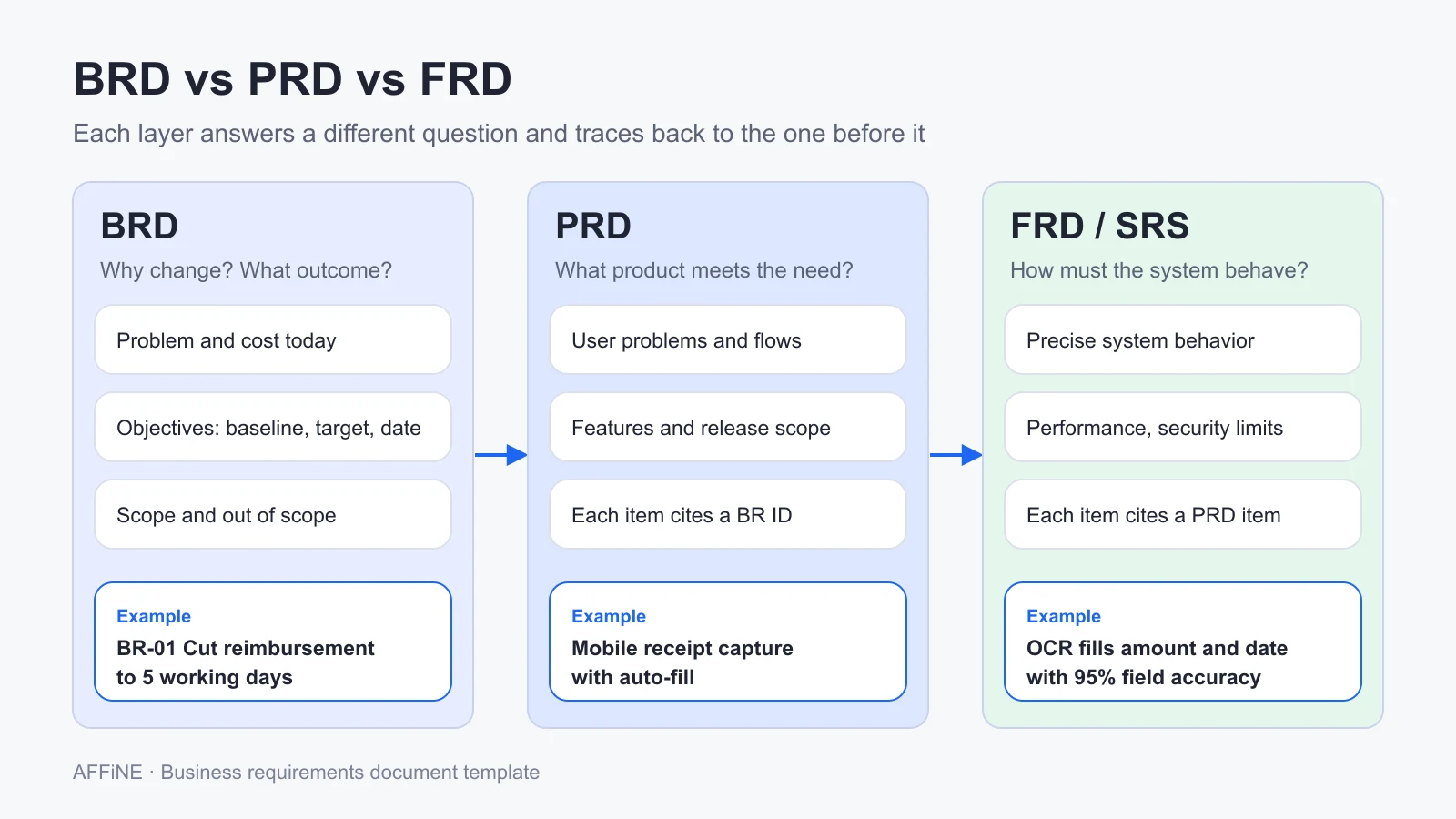
Not every project needs all three. Internal process changes often go straight from BRD to a vendor evaluation. Small product teams often merge the BRD's problem and objectives into the top of a PRD. If you do that, keep the "why" section separate and short, so it is not rewritten every time a feature changes. Our PRD template guide covers the product side.
Use the template
Prefer a ready-made page? Open the free business requirements document template in AFFiNE and duplicate it into your workspace, or copy the Markdown version below.
Copy the block below into any editor that reads Markdown, including an AFFiNE page. Every section has a short instruction in italics; delete the instructions once you have filled the section in. The example rows show the expected level of detail.
# Business Requirements Document: [Project name]

> *How to use: replace every bracketed item, keep the section order, and delete the italic instructions when a section is done. Keep solution design (screens, fields, architecture) out of this document.*

## 1. Document control

| Field | Value |
| --- | --- |
| Project | [Project name] |
| Version | 0.1 (draft) |
| Status | Draft / In review / Approved |
| Document owner | [Name, role] |
| Sponsor | [Name, role] |
| Last updated | [YYYY-MM-DD] |

## 2. Executive summary

*Write this last. In three to five sentences: the problem, the outcome the business needs, the scope, and the date it matters by.*

## 3. Problem and current state

*What is going wrong today, who it affects, and what it costs. Use numbers from current reports where you can.*

- Current process: [one or two sentences, or link a process map]
- Pain points: [list]
- Cost of doing nothing: [time, money, risk]

## 4. Business objectives

*Two to four objectives. Each needs a baseline, a target, and a date.*

| ID | Objective | Baseline | Target | By |
| --- | --- | --- | --- | --- |
| OBJ-1 | Reduce median reimbursement time | 14 calendar days | 5 working days | 2027-06-30 |
| OBJ-2 | Reduce finance time spent on claim follow-up | ~30 hours per month | Under 8 hours per month | 2027-06-30 |

## 5. Scope

**In scope**

- [Process, team, or system that will change]

**Out of scope**

- [Related work this project will not do]

## 6. Stakeholders

| Name or group | Role | Interest or need | Involvement |
| --- | --- | --- | --- |
| [Name], Finance Director | Sponsor | Lower processing cost | Approves |
| Finance operations | Business owner | Correct cost coding | Consulted, tests |
| All employees | Users | Faster reimbursement | Informed, pilot group |

## 7. Business requirements

*One testable statement per row. Priority uses MoSCoW: Must, Should, Could, Won't (this time). Every row needs a source and an acceptance measure.*

| ID | Requirement | Priority | Source | Acceptance measure |
| --- | --- | --- | --- | --- |
| BR-01 | Employees can submit a claim with receipts from a phone | Must | Employee survey | 80% of pilot claims submitted from mobile |
| BR-02 | Every claim is coded to a cost center before manager approval | Must | Finance workshop | 0 claims reach finance without a cost center |
| BR-03 | Approved claims are exported to accounting without re-keying | Should | Finance workshop | 0 manual edits in UAT export |

## 8. Assumptions and constraints

- Assumption: [what we take as true, and who confirmed it]
- Constraint: [budget, deadline, regulation, or system that cannot change]

## 9. Risks and dependencies

| Risk or dependency | Impact | Likelihood | Owner | Response |
| --- | --- | --- | --- | --- |
| Accounting system cannot accept imports | High | Medium | [Finance systems lead] | Confirm format by [date] |
| Managers ignore approval notifications | Medium | Medium | [Project manager] | Weekly reminder during pilot |

## 10. Success metrics

*How the sponsor will judge the result after launch. Link each metric to an objective ID.*

- [Metric] measured [how, how often], linked to OBJ-[n]

## 11. Open questions

| Question | Owner | Due |
| --- | --- | --- |
| Does accounting accept a daily file export? | [Name] | [YYYY-MM-DD] |

## 12. Glossary

| Term | Meaning in this document |
| --- | --- |
| Claim | One expense report with one or more receipts |

## 13. Review checklist

- [ ] Every requirement has an ID, priority, source, and acceptance measure
- [ ] Every requirement supports at least one objective
- [ ] The sponsor has read the out-of-scope list
- [ ] No requirement prescribes a screen, field, or technology unless it is a true constraint
- [ ] Every open question has an owner and a due date

## 14. Sign-off

| Name | Role | Version approved | Date |
| --- | --- | --- | --- |
| [Name] | Sponsor | [1.0] | [YYYY-MM-DD] |
| [Name] | Business owner | [1.0] | [YYYY-MM-DD] |

## 15. Change log

| Version | Date | Change | Approved by |
| --- | --- | --- | --- |
| 0.1 | [YYYY-MM-DD] | First draft | - |
Business requirements document example
Here is the template filled in for an illustrative project: a 400-person company replacing email and spreadsheet expense approvals. The company and numbers are invented, but the structure and wording are what we would expect a sponsor to approve.
Problem and current state. Employees email receipts and a spreadsheet to their manager. Finance re-keys approved claims into the accounting system. In the last two quarters, the median time from submission to reimbursement was 14 calendar days, and finance spent about 30 hours a month chasing missing receipts and cost codes.
Business objectives
| ID | Objective | Baseline | Target | By |
|---|---|---|---|---|
| OBJ-1 | Reduce median reimbursement time | 14 calendar days | 5 working days | 2027-06-30 |
| OBJ-2 | Reduce finance time spent on claim follow-up | ~30 hours per month | Under 8 hours per month | 2027-06-30 |
| OBJ-3 | Reduce out-of-policy claims paid | Not measured | Measured monthly, under 2% | 2027-09-30 |
Scope. In scope: employee expense claims, manager approval, finance review, export to the accounting system. Out of scope: corporate card reconciliation, travel booking, supplier invoices, and payroll changes.
Business requirements
| ID | Requirement | Priority | Source | Acceptance measure |
|---|---|---|---|---|
| BR-01 | Employees can submit a claim with receipts from a phone within the policy limits | Must | Employee survey, Mar 2026 | 80% of claims submitted from mobile in pilot month |
| BR-02 | Every claim is coded to a cost center before manager approval | Must | Finance workshop | 0 claims reach finance without a cost center |
| BR-03 | Claims over the policy limit are flagged to the approver before approval | Must | Expense policy v4, section 2 | 100% of over-limit test claims flagged |
| BR-04 | Approved claims are exported to the accounting system without re-keying | Should | Finance workshop | Export file accepted by accounting with 0 manual edits in UAT |
| BR-05 | Managers can delegate approval while on leave | Could | Manager interviews | Delegation tested for 3 managers in pilot |
| BR-06 | Mileage claims calculated from maps | Won't (this phase) | Sales team request | Logged for phase 2 |
The priorities use MoSCoW (Must, Should, Could, Won't have this time), which comes from the DSDM framework. DSDM recommends keeping Must Have work to typically no more than 60% of the effort, so the plan has room for contingency. If everything is a Must, nothing is.
Assumptions and constraints. We assume the current expense policy stays in force through 2027. The budget is fixed for this financial year, and the solution must keep receipts for the retention period set by the finance team.
Open questions. Does the accounting system accept a daily export, or does it need an API connection? Owner: finance systems lead, due 2026-11-15.
How to write a business requirements document in 7 steps
The order matters. Requirements written before the objectives and scope are agreed tend to describe a solution somebody already had in mind.
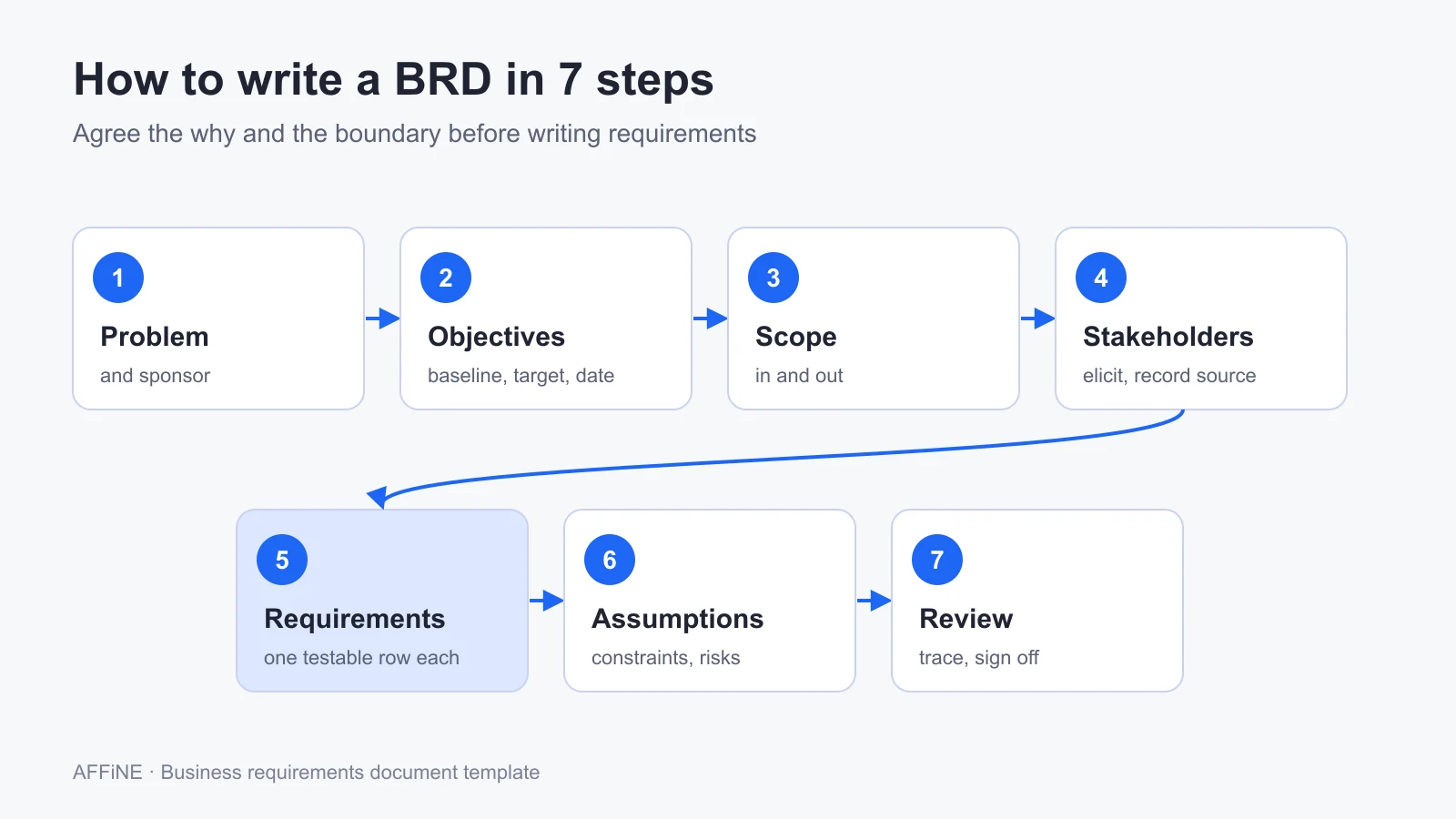
1. Name the problem and the sponsor
Write two or three sentences on what is going wrong today and what it costs, then name the sponsor who owns the outcome and can approve the document. If nobody will sign, stop and find that person first.
2. Set measurable business objectives
Turn the problem into two to four objectives with a baseline, a target, and a date, for example a median reimbursement time of 14 days today and 5 days by June 30, 2027.
3. Draw the scope boundary
List what is in scope and, just as important, what is out of scope. Out-of-scope lines settle most scope arguments before they start.
4. Map stakeholders and gather requirements
List every group affected by the change, then use interviews, workshops, and observation of the current process to collect their needs. Record where each requirement came from.
5. Write each requirement as one testable statement
Give every requirement an ID, one sentence that states one need, a priority, a source, and an acceptance measure. Rewrite anything that says fast, easy, or user-friendly without a number.
6. Record assumptions, constraints, and risks
Write down what you are assuming to be true, the fixed limits such as budget, deadlines, and regulation, and the risks with an owner each. Open questions get a name and a due date.
7. Review, trace, and sign off
Walk the document through with each stakeholder group, check that every requirement supports an objective, then collect sign-off from the sponsor and record the version. Changes after sign-off go through a change log.
How to write requirements people can test
Most weak BRDs fail at the requirements table, not at the summary. A requirement is useful when two people reading it would agree on whether it has been met. These rules get you most of the way:
- One need per row. "Submit and approve claims on mobile" is two requirements with different owners.
- State the outcome, not the design. "Approvers see over-limit claims before approving" leaves room for several designs. "Add a red banner" does not.
- Replace adjectives with numbers. Fast, simple, intuitive, and secure are not testable until you attach a measure.
- Name the source. A requirement with no source is an opinion. Link the interview, policy, or workshop it came from.
- Give every row an ID. IDs let the PRD, test cases, and change requests point at exactly one requirement. IIBA calls this traceability: tracking a requirement from the original stakeholder need to the implemented solution.
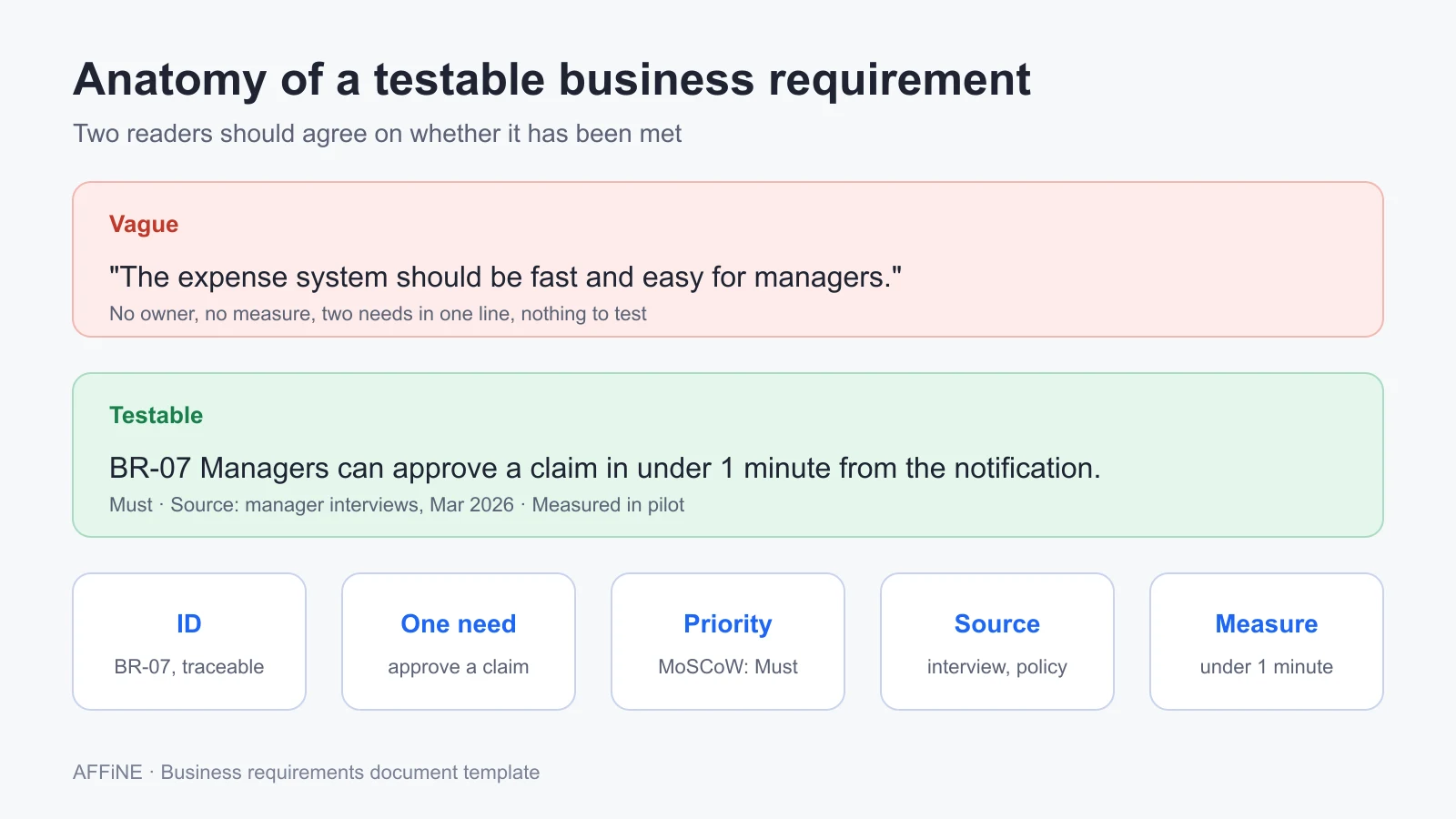
| Vague | Testable |
|---|---|
| The system should be fast | Managers can approve a claim in under 1 minute from the notification |
| Finance needs better visibility | Finance can see all claims awaiting approval, by cost center, updated daily |
| Make the process user-friendly | 80% of pilot users submit their first claim without help |
Review checklist before sign-off
- Every requirement has an ID, a priority, a source, and an acceptance measure.
- Every requirement supports at least one objective, and every objective has at least one requirement.
- The out-of-scope list has been read by the sponsor.
- No requirement names a specific screen, field, or technology unless it is a true constraint.
- Each open question has an owner and a due date.
- The document has a version number, and approvers are listed with dates.
Common BRD mistakes
- Writing the solution first. If the BRD reads like a feature list for a tool someone already chose, the evaluation is over before it started.
- Skipping the out-of-scope list. Silence on scope is read as "maybe", and maybe becomes a change request.
- Approving and forgetting. A BRD that is not updated when priorities change becomes a historical document. Keep a change log and re-approve major changes.
- Collecting needs from managers only. The people who do the work today know where the process breaks. Talk to them, or watch them do it.
- Treating length as quality. A 40-page BRD nobody reads is worse than a 5-page one everyone signed. Link supporting material instead of pasting it in.
How to write a BRD in AFFiNE
AFFiNE is a workspace that combines documents, whiteboards, and databases, so you can keep the BRD, its requirements table, and its process maps in one place. A practical setup:
- Write the BRD in page mode. Paste the template above into a new doc. Markdown headings, tables, and checklists become editable blocks.
- Turn the requirements table into a database. AFFiNE's database blocks can be viewed as a table or a kanban board, so you can track requirements by priority or status without a separate tool.
- Map the current and future process on a whiteboard. Switch the same doc to edgeless mode to draw the as-is and to-be flows next to the text, then reference them from the problem section.
- Use doc properties for document control. Doc info properties such as tags and dates can hold status and review dates, and backlinks show which PRDs and meeting notes mention the BRD.
AFFiNE is one option among several. If you need formal requirements management with audit trails, baselines, and test coverage reports, a dedicated tool may fit better. We compare several in our guide to requirements management tools.
FAQ
What is a business requirements document?
A business requirements document (BRD) records why a project exists and what the business needs from it: the problem, measurable objectives, scope, stakeholders, business requirements, constraints, and how success will be judged. It is written before solution design and is approved by the sponsor.
What should a business requirements document template include?
At minimum: document control, executive summary, problem and current state, business objectives with metrics, scope and out of scope, stakeholders, numbered business requirements with priority and acceptance measures, assumptions and constraints, risks and dependencies, open questions, and a sign-off table.
Who writes a BRD?
Usually a business analyst or project manager writes it, working from interviews and workshops with the business owner, the people who do the work today, and the teams who will build or run the solution. The project sponsor approves it.
What is the difference between a BRD and a PRD?
A BRD explains why the business needs a change and what outcomes it must deliver, in business language. A PRD describes the product that will meet those needs: features, user flows, release scope, and product behavior. The BRD comes first, and each PRD item should trace back to a BRD requirement.
How long should a business requirements document be?
Long enough that every requirement is testable and nothing important is implied. For a single-team change that is often three to six pages. Large regulated programs can run to dozens of pages, but a length that nobody reads is a warning sign, so move detail into linked documents.
Do agile teams still need a BRD?
Not always as a formal document, but they still need its content: the problem, objectives, scope, and the business rules that stories must respect. Many agile teams keep a short BRD as the source for the backlog and update it when priorities change, instead of freezing it.
What is the difference between business requirements and functional requirements?
A business requirement states an outcome the organization needs, such as approving 90% of expense claims within five working days. A functional requirement states what a system must do to support that outcome, such as routing a claim to the approver's manager automatically. Functional requirements usually live in an FRD, SRS, or PRD.
Sources and editorial notes
- IIBA, BABOK Guide glossary, for the definitions of business, stakeholder, solution, functional, and non-functional requirements, and requirements traceability. Accessed October 28, 2026.
- Agile Business Consortium, MoSCoW Prioritisation, for the MoSCoW categories and the DSDM guidance on Must Have effort (typically no more than 60%) and Could Have effort (around 20%). Accessed October 28, 2026.
- AFFiNE documentation, Blocks with databases and Doc info. Accessed October 28, 2026.
- SERP review of the top results for "business requirements document template", "how to write a business requirements document", and "BRD vs PRD" (Atlassian, Asana, ProjectManager, HubSpot, Lucid, Wrike, Plane, and others) on October 28, 2026, used to find gaps rather than as factual sources.
How this guide was prepared: AFFiNE wrote this article in October 2026. The template structure, the worked expense-approval example, and the writing rules reflect common business analysis practice and our own suggestions; the example company and its numbers are invented for illustration and are not a customer case. Definitions come from the primary sources listed above. AI tools assisted with research and drafting, and the AFFiNE team reviewed and edited the content.