Easy Drawing Ideas: 50 Simple Things to Draw From Shapes
What changed (Nov 12, 2026): Rewrote the guide around 50 easy drawing ideas, each with the shapes to start from, added three step-by-step examples, pencil and shading basics, a 7-day practice plan and six FAQs, replaced the decorative images with labeled step illustrations, and removed broken sources and an unsupported stress-relief claim.
Almost anything is easier to draw once you see it as a few basic shapes stacked together: a mug is an ellipse and two lines, a cat is a circle, a pear shape and two triangles, a house is a square under a triangle. Below are 50 easy drawing ideas grouped by subject. Each one lists the shapes to start with and the skill it helps you practice, so you can pick something that fits the time you have and actually finish it.
Quick answer: the easiest things to draw. If you are brand new, start with subjects built from one or two shapes: an apple, the sun, a donut, a ladybug, a snail or a cloud. Next try subjects that combine three or four shapes: a house, a coffee mug, a tulip, a fish and a sitting cat. All of them are in the list below. If you cannot decide, draw whatever object is closest to you.
What you need: a pencil (HB or 2B is enough), an eraser and any paper. Colored pencils, markers or a fine pen are optional.
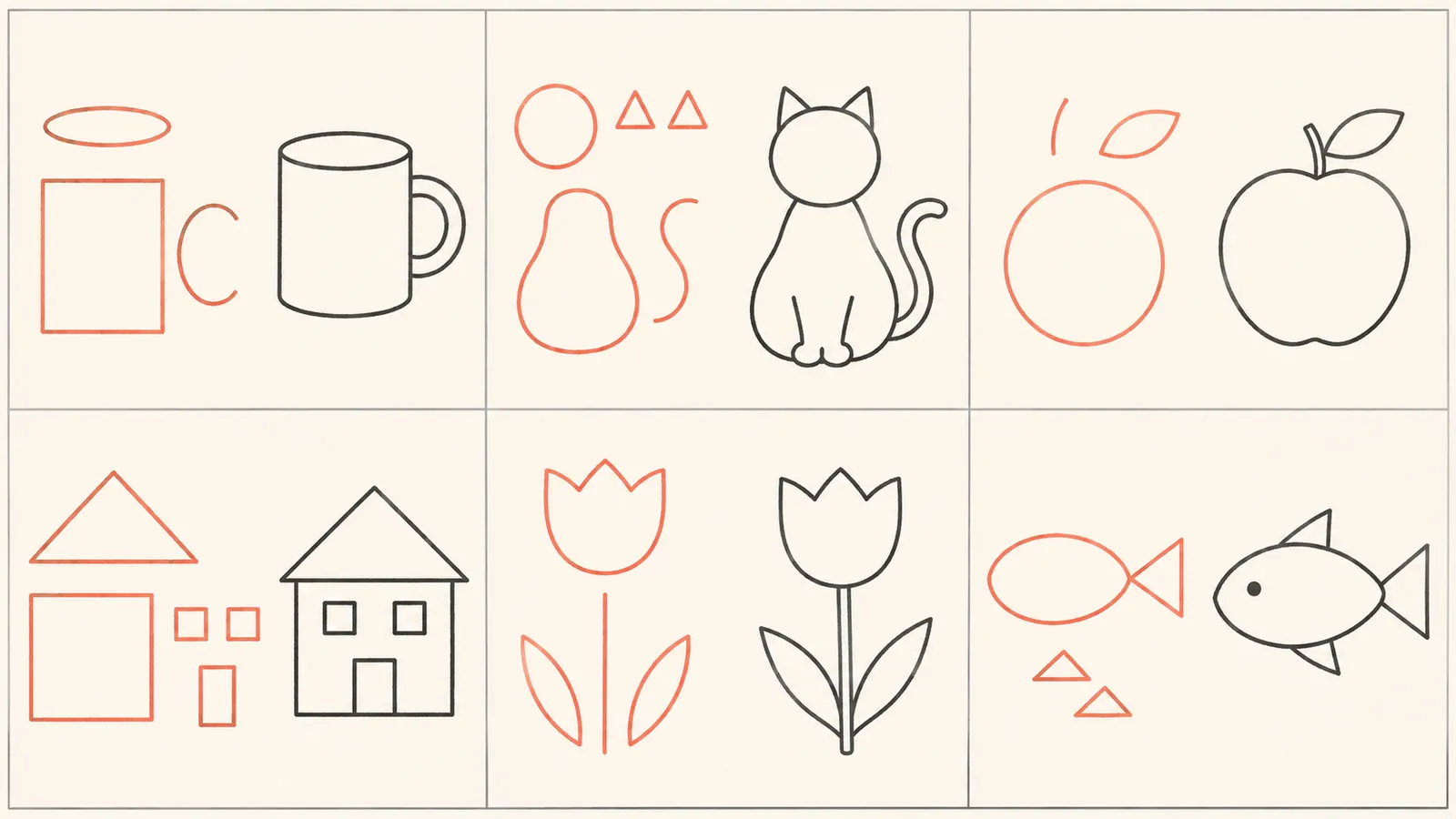
Six easy subjects next to the basic shapes they start from. AI-generated illustration, checked against the written steps.
How to Draw Anything Easy: Start With Shapes
Artists call this approach construction: you break a complex object into basic shapes, then join and refine those shapes into the finished drawing (The Virtual Instructor). Every idea in the tables below follows the same four moves:
- Sketch the biggest shape first, lightly. Press softly so the line is easy to erase.
- Add the smaller shapes that attach to it (ears, handles, petals, roofs).
- Trace the outline you want to keep with a firmer line and erase the leftover construction lines.
- Add a few details or simple shading only after the big shapes look right.
If a drawing looks wrong, go back to step 1 and check the big shape. Details rarely fix a proportion problem.
50 Easy Drawing Ideas, With the Shapes to Start From
Everyday objects (1-10)
Objects on your desk are ideal first subjects because you can look at the real thing while you draw.
| # | Idea | Start with these shapes | Practice focus |
|---|---|---|---|
| 1 | Coffee mug | Ellipse on top, two vertical lines, curved bottom, C-shaped handle | Ellipses |
| 2 | Closed book | Rectangle cover plus a thin strip for the pages | Straight, parallel lines |
| 3 | Desk lamp | Trapezoid shade, thin rectangle stem, flat oval base | Stacking shapes |
| 4 | Sunglasses | Two rounded rectangles joined by a small arc | Symmetry |
| 5 | Light bulb | Circle, small rectangle neck, zigzag thread lines | Curves into straight lines |
| 6 | Pencil | Long rectangle, triangle tip, small rectangle eraser | Proportion |
| 7 | Backpack | Rounded rectangle, smaller rectangle pocket, two curved straps | Overlapping shapes |
| 8 | Sneaker | Long wedge for the upper, flat rectangle sole, crossing lines for laces | Simple perspective |
| 9 | Umbrella | Half circle with a scalloped edge, J-shaped handle | Repeated curves |
| 10 | Key | Circle, long rectangle shaft, small squares for the teeth | Small details |
Food (11-18)
| # | Idea | Start with these shapes | Practice focus |
|---|---|---|---|
| 11 | Apple | Circle with a dip at the top, short stem, oval leaf | Round forms, shading |
| 12 | Banana | Two curved lines that meet at both ends, short stem | Smooth curves |
| 13 | Pizza slice | Triangle, curved band for the crust, small circles for toppings | Pattern |
| 14 | Cupcake | Trapezoid wrapper, bumpy cloud of frosting, circle cherry | Texture lines |
| 15 | Ice cream cone | Upside-down triangle, one or two circle scoops, crossing lines on the cone | Cross-hatching |
| 16 | Donut | Circle with a smaller circle inside, wavy icing line, sprinkle dashes | Concentric shapes |
| 17 | Strawberry | Rounded upside-down triangle, seed dots, zigzag leaves on top | Stippling |
| 18 | Sushi roll | Circle inside a circle, small shapes for the filling | Layering |
Nature and plants (19-26)
| # | Idea | Start with these shapes | Practice focus |
|---|---|---|---|
| 19 | Tulip | U-shaped cup with pointed petal tips, long stem line, two long leaves | Simple botanical form |
| 20 | Daisy | Small circle center, ring of long ovals for petals | Radial repetition |
| 21 | Leaf | Pointed oval, center line, angled vein lines | Line weight |
| 22 | Cactus in a pot | Tall rounded rectangle, smaller rounded arms, trapezoid pot | Combining shapes |
| 23 | Tree | Bumpy cloud shape for the crown, rectangle trunk, a few branch lines | Organic outlines |
| 24 | Mountain range | Overlapping triangles, zigzag snow line near the peaks | Overlap and depth |
| 25 | Sun and clouds | Circle with ray lines; clouds from overlapping circles with a flat base | Basic composition |
| 26 | Moon and stars | Crescent from two overlapping circles, five-point stars | Negative space |
For more flower subjects and printable outlines, see the flower template guide.
Animals (27-36)
| # | Idea | Start with these shapes | Practice focus |
|---|---|---|---|
| 27 | Sitting cat | Circle head, two triangle ears, pear-shaped body, S-curve tail | Construction |
| 28 | Fish | Oval body, triangle tail, small triangle fins | Simple silhouette |
| 29 | Bird | Circle head, teardrop body, small triangle beak | Joining shapes |
| 30 | Snail | Spiral shell, long rounded body, two antenna lines | Spirals |
| 31 | Owl | Egg-shaped body, two large circle eyes, small triangle beak | Symmetry |
| 32 | Turtle | Half-circle shell, hexagon pattern, four rounded legs | Pattern on a form |
| 33 | Bunny | Circle head, two long oval ears, oval body | Proportion |
| 34 | Penguin | Tall egg shape, inner oval belly, small triangle feet | Value contrast |
| 35 | Butterfly | Long thin oval body, two pairs of rounded wing shapes | Mirror symmetry |
| 36 | Ladybug | Circle body, half-circle head, center line, dots | Simple pattern |
Buildings, places and vehicles (37-42)
| # | Idea | Start with these shapes | Practice focus |
|---|---|---|---|
| 37 | House | Square walls, triangle roof, rectangle door, square windows | Straight lines |
| 38 | Lighthouse | Tall narrow trapezoid, stripes, small rectangle lamp room, triangle cap | Tapering forms |
| 39 | Tent | Triangle, center line for the door flap | Minimal shapes |
| 40 | Hot air balloon | Circle that narrows at the bottom, small square basket, connecting lines | Curved stripes |
| 41 | Sailboat | Triangle sail, trapezoid hull, wavy water lines | Simple scene |
| 42 | Rocket | Long rounded rectangle, cone top, triangle fins, circle window | Symmetry |
Cute doodles and patterns (43-50)
| # | Idea | Start with these shapes | Practice focus |
|---|---|---|---|
| 43 | Cloud with a face | Bumpy cloud outline, two dot eyes, small curved smile | Expression |
| 44 | Smiling star | Five-point star with rounded tips, simple face | Rounding corners |
| 45 | Heart with wings | Heart, two scalloped wing shapes | Mirror symmetry |
| 46 | Rainbow | Several nested arcs, a small cloud at each end | Even spacing |
| 47 | Ghost | Upside-down U with a wavy bottom edge, oval eyes | Simple character |
| 48 | Pumpkin | Wide oval, curved ridge lines, short rectangle stem | Curved contour lines |
| 49 | Mushroom | Half-circle cap with dots, short rounded stem | Two-shape subjects |
| 50 | Pattern tile | Square divided by one curvy line; fill each area with dots, stripes or circles | Relaxed repetition |
Want more prompts once you finish these? The drawing ideas collection groups themes by mood and subject, and the aesthetic drawing ideas guide focuses on line art and soft, aesthetic styles.
Cool Things to Draw When the Basics Feel Easy
Once single subjects feel comfortable, combine two or three ideas from the list into one small scene. You still start each part from its shapes, so the drawing stays manageable:
- Rocket over a mountain range: the rocket (42) launching above overlapping triangles (24), with a curved smoke trail.
- Lighthouse at night: the lighthouse (38) under a crescent moon and stars (26), with two straight beams of light.
- Hot air balloons above the clouds: two or three balloons (40) of different sizes over a row of clouds (25).
- Simple scenery in a circle: draw a circle frame, then fit a mountain (24), a tree (23) and the sun (25) inside it.
- Cactus wearing sunglasses: the cactus in a pot (22) with the sunglasses (4) on top. Small jokes like this make good sketchbook pages.
- Patterned hand: trace your hand lightly, then divide it with curvy lines and fill each area like the pattern tile (50).
- Sneaker from three angles: draw the sneaker (8) from the side, the front and above on one page.
5-Minute Things to Draw When You're Bored
Short exercises are useful when you are bored or a full drawing feels like too much. Set a timer and try one of these:
- One-line mug: draw your mug without lifting the pencil.
- Ten tiny leaves: fill a small box with ten different leaf shapes.
- Three apples: draw the same apple small, medium and large.
- Shape hunt: pick any object in the room and draw only the shapes you see in it, no details.
- Mountain strip: a row of overlapping triangles with a horizon line.
- Pattern tile: one square, one curvy line, two patterns.
- Your keys, from life: look at the real keys more often than at the paper.
Easy Drawing Ideas for Kids
Most of the 50 ideas work for children too. A few adjustments make them easier to finish:
- Choose subjects with familiar shapes: sun, house, fish, ladybug, rainbow, cloud with a face, ghost and pumpkin are good first picks.
- Say the steps out loud: "Draw a big circle. Now two triangles on top for ears." Spoken steps are easier to follow than a finished example to copy.
- Use bold tools: crayons, markers or a soft pencil make lines easy to see.
- Stop at "finished enough": let the child decide what details to add, and keep each drawing short enough to complete in one sitting.
Three Step-by-Step Examples
How to draw a coffee mug
- Draw a flat ellipse for the rim. Keep the ends rounded, not pointed.
- Drop two vertical lines from the left and right ends of the ellipse.
- Join them at the bottom with a curve that bends the same way as the front of the rim.
- Add a C-shaped handle on one side, then a smaller C inside it for thickness.
- Shade the side away from the light with a few parallel lines.
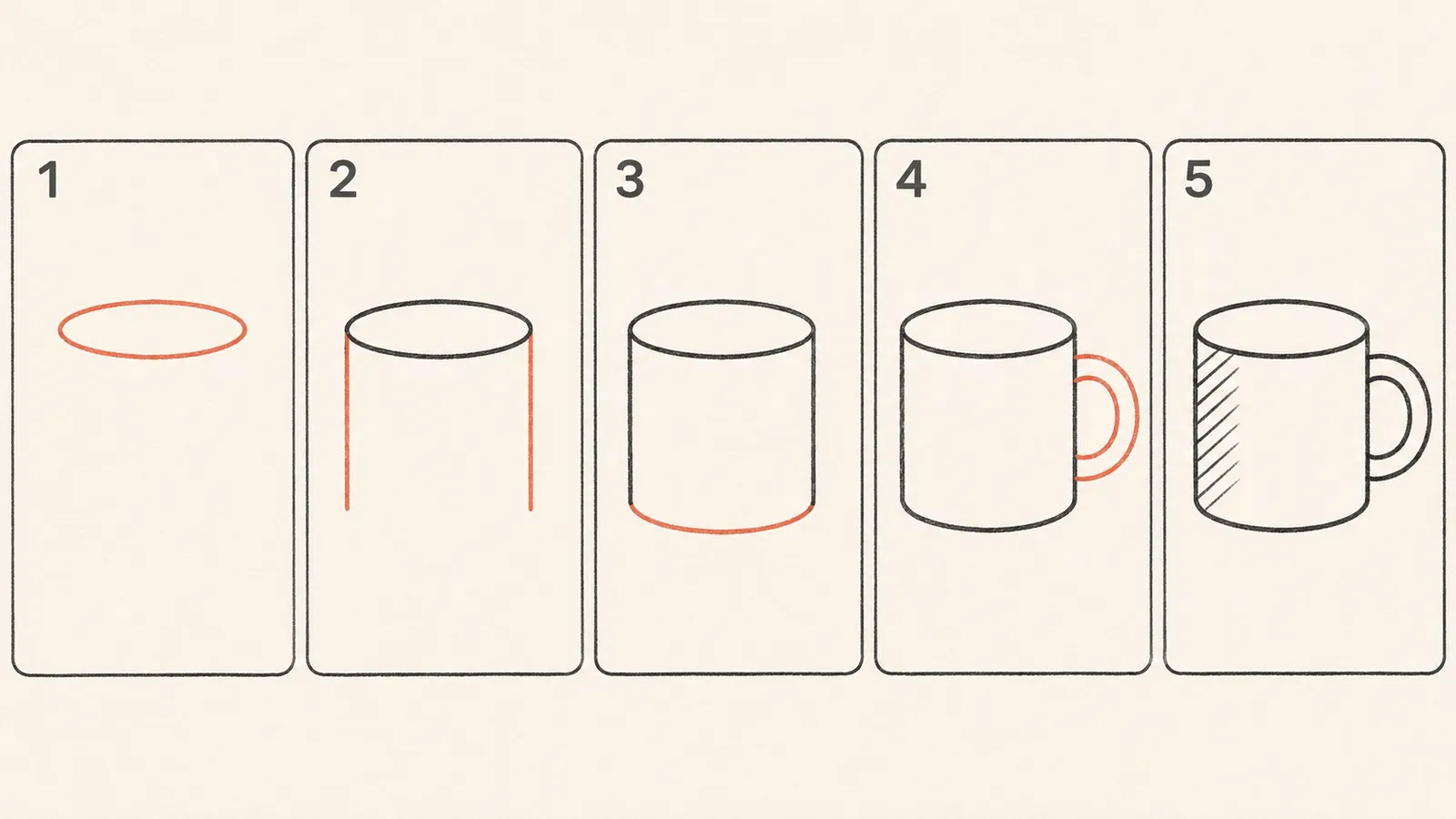
Drawing a coffee mug in five steps, from an ellipse to simple shading. AI-generated illustration, checked against the written steps.
How to draw a sitting cat
- Draw a circle for the head and a larger pear shape below it for the body.
- Add two triangles on top of the head for ears.
- Sketch two small ovals at the base of the body for front paws.
- Draw an S-curve tail that wraps around the body.
- Add eyes, a small triangle nose and whiskers, then erase the overlapping lines.
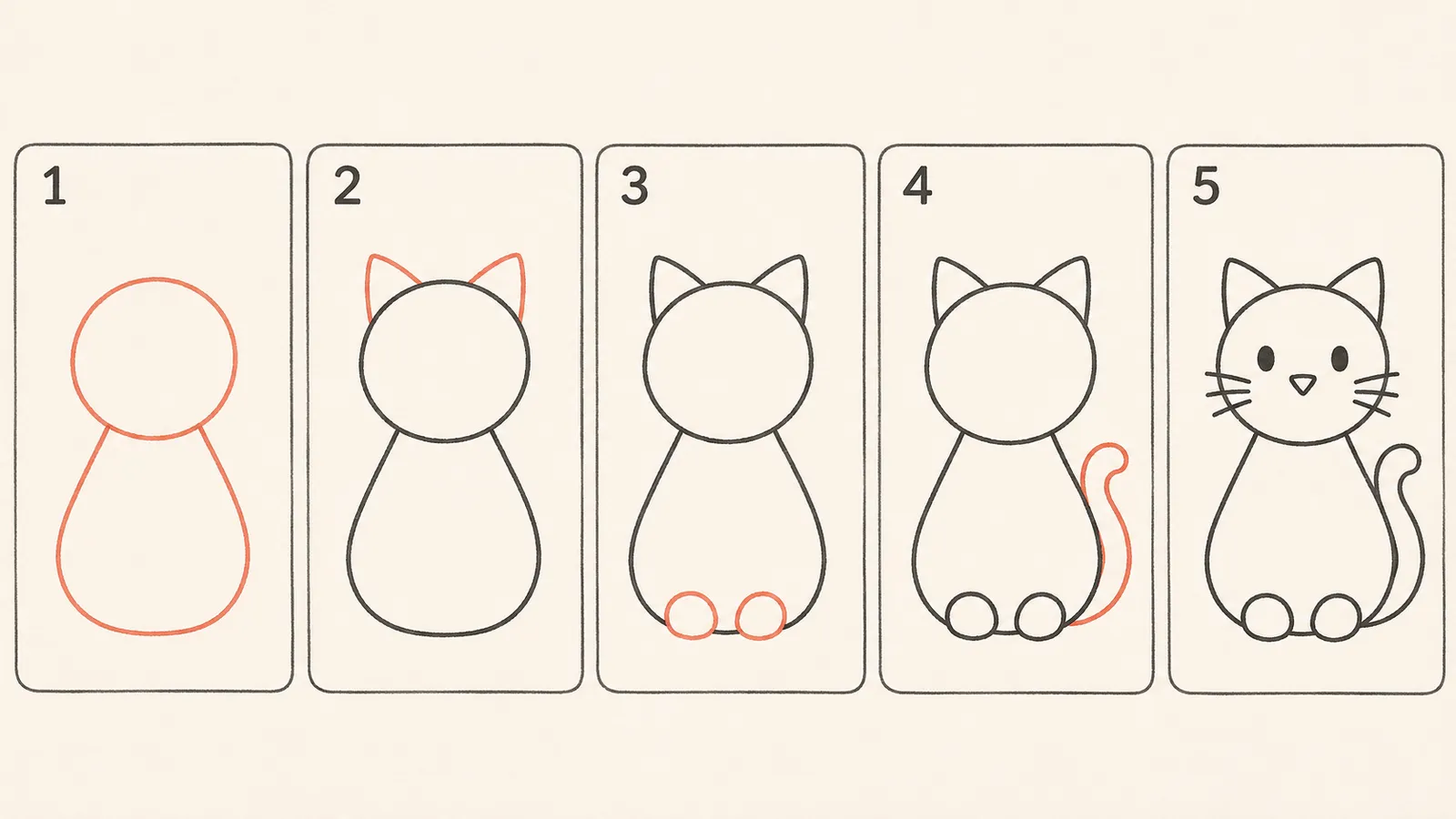
A sitting cat built from a circle, a pear shape and two triangles. AI-generated illustration, checked against the written steps.
How to draw a pumpkin
- Draw a wide oval.
- Add one curved line down the middle, then two more on each side that bulge outward.
- Draw a short, slightly bent rectangle on top for the stem.
- Darken the deep grooves between ridges so the pumpkin looks round.
- For a jack-o'-lantern, add triangle eyes and a zigzag mouth.
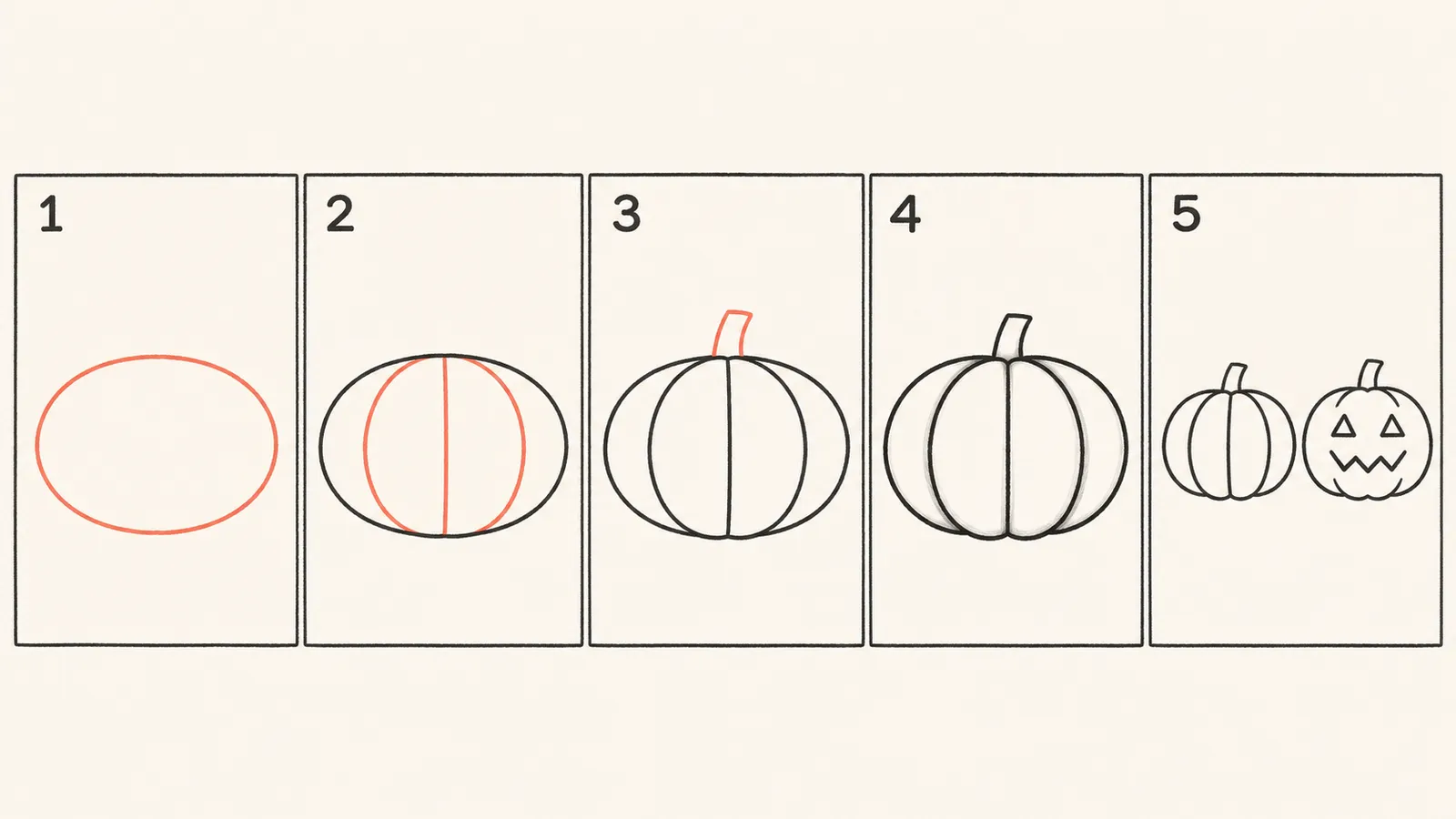
A pumpkin drawn from one oval and curved ridge lines, with an optional jack-o'-lantern face. AI-generated illustration, checked against the written steps.
For a seasonal page, add the ghost (47), a bat (small circle body, two scalloped wings, pointed ears) and a witch hat (tall triangle with a bent tip, flat oval brim).
Pencil Sketching Basics That Make Easy Drawings Look Finished
Which pencil to use
Pencil grades describe how hard or soft the graphite core is. H stands for hard: H pencils contain more clay filler and make lighter lines. B stands for blackness: B pencils are softer and darker. Grades run from 9H to 9B, with HB and F in the middle, and standard drawing sets usually cover 2H to 6B (Mont Marte).
| Grade | Mark | Good for |
|---|---|---|
| 2H | Light and fine | Construction lines you plan to erase |
| HB | Medium | Everyday sketching and outlines |
| 2B | Darker and softer | Shading and soft edges |
| 6B | Very dark | Deepest shadows and bold accents |
One HB or 2B pencil is enough for everything in this article. Add other grades only when you want more contrast.
Four simple ways to shade
- Hatching: parallel lines. Place them closer together for darker areas.
- Cross-hatching: a second layer of parallel lines in a different direction over the first (BingeDrawing).
- Stippling: dots. More dots, closer together, read as darker.
- Scribbling: small loose loops, useful for fur, foliage and rough textures.
Before shading, decide where the light comes from and keep the shadows on the opposite side of every object.
Blending
To soften pencil marks, use a tissue, a cotton bud or a paper blending stump. Avoid blending with your finger: skin oils can transfer to the paper and leave patchy marks (Ioanna Ladopoulou).
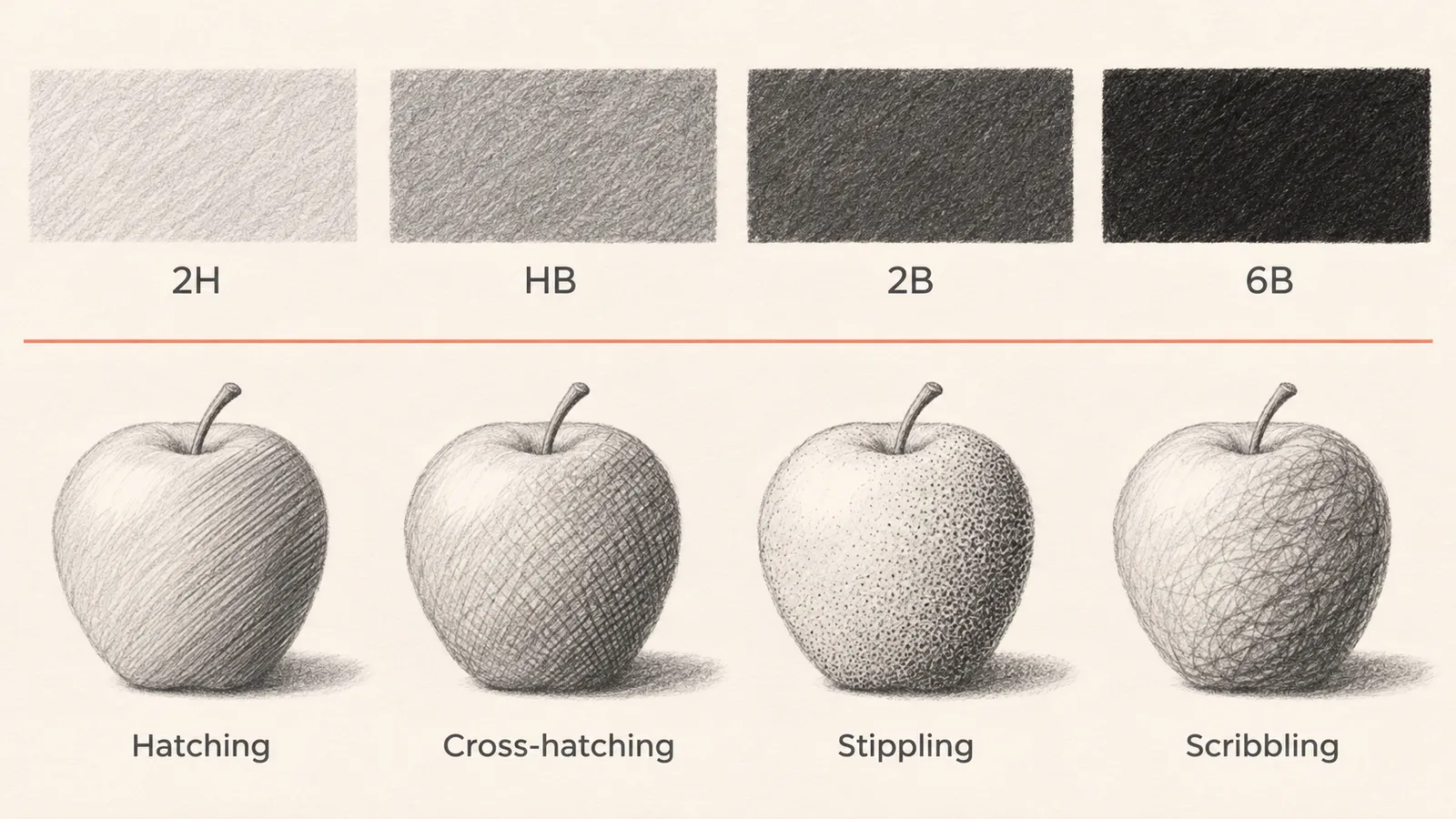
Value swatches for 2H, HB, 2B and 6B pencils, and the same apple shaded with hatching, cross-hatching, stippling and scribbling. AI-generated illustration, checked against the written steps.
How to Make an Easy Drawing Look Cute or Cartoony
Cute characters borrow features from what the ethologist Konrad Lorenz called the baby schema (Kindchenschema): a large head compared with the body, large eyes, a round face and small features (Wikipedia: Cuteness). To turn any idea from the list into a cute version:
- Make the head bigger and the body and limbs shorter.
- Draw large eyes placed slightly low on the face.
- Keep the nose and mouth small and close together.
- Round off sharp corners.
- Add a face to an object: two dots and a small curve work on a cloud, a mug or a mushroom.
- For a cartoon look, go over the final outline with one even, confident line and fill areas with flat color instead of shading.
Pattern and Doodle Ideas
Pattern doodles are a low-pressure way to practice line control. The Zentangle Method, for example, builds structured patterns (called tangles) from dots, lines, simple curves, S-curves and orbs, drawn on small paper tiles without planning a final image (Zentangle). You can borrow the idea with the pattern tile from idea 50: split a square with one line and fill each area with a different repeat.
Patterns and small icons also work well in planners. If you keep a bullet journal, the stencil sets guide explains when stencils help and when freehand doodles are the better choice, and the bullet journal template gives you pages to decorate.
A 7-Day Practice Plan
Ten to fifteen minutes a day is enough to get through this plan. Keep every page so you can compare Day 1 with Day 7.
| Day | Focus | Draw |
|---|---|---|
| 1 | Circles and ovals | Apple, donut, sun, ladybug |
| 2 | Straight lines | Book, house, pencil, tent |
| 3 | Ellipses and cylinders | Coffee mug, cactus pot, desk lamp |
| 4 | Animals from shapes | Sitting cat, fish, owl |
| 5 | Shading | One apple shaded four ways (hatching, cross-hatching, stippling, scribbling) |
| 6 | Cute versions | Redraw Day 4's animals with bigger heads and eyes |
| 7 | A small scene | Combine three ideas on one page, for example a simple scenery with a house, a tree and the sun |
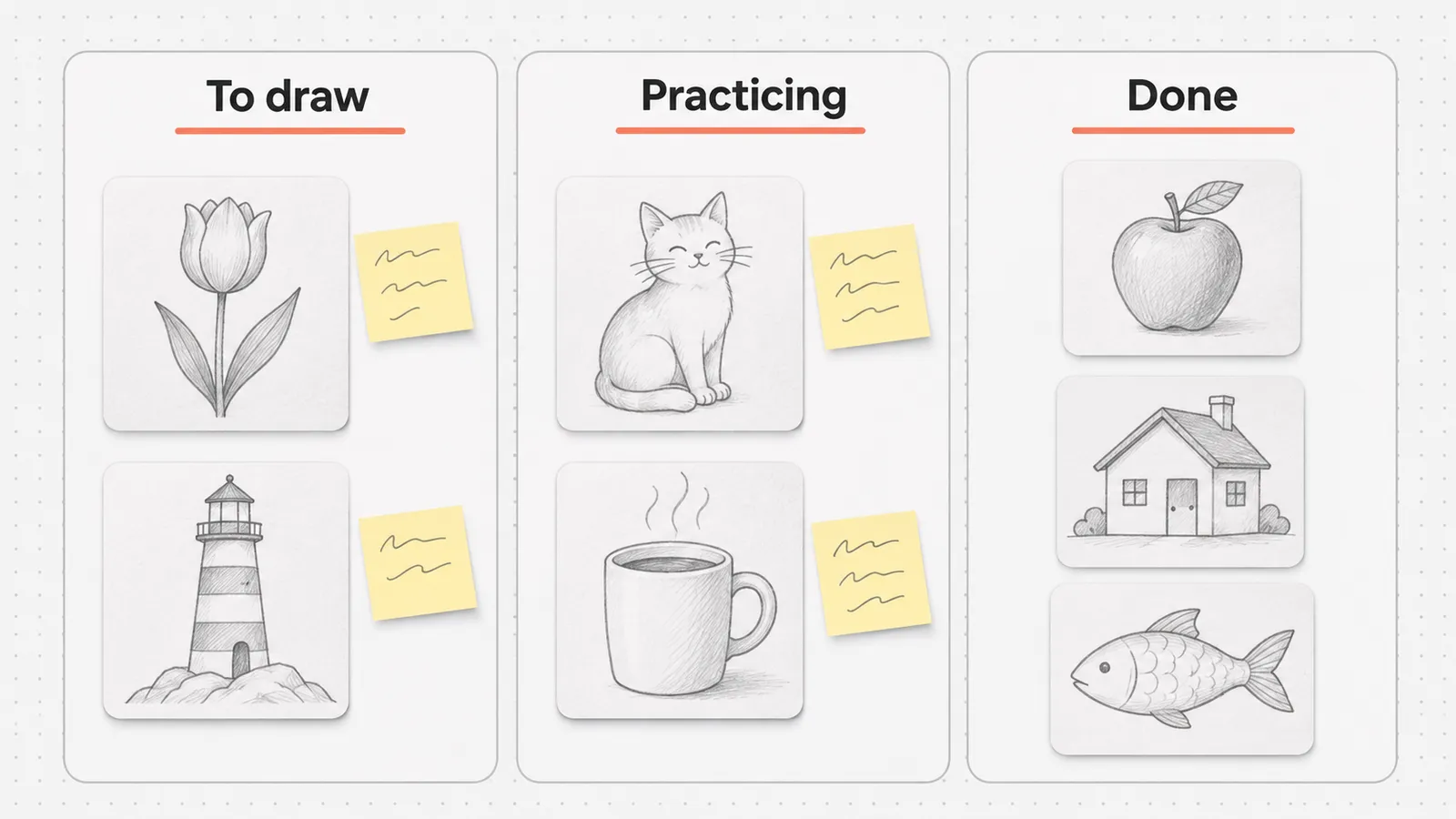
A drawing practice board with To draw, Practicing and Done columns. Illustrative mock-up, not a screenshot of AFFiNE. AI-generated illustration, checked against the written steps.
Common Beginner Mistakes and Quick Fixes
| Mistake | Quick fix |
|---|---|
| Pressing hard from the first line | Start with light construction lines (2H or a light touch with HB) and darken only the lines you keep |
| Drawing details before the big shapes | Block in the largest shape first; add eyes, windows or patterns last |
| Pointed ends on ellipses (mug rims, pots) | Keep both ends of an ellipse rounded |
| A lopsided symmetrical subject | Draw a light center line first for butterflies, owls, rockets and hearts |
| Every outline the same weight | Use a darker line for edges in shadow and a lighter one for edges in light |
| Erasing constantly | Finish the whole drawing first, then decide what to fix |
When you are ready to draw people, a body drawing base applies the same shape-first thinking to proportions and poses.
Keep Your Drawing Ideas in One Place
A list of ideas is only useful if you can find it when you sit down to draw. One simple system:
- Photograph each finished sketch with your phone.
- Put the photos on a whiteboard with three columns: To draw, Practicing and Done.
- Move an idea to Done when you have drawn it at least twice, and write one short note about what improved.
You can do this on paper, a corkboard or any digital board. In AFFiNE, the Edgeless whiteboard gives you an open canvas for images, sticky notes and text in the same space. If you want to plan a sequence, such as a seven-day challenge or a short comic, the Storyboard Template starts you with five scene cards whose sample illustrations you can replace with your own sketches or photos, and the finished board can be exported to PDF or PNG. Students who sketch to learn can apply the same habit to visual note-taking.
How This Guide Was Put Together
- Shape recipes and step-by-step examples describe the standard construction approach taught in beginner drawing courses. They are instructions, not the results of a test or study.
- Facts about pencil grades, cross-hatching, blending, the baby schema and the Zentangle Method link to the sources they come from. All sources were opened on November 11, 2026.
- Illustrations were made for this article with an AI image generator and then checked so that each panel matches the written steps. They are teaching diagrams, not photos of hand-drawn work. The practice board image is an illustrative mock-up, not a screenshot of AFFiNE.
Frequently Asked Questions
What is the easiest thing to draw for beginners?
Subjects built from one or two basic shapes are the easiest: an apple, the sun, a donut, a ladybug, a snail or a cloud. Once those feel comfortable, try subjects that combine three or four shapes, such as a house, a coffee mug, a tulip, a fish or a sitting cat.
What are easy things to draw when you're bored?
Pick one idea from the 50 in this guide, combine two of them into a small scene, or try a 5-minute exercise: draw your mug in one continuous line, fill a box with ten different leaves, or divide a square with a curvy line and fill each part with a pattern.
What are good easy drawing ideas for kids?
Good first subjects for kids are the sun, a house, a fish, a ladybug, a rainbow, a cloud with a face, a ghost and a pumpkin. Saying each step out loud and using crayons or markers makes them easier to follow and finish in one sitting.
Which pencil should a beginner use?
A single HB or 2B pencil is enough to start. HB is good for general sketching and outlines, and 2B is softer and darker for shading. Harder H pencils make lighter lines for construction, and softer grades such as 6B make the darkest shadows.
What should I draw if I have no ideas?
Draw the object closest to you, such as a mug, your keys or a pencil, because you can look at it while you work. Or pick a random number from 1 to 50 and draw that idea from the list, starting with the shapes in its row.
How often should I practice drawing?
There is no fixed rule. Short, regular sessions of 10 to 15 minutes are easier to keep up than occasional long ones. Keep your pages so you can compare your first drawings with later ones.