SIPOC Diagram: Template, Example, and How to Create One
A SIPOC diagram gives a team a high-level view of a process before it draws task-level flow. The acronym stands for Suppliers, Inputs, Process, Outputs, and Customers. Used well, the diagram makes the process boundary and major exchanges reviewable; it does not prove root cause, measure performance, or replace a detailed procedure.
This practical scope-setting guide is for process owners, operations managers, quality practitioners, support leaders, and workshop facilitators. It includes a template, six-step workflow, and disclosed fictional customer-support example.
Key takeaways
- Write the purpose, start event, end event, owner, evidence, and review date before filling the five columns.
- Work backward from outputs and customers when that makes requirements easier to see; this facilitation order is often called COPIS.
- Keep the Process column at five to seven high-level stages. Put decisions, handoffs, exceptions, and instructions in a follow-on map or procedure.
- Trace every important input to a supplier and every output to at least one customer.
- Treat the artifact as a scope hypothesis until the people who supply, perform, and receive the work validate it.
Table of contents
- What is a SIPOC diagram?
- SIPOC anatomy and template
- When to use SIPOC—and when not to
- How to create a SIPOC diagram in six steps
- Worked SIPOC example: fictional customer support
- What is COPIS?
- SIPOC vs. process map, swimlane, flowchart, and value-stream map
- Common SIPOC mistakes
- Frequently asked questions
What is a SIPOC diagram?
SIPOC is a process-scoping structure with five connected views:
- Suppliers provide information, materials, services, or other inputs.
- Inputs are what the process needs in order to operate.
- Process is a short sequence of major activities that transforms or uses those inputs.
- Outputs are the products, services, records, decisions, or signals the process produces.
- Customers are the internal or external recipients of those outputs.
The American Society for Quality's SIPOC+CM guidance describes SIPOC as a high-level view of the current process, recommends defining start and end boundaries, and keeps the Process column to five to seven core activities. Its +C and +M extension adds constraints and measures; those fields can be useful, but the five SIPOC columns remain the foundation.
SIPOC anatomy and template
The five columns need a metadata frame so reviewers do not imagine different boundaries.
| Field | Question to answer | Quality check |
|---|---|---|
| Purpose | Why are we defining this process now? | Names the decision or conversation the artifact must support |
| Start event | What observable event puts work inside the boundary? | Uses a specific trigger, not start |
| End event | What observable condition completes the scoped process? | Names the delivered outcome or disposition |
| Process owner | Which role is accountable for keeping the definition current? | Names one accountable role, not every participant |
| Evidence | Which records, policies, examples, or observations support the entries? | Includes source and date where freshness matters |
| Review date or trigger | When must the team revisit the artifact? | Includes a date, policy change, failed assumption, or changed process |
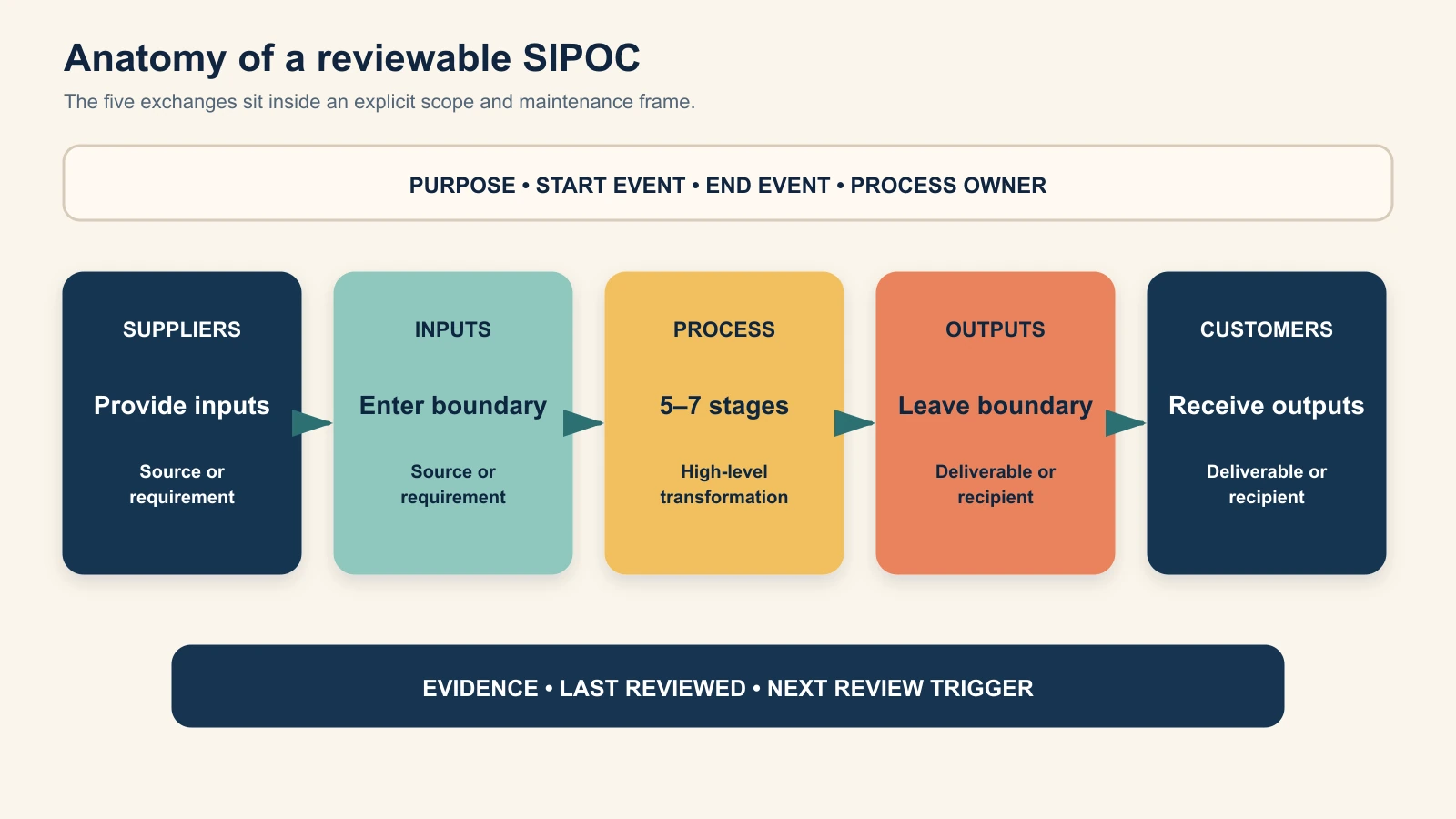
The five columns describe exchanges; the metadata makes the scope and maintenance responsibility explicit.
Copyable SIPOC template
Copy this worksheet into a document or canvas. Keep the five columns concise and put evidence in the traceability table.
- Purpose:
[decision or scope question] - Start event:
[observable trigger] - End event:
[observable completed outcome] - Process owner:
[accountable role] - Evidence:
[records, observations, policies, and dates] - Last reviewed / next trigger:
[date or change condition]
| Suppliers | Inputs | Process: 5–7 stages | Outputs | Customers |
|---|---|---|---|---|
| Who or what provides an input? | What must be available or true? | 1. Verb + object | What leaves the process? | Who receives or depends on the output? |
| Add internal and external sources | Add requirement or evidence note | 2–5. Major stages only | Add observable deliverable or signal | Add internal and external recipients |
| Final stage |
Traceability check
| Item | Supplied by / received by | Requirement or evidence | Gap or follow-up |
|---|---|---|---|
Input: [name] | Supplier: [role or system] | [record, format, freshness, acceptance rule] | [owner and next action] |
Output: [name] | Customer: [role, team, or external recipient] | [definition of ready or accepted] | [owner and next action] |
When to use SIPOC—and when not to
Start with SIPOC when the boundary is unsettled, participants use different definitions for the same process, or a team needs a shared overview before investigating detail. The U.S. Environmental Protection Agency's Lean in Government Starter Kit presents SIPOC as a scoping aid before a more detailed process map.
It is especially useful when the team must agree on:
- the event that starts the process and the condition that ends it;
- the few major stages inside the boundary;
- the information, material, or service entering and leaving;
- the internal and external parties involved in those exchanges; and
- the unresolved questions to bring into deeper mapping.
Do not use it as the final artifact when someone must execute the work, follow branching decisions, assign each handoff, measure delays, or operate a regulated control. A SIPOC also cannot demonstrate why a problem occurred. If causation is the question, use observed evidence and a suitable root cause analysis template.
How to create a SIPOC diagram in six steps
1. Define the purpose and boundary
Write one sentence describing the question the artifact must support. Then name an observable start event and end event. Record what is explicitly out of scope so the Process column does not expand during the workshop.
2. List outputs and customers
Ask what must leave the process and who uses, receives, records, or depends on it. Keep outputs observable: complete escalation package is more reviewable than good escalation. Add the requirement or acceptance question that each customer would use.
3. Identify inputs and suppliers
For every input, name who or what provides it. Separate a supplier from the process owner: the customer can supply an issue description, while a support operations lead remains accountable for the process definition. Mark missing evidence instead of guessing.
4. Write five to seven high-level process stages
Use verb-led labels such as Validate request or Confirm resolution. A stage should change the state of the work without listing screen clicks or every exception. ASQ's five-to-seven guideline protects the boundary-level view; move task detail into a process map template.
5. Validate traceability and scope
Walk left to right and right to left. Does every important input have a supplier? Does every output have a customer? Do the stages plausibly transform the named inputs into the named outputs without crossing the boundary? Record gaps as open questions with owners.
6. Record ownership, evidence, and review triggers
Add the accountable process owner, evidence sources, validation participants, last-reviewed date, and events that should reopen the artifact. Examples include a changed policy, a new input source, an output rejected by its customer, or a boundary changed by another team.
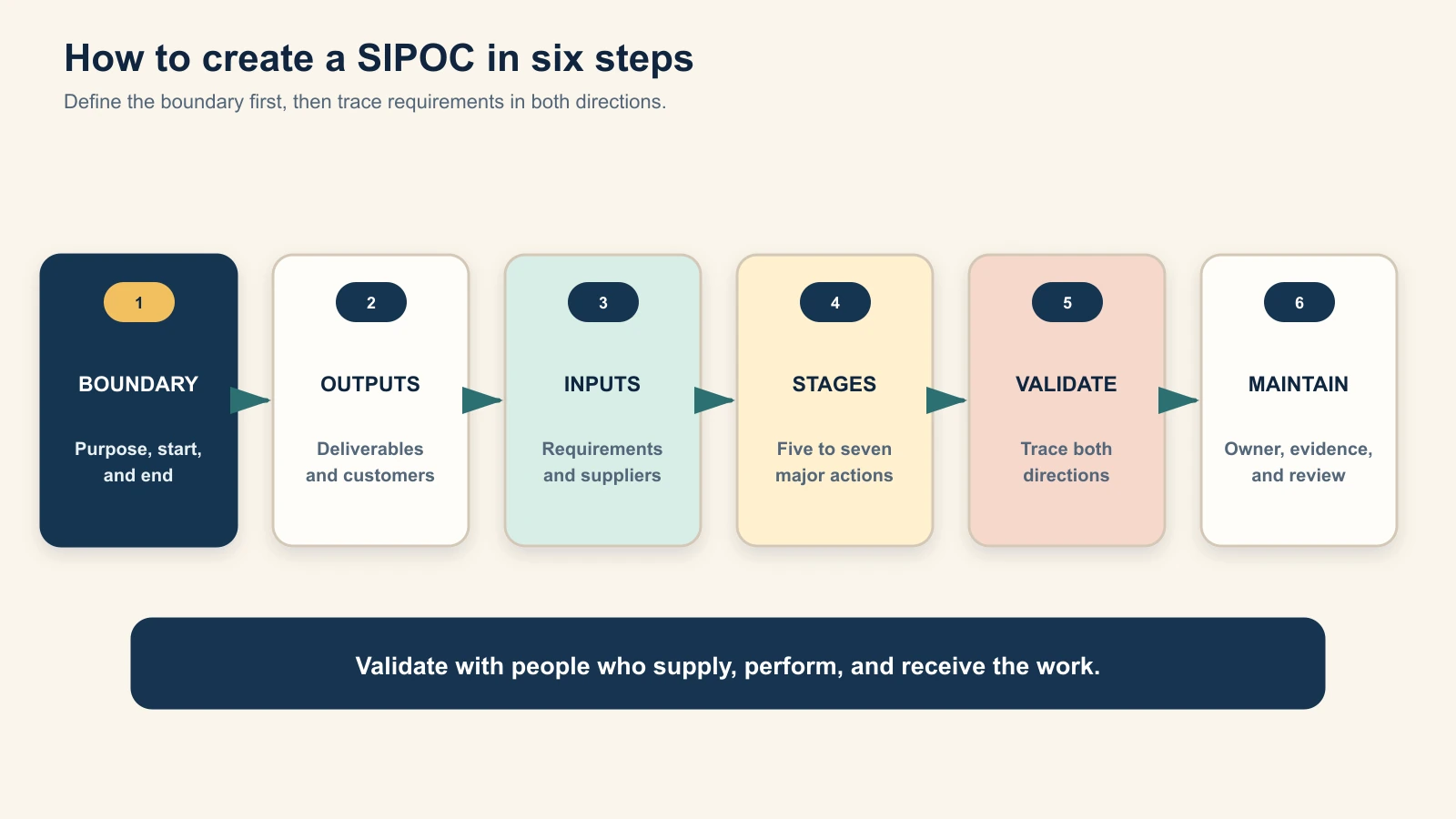
The order starts with scope, works through outputs and inputs, then validates the complete high-level view.
Worked SIPOC example: fictional customer support
The following SIPOC example is teaching material. It is not an AFFiNE customer story, internal policy, benchmark, or claim about service performance. The purpose is to show how to make the fields traceable while keeping task-level decisions out of scope.
Scope metadata
| Field | Fictional entry |
|---|---|
| Purpose | Define the boundary and major exchanges for handling one customer support request; do not estimate performance |
| Start event | A customer support request is received with an issue description |
| End event | The requester receives a response and the request is resolved, escalated with a complete package, or closed under the documented policy |
| Process owner | Support operations lead |
| Evidence set | Recent representative request records, current service policy, current triage rules, and system-field definitions; a real team must provide these |
| Review trigger | Service-policy change, new request channel, rejected escalation package, changed telemetry, or owner-approved review date |
Five-column view
| Suppliers | Inputs | Process | Outputs | Customers |
|---|---|---|---|---|
| Customer; product telemetry; account system; support team | Issue description; account context; logs; service policy; triage rules | Receive and validate → Classify → Diagnose → Resolve or escalate → Confirm and close | Customer response; resolution; escalation package; defect signal; updated knowledge | Requester; support operations; product or engineering; service owner |
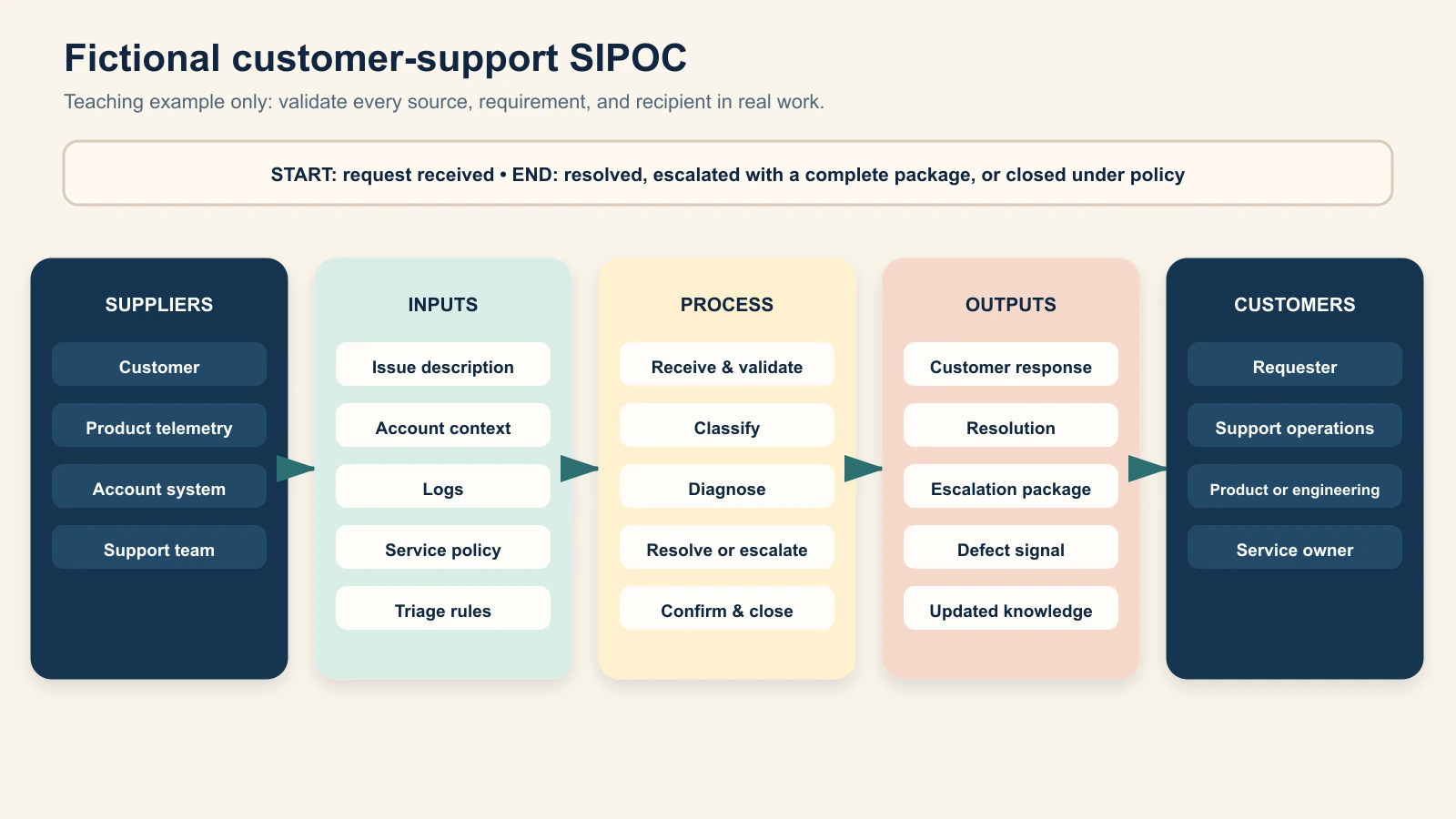
Every entry is disclosed for teaching; a real process owner must validate sources, requirements, and recipients.
Input and output traceability
| Direction | Item | Mapping in this example | Validation question |
|---|---|---|---|
| Supplier → input | Issue description | Customer | What makes the description sufficient to begin validation? |
| Supplier → input | Account context | Account system | Which fields are authoritative and current? |
| Supplier → input | Logs | Product telemetry | Which events, time range, and access rules apply? |
| Supplier → input | Service policy and triage rules | Support team | Which approved version governs this request? |
| Output → customer | Customer response and resolution | Requester | What counts as a clear response and confirmed disposition? |
| Output → customer | Escalation package | Product or engineering; support operations | Which evidence makes the package ready for handoff? |
| Output → customer | Defect signal | Product or engineering; service owner | Who reviews the signal, and what happens next? |
| Output → customer | Updated knowledge | Support operations and future support work | Who approves and maintains the knowledge entry? |
Text equivalent and validation boundary
The process begins when a customer request arrives with an issue description. The customer, telemetry, account system, and support team supply the description, context, logs, policy, and triage rules. Support receives and validates the request, classifies it, diagnoses it, resolves or escalates it, then confirms and closes. The process produces a response, resolution or escalation package, possible defect signal, and updated knowledge for the requester and internal recipients.
For this guide, we built the fictional example from the blank worksheet, checked suppliers against inputs and outputs against customers, then read the five stages against the start and end. Every entry had a visible mapping; unresolved requirements remain for a real process owner.
This check only tests internal traceability within the teaching artifact. It does not prove that the process is fast, effective, compliant, controlled, or causally responsible for an outcome. Those conclusions require observed data, defined measures, appropriate controls, and accountable review.
What is COPIS?
COPIS uses the same five categories in a different workshop order: Customers, Outputs, Process, Inputs, Suppliers. Starting with the customer and required output can reduce the temptation to describe whatever the current supplier already provides. In this guide's workflow, Steps 2 and 3 use that customer-back order before the team finalizes process stages.
COPIS is a facilitation choice, not a second mandatory method. Supplier-first work can still fit a process constrained by available inputs. Choose the order that exposes assumptions, then publish the completed five-column view.
SIPOC vs. process map, swimlane, flowchart, and value-stream map
Choose the artifact by the question it must answer.
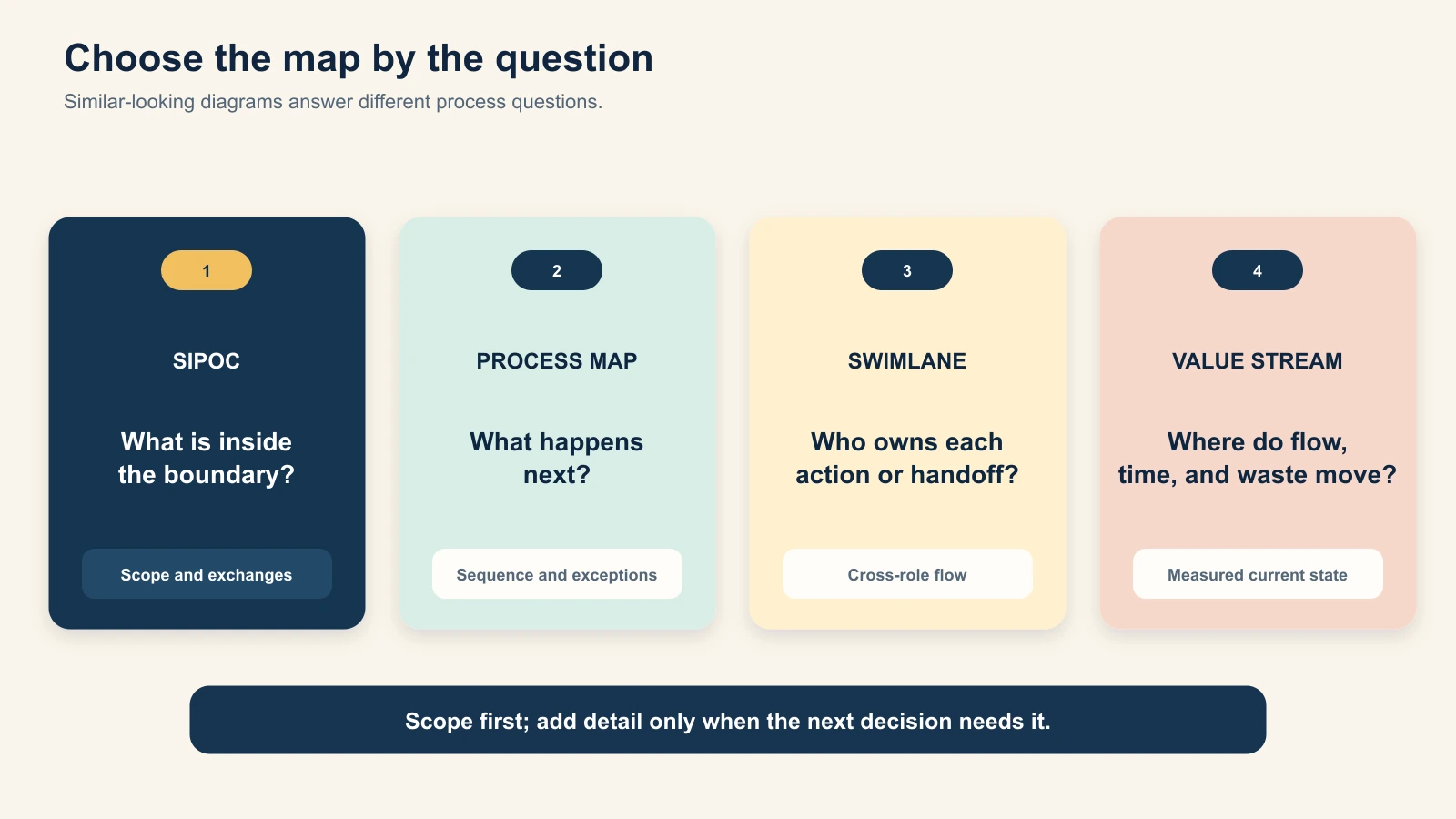
SIPOC establishes the boundary; follow-on methods add sequence, ownership, exceptions, or measured flow.
| Method | Primary question | Typical detail | Best next output |
|---|---|---|---|
| SIPOC | What is inside the process boundary, and what enters and leaves? | Five to seven major stages | Shared scope and exchange model |
| Process map or flowchart | What happens next, including decisions and exceptions? | Activities, decisions, loops, and endpoints | Reviewable sequence; see the business process mapping guide or a free online flowchart maker comparison |
| Swimlane diagram | Who owns each action and handoff? | Sequence divided by roles, teams, or systems | Cross-functional ownership map; use the swimlane diagram guide |
| Value-stream map | Where do material, information, time, queues, and waste move? | Current-state flow with observed process data | Measured current/future-state analysis |
ASQ's flowchart guidance focuses on boundaries, sequenced steps, decisions, and participant review. The Lean Enterprise Institute's value-stream mapping overview adds whole-stream material and information flow plus process data. Merely renaming a SIPOC does not add those details.
Make the diagram accessible
Publish the five columns as real text, not just pixels. The World Wide Web Consortium's guidance on non-text content requires an equivalent text alternative. Use headings and tables in a meaningful order, and do not rely on color alone.
Pair a large visual with concise alt text and a nearby complete table or text equivalent. Test narrow widths and state relationships in text instead of relying on arrow position.
Common SIPOC mistakes
- Starting without a boundary. Name the observable trigger and completed outcome before adding stages.
- Writing a task list. Keep five to seven major stages and move clicks, exceptions, and rework to a detailed map.
- Confusing suppliers with owners. A supplier provides an input; the process owner remains accountable for the maintained definition.
- Listing inputs without sources or requirements. Add who provides each input and what makes it usable.
- Listing outputs without customers. Name who receives or depends on each deliverable or signal.
- Mixing current and proposed states. Label the state and keep proposed changes visibly separate until validated.
- Hiding gaps with generic words. Replace
data,review, andteamwith the specific record, action, or role. - Treating scope as causal proof. SIPOC can frame an investigation; it cannot establish why a result occurred.
- Publishing without maintenance metadata. Add an owner, evidence set, review date, and change triggers.
Keep the SIPOC and evidence together in AFFiNE
Use an AFFiNE Edgeless canvas for the five-column visual and a Page block for boundaries, traceability, sources, open questions, owner, and review date. Keep the worksheet as reviewable text.
AFFiNE documents the artifact; it does not validate it, measure performance, execute controls, or prove cause. Use qualified review where required.
Start-now checklist
- Write the purpose, start event, end event, and out-of-scope work.
- Name one accountable process owner.
- List observable outputs and their customers.
- List required inputs and their suppliers.
- Reduce the Process column to five to seven verb-led stages.
- Map each important input to a supplier and each output to a customer.
- Mark missing requirements or evidence as open questions with owners.
- Validate the draft with people who supply, perform, and receive the work.
- Record the state, evidence date, last review, and next review trigger.
- Choose the follow-on map needed for sequence, ownership, exceptions, or measured flow.
Frequently asked questions
What is a SIPOC diagram?
A SIPOC diagram is a high-level process view organized into Suppliers, Inputs, Process, Outputs, and Customers. Teams use it to agree on a process boundary and major exchanges before adding task-level sequence, ownership, exceptions, controls, or performance data.
What does SIPOC stand for?
SIPOC stands for Suppliers, Inputs, Process, Outputs, and Customers. Suppliers provide the inputs; the process uses or transforms them; outputs leave the process; and customers receive or depend on those outputs.
How do you create a SIPOC diagram?
Define the purpose and boundaries, list outputs and customers, identify inputs and suppliers, write five to seven high-level stages, validate traceability and scope, then record the owner, evidence, review date, and change triggers.
What is the difference between SIPOC and a process map?
SIPOC shows the high-level boundary, major stages, and exchanges around a process. A process map shows sequence, decisions, loops, and exceptions in more detail. A practical pattern is to scope with SIPOC and then map the uncertain or cross-functional portion.
Does a SIPOC process need exactly five to seven steps?
Five to seven stages is useful guidance for preserving a high-level view, not a mathematical requirement. If the column needs many task-level boxes, the team is probably building a detailed process map and should separate that artifact from the SIPOC.
What is the difference between SIPOC and COPIS?
They use the same five categories. COPIS changes the facilitation order by starting with Customers and Outputs before Process, Inputs, and Suppliers. This can clarify requirements, but it is an optional workshop order rather than a different required deliverable.
Can SIPOC identify root cause?
No. SIPOC can define the process boundary and reveal missing suppliers, inputs, outputs, customers, or requirements. Root-cause conclusions require observed evidence and an appropriate analysis method; the diagram alone does not demonstrate causation.
Who should create and review a SIPOC diagram?
The process owner should coordinate the draft with people who supply inputs, perform the work, and receive outputs. Before operational use, reviewers should check the boundary, evidence, requirements, ownership, and follow-on mapping needs.
Conclusion
A useful SIPOC diagram is small enough to review and specific enough to challenge. Define the boundary, connect suppliers to inputs and outputs to customers, keep the process at a high level, and record the evidence and owner. Then choose a follow-on map when the team needs task sequence, handoff ownership, exceptions, or measured flow.
Start with the blank worksheet above, validate it with the people around the process, and keep the visual and its text equivalent together in AFFiNE.
Last reviewed: August 16, 2026. Recommended review before operational use: a process-improvement professional or experienced process owner familiar with the actual workflow and evidence.
Related Articles
Business Process Mapping: Steps, Symbols, Examples, and Tools
Process Map Template: 7 Types, Symbols, and Editable Examples
Swimlane Diagram: Symbols, Examples, and How to Create One
Root Cause Analysis Template: 5 Whys, Fishbone, and Action Plan