Free Printable Chore Chart for Kids (PDF, A4 and Letter)
Print a free kids' chore chart in A4 or US Letter, copy a filled week for a 7-year-old, and pick chores for ages 2 to 12 from AACAP and AAP lists.

Reviewed by AllenContent Operations Manager


A printable chore chart for kids is a one-page grid of a child's jobs and the days of the week, which the child checks off as each job gets done. This page gives you a free blank chart in A4 and US Letter, a filled example for a 7-year-old, and chore ideas for ages 2 to 12.
Both files are static PDFs for printing. They are not fillable forms, and you do not need an account to download them.
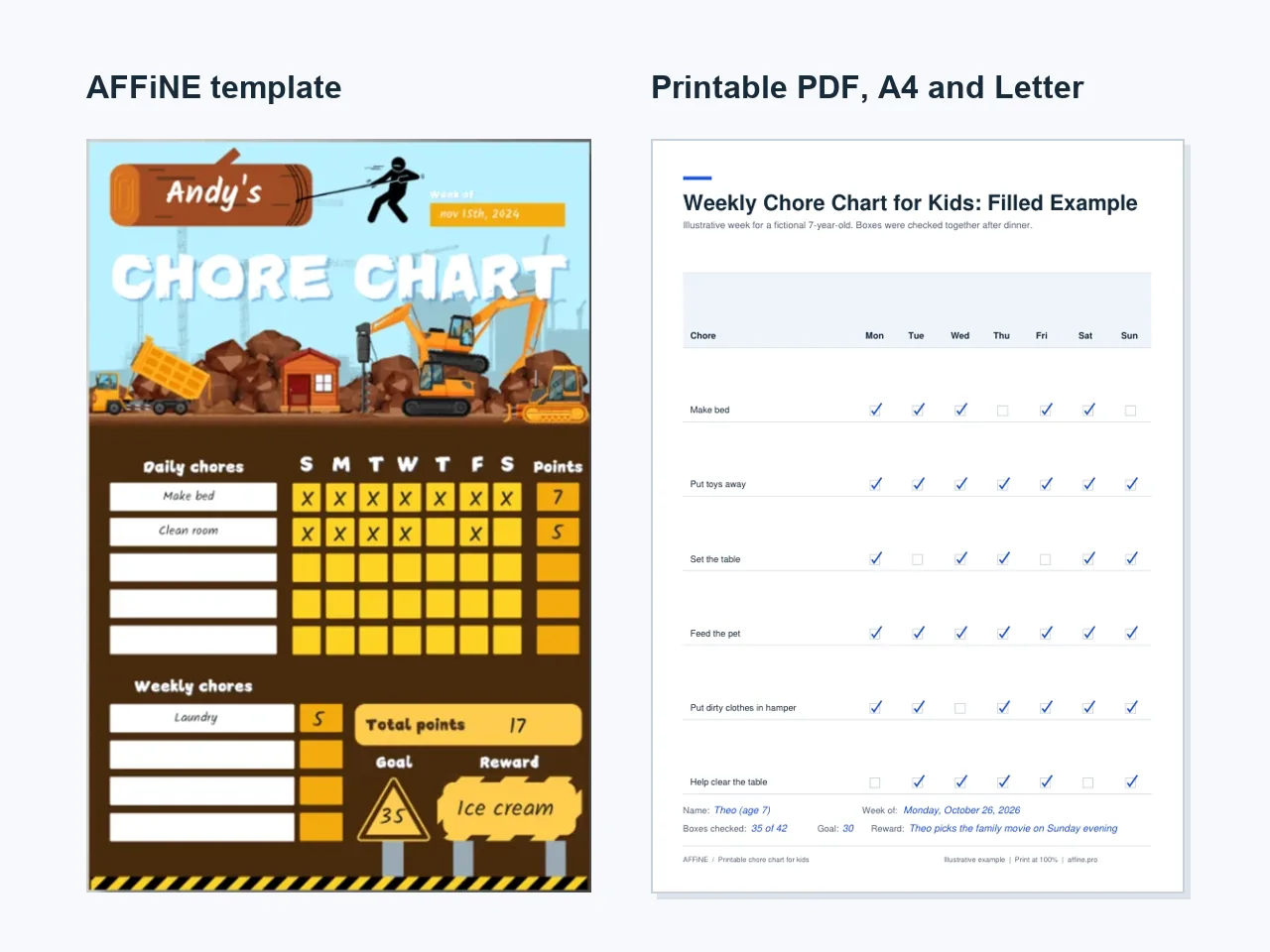
The printable PDF has six chores already printed down the left side: make bed, put toys away, set the table, feed the pet, put dirty clothes in the hamper, and help clear the table. Across the top are seven day columns, Monday to Sunday, with one check box per chore per day. The bottom has a name line and a week-of line.
The AFFiNE template (the Use this template and Preview buttons) is a different, decorated design on an AFFiNE whiteboard. It has:
It comes filled in for a sample child, Andy. Make bed is marked on all seven days for 7 points, clean room on five days for 5 points, and laundry is a weekly chore worth 5 points. That makes 17 total points against a goal of 35, with ice cream as the reward. The chart layout is a single picture, and the name, chores, marks, and numbers are text boxes on top of it. You edit those text boxes. The five daily rows are part of the picture, so a sixth row means drawing your own boxes, and the template does not add up points for you.
The PDF does not reproduce the AFFiNE design. Pick the one that suits you: the PDF for a quick plain sheet, the AFFiNE template if you want points and a reward on the chart itself.
Illustrative example: Theo is a fictional 7-year-old. A parent and Theo checked the boxes together after dinner each day for the week of Monday, October 26, 2026. They agreed the goal and reward on Monday morning, before the week started.
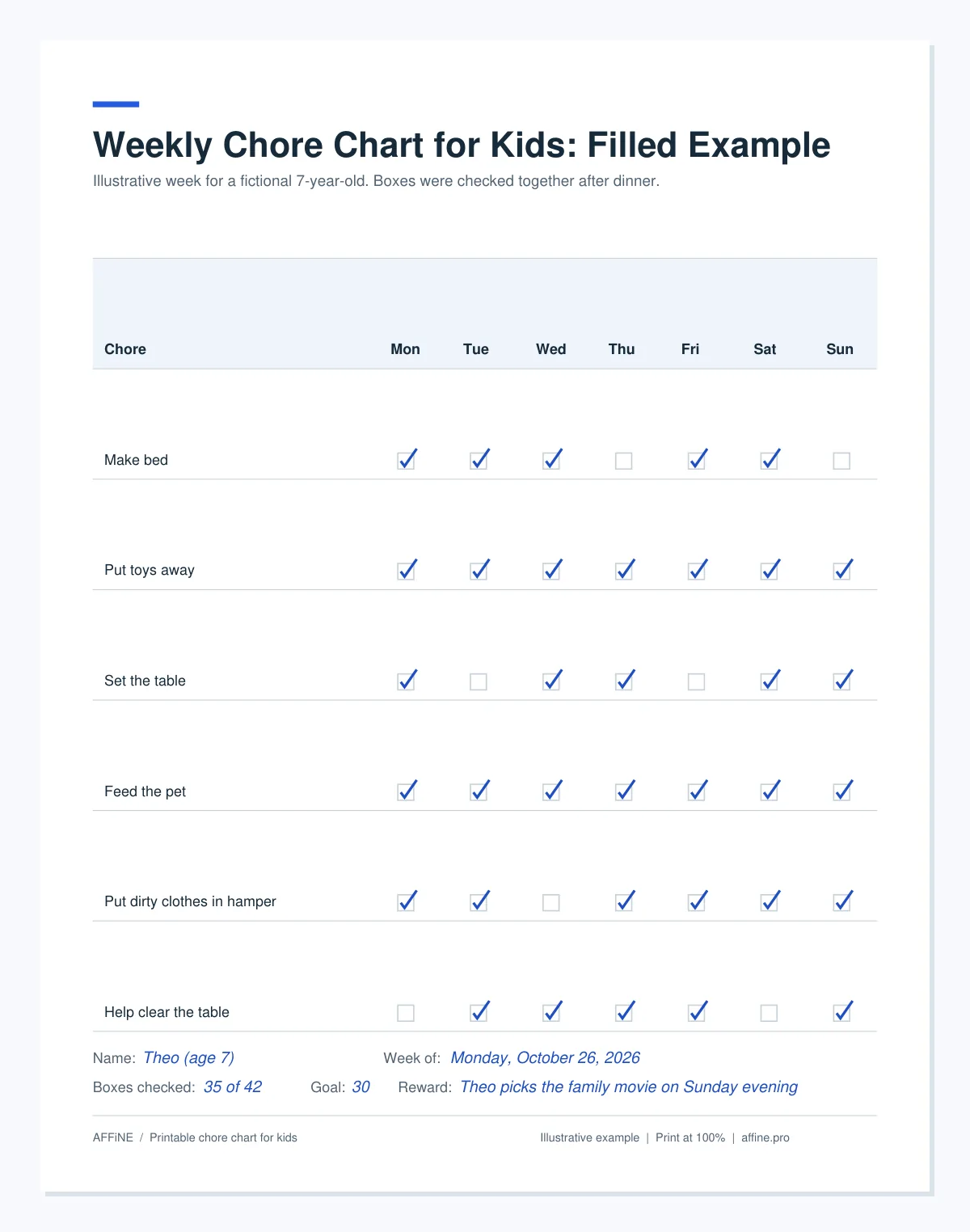
| Chore | Mon | Tue | Wed | Thu | Fri | Sat | Sun | Done |
|---|---|---|---|---|---|---|---|---|
| Make bed | ✓ | ✓ | ✓ | – | ✓ | ✓ | – | 5 |
| Put toys away | ✓ | ✓ | ✓ | ✓ | ✓ | ✓ | ✓ | 7 |
| Set the table | ✓ | – | ✓ | ✓ | – | ✓ | ✓ | 5 |
| Feed the pet | ✓ | ✓ | ✓ | ✓ | ✓ | ✓ | ✓ | 7 |
| Put dirty clothes in hamper | ✓ | ✓ | – | ✓ | ✓ | ✓ | ✓ | 6 |
| Help clear the table | – | ✓ | ✓ | ✓ | ✓ | – | ✓ | 5 |
Week total: 35 of 42 boxes. Goal: 30 boxes. Reward: Theo picks the family movie on Sunday evening.
A few things to copy from this week:
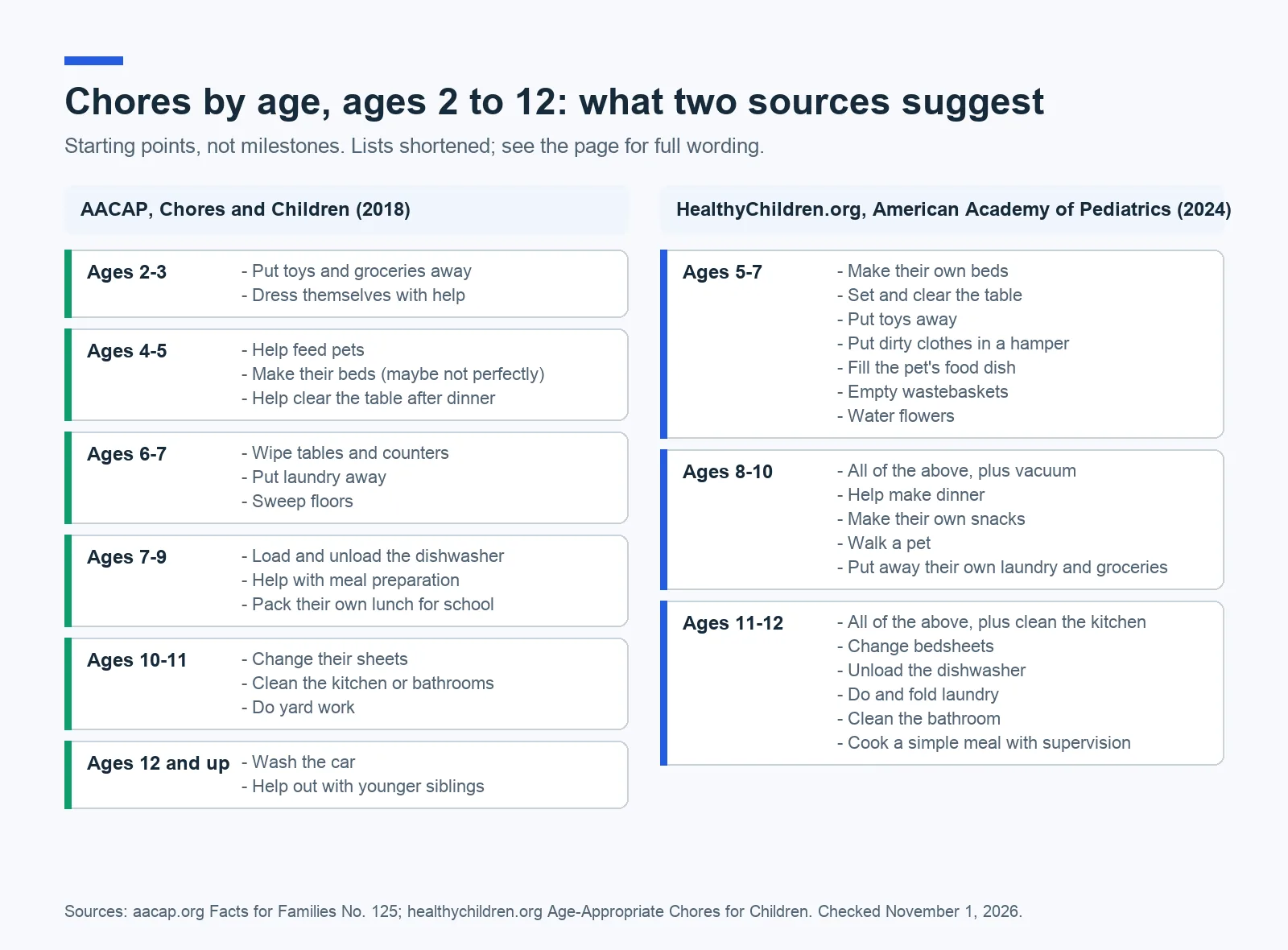
Two physician groups publish suggested lists: the American Academy of Child and Adolescent Psychiatry (AACAP) in its "Chores and Children" fact sheet, and the American Academy of Pediatrics on its parent site, HealthyChildren.org. Their age bands differ, so they are shown separately below. Both are suggestions, not milestones a child must hit.
AACAP suggestions by age (Chores and Children, Facts for Families No. 125, updated June 2018):
| Age | Chores AACAP suggests |
|---|---|
| 2 to 3 | Put toys and groceries away; dress themselves with help |
| 4 to 5 | Help feed pets; make their beds (maybe not perfectly); help clear the table after dinner |
| 6 to 7 | Wipe tables and counters; put laundry away; sweep floors |
| 7 to 9 | Load and unload the dishwasher; help with meal preparation; pack their own lunch for school |
| 10 to 11 | Change their sheets; clean the kitchen or bathrooms; do yard work |
| 12 and up | Wash the car; help out with younger siblings |
HealthyChildren.org list from the AAP (Age-Appropriate Chores for Children, last updated February 2024). These are shortened; the original lists are longer.
Both sources stress patience. AACAP calls chores skills that "may require a learning process", and HealthyChildren.org says not to expect perfection. For a school-age child who is new to chores, HealthyChildren.org suggests introducing one new task at a time, because a long list can be overwhelming. Supervise anything involving cleaning products, hot food, or younger siblings.
Neither source sets out a points system, but both mention rewards and praise:
Practical suggestions from us, not research findings:
The six chores are printed on the sheet. To use different ones, cross a chore out and write the new one beside it, or use the AFFiNE template, where every chore is an editable text box. A clear sheet protector and a dry-erase marker let you reuse one printout.
This chart tracks one child. If several children and adults share the housework, the family chore chart gives each person a section. For a plain grid you can edit before printing, try the weekly chore chart. To compare ten charts for kids, teens, families, and adults, see the free chore chart templates roundup.
AACAP suggests wiping tables and counters, putting laundry away, and sweeping floors at ages 6 to 7, and loading and unloading the dishwasher or packing their own school lunch at ages 7 to 9. HealthyChildren.org's list for ages 5 to 7 includes making the bed, setting and clearing the table, putting toys away, and filling the pet's food dish.
Fewer than you think. The printable chart has six rows, but a child who is new to chores can start with two or three. HealthyChildren.org suggests adding one new task at a time for school-age children who have not had chores before.
Families differ. AACAP recommends a star chart or reward system with specific goals, and HealthyChildren.org mentions allowances and stickers as options. Some families pay for extra jobs and treat daily chores as part of family life. Pick one approach and keep it consistent.
No. The PDF is a static sheet with the six chores printed on it. You can cross a chore out and write another, or use the AFFiNE template, where the name, chores, and points are text boxes you can change.
The PDF is a plain one-page grid for six chores from Monday to Sunday. The AFFiNE template is a separate illustrated chart with five daily rows starting on Sunday, four weekly rows, and boxes for points, a goal, and a reward. The PDF does not copy the AFFiNE design.
AACAP says research suggests there are benefits to including chores in a child's routine as early as age 3. For ages 2 to 3, the toddler picture-cue chart keeps it to five tasks done with a parent.