Free Chore Chart Templates: 10 Printables for Kids & Adults
A chore chart template is a ready-made grid that pairs household tasks with names and days, so everyone can see who does what and when. Below are 10 free ones: five printable PDFs sized by age (US Letter and A4, no account needed) and five editable AFFiNE templates you can assign, filter, and reuse.
Updated October 28, 2026. Names and chores in the examples are fictional. Every printable file was generated for this guide and read back before publishing; see the notes at the end.
Jump to: pick a chart · printable downloads · all 10 templates · chores by age · six setup steps · why charts fail · FAQs
Pick the right chore chart for your household
The best chore chart is the one its users will actually look at, so start from who will use it. Young children need one row per task and a sticker or check mark the same day. Teens respond to due days and a reward agreed in advance. Adults and roommates need a fair split of the jobs nobody wants, which is where rotation beats fixed assignments.
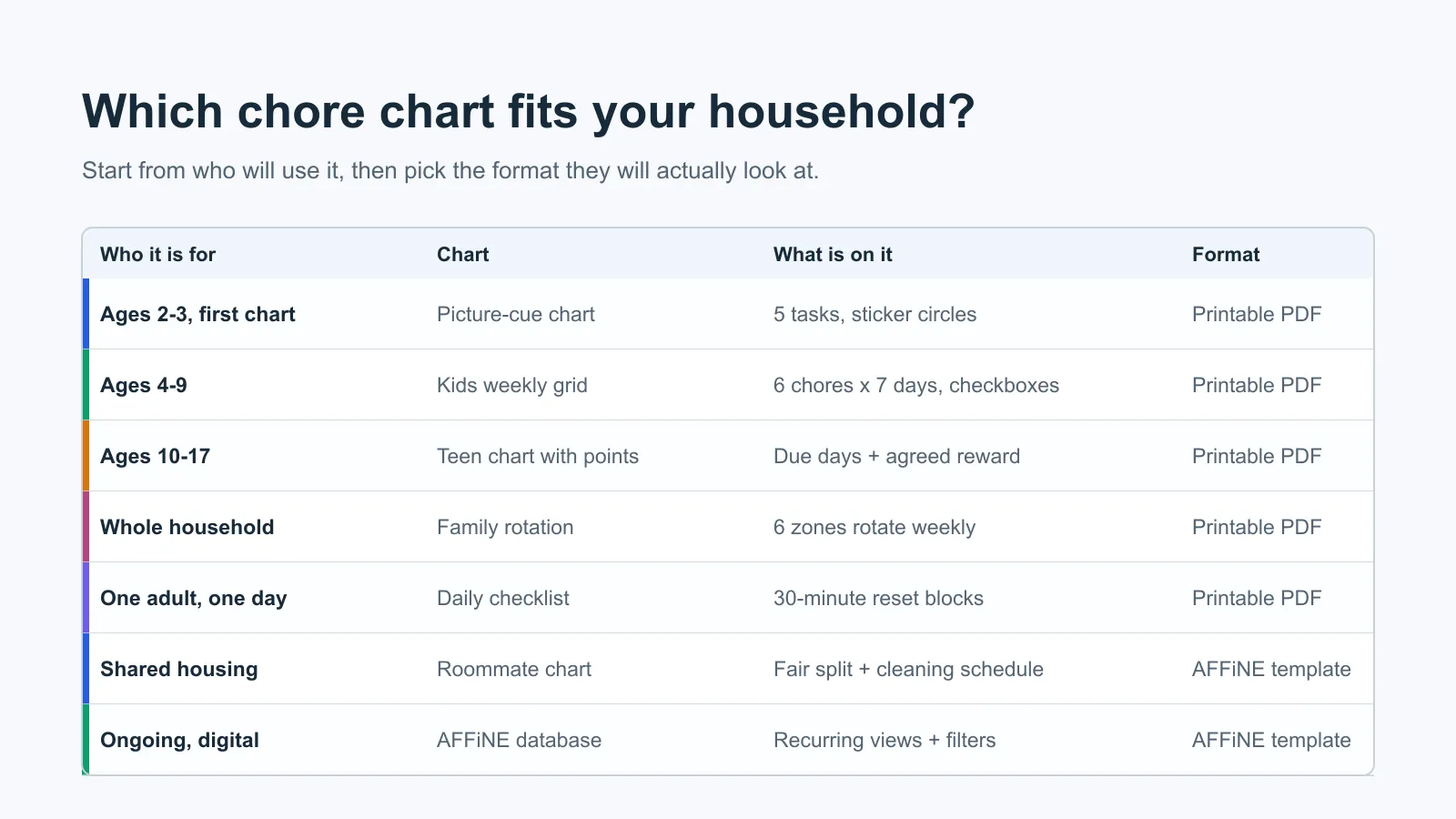
A chore chart template usually has three parts: a column of tasks, a column per day or per person, and a way to mark a task done. Everything else, points, colors, reward rows, is optional decoration on top of that grid.
Download the free printable chore charts
Five charts, ten PDF files. Each chart comes in US Letter and A4, prints at 100% or Actual size, and works with a pen, stickers, or a laminator and dry-erase marker.
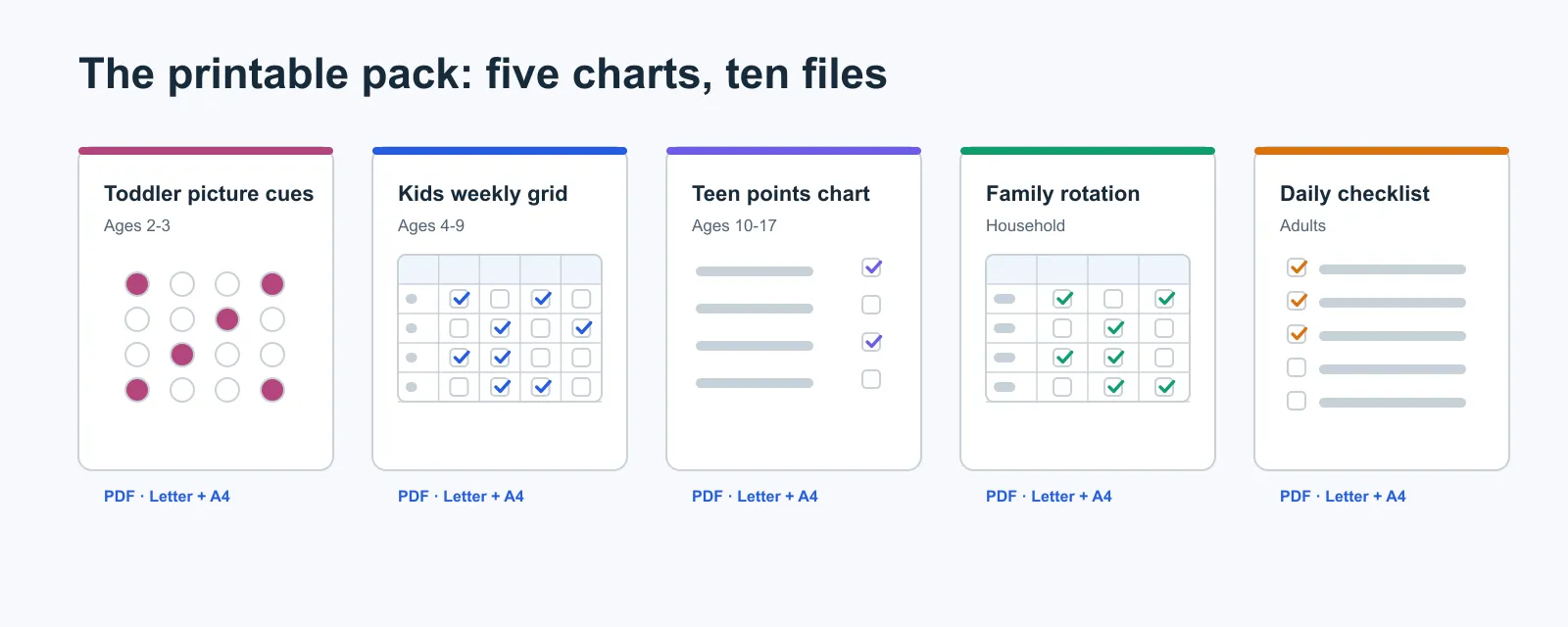
| Printable chart | Best for | US Letter | A4 |
|---|---|---|---|
| First chore chart with picture cues | Ages 2-3, with a parent helping | Letter | A4 |
| Weekly chore chart for kids | Ages 4-9: 6 chores x 7 days | Letter | A4 |
| Weekly chore chart for teens | Ages 10-17: due days, points, agreed reward | Letter | A4 |
| Family rotation chart | Households sharing 6 zones on a 4-week rotation | Letter | A4 |
| Daily chore checklist | Adults: a 30-minute daily reset in 3 blocks | Letter | A4 |
The 10 best free chore chart templates for kids and adults
Each entry lists who it suits, what is on it, and whether you print it or edit it. The five printables are the PDFs above; the five editable ones open as AFFiNE templates.
1. First chore chart with picture cues (printable)
- Best for: ages 2-3 doing their first chores with a parent.
- What is on it: five simple tasks with word cues and seven sticker circles per task.
- Get it: Letter or A4.
At this age the chart is really for the parent: it reminds you to notice and praise the same five actions every day. Keep tasks under two minutes each.
2. Weekly chore chart for kids (printable)
- Best for: ages 4-9 building a daily habit.
- What is on it: six starter chores across seven days, with a name and week-of line.
- Get it: Letter or A4.
Check the boxes together at a fixed time, such as right after dinner. If you prefer a digital version of the same grid, the weekly chore chart template in AFFiNE mirrors this layout. To see this sheet filled in for a 7-year-old, with chores by age from AACAP and the AAP, open the printable chore chart for kids.
3. Weekly chore chart for teens (printable)
- Best for: ages 10-17 who respond to autonomy and clear stakes.
- What is on it: ten rows with due day, points, done, and a checked-by column, plus a line where you agree the weekly reward in advance.
- Get it: Letter or A4.
The checked-by column matters more than the points: it shifts the chart from "parents nagging" to "both sides auditing the same record."
4. Family rotation chore chart (printable)
- Best for: households of two to five sharing the unpopular zones.
- What is on it: six zones (kitchen, bathrooms, floors, laundry, trash, living room) on a four-week rotation; everyone moves one column to the right each week.
- Get it: Letter or A4.
Rotation is the simplest fairness mechanism: nobody owns the bathroom forever, and nobody has to renegotiate assignments every week.
5. Daily chore checklist for adults (printable)
- Best for: one adult keeping a home tidy in about 30 minutes a day.
- What is on it: morning, afternoon, and evening blocks with a few fixed tasks each, plus blank rows for your own.
- Get it: Letter or A4.
Adult chore systems are a bigger topic on their own, from fair splits with a partner to ADHD-friendly setups; we cover that in the chore chart for adults guide. For a once-a-week deeper pass, pair this checklist with the weekly deep cleaning checklist.
6. Weekly chore chart (AFFiNE template)
- Best for: families who want the weekly grid on phones instead of the fridge.
- What is on it: a database of chores with assignee, weekday, and a done checkbox, plus a per-person filtered view.
- Get it: open the weekly chore chart template.
7. Family chore chart (AFFiNE template)
- Best for: families assigning recurring chores across a week.
- What is on it: a members-and-responsibilities database with task, member, weekday, and progress fields.
- Get it: open the family chore chart template.
8. Daily chore chart (AFFiNE template)
- Best for: one person structuring a single day's housework.
- What is on it: a dated task list grouped by time of day, with checkboxes that carry over to tomorrow if you copy the page.
- Get it: open the daily chore chart template.
9. Chore chart printable (AFFiNE template)
- Best for: people who want to start digital but keep a paper copy.
- What is on it: a clean grid laid out for printing, so you can edit it on screen and print a fresh copy any week.
- Get it: open the chore chart printable template.
10. Roommate chore chart and cleaning schedule (AFFiNE template)
- Best for: shared apartments and houses where fairness is the flashpoint.
- What is on it: a per-person checklist, a worked three-roommate cleaning schedule, and a two-roommate variant.
- Get it: open the roommate chore chart template.
For students living in shared housing, balancing these household responsibilities with a demanding syllabus often leads to a search for i need help with my homework to manage the academic side of their schedule.
Chore list by age
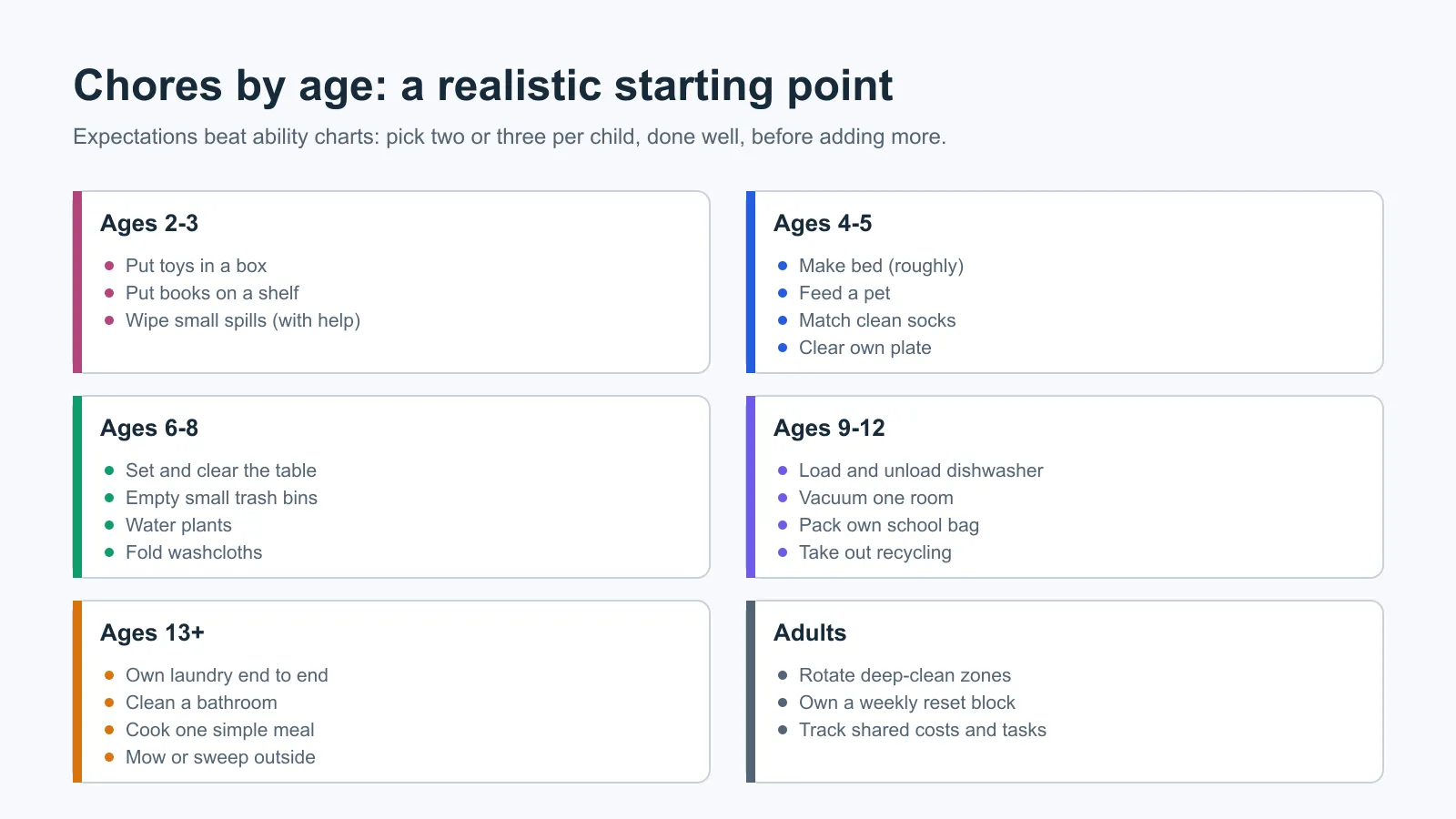
Age charts are starting points, not rules: pick two or three chores per child, done well, before adding more. A six-year-old who reliably feeds the pet and clears their plate is ahead of a six-year-old with ten assigned chores that nobody tracks.
| Age band | Realistic chores |
|---|---|
| 2-3 | Put toys in a box, put books on a shelf, wipe small spills with help |
| 4-5 | Make bed (roughly), feed a pet, match clean socks, clear own plate |
| 6-8 | Set and clear the table, empty small trash bins, water plants, fold washcloths |
| 9-12 | Load and unload the dishwasher, vacuum one room, pack own school bag, take out recycling |
| 13+ | Own laundry end to end, clean a bathroom, cook one simple meal, mow or sweep outside |
| Adults | Rotate deep-clean zones, own a weekly reset block, track shared costs and tasks |
Why bother at all? In a longitudinal analysis of data following children into adulthood, University of Minnesota researcher Marty Rossmann found that starting chores at ages 3-4 was a strong predictor of later self-sufficiency, as reported by The Wall Street Journal (checked October 28, 2026). The chart is just the tool that makes "starting chores" survivable for the adult in charge.
How to set up a chore chart that sticks
Most chore charts die in week two. The six steps below are the difference between a chart that becomes furniture and one that becomes routine.
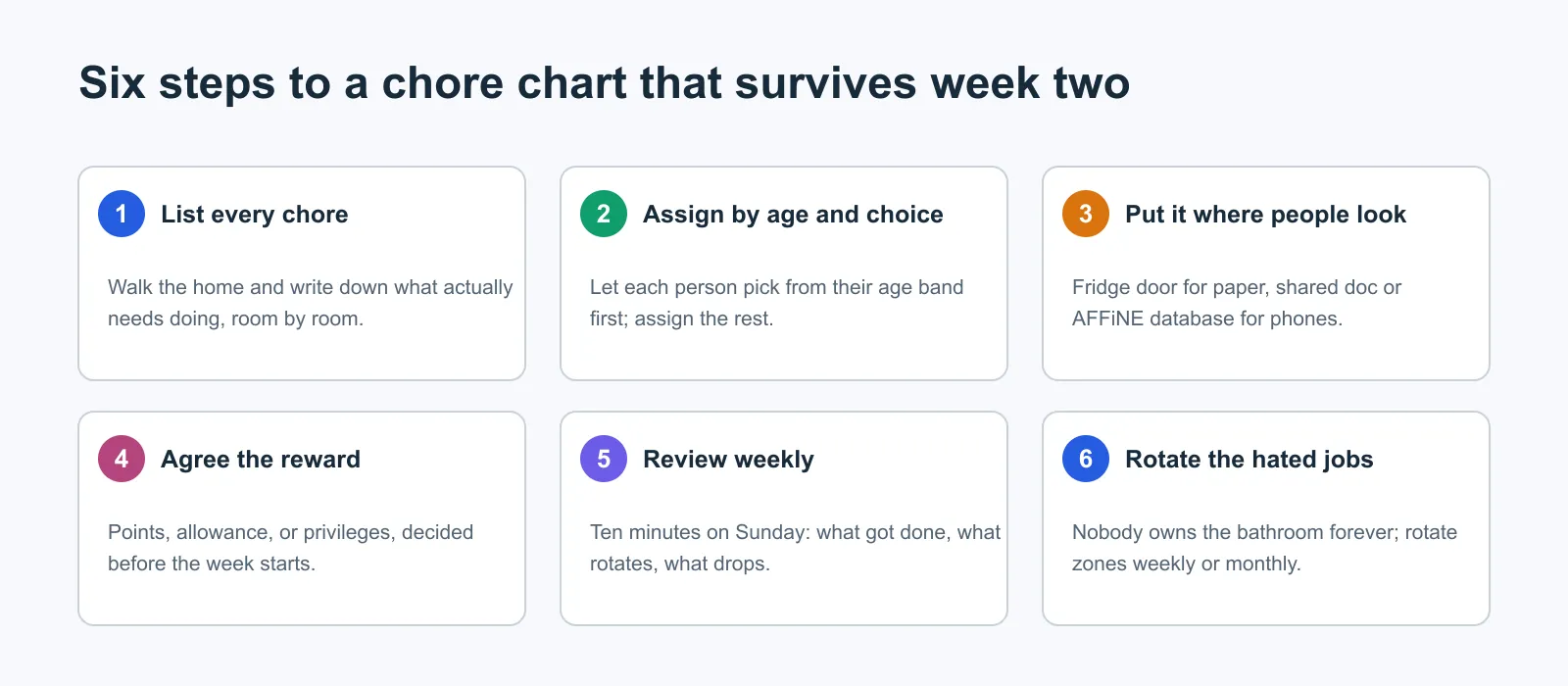
- List every chore. Walk the home room by room and write down what actually needs doing, including the invisible jobs like wiping the bathroom sink.
- Assign by age and choice. Let each person pick from their age band first; assign whatever is left. Chosen chores get done more reliably than imposed ones.
- Put the chart where people look. Fridge door for paper, or a shared doc or AFFiNE database for phones. A chart in a drawer is a chart that does not exist.
- Agree the reward in advance. Points, allowance, or privileges, decided before the week starts, not negotiated after it ends.
- Review weekly. Ten minutes on Sunday: what got done, what rotates, what drops off the list entirely.
- Rotate the hated jobs. Nobody owns the bathroom forever. Rotate zones weekly or monthly so resentment never builds.
Why chore charts fail
If your last chart quietly disappeared, it was probably one of these five causes:
- Too many chores. A chart with 15 daily tasks is a guilt poster. Cut to three to six per person.
- No fixed check-in time. Checking boxes "whenever" means never. Tie it to a meal or bedtime.
- Rewards that drift. If the promised reward slips once, the chart is dead. Pay out on schedule, every week.
- Permanent assignments. Fixed ownership of the worst jobs breeds quiet resentment. Rotate.
- A chart nobody sees. Out of sight really is out of mind, especially for children.
Why use a chore chart template at all
A template saves you the blank-page problem: the columns, rows, and reward lines already exist, so you spend your ten minutes assigning chores instead of drawing grids. Beyond that, charts work because they make expectations visible. A task on paper is a fact; a task said out loud is an argument waiting to happen. The six specific benefits:
- Visible expectations
A task written on a chart is a fact the whole household can see, not a request someone has to remember or repeat.
- Accountability
Each chore has a name next to it, so "I didn't know" stops being available as an excuse, for kids and adults alike.
- Fairness through rotation
A chart with rotating assignments proves the unpopular jobs are shared, which removes the main source of household resentment.
- Routine building
Checking the chart at a fixed daily time turns individual chores into a habit loop that needs less willpower each week.
- A record for rewards
Checked boxes are an auditable record, which is what makes agreed points, allowance, or privileges enforceable without arguing.
- Less nagging
The chart does the reminding, so parents and partners can audit the record instead of repeating requests.
Build your chore chart in AFFiNE
Disclosure: AFFiNE publishes this blog. If your household lives on phones, the printable charts also work as a database. We tested this path on October 28, 2026 in a local workspace at app.affine.pro, without signing in. We typed a family's nine chores as Markdown checkboxes, and each line became a to-do block. We then selected the blocks and used the toolbar's convert-to-database action, which turned the list into a table with one row per chore. Adding a Kanban View created a status field with To do, Doing, and Done groups, and we typed a member's name as a new option to filter per person. Switching between Kanban and Table views keeps the same rows, so nobody retypes anything.
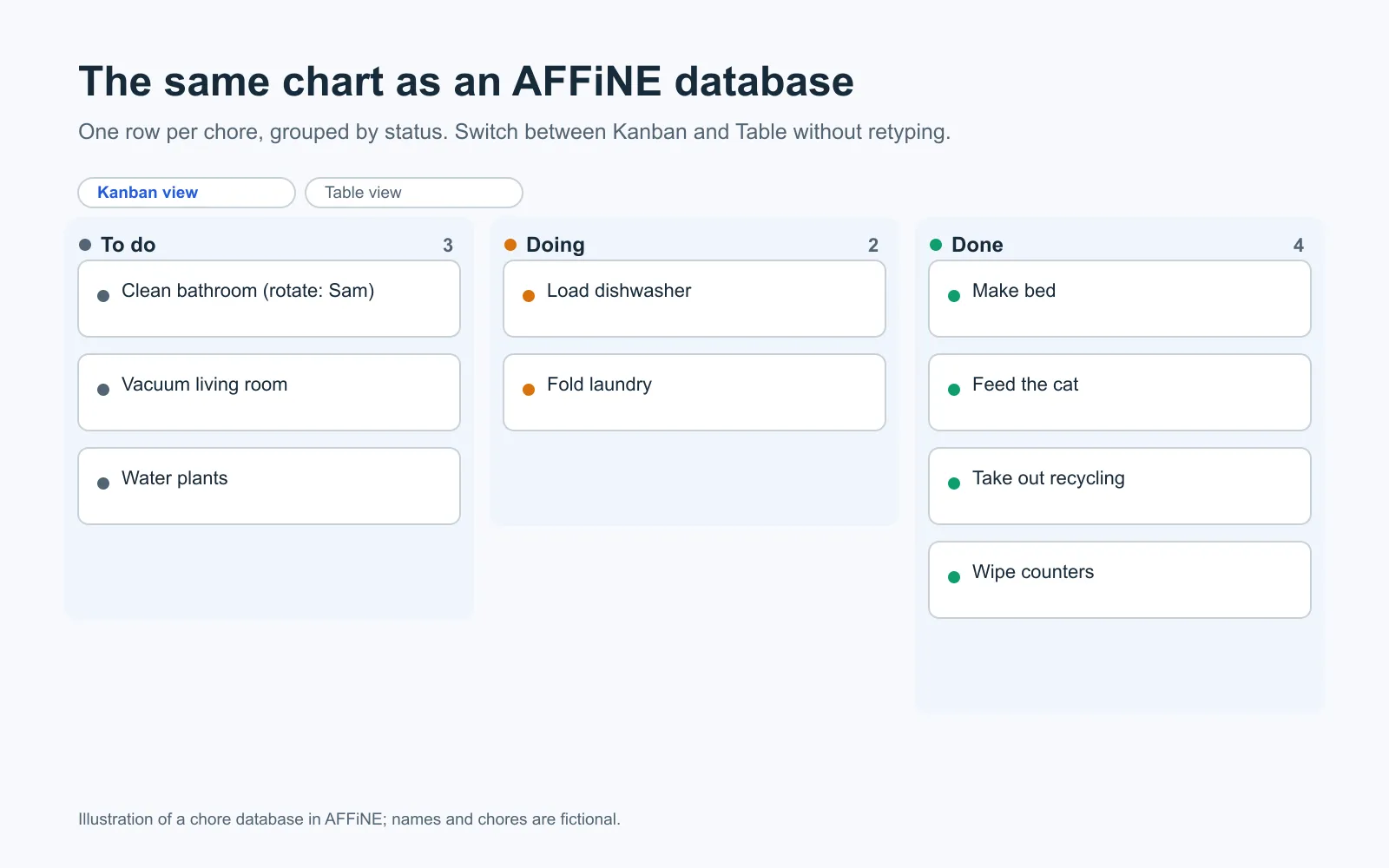
Where AFFiNE genuinely helps: recurring charts (copy last week's database instead of printing a new sheet), per-person filtered views, and keeping the chore list next to the meal plan and the family calendar in one workspace. Where paper wins: toddlers, sticker rewards, and anything that needs to live on the fridge. Pick the medium your household will look at.
If you also run a household to-do list for non-chore tasks, the to-do list template guide has printable daily and work lists that pair well with these charts, and the spring cleaning checklist covers the seasonal deep-clean jobs that do not belong on a weekly chart.
Chore chart FAQs
What is a chore chart?
A chore chart is a grid that pairs household tasks with names and days, with a box, sticker, or status to mark each task done. It makes expectations visible, creates a record everyone can audit, and removes the daily "who was supposed to do this?" negotiation.
What chores are appropriate for a 4-year-old?
Four-year-olds can make their bed roughly, feed a pet with measured food, match clean socks, and clear their own plate. Keep tasks under five minutes, do them alongside the child at first, and check the chart together at a fixed time each day.
Should kids get paid for chores?
Both approaches work; consistency matters more than the choice. Many families separate "contributor chores" (unpaid, because you live here) from "extra jobs" (paid, like washing the car). Whatever you choose, agree it in advance and pay out on schedule.
How many chores should a child have per day?
Two or three is the sustainable range for most children. A short list finished every day builds the habit; a long list avoided every day builds avoidance. Add a chore only after the current set runs smoothly for a few weeks.
What is the best chore chart for roommates?
A rotation chart. Fixed assignments let resentment build around the worst jobs, while a weekly rotation through zones keeps the split provably fair. The roommate chore chart template includes a worked three-person schedule you can copy.
How do I make a chore chart for adults?
List every task the household needs, agree what "done" means for each, then assign by preference and rotate the rest. Keep a visible weekly reset block and review it together. The full method is in our chore chart for adults guide.
Are printable chore charts better than apps?
Neither is better; visibility is what matters. Paper wins for young children and fridge-door households. Apps and databases win for teens, roommates, and recurring schedules. Many families print the week from a digital chart, which gets you both.
Notes on sources and files: the Rossmann finding is reported by The Wall Street Journal (checked October 28, 2026); the original analysis uses the University of Minnesota's longitudinal data. The ten printable PDFs were generated for this article with scripts/content/create-chore-chart-pdfs.py and verified by re-reading each file. The AFFiNE walkthrough was tested in a local browser workspace on October 28, 2026. The figures on this page are original illustrations; names and chores in them are fictional.
Want the editable versions? Open the weekly, family, daily, or printable chore chart templates in AFFiNE and make them yours.