Free Study Planner Template (SMART Goals + Pomodoro)
Free study planner template: plan a week with SMART goals, Pomodoro time blocks and self-tests, then copy it to AFFiNE or print A4 PDFs.

Reviewed by AllenContent Operations Manager

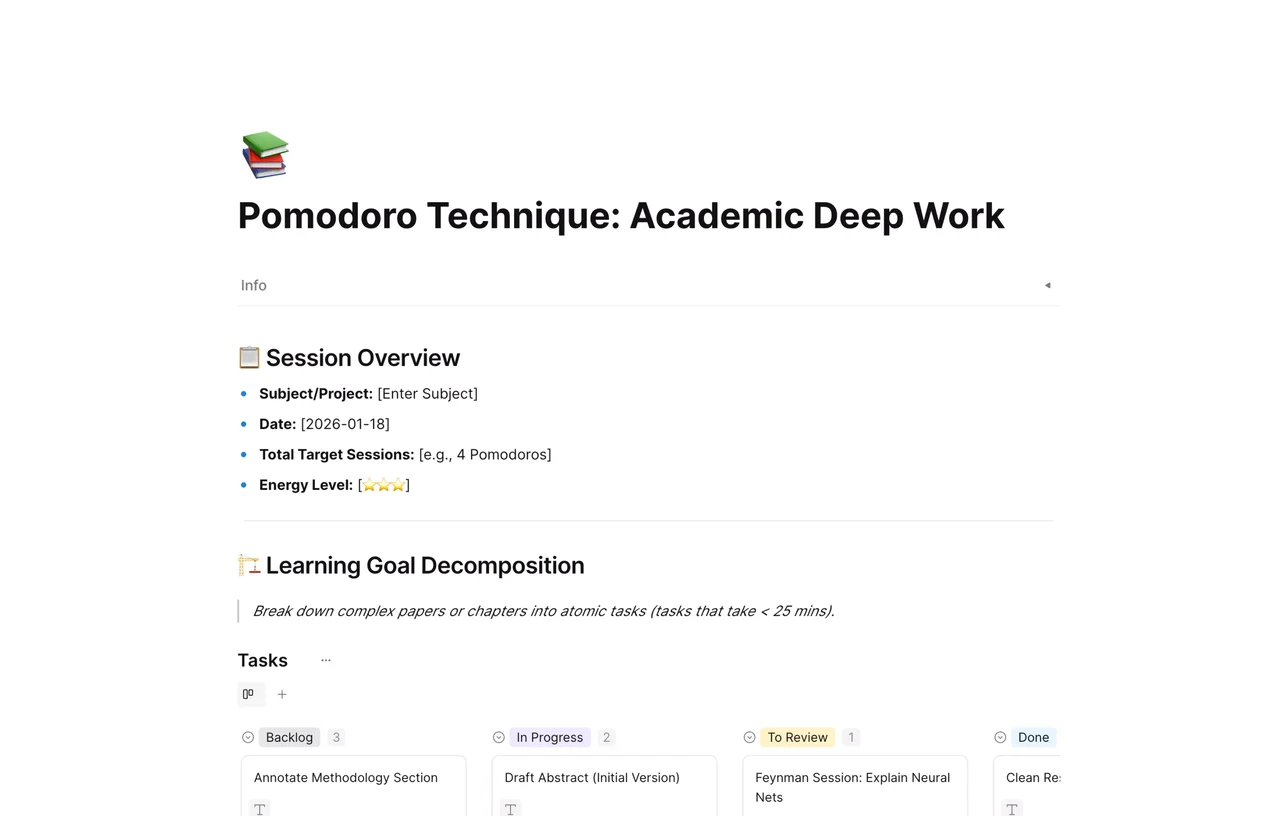
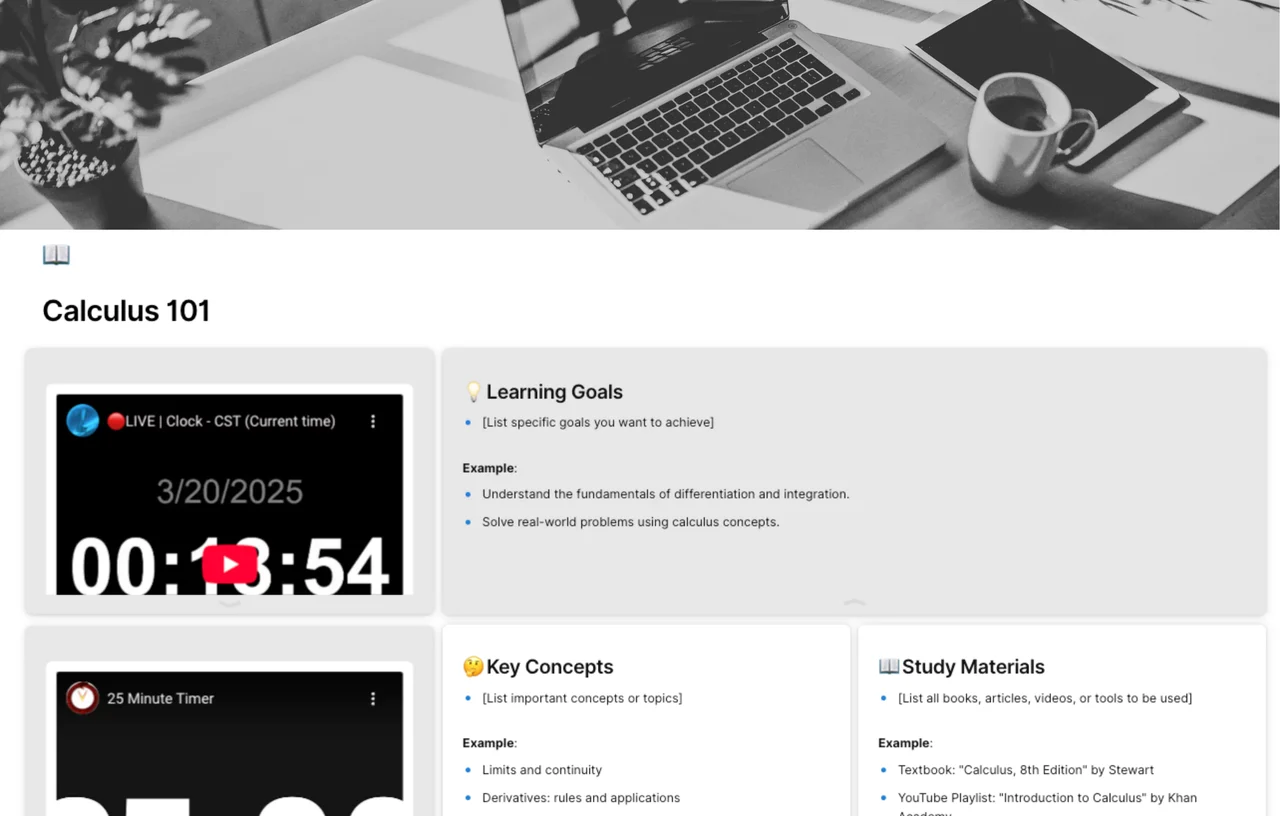
A study planner template is a reusable page that turns course goals into a weekly schedule: what to study, when, for how long, and how you will check that it worked. This one gives you AFFiNE's Productive Study Planner, a filled one-week example for a university student, and blank and filled printable A4 PDFs.
The PDFs are printable worksheets, not fillable forms.
The AFFiNE template is one long page with five sections. Every table comes with sample data that you replace.
What it does not do. The sections use plain tables, not databases. Nothing is sorted, filtered or added up for you, the "Kanban" board is three separate tables, and the completion rate is typed text. The planner includes one example day, so you copy it for the other days. The sample dates are from 2025, and two leftover image placeholder notes ("[SVG: Replace with ...]") can be deleted.
Illustrative example: The student, courses, dates and scores are fictional. Ana is a second-year computer science undergraduate taking four courses. This is her plan for Monday 9 November to Sunday 15 November 2026, outside lectures and labs.
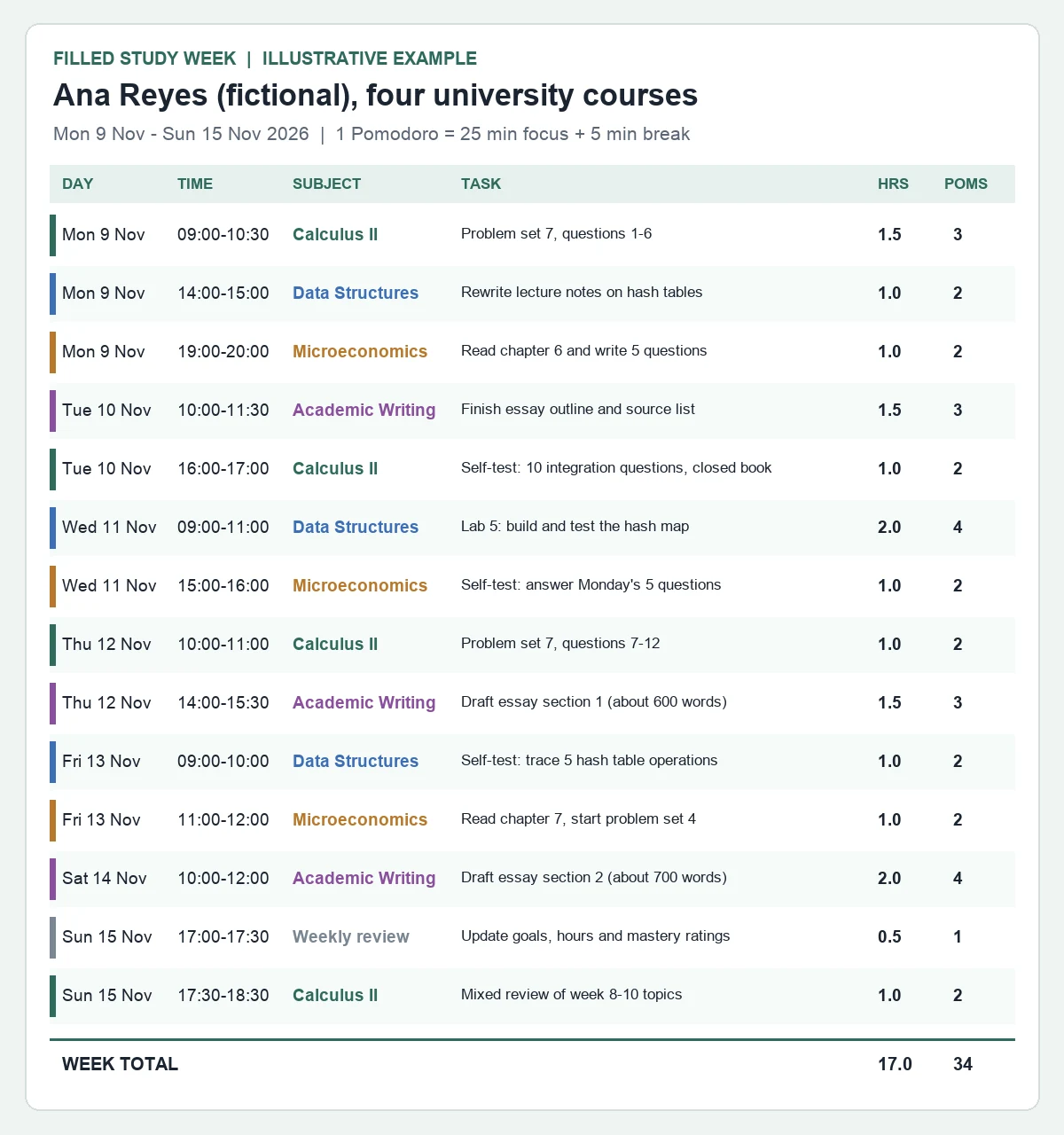
Each Pomodoro here means 25 minutes of focus plus a 5-minute break, so one hour of planned time holds two sessions. The week adds up to 17.0 hours in 14 blocks and 34 Pomodoro sessions.
| Day | Time | Subject | Task | Hours | Pomodoros |
|---|---|---|---|---|---|
| Mon 9 Nov | 09:00–10:30 | Calculus II | Problem set 7, questions 1-6 | 1.5 | 3 |
| Mon 9 Nov | 14:00–15:00 | Data Structures | Rewrite lecture notes on hash tables | 1.0 | 2 |
| Mon 9 Nov | 19:00–20:00 | Microeconomics | Read chapter 6 and write 5 questions | 1.0 | 2 |
| Tue 10 Nov | 10:00–11:30 | Academic Writing | Finish essay outline and source list | 1.5 | 3 |
| Tue 10 Nov | 16:00–17:00 | Calculus II | Self-test: 10 integration questions, closed book | 1.0 | 2 |
| Wed 11 Nov | 09:00–11:00 | Data Structures | Lab 5: build and test the hash map | 2.0 | 4 |
| Wed 11 Nov | 15:00–16:00 | Microeconomics | Self-test: answer Monday's 5 questions | 1.0 | 2 |
| Thu 12 Nov | 10:00–11:00 | Calculus II | Problem set 7, questions 7-12 | 1.0 | 2 |
| Thu 12 Nov | 14:00–15:30 | Academic Writing | Draft essay section 1 (about 600 words) | 1.5 | 3 |
| Fri 13 Nov | 09:00–10:00 | Data Structures | Self-test: trace 5 hash table operations | 1.0 | 2 |
| Fri 13 Nov | 11:00–12:00 | Microeconomics | Read chapter 7, start problem set 4 | 1.0 | 2 |
| Sat 14 Nov | 10:00–12:00 | Academic Writing | Draft essay section 2 (about 700 words) | 2.0 | 4 |
| Sun 15 Nov | 17:00–17:30 | Weekly review | Update goals, hours and mastery ratings | 0.5 | 1 |
| Sun 15 Nov | 17:30–18:30 | Calculus II | Mixed review of week 8-10 topics | 1.0 | 2 |
| Total | 17.0 | 34 |
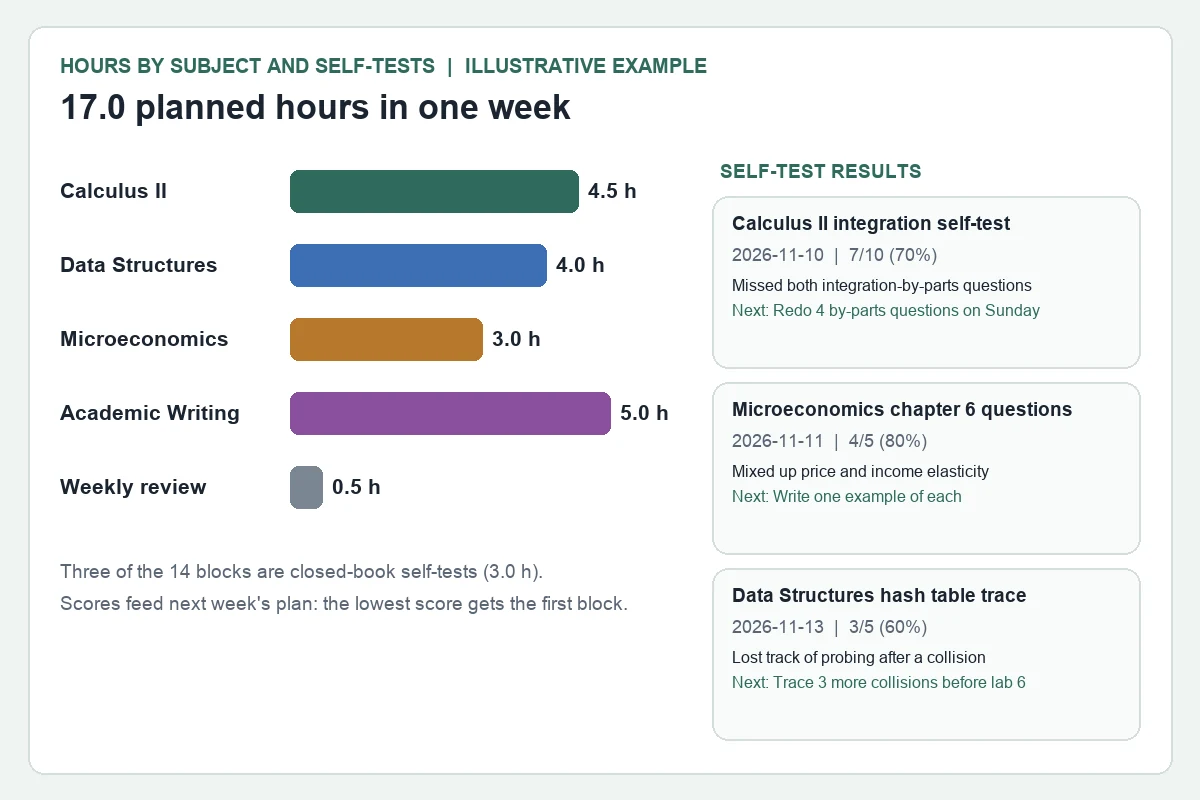
Hours by subject. Each course gets blocks on at least three different days, and three blocks are closed-book self-tests.
| Subject | Blocks | Hours | Self-test hours |
|---|---|---|---|
| Calculus II | 4 | 4.5 | 1.0 |
| Data Structures | 3 | 4.0 | 1.0 |
| Microeconomics | 3 | 3.0 | 1.0 |
| Academic Writing | 3 | 5.0 | 0.0 |
| Weekly review | 1 | 0.5 | 0.0 |
| Total | 14 | 17.0 | 3.0 |
SMART goals for the week, written in the template's My SMART Goals columns:
| Goal Description | Category | Start Date | End Date | Status | Progress | Notes |
|---|---|---|---|---|---|---|
| Score 75% or higher on the Calculus II final | Academics | 2026-11-09 | 2026-12-14 | In Progress | 30% | Two problem-set blocks and one self-test a week |
| Submit a 2,000-word Academic Writing research essay | Research | 2026-11-02 | 2026-11-27 | In Progress | 40% | Outline done; draft sections 1 and 2 this week |
| Pass every test in Data Structures lab 5 | Academics | 2026-11-09 | 2026-11-13 | Not Started | 0% | One 2-hour lab block on Wednesday |
Self-test results, logged in the Mock Test Tracker:
| Exam Name | Date Taken | Score | Analysis | Action Items |
|---|---|---|---|---|
| Calculus II integration self-test | 2026-11-10 | 7/10 (70%) | Missed both integration-by-parts questions | Redo 4 by-parts questions on Sunday |
| Microeconomics chapter 6 questions | 2026-11-11 | 4/5 (80%) | Mixed up price and income elasticity | Write one example of each |
| Data Structures hash table trace | 2026-11-13 | 3/5 (60%) | Lost track of probing after a collision | Trace 3 more collisions before lab 6 |
Priority list: High: Submit Data Structures lab 5 (due Fri 13 Nov); Hand in Calculus II problem set 7 (due Fri 13 Nov). Medium: Draft essay sections 1 and 2; Start Microeconomics problem set 4 (due Tue 17 Nov). Low: Sort lecture notes into one folder per course.
To copy this into the AFFiNE template, put each day's blocks in a copy of the Monday table, the hours in the Study Hour Tracker, the scores in the Mock Test Tracker, and the tasks in the priority checklists.
Ana has three finals, starting with Calculus II on Monday 14 December 2026. Four weeks before, the planner switches from coursework to a countdown. The plan below adds up to 68 hours over 28 days.
| Week | Dates | Days left | Focus | Planned hours | Checks |
|---|---|---|---|---|---|
| 1 | 16–22 Nov | 28–22 | List every exam topic and rate it strong, shaky or new | 16 | One short self-test per exam subject |
| 2 | 23–29 Nov | 21–15 | Shaky and new topics first; submit the essay on 27 Nov | 18 | One self-test per subject on last week's topics |
| 3 | 30 Nov–6 Dec | 14–8 | Mixed questions across topics; one timed past paper per exam | 20 | Three timed past papers, errors logged |
| 4 | 7–13 Dec | 7–1 | Second timed paper, fix logged errors, light review on the last two days | 14 | Three timed past papers, then rest |
| Total | 68 |
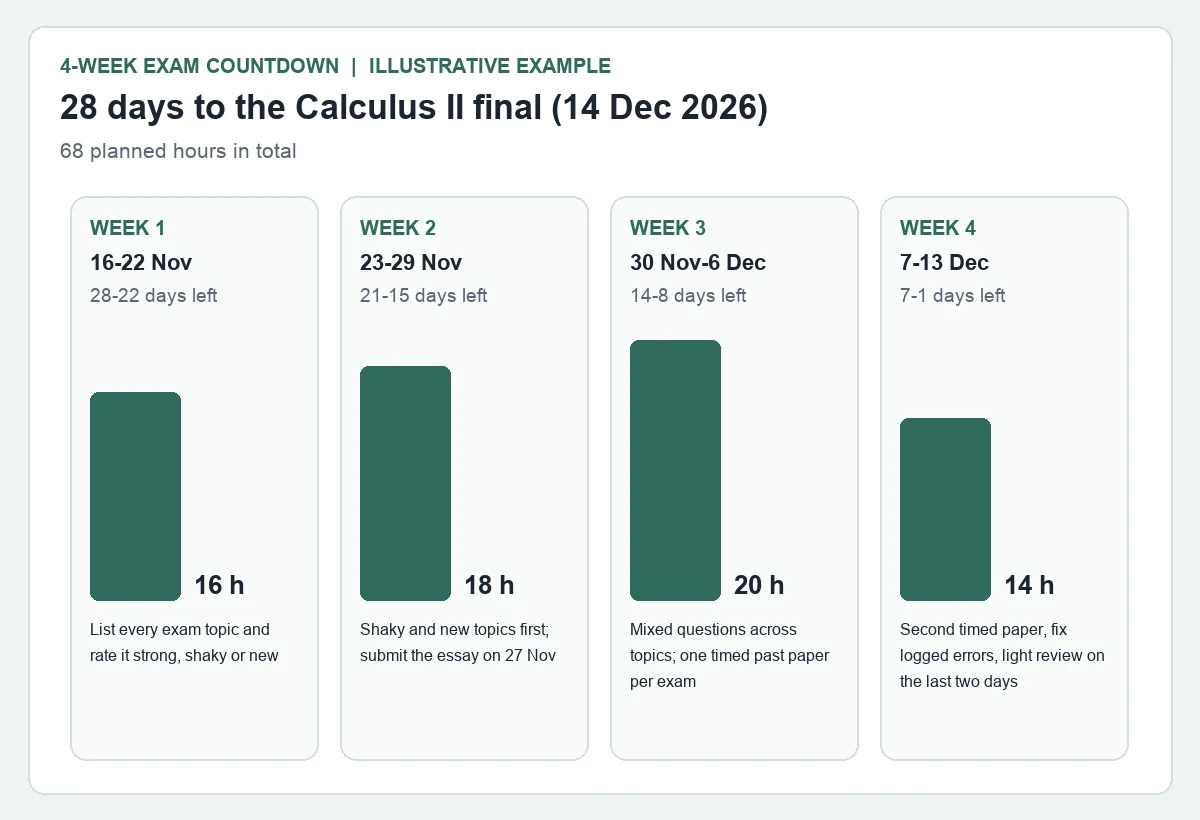
In the AFFiNE template, this lives in the Exam Preparation Hub. Log each timed paper in the Mock Test Tracker, turn repeated mistakes into Revision Notes Highlights, and list past papers under Exam-Specific Resources. The weekly hours are Ana's numbers. Set yours from the hours you actually logged in normal weeks, not from a target you have never reached.
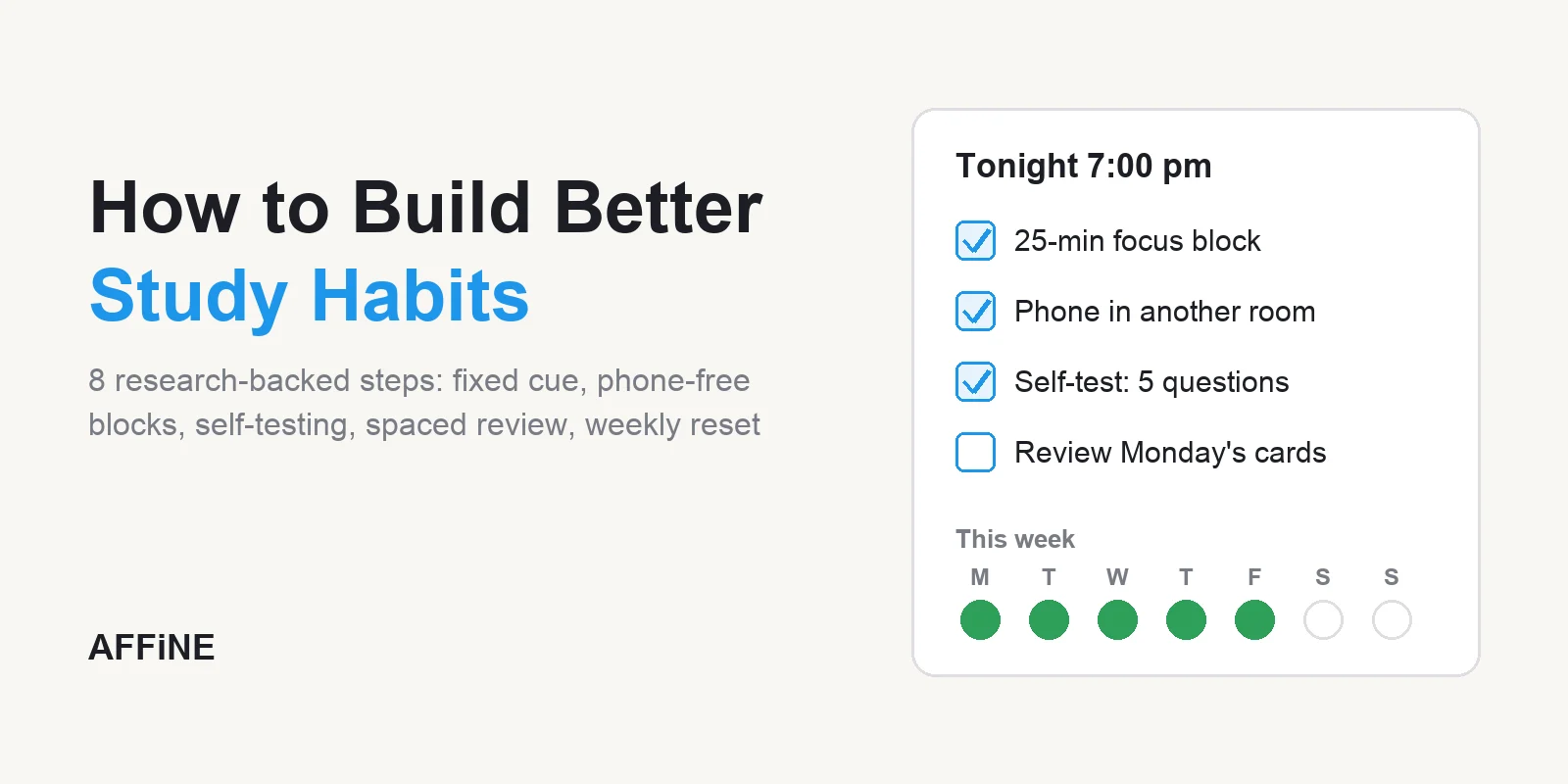
Pomodoro. Francesco Cirillo developed the Pomodoro Technique in the 1980s while preparing for a university exam, using a tomato-shaped kitchen timer. On his official site, Cirillo describes the 25-minute timer as only one part of the method, which also covers planning, estimating effort, handling interruptions and recording what happened. The Pomodoro Sessions column is where your estimate goes. At the weekly review, compare planned sessions with finished ones and adjust next week's blocks.
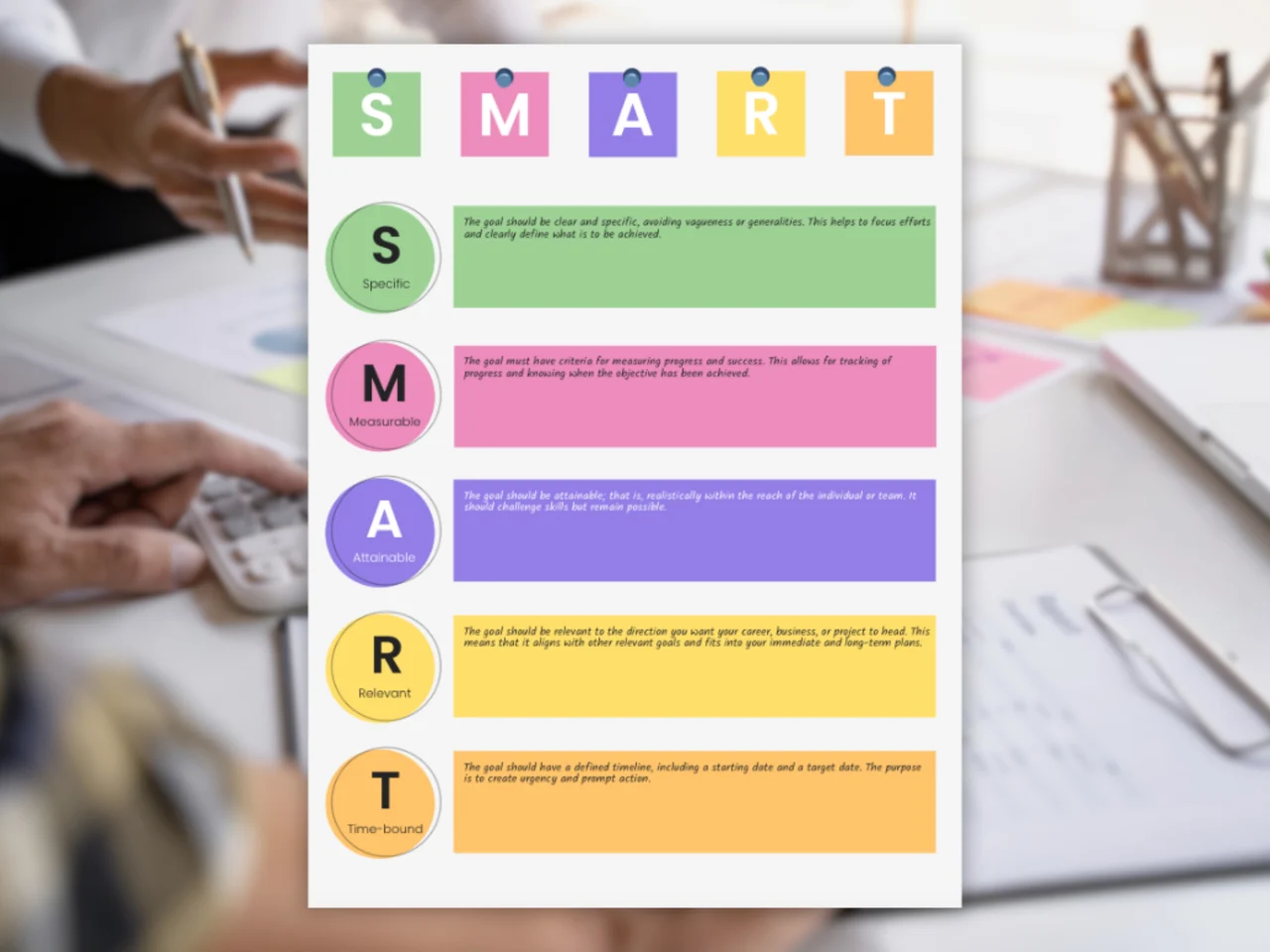
SMART goals. The acronym comes from George T. Doran's 1981 article in Management Review, where the letters stood for Specific, Measurable, Assignable, Realistic and Time-related. The template uses the more common later wording: Specific, Measurable, Achievable, Relevant and Time-bound. A quick check for a study goal: on the end date, could someone else tell whether you met it? "Score 75% or higher on the Calculus II final" passes. "Get better at calculus" does not.
Self-testing. In a review of ten learning techniques, Dunlosky and colleagues (2013) rated practice testing and distributed practice (spreading study over time) as high utility, and rated highlighting and rereading as low utility. In the planner, that means ending some blocks with closed-book questions instead of another read-through, and coming back to a topic on several days, as the Sunday mixed review does.
| Template | What the AFFiNE template contains | Pick it when |
|---|---|---|
| Productive Study Planner (this page) | SMART goals, a time-block day with Pomodoro counts, priority lists, a three-table task board, hour, mastery and completion trackers, an exam hub and a resource library | You study alone toward several goals and want one page for the whole term |
| Exam prep study planner | A "Days until exam" line (28 in the sample), an Exam Dashboard, a Subject-Specific Review Plan with last and next review dates, and a Practice Test Log & Analysis | You are planning one exam period and want a countdown rather than a weekly schedule |
| Subject-focused study planner | A Subject Database, a lecture notes index, a reading list, a research project planner, an assignment tracker by subject and a flashcard table | Your problem is organizing material per course, not scheduling time |
| Collaborative study planner | A team dashboard with roles, a shared assignment tracker with assignees, meeting notes with action items, a shared resource library, a discussion area and group and individual progress tables | A study group or project team shares one plan |
Goals with end dates, a weekly schedule of study blocks, a priority list, and a way to check progress, such as logged hours and self-test scores. For exam season, add a countdown and a log of practice papers. The PDFs on this page include all of these. The AFFiNE template covers everything except the countdown.
Estimate how many 25-minute sessions each block needs and write the number next to it. With a 5-minute break after each session, one hour holds two sessions, so a 1.5-hour block holds three. After the week, compare planned sessions with finished ones to make better estimates.
No. The PDFs are a separate two-page worksheet made for this page, not an export of the AFFiNE template, with columns for hours and Pomodoros and a 4-week countdown. Use this template copies AFFiNE's original Productive Study Planner, which has more sections and its own 2025 sample data. The PDFs are not fillable forms.
No. The AFFiNE template uses plain tables, so totals such as the 66.7% completion rate are typed in. Add up your hours by hand during the weekly review, or keep a running total in the Notes column.
Yes. Keep one goal for the exam, fill the week with revision blocks, and log each practice paper in the Mock Test Tracker. If that exam is all you are planning for, the exam prep study planner's countdown and review dates may fit better.