How to Build Better Study Habits: 8 Research-Backed Steps
Good study habits are small, repeatable routines that make studying the default rather than a daily fight with your phone. To build better study habits, tie each session to a fixed cue, study in short phone-free blocks, test yourself instead of rereading, spread review over several days, and check the routine once a week. The eight steps below show how to do each one, with the research behind it and a sample week you can copy.
Quick version
- Pick one fixed time and place, and write it as an if-then plan.
- Start small: one 25-minute block a day.
- Put your phone in another room before you start.
- Capture distracting thoughts on a list instead of acting on them.
- End every block by testing yourself.
- Review each topic again after 1 day, 3 days, and 1 week.
- Track the habit, not the hours.
- Reset the plan once a week.
Why Study Habits Matter More Than Willpower
Most students do not fail to study because they lack motivation. They fail because every session starts with a decision: when, where, what, and for how long. Each decision is a chance to open Netflix or TikTok instead.
A habit removes those decisions. In a study of how habits form, Lally and colleagues (2010) followed 96 people who repeated a new daily behavior in the same context. Reaching peak automaticity took a median of 66 days, with a range of 18 to 254 days. Missing a single day did not reset progress. Two lessons follow for students: expect a study habit to take weeks rather than days, and do not quit after one missed session.
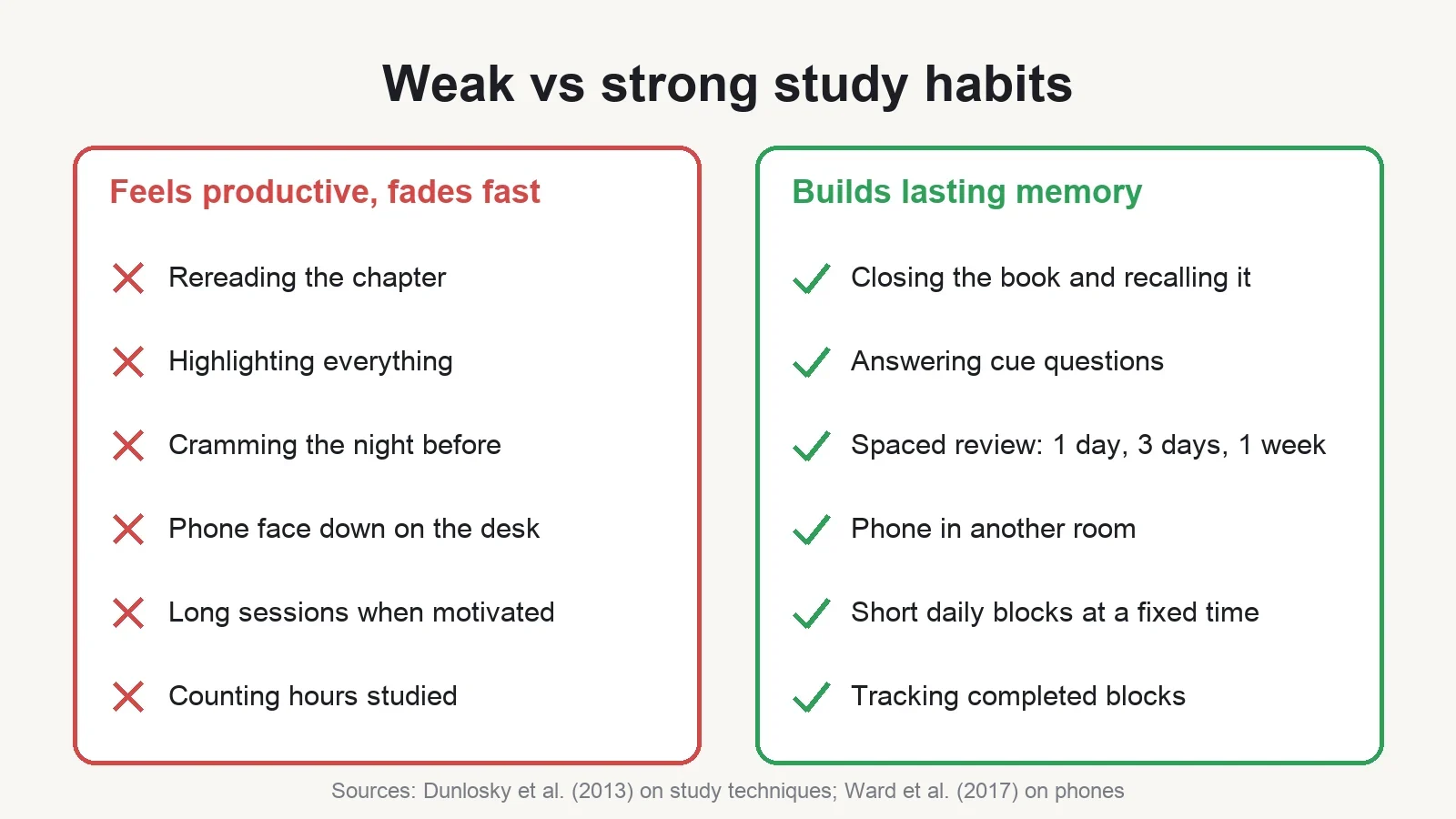
Distraction makes this harder than it used to be. In Ward and colleagues (2017), students who left their phone in another room did better on working-memory tasks than students whose phone sat face down on the desk, even when the phone was silent. The phone did not need to ring to cost attention. It only needed to be in sight.
Step 1: Pick One Fixed Study Time and Place
Choose a time when your energy is reasonably good and that you can repeat on most days. It does not have to be 6 am. Then choose one place, ideally a desk you use only for study, with good light and a chair you can sit in for 30 minutes.
Write the plan as an if-then sentence, called an implementation intention:
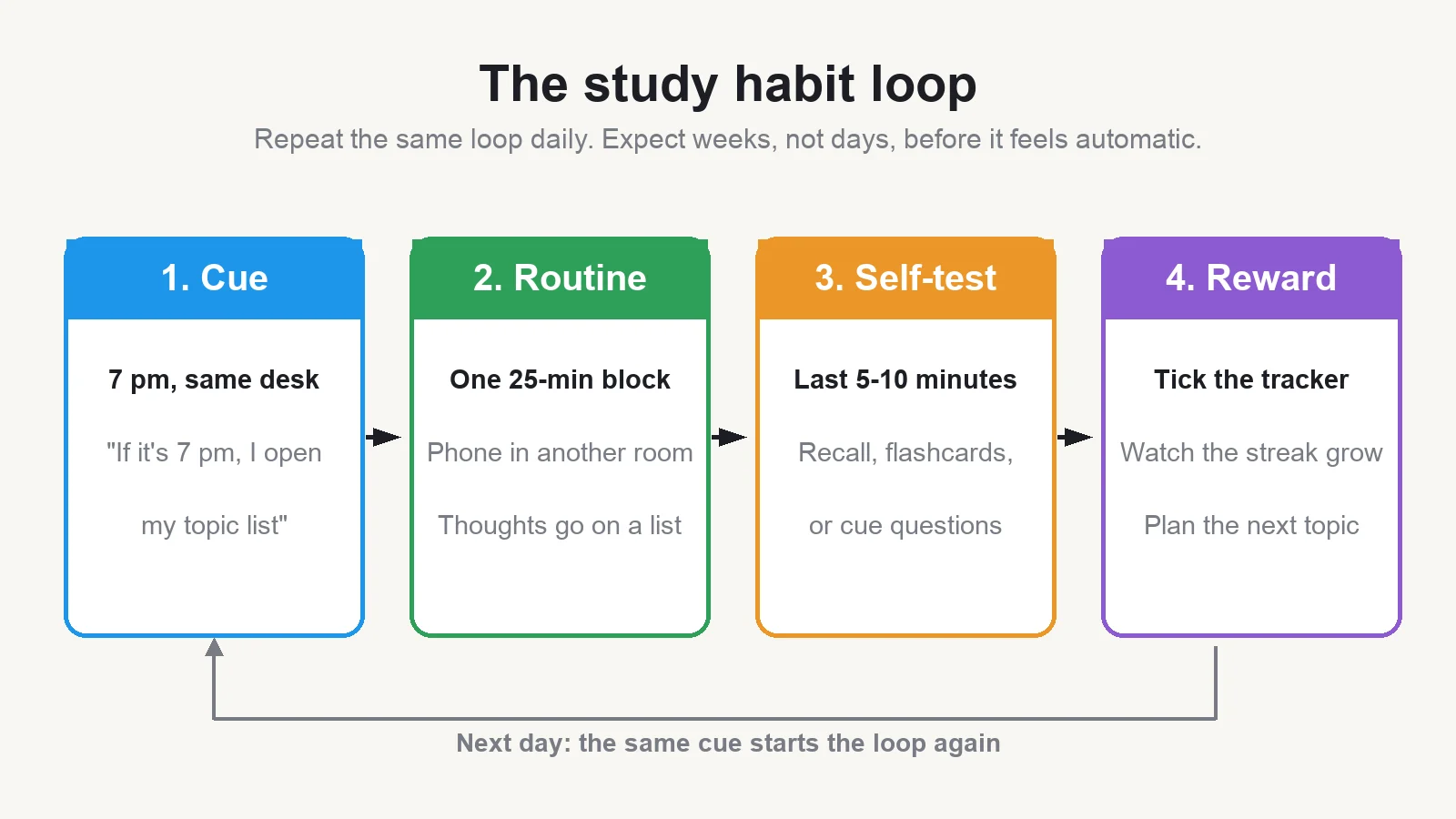
- "If it is 7 pm on a weekday, then I sit at my desk and open the next topic on my list."
- "If I finish dinner, then I review yesterday's flashcards for 10 minutes."
A meta-analysis of 94 studies by Gollwitzer and Sheeran (2006) found that if-then plans had a medium-to-large effect on reaching goals, compared with simply intending to act. The "if" part becomes your cue. Over time, the time and the place start the session for you.
Step 2: Start With a Habit Too Small to Skip
A two-hour plan sounds impressive on Sunday and collapses by Wednesday. Start with one focused block a day, around 25 minutes, and stop when it ends. A short block that you actually do builds the habit. A long block that you skip builds the opposite habit.
Once the block feels automatic, usually after two to three weeks, add a second block or extend the first to 45 minutes. Increase one thing at a time.
If you study best with a visible timer, a kitchen timer or hourglass timer for focus sessions works without unlocking your phone.
Step 3: Make Distractions Harder to Reach
Willpower is unreliable. Distance is reliable. Before each block:
- Put your phone in another room, or at least in a bag out of sight. Silent mode on the desk is not enough, as the Ward study shows.
- Close every tab and app you do not need for this topic.
- Turn on a focus mode on your laptop that blocks social sites for the length of the block. These tools to reduce online distractions compare site blockers and focus timers.
- Put what you need on the desk first: notes, textbook, water, a pen. Getting up to fetch things is how sessions end.
If you study with others online, agree on "cameras on, phones away" rules for the block, and chat only in the break.
Step 4: Capture Wandering Thoughts Instead of Acting on Them
Even with your phone away, your own mind interrupts: "Did I reply to that message?" "I should check the assignment deadline." Acting on each thought breaks the block.
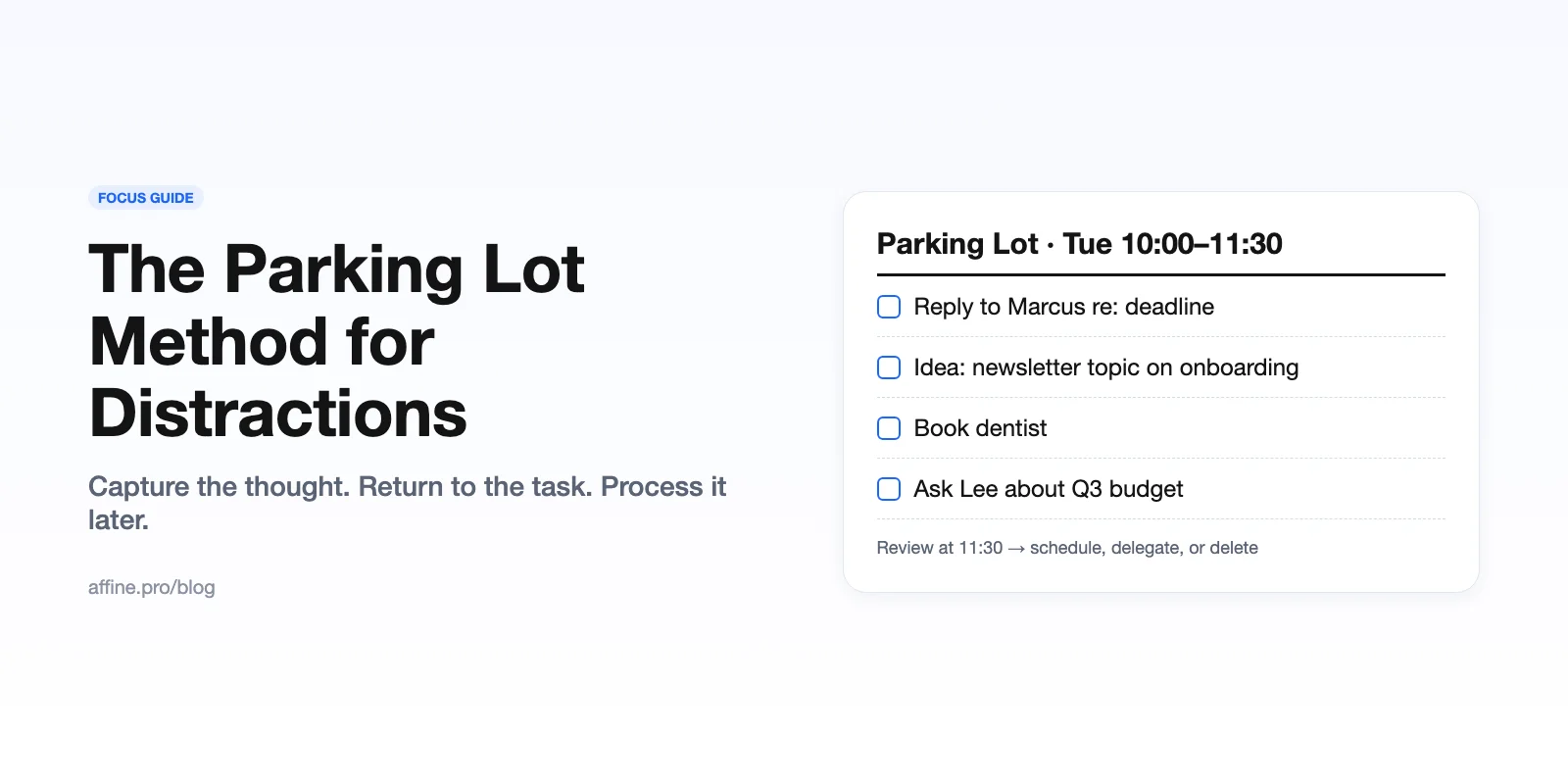
Keep a single paper list or note beside you. When a thought appears, write it in a few words and go straight back to work. Deal with the list in your break. This is the parking lot method for distractions, and it works because the thought is saved somewhere you trust, so you can let it go instead of holding it in mind.
Step 5: End Every Session by Testing Yourself
Rereading and highlighting feel productive but do little for long-term memory. In a large review of ten study techniques, Dunlosky and colleagues (2013) rated practice testing and spaced practice as "high utility," and rated rereading and highlighting as "low utility."
Practice testing does not need a formal test. Spend the last 5 to 10 minutes of each block on any of these:
- Close the book and write down everything you remember about the topic, then check what you missed.
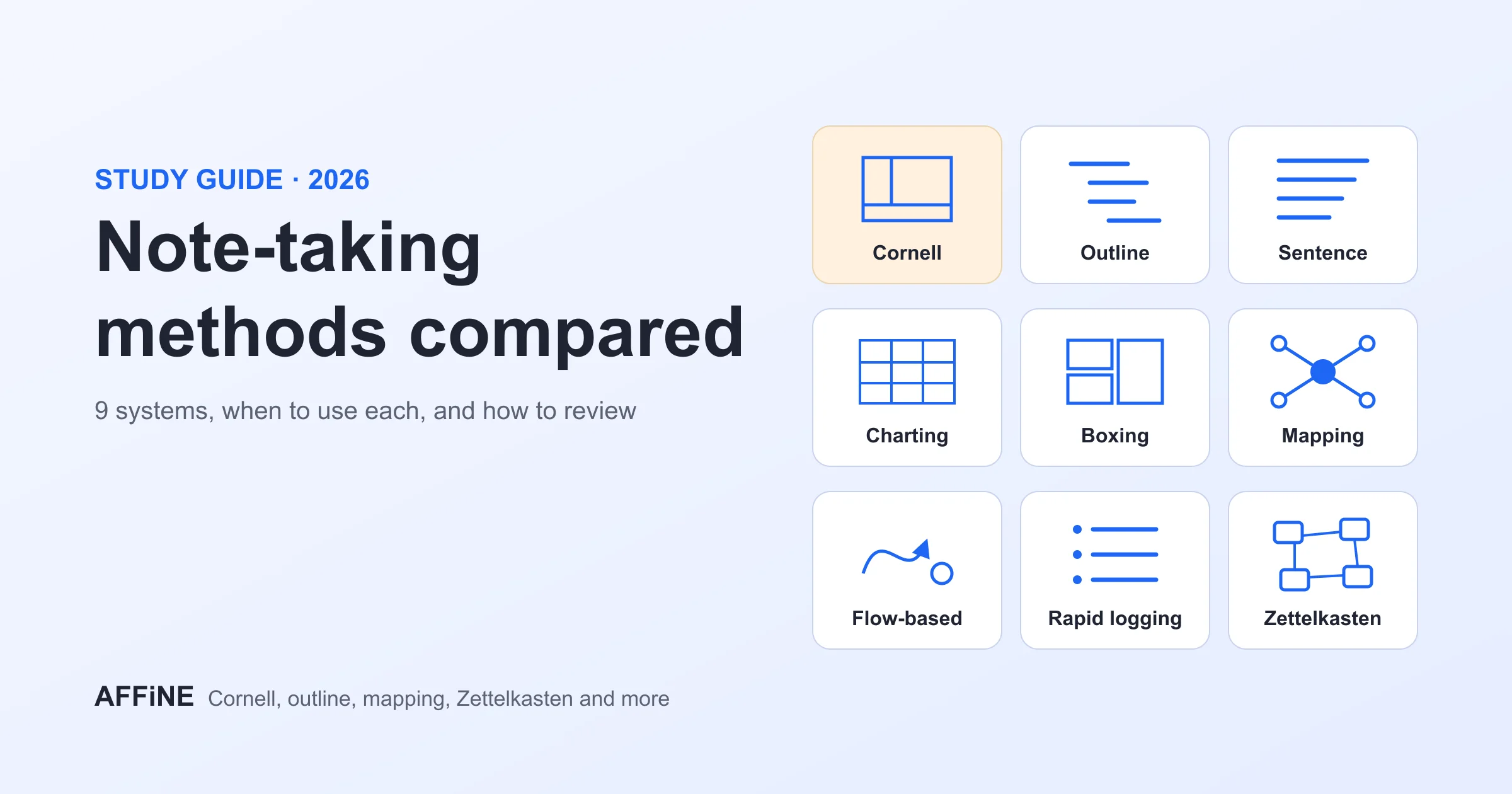
- Answer the cue questions in the margin of your notes. The Cornell method builds these questions in.
- Use flashcards and say the answer out loud before flipping the card.
- Explain the idea to someone else, or to an empty chair, in plain words.
In a classic experiment, Roediger and Karpicke (2006) found that students who took a recall test after reading remembered more a week later than students who reread the passage, even though the rereaders felt more confident.
Step 6: Space Your Review Over Several Days
Studying the same topic for three hours in one night is cramming. Studying it for one hour on three separate days is spacing, and it leads to much better retention. A meta-analysis by Cepeda and colleagues (2006) covering hundreds of comparisons found that spreading practice across sessions consistently beat massed practice for long-term recall.
A simple schedule works for most courses:
| When | What to do | Time |
|---|---|---|
| Same day | Learn the topic and test yourself at the end | 25–45 min |
| Next day | Quick self-test, fix gaps | 10 min |
| 3 days later | Flashcards or blank-page recall | 10 min |
| 1 week later | Mixed questions with older topics | 15 min |
| Before the exam | Timed practice paper | One full paper |
A spaced repetition app can schedule flashcard reviews for you. If you have a test coming up, build these reviews into a dated study plan. For more recall techniques, see these memorization techniques.
Step 7: Track the Habit, Not the Hours
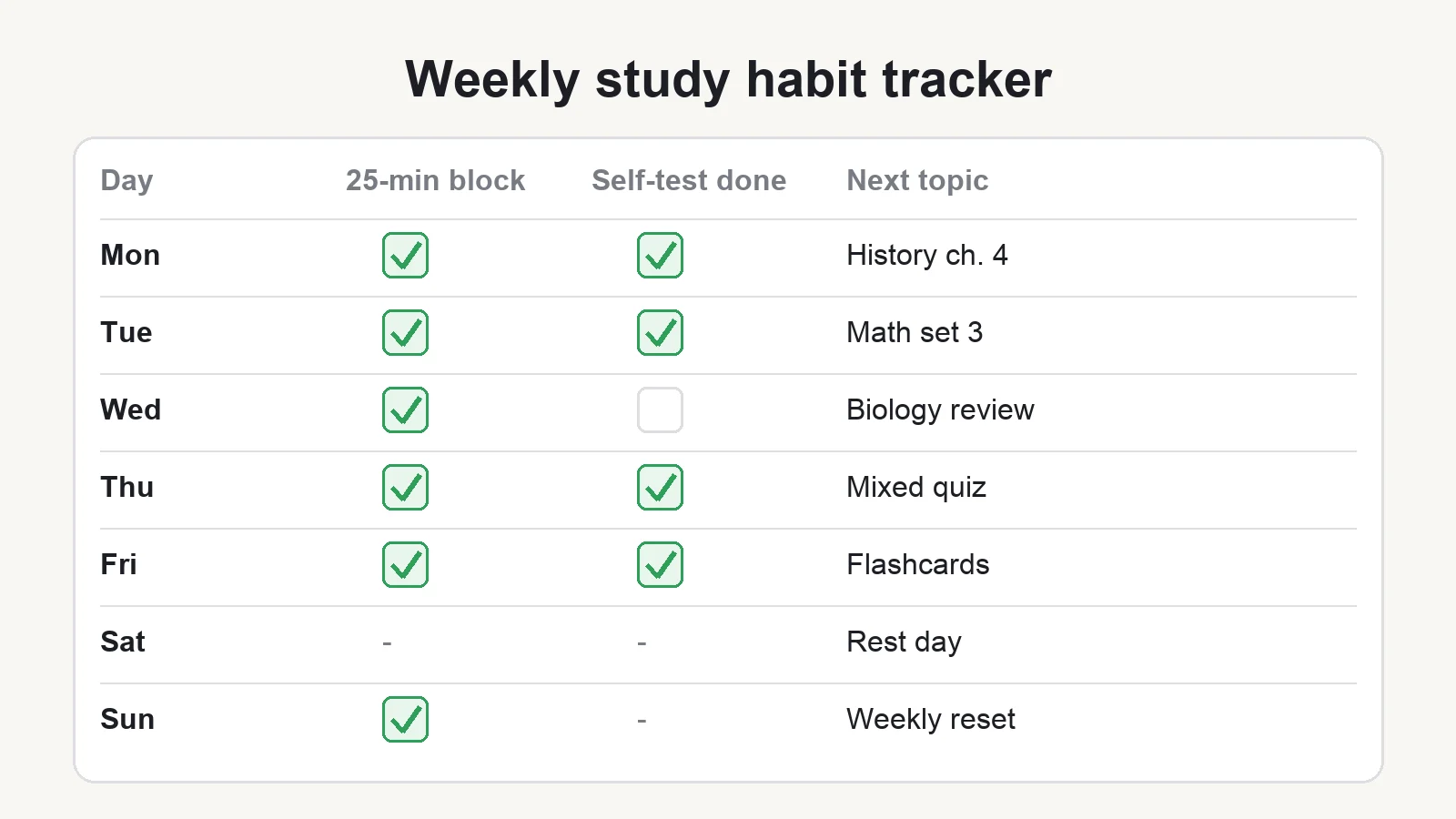
Hours are a poor measure. Three distracted hours can teach less than one focused block. Track whether you did the habit instead:
- One tick for each completed block.
- One tick when the self-test at the end was done.
- A short note on what you will study next time.
Seeing an unbroken run of ticks is the reward that keeps the loop going. A paper chart works, or use a habit tracker template. Keep it next to your study list so you see both at once.
Step 8: Reset Your Plan Once a Week
Pick 15 minutes at the end of each week, for example Sunday evening, and ask four questions:
- Which blocks did I miss, and why? Move the cue if the time keeps failing.
- Which topics did I test badly on? Put them first next week.
- What is due soon? Add assignments and tests to the list.
- Is the block still easy? If yes, add 10 minutes or a second block.
If you study with a partner or group, use part of the reset to quiz each other. Group study works best with a clear task for each session, such as swapping practice questions. These study group assignment examples show how to split the work.
A Sample Study Routine for One Week
| Day | Block 1 (25–45 min) | Quick review (10 min) |
|---|---|---|
| Mon | New topic: Biology, cell transport | — |
| Tue | New topic: History, chapter 4 | Biology self-test |
| Wed | New topic: Math, problem set 3 | History self-test |
| Thu | Biology practice questions | Math: redo two missed problems |
| Fri | Mixed quiz from all three subjects | Flashcards from Monday |
| Sat | Rest, or catch up on a missed block | — |
| Sun | 15-minute weekly reset | Plan next week |
Adjust the subjects, but keep the shape: one new topic per block, a short review of an older topic, and a weekly reset.
Use Technology Without Letting It Take Over
Technology is not the enemy of good study habits. Used on purpose, it removes busywork:
- Notes in one place. Keep class notes, slides, and readings in one app so you do not lose time searching. Switching between many apps has its own cost, as explained in why students lose time switching between study tools.
- AI for practice, not answers. AI tools can turn your notes into flashcards or quizzes, which supports Step 5. Check every answer against your course material, and follow your school's rules on AI use.
- A visible plan. In AFFiNE, you can keep your topic list, weekly tracker, and notes on the same page or whiteboard, so the plan is open every time you start a block.
The rule is simple: use a tool during a block only if it helps you study the topic in front of you. Everything else waits for the break.
Common Study Habit Mistakes
- Planning more than you can do. A schedule you abandon on day three teaches you to ignore schedules. Start smaller.
- Confusing reading with studying. If you did not test yourself, you only read.
- Studying with the phone in reach. Face down still costs attention.
- Quitting after one missed day. One miss does not break a habit. Two or three in a row start to.
- Only studying right before tests. Cramming can get you through a test, but most of it is gone a week later.
Frequently Asked Questions
How long does it take to build a study habit?
It varies. In the Lally study, people took a median of 66 days to make a daily behavior automatic, with a range of 18 to 254 days. Expect a few weeks before studying feels routine, and keep going after a missed day.
How many hours a day should I study?
There is no single number. One or two focused 25 to 45 minute blocks a day, with self-testing, usually beat long unfocused sessions. Add time only when the current routine feels easy.
What are the most effective study habits?
Practice testing and spacing your review over several days have the strongest research support. Studying at a fixed time and place, and keeping your phone out of sight, make those techniques easier to keep up.
How do I stop getting distracted while studying?
Put your phone in another room, close unrelated tabs, and write down wandering thoughts on a list to handle in your break. Short blocks with a clear end also make it easier to stay focused.
Is it better to study in the morning or at night?
Study when you are reasonably alert and can repeat the same time on most days. Consistency matters more than the hour. Protect your sleep, because staying up late to study usually costs more than it gains.
Should I study alone or in a group?
Do most learning alone, then use a partner or group for testing each other and explaining ideas. Groups work best with a clear task for each session.
Sources
- Lally, P., van Jaarsveld, C. H. M., Potts, H. W. W., and Wardle, J. (2010). How are habits formed: Modelling habit formation in the real world. European Journal of Social Psychology.
- Ward, A. F., Duke, K., Gneezy, A., and Bos, M. W. (2017). Brain Drain: The Mere Presence of One's Own Smartphone Reduces Available Cognitive Capacity. Journal of the Association for Consumer Research.
- Gollwitzer, P. M., and Sheeran, P. (2006). Implementation Intentions and Goal Achievement: A Meta-analysis of Effects and Processes. Advances in Experimental Social Psychology.
- Dunlosky, J., Rawson, K. A., Marsh, E. J., Nathan, M. J., and Willingham, D. T. (2013). Improving Students' Learning With Effective Learning Techniques. Psychological Science in the Public Interest.
- Roediger, H. L., and Karpicke, J. D. (2006). Test-Enhanced Learning. Psychological Science.
- Cepeda, N. J., Pashler, H., Vul, E., Wixted, J. T., and Rohrer, D. (2006). Distributed practice in verbal recall tasks: A review and quantitative synthesis. Psychological Bulletin.
How this guide was prepared: Allen first published this article on the AFFiNE blog in June 2026. In November 2026 the AFFiNE content team rewrote it as a step-by-step guide, added the research behind each step with links to the original studies, replaced the stock photo with original diagrams, and added a sample weekly routine. Research findings are summarized from the published papers and their abstracts. This guide is general study advice, not medical or educational assessment.