Note-Taking Methods: 9 Systems and When to Use Each
Nine note-taking methods, the situation each one fits, what research says about handwriting and review, and a capture, process, review routine that works with any of them.

A note-taking method is a repeatable way to structure notes so you can review and use them later. The nine methods below cover almost every situation: Cornell, outline, sentence, charting, boxing, mapping, flow-based, rapid logging, and Zettelkasten. Each one fits a different job. Cornell and outline work for capturing lectures live. Charting and boxing work for revision. Mapping and Zettelkasten work for building ideas over time.
The method matters less than what you do with the notes afterward. Research on note-taking keeps finding that reviewing notes, especially by testing yourself, does more for recall than the act of writing them. So this guide covers each method, how to pick one for your situation, and a simple review routine that makes any method work. To turn that review into a daily routine, see how to build better study habits.
At a glance
- Fast lecture or meeting: sentence or outline method. Convert to Cornell cues afterward.
- Studying for a test: Cornell, because the cue column turns your notes into a self-quiz.
- Comparing many items: charting. Revising one topic per page: boxing.
- Seeing relationships or brainstorming: mapping or flow-based notes.
- Tasks and daily logs: rapid logging. Research and writing over months: Zettelkasten.
- Whatever you choose: review within 24 hours and quiz yourself from your cues.
Updated October 28, 2026. Published on the AFFiNE blog. AFFiNE makes a note-taking workspace and offers some of the templates linked below, so we are not neutral. The research claims link to the original papers or university pages, checked on October 28, 2026. The method descriptions follow the standard versions taught by university learning centers; where a method has a known originator, we name it.
The 9 note-taking methods compared
| Method | How it works | Best for | Live or after? | Review built in |
|---|---|---|---|---|
| Cornell | Page split into notes, cue column, and summary | Lectures, textbooks, exam prep | Live, then process | Yes, cues and summary |
| Outline | Indented headings and sub-points | Structured lectures, reading | Live | No |
| Sentence | One new line per fact or idea | Fast talks with little structure | Live | No |
| Charting | Table with a column per category | Comparisons, timelines, data | Live if you know the categories | Partly |
| Boxing | One box per topic on the page | Revision, digital notes | After | Partly |
| Mapping | Main idea in the center, branches outward | Brainstorming, concepts | Live or after | No |
| Flow-based | Ideas, arrows, and sketches in free form | Understanding, creative work | Live | No |
| Rapid logging | Short bullets marked with symbols | Tasks, events, daily notes | Live | Yes, monthly migration |
| Zettelkasten | Atomic notes in your own words, linked | Research, writing, long projects | After | Yes, through links |
What research says about taking notes
Before choosing a method, it helps to know which parts of note-taking actually help memory. Researchers split note-taking into two effects: the encoding effect (writing the notes helps you learn) and the storage effect (having notes to review later helps you learn).
- Taking notes helps, but only modestly on its own. Keiichi Kobayashi's 2005 meta-analysis of 57 studies comparing note-taking with no note-taking describes the encoding effect, without later review, as "positive but modest."
- Handwriting vs. typing is still debated. A 2014 study by Mueller and Oppenheimer found an advantage for longhand notes on conceptual questions. Later replications did not hold up the same way. Morehead, Dunlosky, and Rawson (2019) did not reproduce the conceptual-question result, and a preregistered replication by Urry and colleagues (2021) concluded that the results "do not support the idea that longhand note taking improves immediate learning via better encoding."
- Review is where handwriting may matter. A 2024 meta-analysis of 24 studies by Flanigan and colleagues found that taking and reviewing handwritten notes led to higher achievement among college students (Hedges' g = 0.248), even though typing produced far more notes (g = 0.919). That is a small advantage, and it depends on the review step.
- "Learning styles" are not a good basis for picking a method. A review by Pashler and colleagues (2008) found no adequate evidence that matching instruction to a learner's preferred style improves learning. Pick a method for the material and situation, not because you think of yourself as a "visual learner."
The practical takeaway: write in your own words instead of transcribing, and plan time to review. If you type, resist copying the speaker word for word.
1. The Cornell method
The Cornell method was developed by Walter Pauk, an education professor at Cornell University, and described in his book How to Study in College. Cornell's Learning Strategies Center still teaches it.
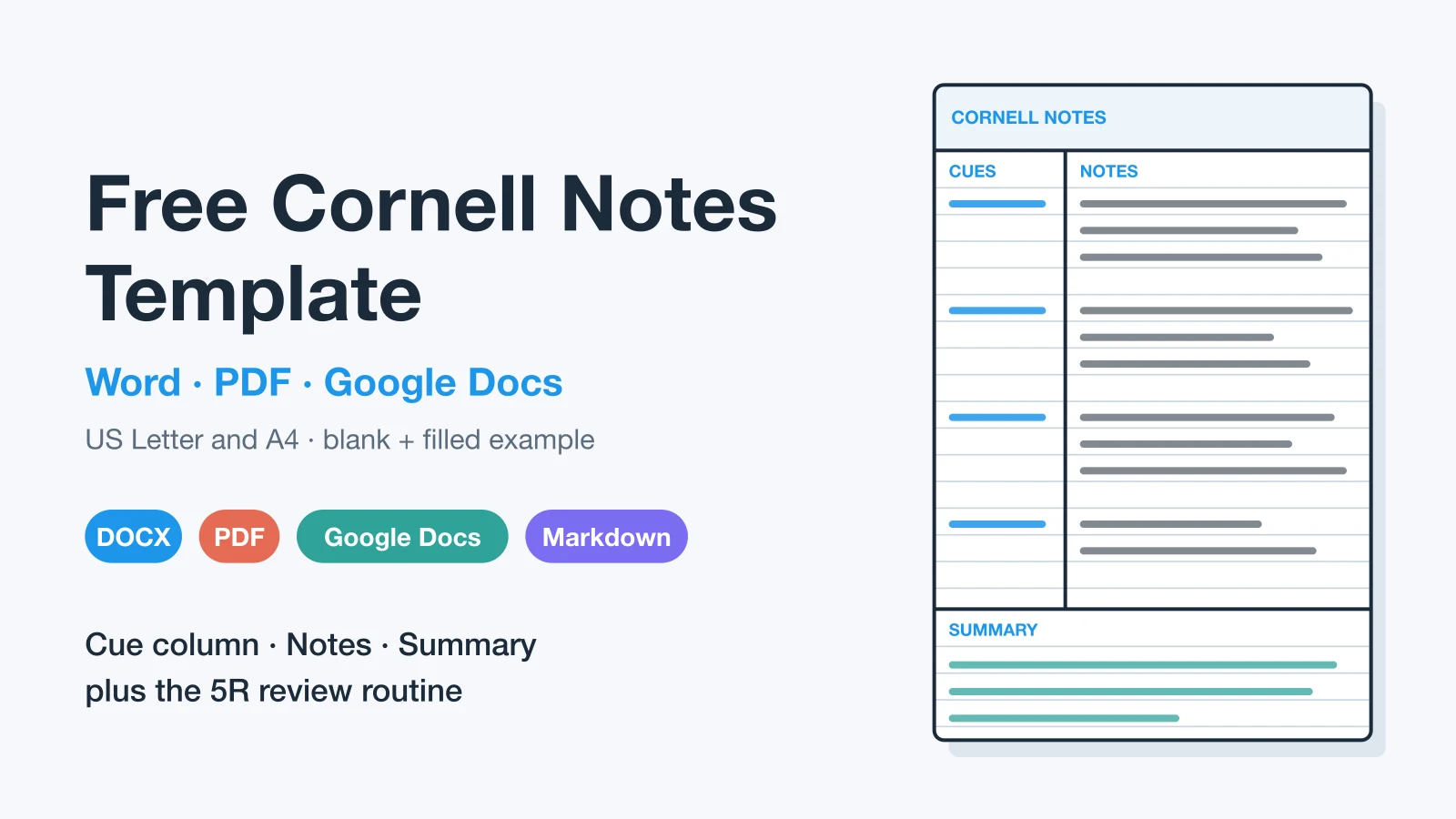
How it works. Divide the page into three parts:
- Notes column (right, about two-thirds of the width): take notes during the lecture or reading.
- Cue column (left, about one-third): after class, write questions and keywords that your notes answer.
- Summary (bottom): write two to four sentences on the main point of the page.
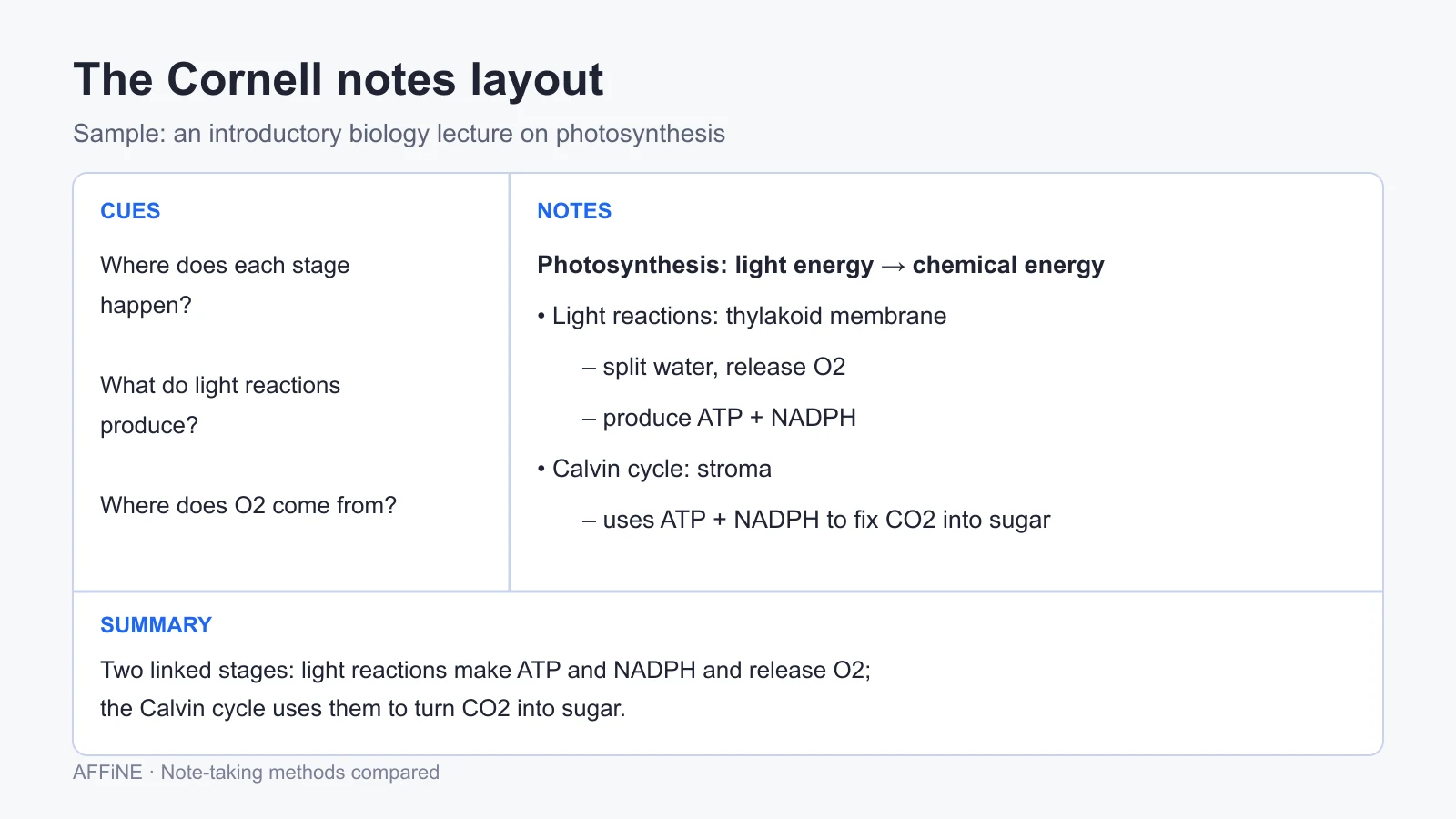
The 5 Rs. Pauk's process is often taught as five steps: Record the notes, Reduce them to cues, Recite by covering the notes and answering your cue questions aloud, Reflect on how the ideas connect, and Review regularly.
- Best for: lectures, textbook chapters, and any material you will be tested on.
- Weak spot: it takes time after class. If you skip the cue column, it is just an outline with a wide margin.
The Recite step is the reason Cornell works so well for exams: it builds self-testing into your notes. For a filled example and a full walk-through, read our Cornell note-taking guide. For printable versions, see the free Cornell notes template for Word, PDF and Google Docs, or copy the Cornell notes template into AFFiNE.
2. The outline method
The outline method organizes notes as a hierarchy: main topics at the left margin, supporting points indented beneath them, and details indented further.
Photosynthesis
  - Light reactions (thylakoid membrane)
    - Water split, O2 released
    - Produces ATP and NADPH
  - Calvin cycle (stroma)
    - Uses ATP + NADPH to fix CO2
- Best for: well-organized lectures, textbook chapters with clear headings, and meeting agendas.
- Weak spot: it breaks down when the speaker jumps between topics, and it hides links between distant points.
Outlines are also the fastest way to take digital notes, because every notes app supports bulleted, indented lists. Turn an outline into Cornell notes later by adding a question beside each main heading.
3. The sentence method
The sentence method records each new fact, idea, or topic as a separate numbered line. You do not try to organize anything during the session.
- Best for: fast lectures, discussions, and meetings where you cannot predict the structure.
- Weak spot: the notes are hard to review as they are. Plan to group lines by topic or turn them into an outline the same day.
4. The charting method
The charting method sets up a table before the session, with one column per category. Each row is one item you are comparing.
| Theory | Key thinker | Main idea | Criticism |
|---|---|---|---|
| Behaviorism | B. F. Skinner | Behavior is shaped by reinforcement | Ignores inner mental states |
| Cognitivism | Jean Piaget | Learners build mental structures in stages | Stages are less fixed than proposed |
- Best for: comparisons, timelines, statistics, and subjects such as history, pharmacology, or product research.
- Weak spot: you need to know the categories in advance. It does not suit open-ended discussion.
A database or table block in a digital tool makes charting easier, because you can add columns and sort rows later.
5. The boxing method
The boxing method groups related notes into boxes on the page, one box per subtopic. It became popular with tablet users, because digital tools make it easy to draw, resize, and move boxes.
- Best for: revision sheets, one-page summaries, and seeing a topic's parts at a glance.
- Weak spot: it is hard to do live, because you need to know how ideas group before you draw boxes.
6. The mapping method (and mind maps)
The mapping method puts the main topic in the center or at the top and branches subtopics outward, with details on smaller branches. A mind map is the most common form. A concept map goes further and labels the links between ideas, such as "causes" or "is part of."
- Best for: brainstorming, essay planning, and topics where relationships matter more than order.
- Weak spot: maps get crowded fast, and they hold less detail than linear notes.
See real layouts in our mind map examples, or compare mind maps, concept maps, and flowcharts in our guide to visual note-taking methods.
7. Flow-based notes and sketchnotes
Flow-based note-taking captures ideas as you understand them, linking them with arrows, short phrases, and small drawings instead of following a fixed layout. Sketchnoting is a visual style of the same approach, mixing text, icons, and frames.
- Best for: understanding complex ideas, talks where you want the big picture, and creative work.
- Weak spot: the notes are messy and hard to scan for a specific fact later.
Because flow-based notes force you to put ideas in your own words, they fit the research finding that paraphrasing beats transcribing.
8. Rapid logging (Bullet Journal)
Rapid logging comes from the Bullet Journal Method, created by Ryder Carroll. You write short bullets and mark each with a symbol: a dot for a task, a circle for an event, and a dash for a note. At the end of each month, you migrate unfinished tasks forward or drop them.
- Best for: daily notes, tasks, meeting action items, and journaling.
- Weak spot: it is designed for tracking life and work, not for learning detailed material.
9. The Zettelkasten method
The Zettelkasten ("slip box") method is closely linked to the German sociologist Niklas Luhmann. You write one idea per note in your own words, add its source, and link it to related notes. Over time, the links form a network you can use to write and think.
- Best for: research, writing, and any subject you will work on for months or years.
- Weak spot: it is slow, and it does not help you capture a lecture in real time. Most people take notes with another method and turn the best ideas into Zettelkasten notes afterward.
Read our step-by-step Zettelkasten method guide, or start from the digital Zettelkasten template.
How to choose a note-taking method
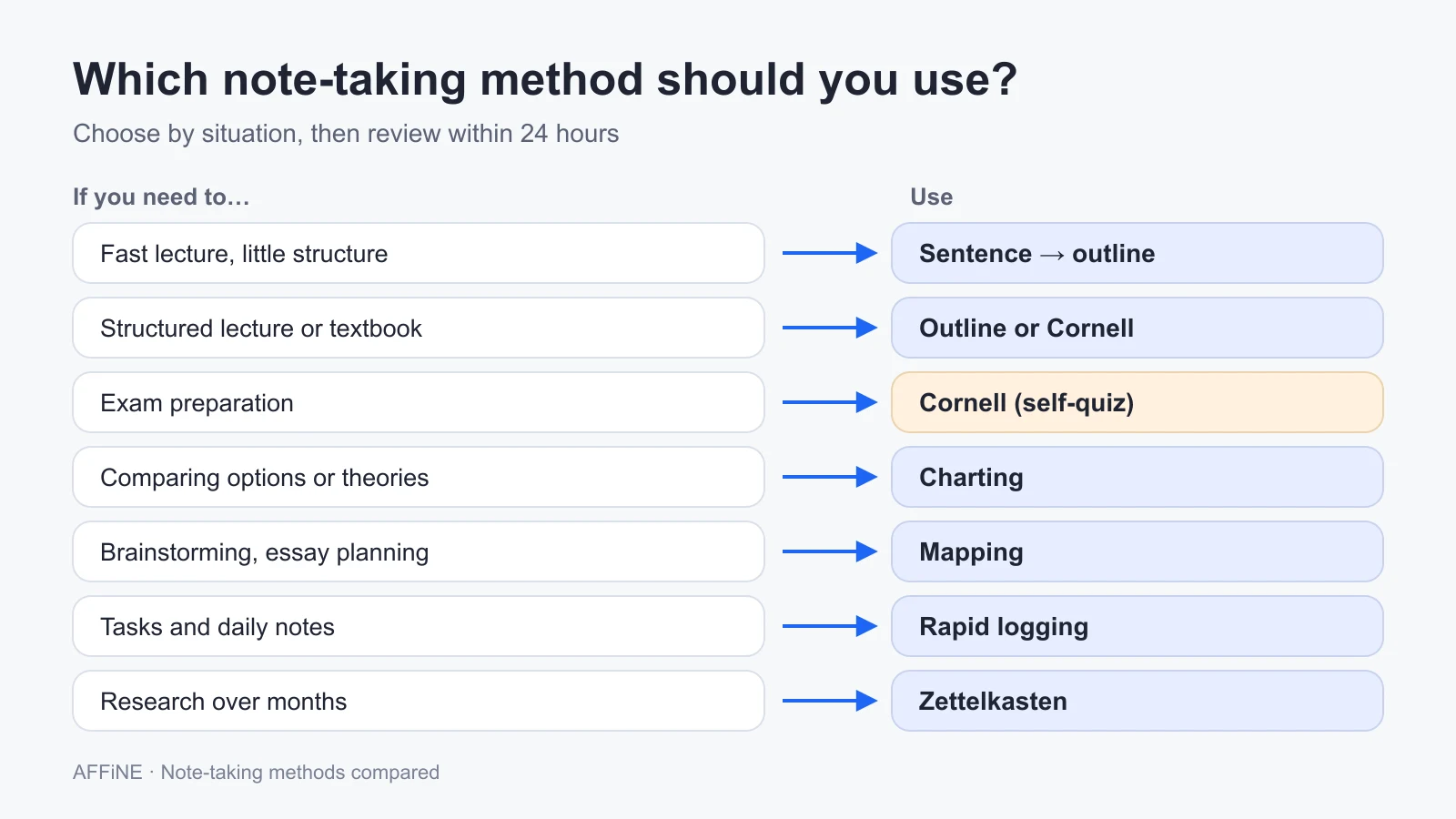
Pick the method for the situation, not for your personality. These are our recommendations, based on how each method's structure fits the material.
| Situation | Capture with | Then turn it into |
|---|---|---|
| Fast lecture, little structure | Sentence | Outline or Cornell cues the same day |
| Structured lecture or textbook | Outline or Cornell | Cornell cues and a summary |
| Exam preparation | Cornell | Self-quiz from the cue column |
| Comparing options or theories | Charting | Boxed revision sheet |
| Brainstorming or essay planning | Mapping | Outline for the draft |
| Meetings | Sentence or outline | Rapid-log action items with owners |
| Reading for research | Outline or highlights | Zettelkasten notes |
Most people end up combining methods: one for capture during the session, and one for processing afterward. That is normal. The capture method needs to be fast, and the processing method needs to be easy to review.
How to test a method in two weeks
- Choose one situation. For example, one recurring lecture or your weekly team meeting. Do not change everything at once.
- Choose one capture method from the table. Use it for every session in that situation for two weeks.
- Process notes within 24 hours. Add cues, a summary, or action items while you still remember the context.
- Quiz yourself once a week. Cover your notes and answer your cue questions, or explain the topic aloud from memory.
- Keep it or switch. If you could answer most of your questions and find things quickly, keep the method. If not, change one thing, such as the capture method, and test again.
A worked example: the same 10 minutes, three ways
Here is how three methods handle the same short passage of an introductory biology lecture on photosynthesis. This is an illustrative example we wrote for this guide, not a recorded lecture.
Sentence method (during the lecture):
- Photosynthesis turns light energy into chemical energy, in chloroplasts.
- Two stages: light reactions and Calvin cycle.
- Light reactions in thylakoids, split water, release O2.
- Make ATP and NADPH.
- Calvin cycle in stroma, uses ATP and NADPH to fix CO2 into sugar.
Outline method (the same content, restructured that evening): the outline shown in the outline section above. It takes about five minutes and shows the two stages side by side.
Cornell cues (added after the outline):
- Where does each stage happen?
- What do the light reactions produce, and what uses it?
- Where does the released oxygen come from?
Summary: "Photosynthesis has two linked stages. The light reactions use water and light to make ATP and NADPH and release oxygen. The Calvin cycle uses them to turn CO2 into sugar."
The sentence notes were fastest to take but hardest to study. The cues are what make the notes useful a week later: each one is a test question you can answer from memory.
A simple review routine for any method
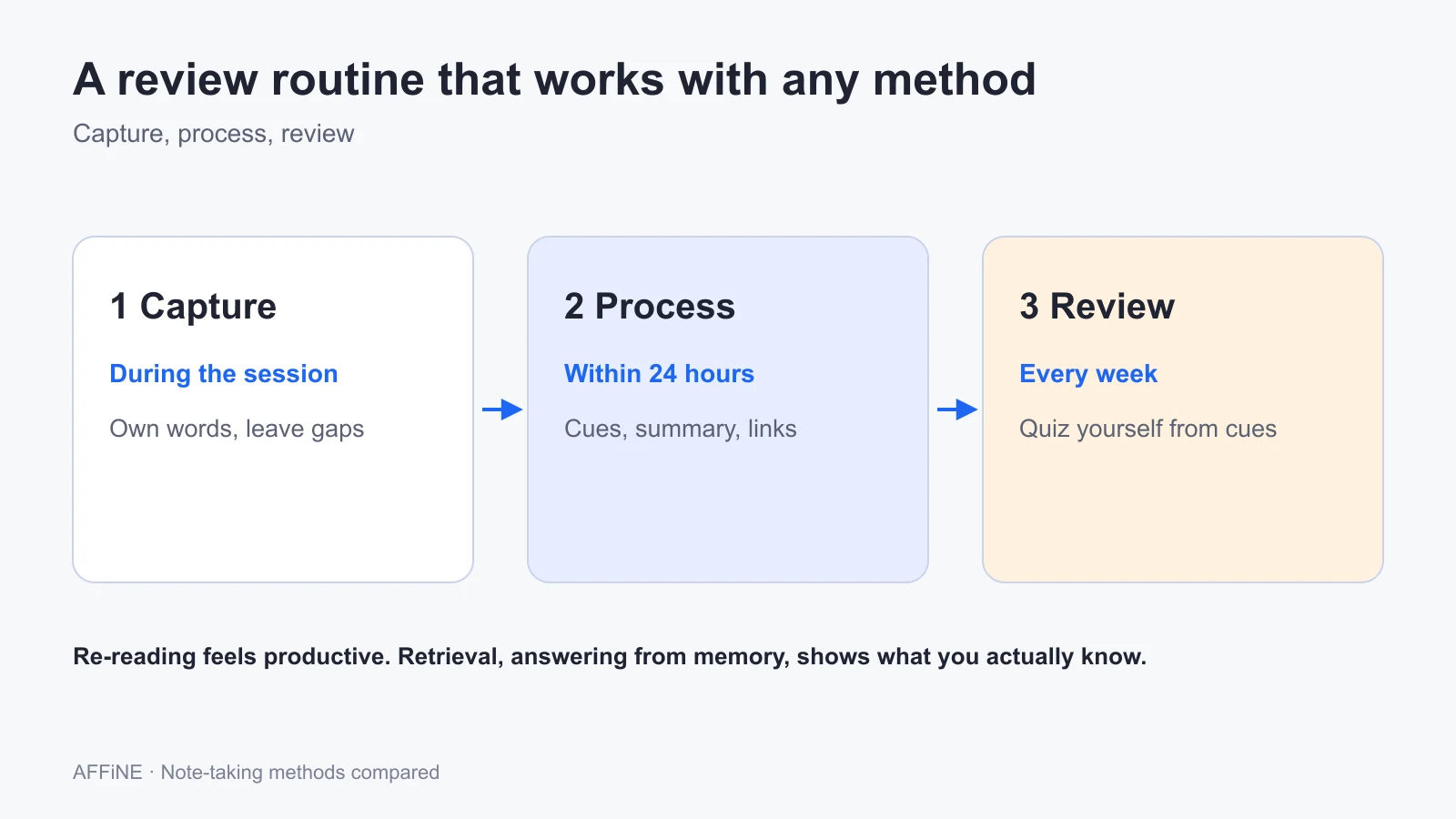
- Capture during the session. Write in your own words and leave space for gaps.
- Process within 24 hours. Fill gaps, add cue questions or action items, and write a two-sentence summary.
- Review weekly by retrieval. Cover your notes and answer your questions from memory before re-reading. Retrieval practice, bringing information to mind instead of re-reading it, is one of the best-supported study strategies in learning research.
If you only have time for one thing, do step 3. Re-reading feels productive, but quizzing yourself shows you what you actually remember.
Two techniques for processing notes
These are not capture methods. Use them in the process step, on notes you already have.
The Feynman technique. Named after the physicist Richard Feynman, it tests whether you understand a topic: explain it in plain words, as if to someone new to the subject, without looking at your notes. Wherever you get stuck or fall back on jargon, go back to your notes or the source, then explain it again. It works well with Cornell cues, because each cue is a prompt to explain.
Progressive summarization. Tiago Forte's technique summarizes a note in layers, and only when you need it: first save the passage, then bold the key parts, then highlight the best of the bold, and finally write a short summary at the top in your own words. Forte describes it as a balance between keeping notes short enough to find and detailed enough to understand. It suits reading notes and research that you will come back to, such as Zettelkasten source notes.
Common note-taking mistakes
- Transcribing everything. More words do not mean more learning. Capture main ideas, definitions, and examples.
- Never reviewing. Notes you never open only help through the modest encoding effect.
- Switching methods every week. Give a method at least two weeks before you judge it.
- Building a system before you have notes. Start with one notebook or page type, then add structure when you feel the need.
- Highlighting instead of thinking. Highlights are a starting point. Turn them into a question or a sentence in your own words.
Using these methods in a digital workspace
Any notes app handles outline and sentence notes. The differences appear with the other methods: charting needs tables, mapping needs a canvas, and Zettelkasten needs links.
In AFFiNE, a doc and a whiteboard (Edgeless mode) are two views of the same page. That lets you take outline or Cornell notes in the doc, then switch to the whiteboard to map, box, or sketch the same content. Table and Kanban views handle charting, linked pages handle Zettelkasten, and the Journal gives you a dated page each day for rapid logging. You can start from the Cornell notes template, the visual mind map study planner, or the study guide template.
When AFFiNE is not the best fit: if you mostly handwrite on a tablet with a stylus and want annotation on PDF slides, a handwriting-first app is a better choice. Compare options in our roundup of free note-taking apps. If you want AI to transcribe lectures, see our guide to lecture note-taking with AI, and remember that a transcript is not a set of notes until you process it.
For turning your notes into a long-term system, see how to build a PKM system. For meetings, use the formats in our meeting notes templates.
Note-taking methods FAQ
What are the 5 main note-taking methods?
The five most commonly taught methods are Cornell, outline, sentence, charting, and mapping. Many guides also include boxing, flow-based notes, rapid logging, and the Zettelkasten method, which brings the list to nine.
What is the most effective note-taking method?
There is no single best method. For exam preparation, the Cornell method is a strong default because its cue column turns notes into self-test questions. Research suggests that reviewing your notes and quizzing yourself matters more than which layout you use.
What are the 5 Rs of note-taking?
The 5 Rs come from the Cornell method: Record, Reduce, Recite, Reflect, and Review. You record notes in class, reduce them to cue questions, recite answers from memory, reflect on connections, and review regularly.
Is it better to take notes by hand or on a laptop?
The evidence is mixed. Early studies favored handwriting, but direct replications did not confirm a learning advantage while taking notes. A 2024 meta-analysis found a small advantage for taking and reviewing handwritten notes. If you type, paraphrase instead of transcribing and avoid distractions.
Which note-taking method is best for fast lectures?
The sentence method or a loose outline. Both are quick to write. Turn them into an outline or add Cornell cues within 24 hours, while you still remember the context.
What is the difference between note-taking and note-making?
Note-taking records information during a lecture, meeting, or reading. Note-making happens afterward: you reorganize those notes in your own words, add questions and links, and summarize them. Cornell cues, the Feynman technique, and Zettelkasten notes are all forms of note-making.
Can you combine note-taking methods?
Yes, and most people do. A common pattern is to capture with the sentence or outline method, process with Cornell cues, and move lasting ideas into Zettelkasten notes.
Sources and editorial notes
- Cornell University Learning Strategies Center, The Cornell Note Taking System. Cites Pauk and Owens, How to Study in College, 10th ed., 2010. Accessed October 28, 2026.
- Kobayashi, K. (2005). What limits the encoding effect of note-taking? A meta-analytic examination. Contemporary Educational Psychology, 30(2), 242–262.
- Morehead, K., Dunlosky, J., and Rawson, K. A. (2019). How much mightier is the pen than the keyboard for note-taking? Educational Psychology Review, 31, 753–780.
- Urry, H. L., et al. (2021). Don't ditch the laptop just yet. Psychological Science.
- Flanigan, A. E., Wheeler, J., Colliot, T., Lu, J., and Kiewra, K. A. (2024). Typed versus handwritten lecture notes and college student achievement: A meta-analysis. Educational Psychology Review, 36.
- Pashler, H., McDaniel, M., Rohrer, D., and Bjork, R. (2008). Learning styles: Concepts and evidence. Psychological Science in the Public Interest, 9(3).
- The Learning Scientists, New findings inform the laptop versus longhand note-taking debate, 2019.
- Retrieval Practice, What is retrieval practice?. Accessed October 28, 2026.
- Bullet Journal, The Bullet Journal Method by Ryder Carroll. Accessed October 28, 2026.
- Forte Labs, Progressive Summarization: A practical technique for designing discoverable notes. Accessed October 28, 2026.
How this guide was prepared: Allen first published this guide on the AFFiNE blog in June 2025. The AFFiNE team rewrote it in October 2026 to compare nine methods, add a situation-based picker, a worked example, a review routine, and two processing techniques, and to replace a learning-styles table that research does not support. Research findings are summarized from the abstracts and publisher pages linked above; we did not run our own study. The method recommendations and the worked example are our own guidance, not measured results. AI tools assisted with research and drafting, and the AFFiNE team reviewed and edited the content.
Pick one method and test it this week
Choose one recurring class or meeting, take notes with one method from the picker above, and add cue questions within 24 hours. After two weeks, you will know whether it works for you.