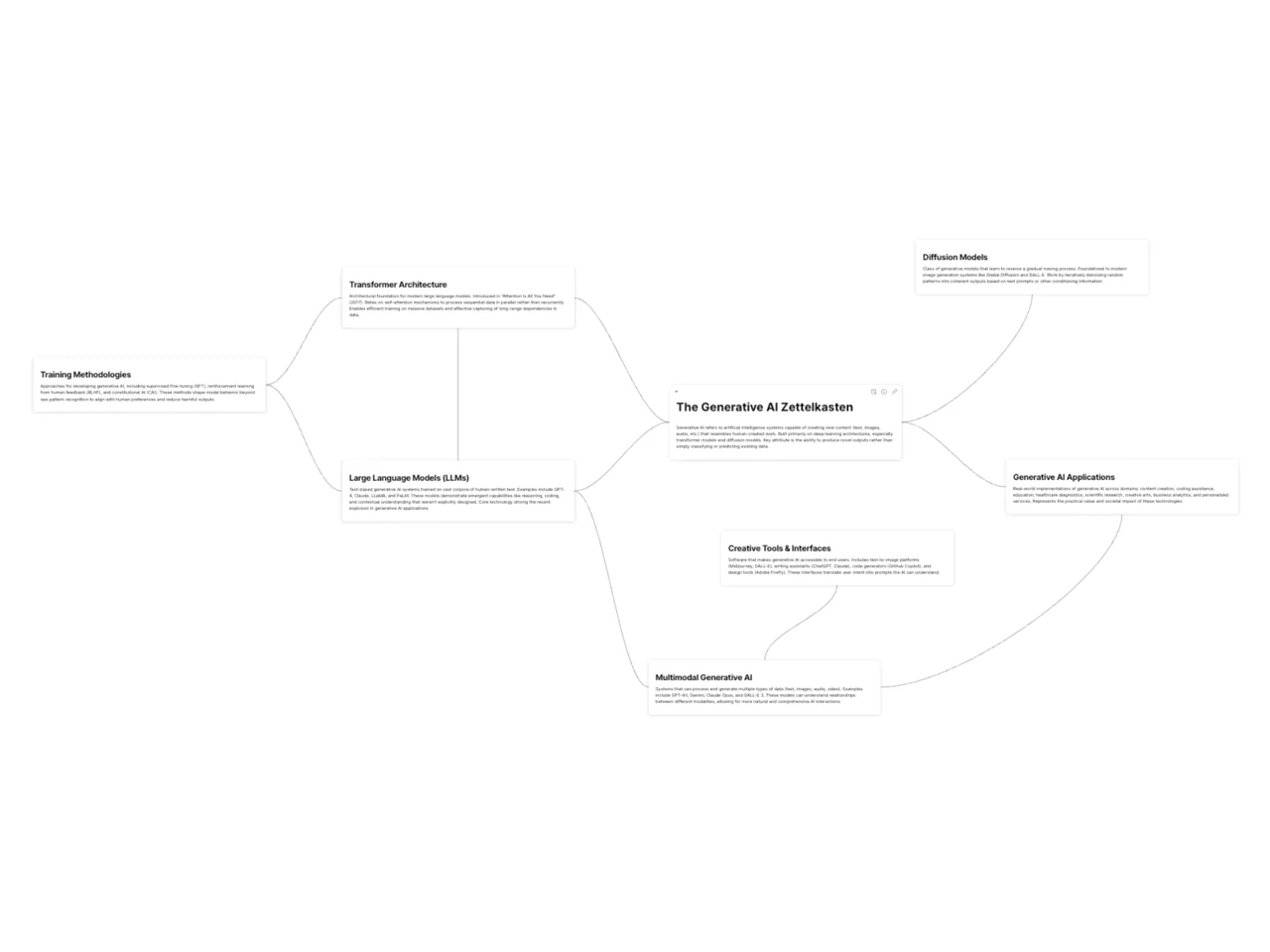
A digital Zettelkasten is a note-taking system in which you write short notes that each hold one idea and link them to related notes in software, so your knowledge grows as a connected network instead of a pile of files. The method is closely associated with the German sociologist Niklas Luhmann, who kept a paper slip box. This AFFiNE template opens on the whiteboard with a worked example: a central "Artificial Intelligence (AI)" hub note connected by arrows to ten topic notes, each with a short explanation you can replace.
What's included in this template
- One central hub note (Artificial Intelligence) that acts as an entry point
- Ten linked topic notes: Machine Learning, Data Science for AI, AI Ethics and Governance, Computer Vision, Robotics and Automation, Deep Learning, Reinforcement Learning, Natural Language Processing, Applications of AI, and Neural Network Architectures
- A short summary paragraph inside each note
- Connector arrows from the hub to every topic note, on an infinite canvas you can extend
Who it's for
- Students and researchers who want to connect reading notes across courses or papers.
- Writers building a pool of ideas they can turn into articles or chapters.
- Self-learners mapping a new field, as the AI example does.
- Knowledge workers who want a visual alternative to folders for a personal knowledge base.
How to use this digital Zettelkasten in AFFiNE
- Duplicate the template. Click Use this template to copy the board into your workspace.
- Choose your hub. Rename the center note to your topic and delete example notes you do not need.
- Write atomic notes. Put one idea per card, in your own words, with the source noted at the bottom.
- Link related ideas. Draw connectors between notes and label a link when the relationship is not obvious.
- Add new notes regularly. After reading or a meeting, add notes and connect each one to at least one existing note.
- Review and write. Follow chains of linked notes to find arguments, then draft from them in an AFFiNE doc.
Tips for a working Zettelkasten
- Separate quick fleeting notes from permanent notes you have rewritten and linked.
- Prefer links over folders; a note can belong to several topics.
- Use hub notes (like the AI card here) as tables of contents for large clusters.
Frequently asked questions
What is the Zettelkasten method?
It is a way of taking notes where each note holds one idea and is linked to other notes. Over time the links reveal connections you can use for thinking and writing.
What is the difference between a digital and a paper Zettelkasten?
A paper Zettelkasten uses index cards with numbered IDs and handwritten references. A digital version uses links, search, and a canvas, which makes notes faster to connect and rearrange.
How do I start a Zettelkasten?
Start small: pick one topic, write a few atomic notes from something you just read, and link each to at least one other note. Add to it a little every day.
Should each note contain only one idea?
Yes. Keeping notes atomic makes them easier to link and reuse in different contexts.
Explore more Zettelkasten templates, such as the academic research Zettelkasten, or read the Zettelkasten method guide and how to build a second brain.