
How Bilingual E-Learning Is Transforming Drivers Ed for Texas Adults
Bilingual e-learning is changing what required driver education feels like for adults in Texas. It makes road-safety material easier to understand, easier to finish around a work schedule, and easier to connect to the decisions a driver actually makes at a four-way stop or a highway merge. For many adult learners the obstacle was never motivation. It is language comfort, shift work, childcare, and the pressure of learning rules that carry real consequences on the road.
The scale of that gap is specific to Texas. Close to three in ten Texas residents speak Spanish at home in recent American Community Survey language estimates, and first-time license applicants between 18 and 24 must complete a six-hour adult driver education course before they test, according to the Texas Department of Public Safety. When a requirement reaches every adult in that age range but the course experience is built around one language, the result is a design problem as much as a language problem.
Key takeaways
- Adult learners arrive with real-life urgency: a license affects work, childcare, and independence.
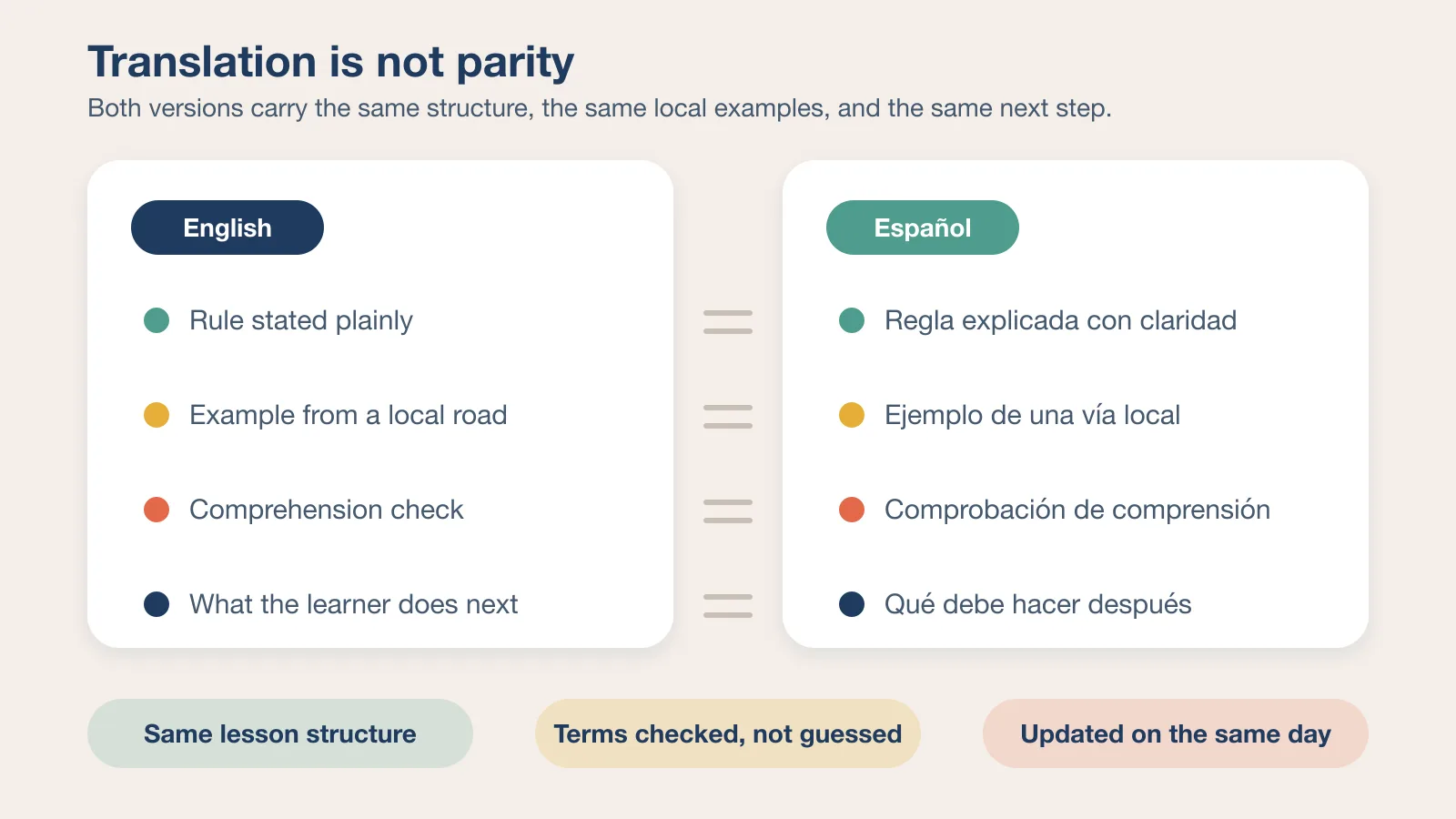
- A Spanish-language course needs its own instructional design, not a translation layer over English screens.
- Course structure — lesson order, definitions, examples, checks, next steps — behaves like a knowledge system.
- Learners notice when the second-language version is thinner, harder to navigate, or slower to update.
Why Bilingual E-Learning Works for Adult Drivers
Adult learners usually bring real-life urgency into a course. They may need a license for work, school, childcare, medical appointments, or basic independence. A learner searching for texas drivers ed in spanish is often looking for more than a translated page. They need driving terms, road rules, examples, and course steps explained in a language that lets them learn with confidence.
Good bilingual e-learning removes the friction that appears when someone understands the topic but struggles with the wording. Road signs, right-of-way rules, alcohol laws, insurance basics, and licensing steps already carry enough detail on their own. When the course language feels clear, the learner can spend attention on judgment, safety, and preparation instead of mentally translating every line.
That difference compounds across a course. A learner who re-reads each paragraph twice moves slower, retains less, and is more likely to abandon a module halfway through a shift break. Language comfort is not a nicety layered on top of the curriculum; it is part of whether the curriculum lands at all.
How Texas Adults Learn Differently Online
Adult drivers do not study the way teenagers do. Many already understand traffic from years spent as passengers, cyclists, delivery workers, parents, or licensed drivers in another country. What they need is a structured path through Texas-specific rules and license requirements, not an introduction to the idea of driving.
Online learning fits that reality because it lets adults return to lessons when the house is quiet, during a break, or after a shift ends. The best online driver education feels practical. It does not bury the learner in long blocks of text. It breaks information into lessons that explain one idea at a time, then connects that idea to a real situation: a four-way stop, a school zone, a highway merge, a work-zone sign, or a nighttime driving decision.
A useful course for adults should include:
- a clear lesson order the learner can see at a glance
- plain explanations of Texas road rules
- examples that match everyday driving rather than textbook scenarios
- short comprehension checks after important topics
- mobile-friendly access that survives an interrupted session
- reminders about licensing steps and required documents
- language support that does not feel secondary
The same principle drives well-built personalized study plans: the learner should always be able to see where they are, what is next, and how much is left. Adults studying in the margins of a working week need that orientation more than anyone.
What Spanish-First Drivers Ed Should Explain Clearly
A Spanish-language drivers ed course should be a primary build, not an afterthought. Direct translation alone leaves gaps, especially where legal, safety, and licensing terms carry specific meaning. "Right of way," "yield," "implied consent," and "certificate of completion" are not casual phrases. Each one maps to an action a driver or an applicant has to take correctly.
Strong bilingual course design starts from the question adult learners actually ask: what do I need to know, and what do I do next?
A lesson about right of way should state the rule, then show how the decision plays out at a stop sign, during a left turn, at a pedestrian crossing, and when an emergency vehicle approaches from behind. A lesson about impaired driving should explain consequences without reading like a warning poster. A lesson about licensing should show the sequence plainly, so the learner knows what happens once the course is complete.
| Learning area | What the course should make clear |
|---|---|
| Road rules | What the rule means in normal traffic |
| Signs and signals | How to recognize and respond quickly |
| Licensing steps | What the learner must complete next |
| Safety decisions | How choices affect passengers and others |
| Course progress | Where the learner is and what remains |
Where Knowledge Design Supports Safer Learning
The connection between bilingual e-learning and knowledge design is stronger than it first appears. A driving course is a knowledge system. It holds lesson order, definitions, rules, examples, checks, documents, and learner progress. If that system is messy, the student works harder than the material requires. If it is organized, learning feels calmer and completion feels reachable.
This is where course teams can borrow from modern knowledge base thinking. Information should be easy to find, easy to revisit, and easy to connect to the next action. An adult learner may need to return to a lesson about license documents, road signs, or completion steps days after first reading it. That material should not disappear into a menu that only makes sense to the person who built it.
Separating three layers keeps the course navigable in either language.
| Layer | What belongs there | Design rule |
|---|---|---|
| Instruction | Lessons, definitions, worked examples | One idea per screen, written natively in the learner's language |
| Reference | Signs, penalties, document lists, glossary | Searchable and reachable without losing lesson progress |
| Next step | Testing, documents to bring, completion certificate | Stated before the learner needs it, not after |
The discipline that keeps a study guide template usable weeks after it was written applies here too. Structure is what makes content revisitable, and revisitable content is what an adult learner relies on when a lesson gets interrupted by work, a child, or a commute.
What a Better Lesson Path Looks Like
A strong bilingual course path usually follows a natural sequence.
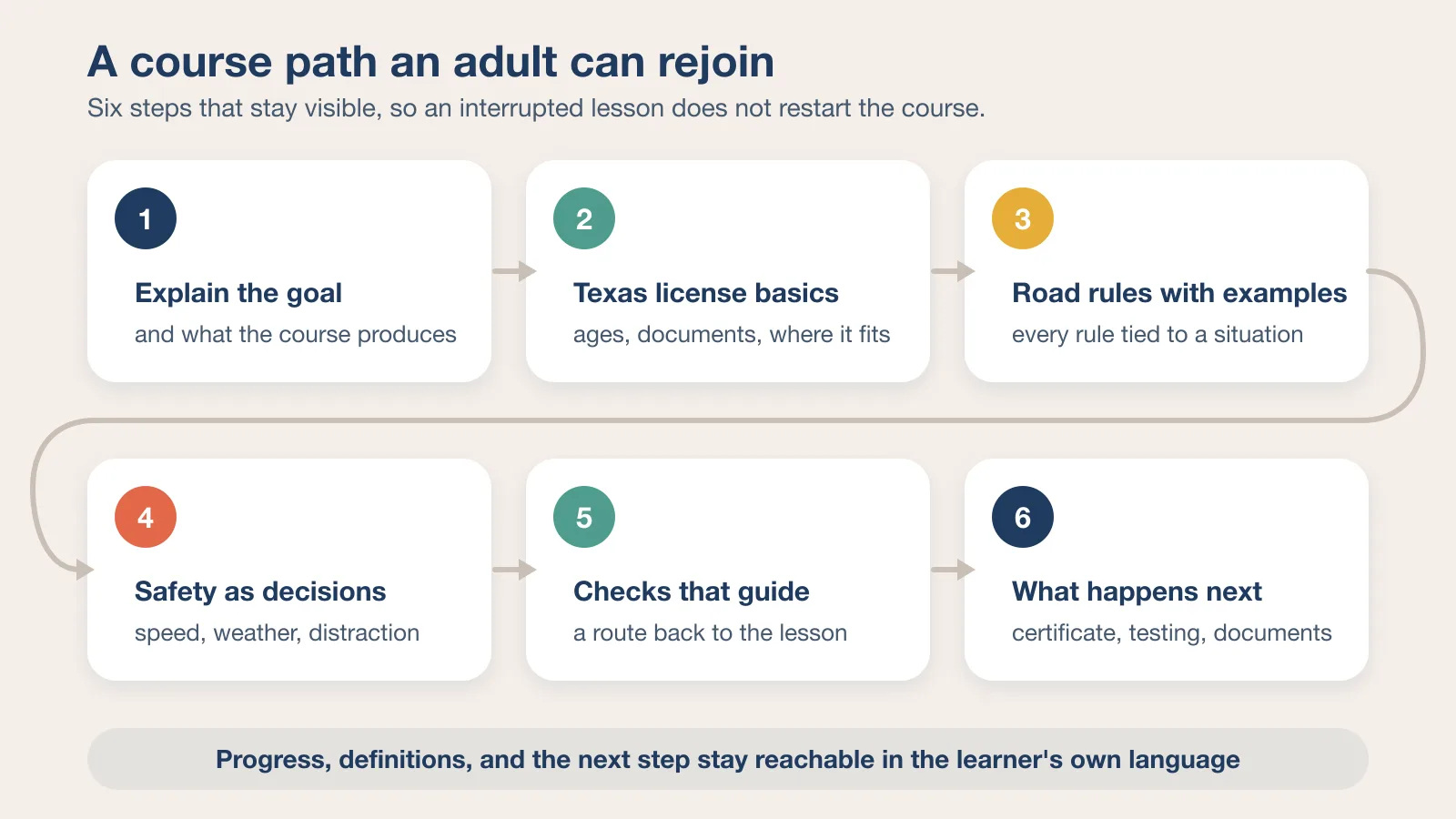
- Explain the goal. State what the learner will be able to do and what the course produces at the end.
- Introduce Texas license basics in plain language. Age rules, required documents, and where the course fits in the process.
- Teach road rules with direct examples. Pair every rule with a situation the learner recognizes from local streets and highways.
- Connect safety topics to real driving choices. Frame impairment, speed, distraction, and weather as decisions rather than warnings.
- Check comprehension without making the course feel punitive. Short checks that diagnose a gap and route the learner back to the relevant lesson.
- Show what happens after completion. The certificate, the testing step, and the documents required at the licensing office.
Sequencing matters more for adults than for teenagers, because adults rarely study in one continuous stretch. A learner who can see the shape of the course is far more likely to finish it.
Why Completion Matters to a Whole Household
In many households, one person completing drivers ed changes everyone's schedule. A new license can change who drives to work, who takes children to school, who handles appointments, and who can respond when something unexpected happens. Adult drivers ed is rarely only a personal task. It supports the rhythm of a whole household.
That is also why completion, not enrollment, is the honest measure of a bilingual course. A course that many learners start and few finish is telling you something about its language design, its pacing, or its mobile experience — not about the learners.
What Education Platforms Can Learn From Bilingual Drivers Ed
Bilingual drivers ed carries a broader lesson for e-learning teams: language support belongs inside the learning experience, not patched on top of it. Learners notice when a course was designed for them. They also notice when the Spanish version feels thinner, less clear, or harder to navigate than the English one — an untranslated button, an outdated screenshot, an example that assumes a different context.
Reviewing a second-language version means checking more than grammar. The course should be tested for whether examples are clear, whether buttons and instructions match the lesson flow, whether support content answers real learner questions, and whether completion steps are easy to understand before the learner reaches them.
Practical review questions include:
- Can a learner explain the next step after each lesson?
- Are safety and legal terms used consistently in both languages?
- Do examples match real Texas driving situations?
- Is mobile use smooth for adults studying between responsibilities?
- Are course-completion instructions clear before the final module rather than after it?
- Does the second-language version ship the same updates on the same day as the first?
The bottleneck is usually not translation capacity. It is the source material: definitions that live in three places, examples that were never written down, and lesson notes that only one instructor understands. Teams moving toward skills-based learning systems run into the same constraint, and the fix is the same — treat the course content as a maintained knowledge base with named owners, not as a set of finished screens.
Building Better Driver Education for Multilingual Adults
Bilingual e-learning improves adult driver education because it treats access as part of course quality. A course is not fully useful if a learner has to fight the language before reaching the lesson. Spanish-language driver education helps adults study in a way that matches how they think, ask questions, and remember instructions.
The strongest courses combine structure with empathy. They explain the rules, show real examples, respect the learner's language, and make the next step visible. For Texas adults who need a license and prefer Spanish-language support, that combination turns a stressful requirement into a manageable learning process — and produces drivers who understood the material rather than merely passed a test.
Frequently Asked Questions
Is drivers ed required for adults in Texas?
First-time applicants between 18 and 24 must complete a six-hour adult driver education course before testing for a license, and applicants 25 and older are exempt from that course requirement, according to the Texas Department of Public Safety. Driver education providers in Texas are licensed by the Texas Department of Licensing and Regulation.
Can adults take Texas drivers ed in Spanish?
Spanish-language options are available among approved online providers. Before enrolling, confirm with the provider that the specific course is state-approved for adult driver education and that the completion certificate it issues is the one the licensing office accepts.
What makes a bilingual course different from a translated one?
A translated course runs existing English screens through a language pass. A bilingual course is designed in each language: terms are chosen for legal accuracy, examples reflect situations the learner recognizes, and navigation, checks, and completion instructions are tested with speakers of that language.
How long does an online adult drivers ed course take?
The Texas adult course covers six hours of instruction. Online delivery lets learners split that across several sessions, which is why saved progress, mobile access, and a visible lesson order matter more for adults than a single uninterrupted sitting.
How should a team review a second-language course before launch?
Test the learner path, not only the copy. Walk through each lesson in the second language, check that terminology stays consistent, confirm every button and instruction matches the lesson flow, and verify that completion steps appear before the final module. Anything unclear in that walkthrough will be worse for a learner studying at the end of a long day.
Related Articles

The Role of AI in Personalized Study Plans for Students
AI Learning Management System: The Shift from Course-Based Training to Skills-Based Learning
Knowledge Base Blueprint: Turn Scattered Docs Into Findable Answers

Study Guide Template: Sections, Examples, and Study Plan