Project Kickoff Meeting Agenda: Free Template and Guide
A project kickoff meeting agenda is the running order for the first working session of a project. In 60 minutes it should confirm why the project exists, what is and is not in scope, who decides what, how the team will communicate, what could go wrong, and what everyone does in the next ten working days. Most teams hold the kickoff after the project charter is approved and before delivery starts.
Use the copy-ready agenda below, then adjust the timings to your project's size. The rest of this guide explains what to prepare, how to run each block, how internal, client, and Agile kickoffs differ, and what to send afterward.
At a glance
- Length: 45–90 minutes. Most projects fit in 60.
- Attendees: sponsor, project lead, delivery leads, and the people whose work will change. Keep it to the people who must agree or act.
- Pre-read: send the charter summary, the draft agenda, and three questions at least two working days ahead.
- Output: a recorded set of decisions, open questions with owners, and next actions with dates, shared within 24 hours.
Copy-ready project kickoff meeting agenda (60 minutes)
Copy this agenda into a shared document and replace the bracketed prompts. Time-box each block. If a block overruns, move the topic to the "open questions" list instead of cutting the last block, because the last block is where owners and dates are agreed.
| Time | Block | Lead | Outcome you need before moving on |
|---|---|---|---|
| 0:00–0:05 | Welcome, purpose of this meeting, and introductions | Project lead | Everyone knows what this meeting will decide |
| 0:05–0:15 | Why this project, and what success looks like | Sponsor | Shared understanding of the problem, objective, and 2–4 success measures |
| 0:15–0:25 | Scope: in, out, and assumptions | Project lead | Agreed boundaries; disputed items logged as decisions to make |
| 0:25–0:35 | Roles and decision rights | Project lead | Each major deliverable and decision has one accountable owner |
| 0:35–0:43 | Timeline and milestones | Delivery lead | Milestones and review gates are understood; dependencies named |
| 0:43–0:50 | Ways of working: communication, tools, and cadence | Project lead | Channels, meeting rhythm, and where the source of truth lives |
| 0:50–0:55 | Top risks and open questions | All | 3–5 risks, each with an owner |
| 0:55–1:00 | Next steps and close | Project lead | Actions with owners and due dates read back aloud |
Project kickoff agenda — [Project name]
Date / time / location or link: [ ]
Facilitator: [Name] · Note-taker: [Name] · Decision-maker in the room: [Sponsor name]
Purpose of this meeting: By the end, we will agree on [objective], [scope boundaries], [owners], and [next ten days of work].
Pre-read (please review before the meeting): [Charter summary link] · [Current timeline] · [Anything else]
- Welcome and introductions (5 min) — Name, role on this project, one thing you need from this group.
- Why this project and what success looks like (10 min) — Problem or opportunity; objective; success measures with baseline and target.
- Scope (10 min) — In scope; out of scope; assumptions to verify.
- Roles and decision rights (10 min) — Sponsor; project lead; delivery owners; who approves what.
- Timeline and milestones (8 min) — Major milestones and review gates; key dependencies.
- Ways of working (7 min) — Main channel; status cadence; where documents and decisions live; response-time expectations.
- Risks and open questions (5 min) — Top risks with owners; questions that need an answer and by when.
- Next steps (5 min) — Actions, owners, due dates; date of the first check-in.
Decisions made: [ ]
Open questions (owner, due date): [ ]
Action items (owner, due date): [ ]
If you need a short round of introductions for a team that has not worked together before, pick one of these ice breaker questions for new teams. Keep it under five minutes and let people pass.
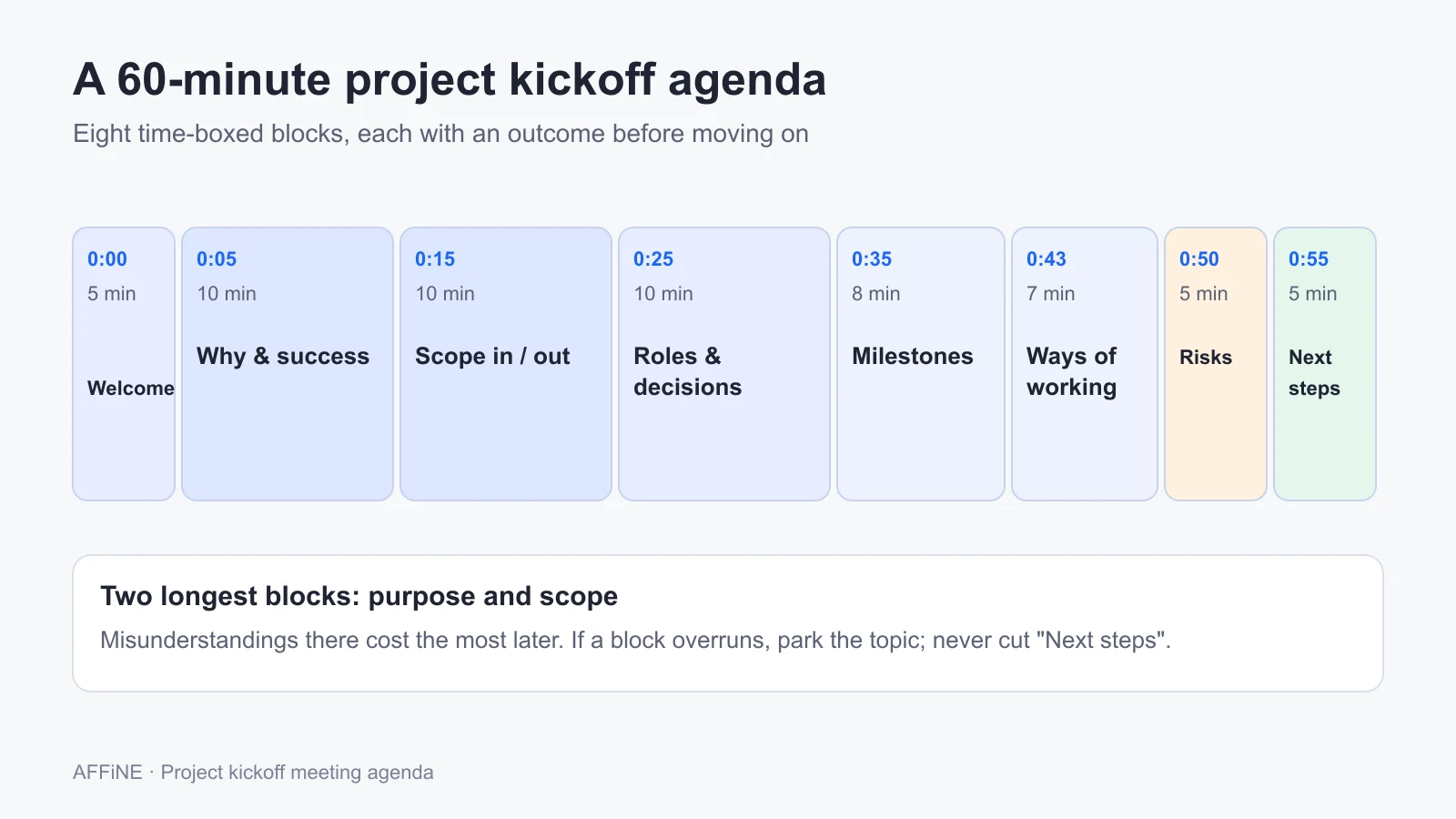 The 60-minute agenda as a timeline. The two longest blocks are purpose and scope, because misunderstandings there are the most expensive to fix later.
What a kickoff meeting is for, and what it is not
A kickoff meeting turns an approved idea into shared, working agreement. Atlassian's guide describes the kickoff as the first meeting of the project team (and the client, where there is one) to establish common goals, with a structured agenda covering scope, the communication plan, and immediate next steps, followed by a written summary of action items (Atlassian). Asana places it after the project charter is approved and before work starts (Asana).
That timing matters. The kickoff is not the place to decide whether the project should happen. That decision belongs to the charter and the sponsor. If the room starts debating whether the project is worth doing, stop, capture the concern, and take it back to the sponsor. A kickoff that reopens authorization usually ends without owners or dates.
A kickoff is also not an information broadcast. If most of the hour is one person reading slides, the background should have been a pre-read. Use the meeting for the things that need people in the same conversation: clarifying boundaries, agreeing decision rights, and committing to next steps.
Before the meeting: a 30-minute preparation checklist
Good kickoffs are mostly prepared in advance. The project lead can work through this list in about half an hour once the charter exists.
- Confirm the decision-maker attends. If the sponsor cannot join, reschedule or get a named delegate with authority to settle scope questions.
- Write a one-paragraph purpose. Problem, objective, and why now. Reuse the charter wording so the two documents agree.
- List in-scope and out-of-scope items. Include at least two plausible items that are out of scope. These prevent the most common "I assumed that was included" disputes.
- Draft a role and decision table. One accountable owner per deliverable and per major decision. A RACI chart is a convenient format.
- Sketch the milestone path. Major milestones and review gates only, not tasks. A simple timeline is enough.
- Prepare three questions for attendees. For example: "What would make this project fail?", "Which dependency worries you most?", "What do you need from this group in the first two weeks?"
- Send the pre-read two working days ahead. Charter summary, draft agenda, the three questions, and the link to the shared document where notes will be taken.
- Assign a facilitator and a note-taker. They should be different people. The facilitator keeps time; the note-taker records decisions, questions, and actions as they happen.
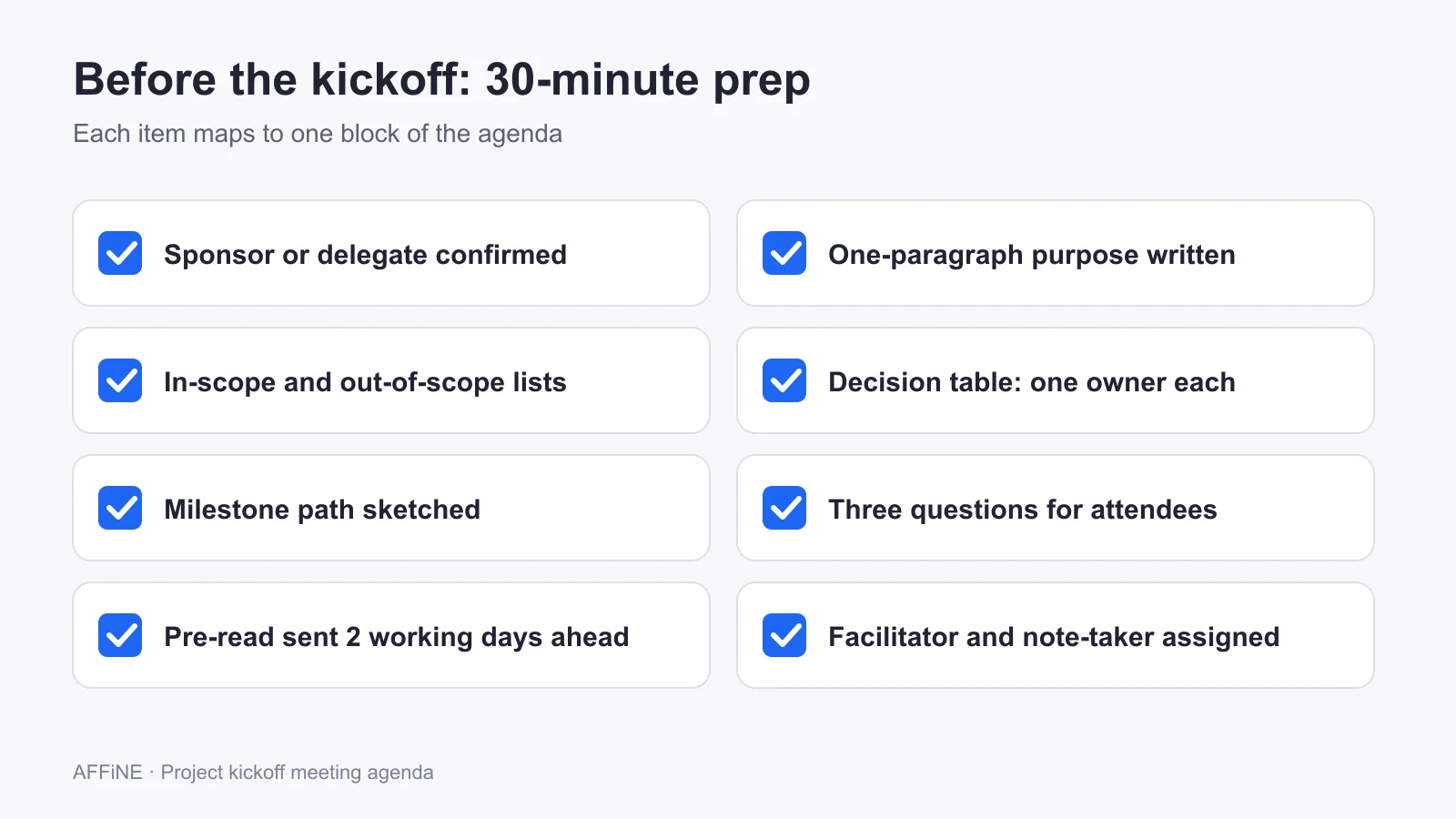 What to have ready before the meeting. Each item maps to one block of the agenda.
How to run each agenda block
1. Open with the purpose of this meeting
State what the meeting will decide, not just what the project is. "By 11:00 we will agree on scope boundaries, owners for the five deliverables, and what happens before our first check-in" gives people a reason to engage and gives the facilitator permission to park side discussions.
2. Let the sponsor explain why the project exists
The sponsor should explain the problem, the objective, and how success will be judged, in their own words. This is the moment the team hears that the work has real backing. Ask the sponsor to name the success measures with a baseline and a target, for example "reduce time to find an internal policy from about ten minutes to under two, measured by a five-question task test before and after rollout."
3. Walk through scope, and invite challenges
Read the in-scope and out-of-scope lists aloud and ask, "What is on neither list that someone here assumed?" Record each disputed item as a decision with an owner and a date. Do not try to resolve every one in the room.
4. Agree roles and decision rights
Show the decision table. For each deliverable and major decision, confirm one accountable person. Teams usually find their gaps here: an approval nobody owns, or two leads who each assumed the other would decide.
5. Show the timeline at milestone level
Keep this to milestones, review gates, and the dependencies that could move them. Detailed task plans belong in the project plan. If someone asks about a task date, note it and move on.
6. Agree ways of working
Decide the main channel for day-to-day questions, the status cadence, where documents and decisions are stored, and expected response times. Capture these in a short communication section. A fuller project communication plan can follow for larger projects.
7. Surface risks and open questions
Ask each delivery lead for the one risk most likely to hurt their part. Write each as "if [condition], then [impact]", give it an owner, and stop at five. This is a starting list, not the risk register.
8. Close with actions read back aloud
The note-taker reads every action with its owner and due date. People correct mistakes on the spot, which is much cheaper than discovering a misunderstanding a week later. Set the date of the first check-in before anyone leaves.
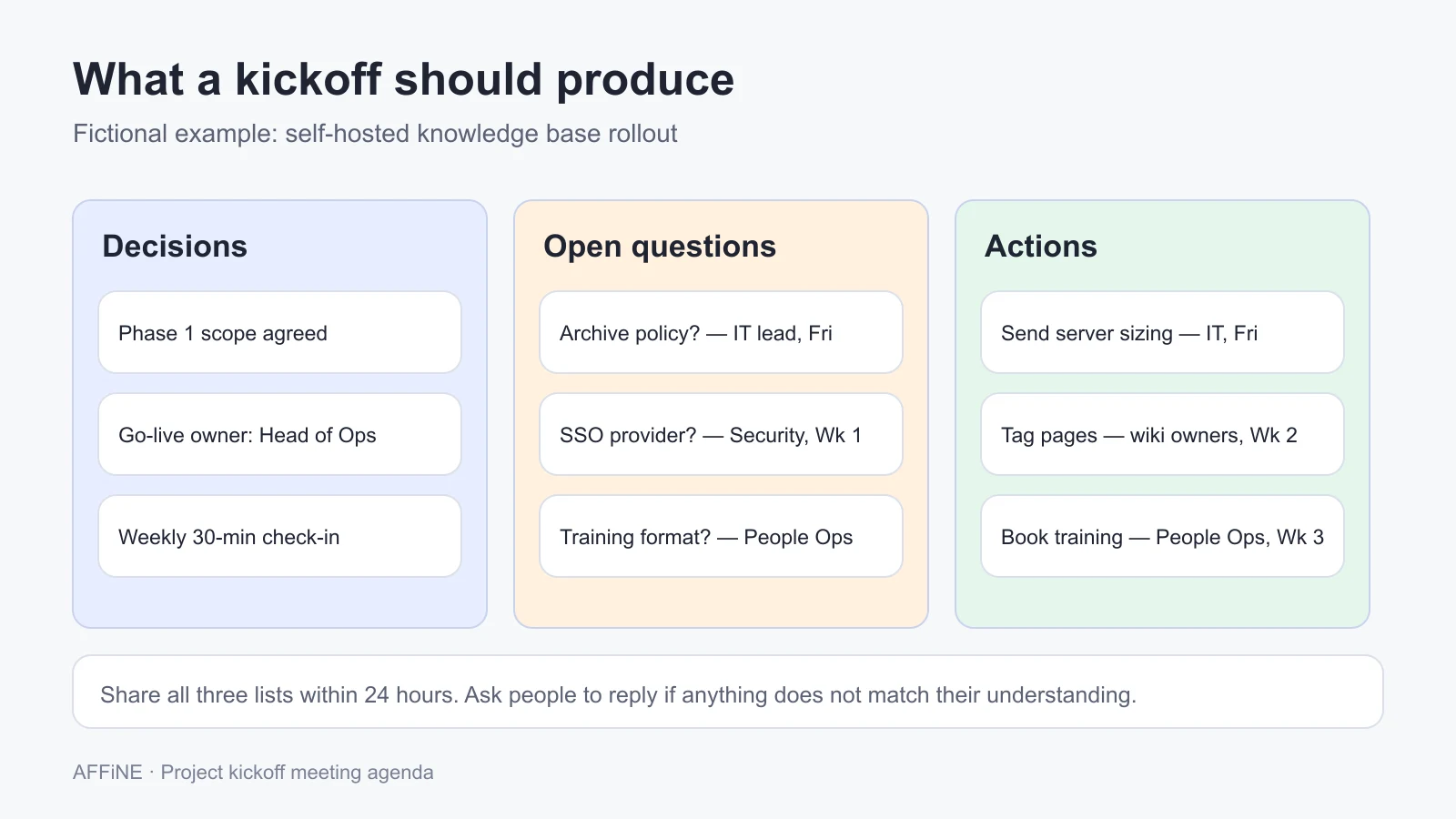 A kickoff should produce three lists: decisions, open questions with owners, and actions with dates.
Internal, client, and Agile kickoffs: what changes
The structure stays the same. The emphasis shifts.
| Kickoff type | Who attends | Spend more time on | Watch out for |
|---|---|---|---|
| Internal team project | Sponsor, project lead, delivery leads, affected teams | Decision rights across departments; handoffs to operations after launch | Teams joining "to stay informed" with no role; invite them to the summary instead |
| Client or agency project | Client sponsor and day-to-day contact, account lead, delivery leads | Scope against the statement of work, approval process, change requests, communication rules | Reopening the contract in the room; refer scope disputes to the scope of work and the commercial owner |
| Agile product initiative | Product owner, sponsor, team, key stakeholders | Product goal, success measures, working agreements, definition of done, first sprint or iteration | Turning the kickoff into backlog refinement; keep detailed stories for sprint planning |
For Agile work, the kickoff often feeds directly into chartering. The California Department of Technology's Agile guidance suggests a collaborative kickoff that covers vision, success criteria, stakeholders, top risks, responsibilities, size and complexity, and the product roadmap, with the resulting charter going to the executive sponsor for approval (California Department of Technology). See our guide to the Agile project charter for that next step.
Remote and hybrid kickoffs
- Share the agenda document on screen and take notes in it live, so everyone sees the same record.
- Shorten each block slightly and add a two-minute break if the meeting runs beyond 60 minutes.
- Ask remote attendees by name for questions during scope and risks. Otherwise the room tends to dominate.
- Record the session only with everyone's agreement, and still write the summary. A recording is not a decision log.
Worked example: kickoff for a self-hosted knowledge base rollout
This fictional example shows how the agenda reads when it is filled in. Names, numbers, and dates are illustrative.
Project: Move the internal handbook and team wikis to a self-hosted knowledge base
Purpose of this meeting: Agree scope for phase 1, owners for migration, security review, and training, and the plan for the first two weeks.
Why (sponsor, Head of Operations): Policies are spread across three tools and several shared drives. New hires take too long to find answers, and some content must stay on company-controlled infrastructure.
Success measures: Median time to find a policy in a five-question test falls from about 10 minutes to under 2; 90% of active handbook pages migrated by Week 6; no open high-severity findings at the security review.
In scope: Handbook, Engineering and Support wikis, single sign-on, page permissions by team, a two-session training.
Out of scope: Customer-facing help center, archive content older than three years, replacing the ticketing system.
Owners: Migration — IT lead. Security review — Security lead. Content clean-up — each team's wiki owner. Training — People Ops. Final go-live decision — Head of Operations.
Milestones: Server and SSO ready (Week 2) · Pilot with Support team (Week 4) · Security review (Week 5) · Go-live (Week 6) · 30-day review (Week 10).
Top risks: If page permissions are mapped wrongly, then confidential pages may be visible to the wrong team. Owner: Security lead. Response: test with three sample accounts before the pilot.
Actions: IT lead sends server sizing to Security by Friday. Each wiki owner tags pages to keep, merge, or archive by Week 2. People Ops books training dates by Week 3. First check-in: next Tuesday, 30 minutes.
Notice what the example leaves out: individual tasks, server configuration detail, and the full risk register. Those belong in the project plan.
After the meeting: the follow-up message
Send the summary within 24 hours, while memory is fresh. Keep it short enough to read on a phone.
Subject: [Project name] kickoff — decisions, owners, next steps
Thanks for joining today's kickoff. The full notes are here: [link].
Decided: [2–4 bullet points]
Open questions: [Question] — [Owner] — [Answer by date]
Actions: [Action] — [Owner] — [Due date]
Next check-in: [Date and time]
Reply by [date] if anything above does not match your understanding.
For recurring meetings after the kickoff, a lighter meeting minutes template is usually enough.
Common kickoff mistakes and how to avoid them
| Mistake | What it looks like | Fix |
|---|---|---|
| Too many topics | The agenda lists every project detail; the last three items never happen | Keep eight blocks or fewer; move detail to the pre-read |
| No decision-maker | Scope questions end with "we'll check with the sponsor" | Confirm the sponsor or a delegate with authority before sending the invite |
| Vague scope | Only an "in scope" list exists | Always list plausible out-of-scope items |
| Shared ownership | Two people "co-own" a deliverable | One accountable owner; others contribute |
| Presentation instead of conversation | One person talks for 40 minutes | Send background as a pre-read; use the meeting for questions and agreement |
| No written follow-up | People remember different outcomes | Send decisions, questions, and actions within 24 hours |
Run the kickoff from one shared page in AFFiNE
You can prepare and run the whole kickoff in AFFiNE. One way to set it up:
- Create a page for the project and paste the copy-ready agenda. Link the charter page, so the kickoff and the charter stay connected through backlinks.
- Switch the same page to edgeless mode to sketch the milestone path, a stakeholder map, or the scope boundary as a diagram on the whiteboard next to the agenda.
- Share the page with attendees before the meeting as the pre-read, and take notes in it during the meeting so there is one record.
- After the meeting, keep the decisions, open questions, and actions on the page and link it from later check-in notes.
Teams that need the kickoff notes to stay on their own infrastructure can self-host AFFiNE. AFFiNE is a workspace for documents and visual planning. It does not send calendar invites, track time, or assign tasks automatically. Use your existing calendar and task tools for those parts.
Frequently asked questions
What should be included in a project kickoff meeting agenda?
Include the purpose of the meeting, introductions, why the project exists and how success will be measured, scope (in and out), roles and decision rights, milestones, ways of working, top risks and open questions, and next steps with owners and dates.
How long should a project kickoff meeting be?
Most kickoffs fit in 60 minutes. Small internal projects can run in 45 minutes. Large, cross-functional, or client projects may need 90 minutes or a second working session; in that case split detailed planning into a separate meeting rather than extending the kickoff.
Who should attend a project kickoff meeting?
The sponsor or a delegate who can make scope decisions, the project lead, delivery leads, and representatives of teams whose work will change. People who only need to stay informed can receive the written summary instead.
What is the difference between a kickoff meeting and a project charter?
The charter is the document that authorizes the project and sets its purpose, scope, authority, and resources. The kickoff meeting comes after approval and turns the charter into shared working agreements, owners, and next steps for the team.
What should you send before a kickoff meeting?
Send a pre-read at least two working days ahead: a charter summary, the draft agenda, a few questions for attendees to think about, and a link to the shared document where notes will be taken.
What do you say to open a project kickoff meeting?
Thank people for coming, state what the meeting will decide by the end, confirm the time box, and introduce the facilitator and note-taker. Then hand over to the sponsor to explain why the project matters.
Sources and editorial notes
- Atlassian, Nailing your project kick-off. Accessed October 26, 2026.
- Asana, Project kickoff meeting: 10-step guide for success. Accessed October 26, 2026.
- California Department of Technology, 3.5.1 The Agile Project Charter. Accessed October 26, 2026.
How this guide was prepared: This article was rewritten in October 2026 from the original July 2023 version. The agenda, timings, checklist, and worked example are AFFiNE editorial recommendations based on the sources above and common project-management practice. They are not results of a controlled study. The worked example is fictional. AFFiNE product descriptions reflect features documented at the time of writing. AI tools assisted with drafting, and the content was reviewed and edited by the AFFiNE team.