Lesson Plan Template: Free Word & PDF + Examples
What changed (Nov 14, 2026): Rewrote the guide around a free lesson plan template (DOCX, PDF, TXT), a completed Grade 7 math example and two shorter examples, the 7 parts of a lesson plan, 6 backward-design steps, templates by type, a framework comparison, differentiation notes, a checklist and sources; replaced a dead source and mismatched links, and merged two duplicate lesson plan template posts into this page.
A lesson plan template is a reusable outline a teacher fills in before class to set what students should learn, how the lesson will run minute by minute, and how learning will be checked. The template below covers the seven parts most schools and teacher-preparation programs ask for: lesson details, a standard, a measurable objective, an assessment, materials, a timed sequence, and differentiation, with space to reflect afterwards.
You can copy it as text, download it as Word or PDF, or start from one of AFFiNE's free lesson plan templates. Further down you will find a completed example, six steps for writing a plan from scratch, and a guide to choosing between daily, weekly, unit, 5E and gradual release formats.
Key takeaways
- Write the objective and the assessment first, then plan activities that get students from one to the other.
- Give every phase a time estimate and check that the total matches your period.
- Use a daily plan for one class, a weekly plan for the flow of five days, and a unit plan for two to six weeks on one topic.
- Pick a framework (direct instruction, gradual release, 5E) to suit the goal of the lesson, not the other way round.
- Add a two-line reflection after you teach so the next copy of the plan is better than the last.
Lesson plan template at a glance
| Part | What to write | Example |
|---|---|---|
| Lesson details | Subject, grade, date, length, unit | Grade 7 math, 50 minutes, lesson 4 of 9 |
| Standard or goal | The standard or course goal the lesson serves | CCSS 7.EE.B.4a |
| Learning objective | One observable skill, with success criteria | Solve px + q = r and check the answer |
| Assessment | How you will know students met the objective | Two-item exit ticket |
| Materials | Everything you need ready before class | Slides, mini whiteboards, two practice sheets |
| Lesson sequence | Timed phases with what teacher and students do | Warm-up, I do, We do, You do, closure |
| Differentiation | Support, extension and accommodations | Step card, harder equations, read-aloud |
Free lesson plan template (Word, PDF and text)
Download the blank template as Word (DOCX), PDF or plain text. The PDF also contains the completed example from the next section. To use it in Google Docs, upload the DOCX to Google Drive and open it with Google Docs.
Lesson plan template
LESSON DETAILS
Teacher: [name]                    Date: [date]
Subject: [subject]                 Grade/class: [grade or section]
Lesson title: [topic]              Length: [minutes]
Unit: [unit name and lesson number, for example lesson 3 of 8]

STANDARD OR GOAL
[Standard code and wording, or the course goal this lesson supports]

LEARNING OBJECTIVE
Students will be able to [observable verb] [content] [condition or level].
Success criteria (what students say, write or do to show it):
- I can [criterion 1]
- I can [criterion 2]

ASSESSMENT
Formative check during the lesson: [question, mini whiteboards, observation]
Exit ticket or product: [task students finish before they leave]
Evidence that the objective is met: [score, rubric level or correct answer]

MATERIALS AND PREPARATION
- [handouts, slides, manipulatives, devices, links]
- [room setup or groups]

LESSON SEQUENCE
Time   | Phase                         | What the teacher and students do
[min]  | Warm-up or hook               | [ ]
[min]  | Direct instruction (I do)     | [ ]
[min]  | Guided practice (We do)       | [ ]
[min]  | Independent practice (You do) | [ ]
[min]  | Closure and exit ticket       | [ ]
Total: [minutes, must match the lesson length]

DIFFERENTIATION
Support: [scaffolds, sentence frames, worked examples]
Extension: [harder problem or open task]
Accommodations: [IEP or 504 plan items, language supports]

HOMEWORK OR NEXT STEP
[practice, reading, or none]

REFLECTION (AFTER TEACHING)
What worked: [ ]
What to change next time: [ ]
Students to follow up with: [ ]
Replace every bracketed prompt. If a section does not apply, write "none" rather than deleting it, so a mentor, a substitute or a co-teacher can see that you thought about it.
Which format to use
| Format | Good for | Watch out for |
|---|---|---|
| Word (DOCX) | Submitting plans to a principal or a teacher-preparation program | Copies multiply across folders |
| Google Docs | Co-planning with a grade-level team in real time | Tables shift when people paste content |
| Printing or handing a plan to a substitute | Hard to edit once filled in | |
| AFFiNE | Reusing a plan, linking it to a weekly view and keeping notes in one workspace | Your school may still ask for a Word or PDF copy |
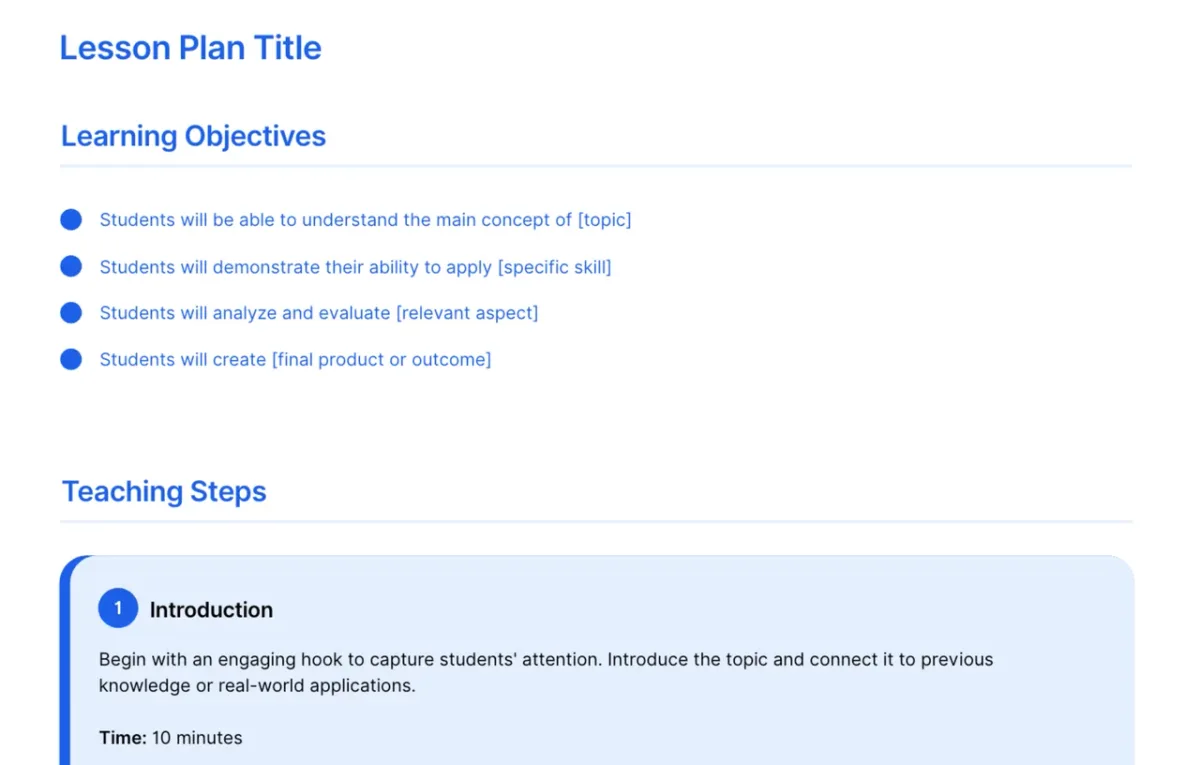
If you prefer to start inside an editor, the basic lesson plan template in AFFiNE has the same objective-first structure with numbered teaching steps and a time field for each step.
The 7 parts of a lesson plan
- Lesson details. Subject, grade or section, date, length and where the lesson sits in the unit. "Lesson 4 of 9" tells a reader what students already know.
- Standard or goal. The state standard, framework code or course outcome the lesson serves. One standard per lesson keeps the plan focused.
- Learning objective and success criteria. What students will be able to do by the end, written with a verb you can observe, plus two or three "I can" statements students can check themselves against.
- Assessment. The question, task or exit ticket that shows whether the objective was met, and what a correct answer looks like.
- Materials and preparation. Handouts, slides, devices, manipulatives, links and room setup. A substitute should be able to find everything from this list.
- Lesson sequence. The phases of the lesson in order, each with a time estimate and what the teacher and students do. Most plans use some version of warm-up, instruction, guided practice, independent practice and closure.
- Differentiation and accommodations. How you will support students who need more help, stretch those who finish early, and meet the accommodations listed in IEP or 504 plans and language supports for multilingual learners.
Many templates add homework and a reflection box. Reflection is optional on paper but is the fastest way to improve a plan you will teach again.
How to write a lesson plan in 6 steps
The order below follows backward design, the approach Grant Wiggins and Jay McTighe describe in Understanding by Design: decide the result and the evidence before choosing activities. Carnegie Mellon's Eberly Center calls this alignment between objectives, assessments and instructional strategies.
- Start from the standard and the unit. Look at what came before this lesson and what comes next, then pick the one standard or goal this lesson moves forward.
- Write one measurable objective. Use the pattern "Students will be able to [verb] [content] [condition]." Choose a verb you can see or hear, such as solve, compare, explain, label or write, and avoid "understand" or "learn about". Carnegie Mellon's guide to learning objectives lists verbs by level of thinking.
- Design the assessment before the activities. Write the exit ticket or task now and solve it yourself. If you cannot say what a correct answer looks like, the objective is still too vague.
- Plan the sequence and time each phase. Begin with a short warm-up that activates prior knowledge, model the skill, practice it together, then let students practice alone while you check in. Add the minutes and make sure they fit the period with a few minutes to spare.
- Add differentiation. For each phase, note one support (a worked example, a sentence frame, a step card) and one extension. Copy the accommodations your students' plans require.
- Prepare materials, then reflect after teaching. List everything you need and make copies the day before. After class, write what worked, what to change and which students need follow-up.
| Objective verb level | Example verbs | Example objective |
|---|---|---|
| Remember and understand | define, list, describe, summarize | Summarize the main events of a story in order |
| Apply | solve, use, calculate, demonstrate | Solve two-step equations and check the answer |
| Analyze | compare, classify, explain why | Compare two sources about the same event |
| Evaluate and create | justify, critique, design, write | Design an experiment to test one variable |
A completed lesson plan example
This fictional Grade 7 math lesson fills in every field of the template above. The minutes in the sequence add up to the 50-minute period, and the exit ticket checks the exact skill in the objective.
Lesson plan example: solving two-step equations (fictional)
LESSON DETAILS
Teacher: Ms. Rivera (fictional)    Date: Tuesday, week 6
Subject: Math                      Grade/class: Grade 7, period 3 (28 students)
Lesson title: Two-step equations   Length: 50 minutes
Unit: Expressions and equations, lesson 4 of 9

STANDARD OR GOAL
CCSS 7.EE.B.4a: solve word problems leading to equations of the form px + q = r.

LEARNING OBJECTIVE
Students will be able to solve equations of the form px + q = r and check the answer.
Success criteria (what students say, write or do to show it):
- I can undo addition or subtraction first, then multiplication or division.
- I can substitute my answer to show that both sides are equal.

ASSESSMENT
Formative check during the lesson: mini whiteboards after each We do problem
Exit ticket or product: solve -2x + 9 = 1; write and solve the equation for a $55 bill
Evidence that the objective is met: both exit ticket items correct (x = 4, g = 8)

MATERIALS AND PREPARATION
- Slides with 3 worked examples, mini whiteboards and markers
- Practice sheet A (8 equations) and sheet B (6 word problems)
- Pairs grouped by mixed readiness from last week's quiz

LESSON SEQUENCE
Time   | Phase                         | What the teacher and students do
5 min  | Warm-up or hook               | x + 7 = 12 and 4x = 20; hook: $15 + $5 per GB = $40
10 min | Direct instruction (I do)     | Model 3x + 5 = 20: subtract 5, divide by 3, x = 5, check
12 min | Guided practice (We do)       | Pairs solve 4 equations; teacher scans the whiteboards
18 min | Independent practice (You do) | Sheet A, then sheet B; teacher pulls a small group
5 min  | Closure and exit ticket       | Students name the two steps, then do the exit ticket
Total: 50 minutes

DIFFERENTIATION
Support: step card (undo + or -, then x or /), positive whole numbers first
Extension: equations such as 2(x + 3) = 14 and writing an original word problem
Accommodations: word problems read aloud; calculators for students whose IEPs list them

HOMEWORK OR NEXT STEP
6 mixed practice problems. Next lesson: variables on both sides.

REFLECTION (AFTER TEACHING)
What worked: [fill in after the lesson]
What to change next time: [ ]
Students to follow up with: [ ]
What makes it work: the objective names one skill, the exit ticket has a right answer the teacher wrote in advance (x = 4 and g = 8), the hook and the exit ticket use the same phone plan so students see the point of the skill, and the differentiation notes are specific enough for a co-teacher to act on.
Two shorter lesson plan examples
Grade 2 reading: retelling a story with gradual release
Objective (30 minutes): students will be able to retell a story with a beginning, middle and end using three picture cues.
| Time | Phase | What happens |
|---|---|---|
| 8 min | Focus lesson (I do) | Teacher reads a short picture book and thinks aloud while sorting three cards into beginning, middle and end |
| 8 min | Guided instruction (We do) | Class retells a second story together; students hold up the card for each part |
| 8 min | Collaborative (You do together) | Partners retell a familiar story to each other using a three-box organizer |
| 6 min | Independent (You do alone) | Each student draws and labels the three parts of a new story; this is the assessment |
The phases follow the gradual release of responsibility model described by Douglas Fisher and Nancy Frey. AFFiNE's GRR lesson plan template gives each phase its own section.
High school biology: osmosis with the 5E model
Objective (55 minutes): students will be able to explain, using evidence from their own data, why potato cores gain or lose mass in salt water and fresh water.
| Time | Phase | What happens |
|---|---|---|
| 5 min | Engage | Show wilted and crisp celery; students write one guess about the difference |
| 20 min | Explore | Groups weigh potato cores, place them in fresh water and salt water, and weigh them again after 15 minutes |
| 12 min | Explain | Groups share their mass changes; teacher introduces osmosis and concentration gradients |
| 10 min | Elaborate | Students predict what happens to red blood cells in the same two solutions |
| 8 min | Evaluate | Claim-evidence-reasoning paragraph scored with a three-level rubric |
The five phases come from the BSCS 5E instructional model. For an inquiry-led version with key questions and hypotheses, see the inquiry-based lesson planning guide.
Lesson plan templates by type
Most teachers use more than one format: a weekly view to see the week, a daily plan for each class, and a unit plan for the topic as a whole. These AFFiNE templates are free to copy into a workspace.
| Template | Best for | What it includes |
|---|---|---|
| Basic lesson plan | A single lesson on one page | Objectives and numbered teaching steps with times |
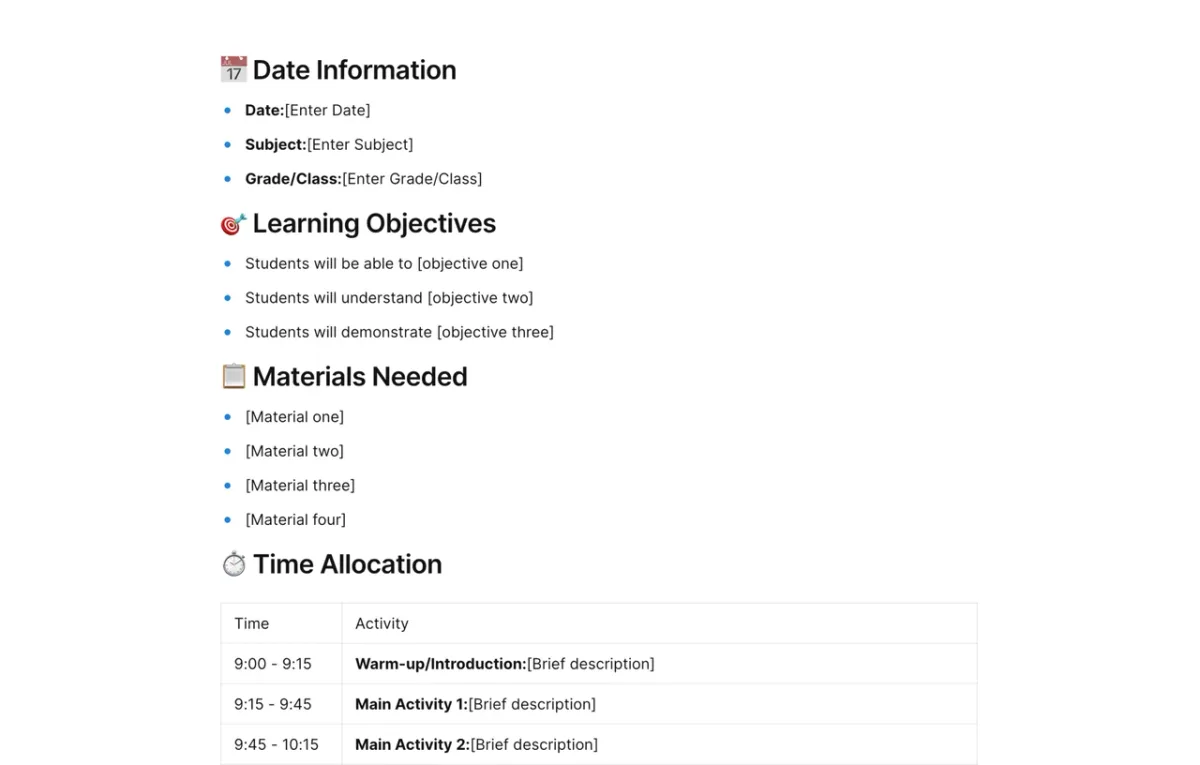
| Daily lesson plan outline | One class period planned minute by minute | Date details, objective starters, materials, timed activity table |
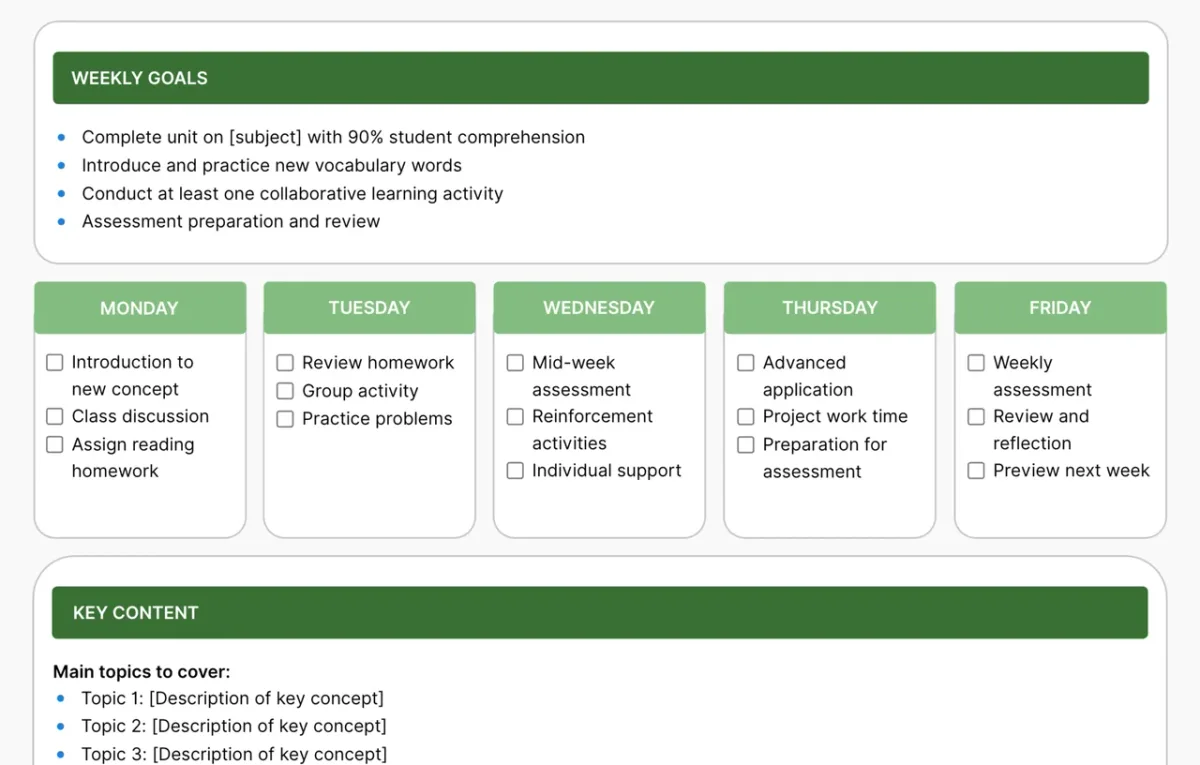
| Weekly lesson planner | Seeing five days at once | Weekly goals, Monday to Friday checklists, key content |
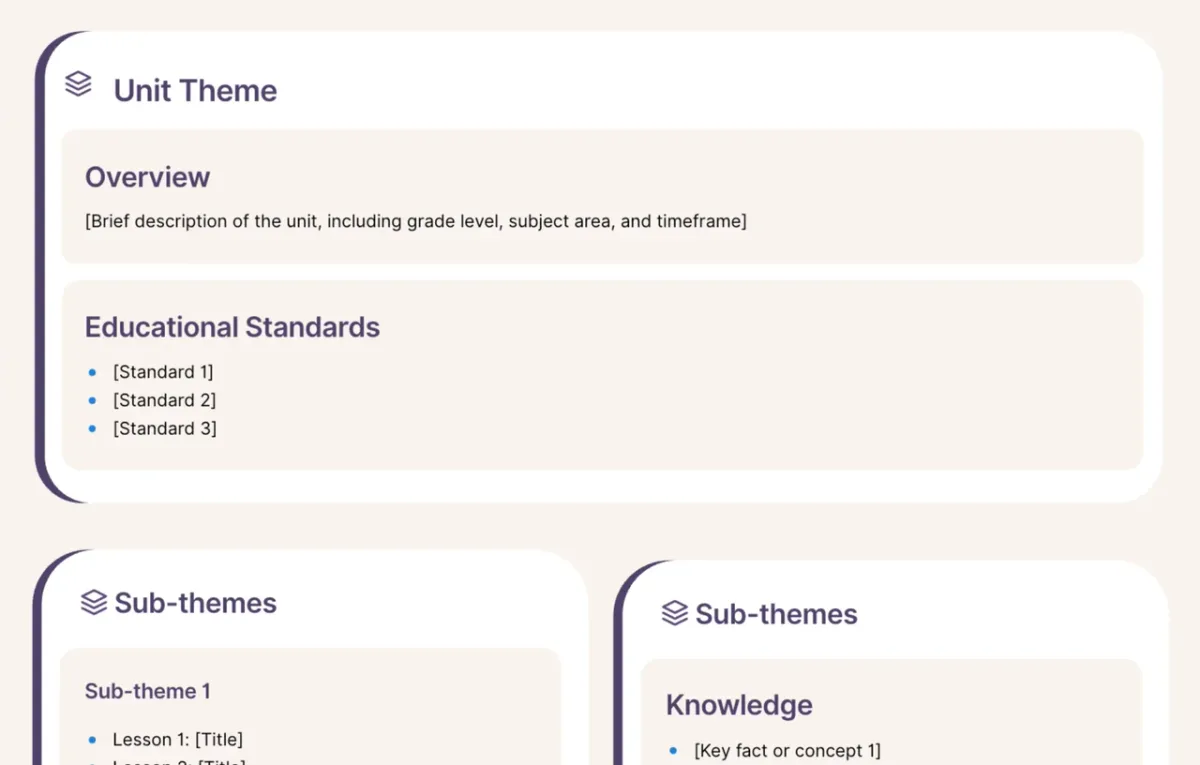
| Unit lesson plan framework | Two to six weeks on one topic | Overview, standards, sub-themes, lessons and assessments |
| Standards-aligned lesson plan | Showing how each lesson maps to standards | Objectives and activities tied to standard codes |
| GRR lesson plan | Modeling a skill before students try it | I do, We do, You do together, You do alone |
| Inquiry-based lesson plan | Science and 5E-style lessons | Key questions, hypotheses, investigation, reflection |
| Project-based learning plan | Multi-week projects | Overview, timeline, success criteria, resources |
| Flipped classroom plan | Video or reading before class | Pre-class work, in-class activities, assessment |
| Differentiated instruction plan | Mixed-readiness classes | Tiered tasks, grouping and assessment options |
| Lesson plan with reflection | New teachers and observed lessons | A reflection section after the plan |
| Math lesson plan | Math lessons with worked examples | Warm-up, introduction, direct instruction |
| Pre-K lesson plan | Early years | A sample shapes lesson with game-based activities |
| Montessori lesson plan | Child-led presentations | Materials, preparation and presentation steps |
| Homeschool lesson plan | Parents teaching several subjects | Subjects, objectives, daily activities, resources |
Browse the full set in the lesson plan template collection.
Lesson plan frameworks compared
A framework is the shape of the lesson sequence. The template above works with any of them; only the rows in the lesson sequence change.
| Framework | Sequence | Best for |
|---|---|---|
| Direct instruction | Hook, model, guided practice, independent practice, closure | New procedures and skills with a right answer |
| Gradual release (GRR) | I do, We do, You do together, You do alone | Reading, writing and any skill students need to see modeled |
| 5E | Engage, Explore, Explain, Elaborate, Evaluate | Science and inquiry where students investigate before the explanation |
| Understanding by Design | Desired results, evidence, learning plan | Planning whole units backward from the assessment |
| SIOP | Content and language objectives across eight components | Classes with multilingual learners |
| UDL | Multiple means of engagement, representation and action | Planning for learner variability from the start |
SIOP is maintained by the Center for Applied Linguistics, and the UDL principles are published by CAST in the UDL Guidelines. Teacher candidates completing edTPA usually receive a program-specific lesson plan form; the seven parts above map onto most of them, but use your program's form for submission.
Adapting a lesson plan for different learners
- Multilingual learners: add a language objective next to the content objective (for example, "explain the two steps using first and then"), plus sentence frames and a word bank.
- Students with IEPs or 504 plans: copy the listed accommodations into the differentiation section of each plan so they are in front of you while you teach.
- Students who need more support: use worked examples, shorter problem sets and a small-group check-in during independent practice.
- Students ready for more: plan an extension that goes deeper, not just more of the same problems.
- Co-teaching: add a column to the lesson sequence that says what each teacher does in each phase, so roles are clear before class.
- School counselors: the same structure works for classroom lessons on study skills or career topics; write the objective as a student skill and plan a short check at the end.
- Preschool and pre-K: shorten each phase, plan movement and hands-on play, and assess by observation. Our guide to preschool lesson planning goes into more detail.
Plan lessons faster in AFFiNE
AFFiNE is a free workspace that combines documents, whiteboards and databases. Disclosure: AFFiNE publishes this guide. For lesson planning, that means:
- Start from a template. Copy any lesson plan template above into your workspace with one click and edit it like a document.
- Reuse instead of rewriting. Duplicate last year's plan, update the dates and read your reflection notes before you teach it again.
- Link the week to the day. Keep a weekly lesson planner page and link each day to its full lesson plan. The lesson plan website template stores plans in a database with course, date and status columns.
- Sketch the lesson flow on a whiteboard. Switch a page to edgeless mode to map a unit, a 5E sequence or a seating plan next to the written plan.
- Share and export. Share a link with a co-teacher, invite up to three members per workspace on the Free plan for real-time editing, export a page to HTML, Markdown or PNG, or print it to PDF.
- Draft with AI if you want to. AFFiNE AI, a paid add-on, can turn a topic and an objective into a first draft. Always check the objective, timings and facts yourself.
If you also need a planner for grading, meetings and parent contacts, see our teacher planner templates, and for subject-specific ideas the math lesson plan guide.
Lesson plan checklist and common mistakes
Before you teach, check that:
- The objective uses an observable verb and names one skill.
- The assessment checks that same skill, and you have written the correct answer.
- Every phase has a time, and the total fits the period with a few minutes spare.
- Students practice the skill themselves for at least a third of the lesson.
- Materials are listed and prepared.
- Differentiation and accommodations are written down, not just remembered.
- A substitute could teach the lesson from the plan alone.
Common mistakes:
- Activities first, objective later. A fun activity that does not lead to the objective uses time without moving learning forward.
- Objectives that cannot be checked. "Students will understand fractions" has no clear evidence. "Students will compare two fractions with unlike denominators" does.
- No time for practice. When the teacher talks for most of the period, there is no evidence of what students can do alone.
- Over-scripting. A plan needs enough detail for someone else to follow, not every sentence you will say.
- Skipping the reflection. Without notes, next year's version repeats this year's problems.
Lesson plan template FAQs
What should a lesson plan template include?
A lesson plan template should include lesson details (subject, grade, date and length), the standard or goal, a measurable learning objective with success criteria, an assessment, a materials list, a timed lesson sequence, and differentiation and accommodations. Many templates also add homework and a reflection section.
What are the 5 parts of a lesson plan?
A common five-part version is objective, materials, procedure, assessment and closure. Some schools use other five-part models, such as the 5E sequence (Engage, Explore, Explain, Elaborate, Evaluate), which describes the phases of the lesson rather than the sections of the plan.
How long should a lesson plan be?
A plan for one class period usually fits on one or two pages. It should be detailed enough that a substitute or co-teacher could teach from it, without scripting every sentence. Plans for observed lessons or teacher-preparation programs are often longer because they ask for rationale and student context.
What is the difference between a daily, weekly and unit lesson plan?
A daily lesson plan details one class period minute by minute. A weekly lesson plan shows the goals and activities for five days at a glance. A unit plan covers two to six weeks on one topic, with the standards, the final assessment and the sequence of lessons that leads to it.
Can I use this lesson plan template in Google Docs?
Yes. Download the DOCX file, upload it to Google Drive and open it with Google Docs. You can also copy the plain-text version into any document editor, or copy one of AFFiNE's lesson plan templates into a free workspace.
Is this lesson plan template free?
Yes. The Word, PDF and text downloads on this page are free to use and change for your classes, and every AFFiNE lesson plan template linked here is free to copy into a workspace.
Sources and review notes
- Grant Wiggins and Jay McTighe, Understanding by Design, expanded 2nd edition (ASCD), for backward design.
- Carnegie Mellon University Eberly Center, alignment of objectives, assessments and instruction and learning objectives.
- UC Santa Barbara Center for Innovative Teaching, Research and Learning, lesson planning.
- BSCS Science Learning, the BSCS 5E instructional model: origins and effectiveness.
- Douglas Fisher and Nancy Frey, Better Learning Through Structured Teaching (ASCD), for the gradual release of responsibility model.
- Center for Applied Linguistics, SIOP; CAST, UDL Guidelines.
- Common Core State Standards for Mathematics, grade 7, standard 7.EE.B.4a.
The example lessons are fictional and written for this guide. The template follows the sections commonly required by school districts and teacher-preparation programs, but your school's own form takes precedence. AFFiNE plan details (Free plan members per workspace, AFFiNE AI as a paid add-on, export formats) were checked against affine.pro/pricing and the AFFiNE export menu in November 2026.