
Structuring Unstructured Web Data for Shared Enterprise Workspaces
Web scraping can collect thousands of pages in a short time, but volume alone does not make the result useful. Product pages, reviews, company profiles, articles, and tables often arrive with different labels, missing fields, repeated records, and inconsistent values. Before any of that material can support a decision, someone has to turn it into data that a team can search, compare, update, and share.
When teams collect public information from many sources, Froxy web scraping proxies can support the collection layer by distributing requests across different IPs and locations. The next challenge is turning that raw material into data that people can search, compare, update, and share.
This guide walks through that process end to end: how to define a data model before scaling collection, four practical ways to structure web data, how to clean and validate records without checking every row by hand, and how to publish the result in a shared workspace that different teams can trust.
Key takeaways
- Start from the business question, not from the HTML of one website. The question decides which fields every record needs, which can stay empty, and how often the data must be refreshed.
- Four structuring methods cover most enterprise use cases: schema-first records, tag-based classification, entity-relationship models, and documents with structured metadata. They can be combined.
- Normalize units, dates, and locations before comparing anything, keep provenance (source URL, collection time, region) with every record, and validate critical fields automatically so human review focuses on exceptions.
- A shared workspace works when one maintained dataset feeds different views, ownership and permissions are explicit, and every view makes recency visible.
Why Raw Web Data Is Hard to Use as a Team
A web page is built for people to read, not for an enterprise workspace to compare. Two websites may describe the same product with different field names, currencies, date styles, or category labels. A scraper can extract both correctly and still produce a dataset that is difficult to use. The most common problems are easy to recognize:
- inconsistent field names across different sources;
- duplicate records collected from several pages;
- missing dates, categories, prices, or identifiers;
- free text that cannot be filtered or compared reliably;
- records with no clear source or collection time.
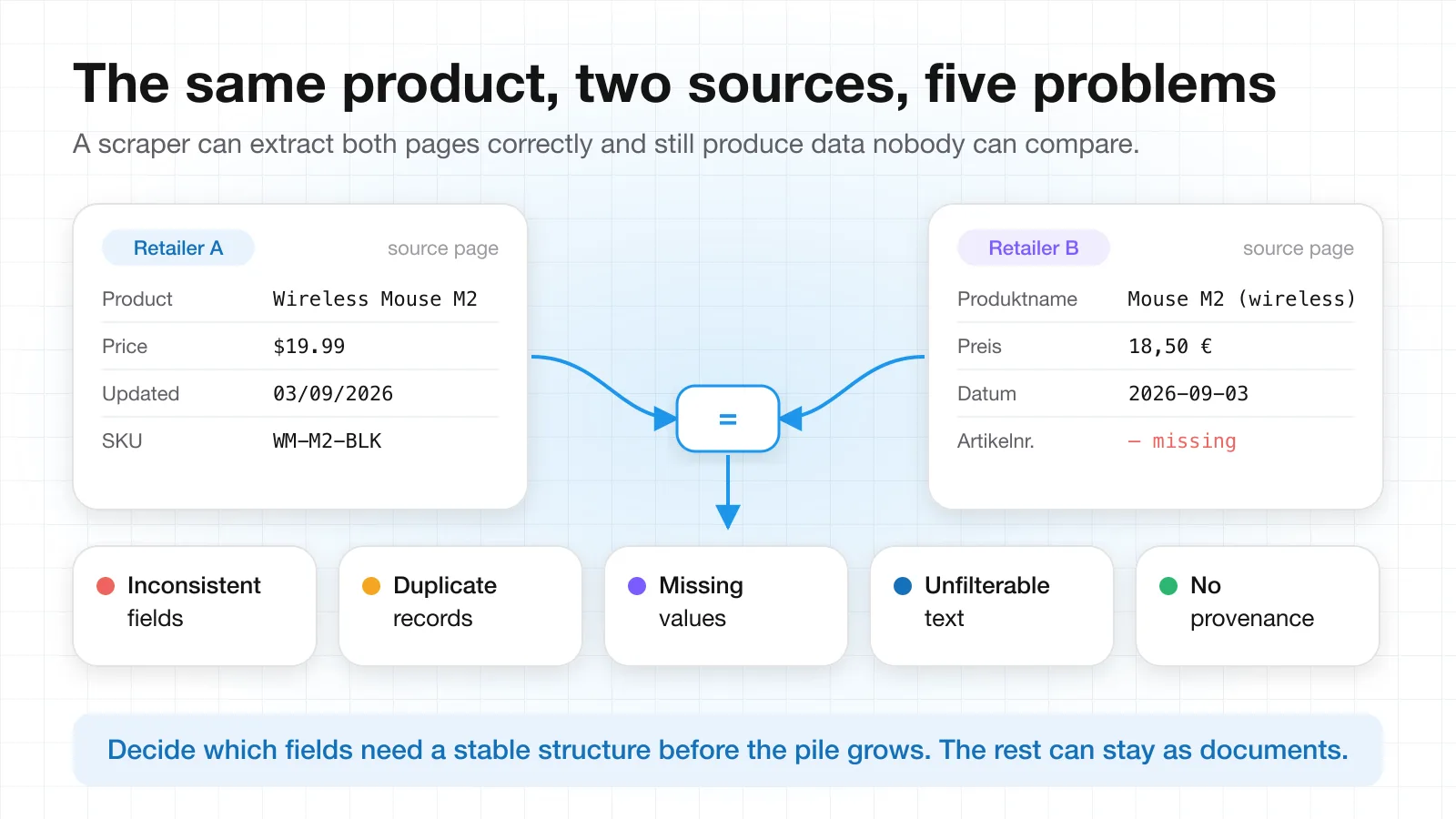
These issues become more expensive when several teams use the same information. Marketing may classify a company one way, procurement may use another label, while an analyst cleans the same fields again before every report. The goal is not to force every piece of web content into a rigid table. Teams need to decide which information requires a stable structure and which parts should remain as documents or source material.
Source context also needs to travel with each record. A URL, collection date, and market or region help future users understand where a value came from and whether it may already be outdated. This is the same idea that the W3C formalizes as provenance: a record of where a piece of data originated and how it was produced, so that later users can judge whether to trust it.
Define the Data Model Before Scaling Collection
A data model is an agreed way to describe each item in a dataset. Defining it early prevents the extraction process from collecting large amounts of information that nobody knows how to use later.
Start With the Business Question
The model should begin with the decision or analysis the data needs to support, not with the HTML structure of one website.
A price-monitoring project needs different information from a supplier-research project. The first may require product ID, price, currency, availability, region, and collection time. The second may focus on company name, location, product categories, certifications, and source documents. This distinction matters because a scraper can technically collect hundreds of fields from a page. Only a smaller set may be useful for the actual business task.
The same discipline applies to research collections. A competitor analysis that tracks pricing pages, feature lists, and positioning needs a different model from one that tracks hiring or partnership announcements, even if both scrape the same company websites.
Turn the Question Into Fields and Rules
Once the purpose is clear, the team can define what every record should contain and how often it needs to be refreshed. A useful preparation sequence is:
- Define the question the dataset needs to answer.
- Identify the public sources that contain the required information.
- Decide which fields every record needs.
- Mark which fields are required and which may remain empty.
- Store source and collection details with each record.
- Set an update frequency based on how quickly the information changes.
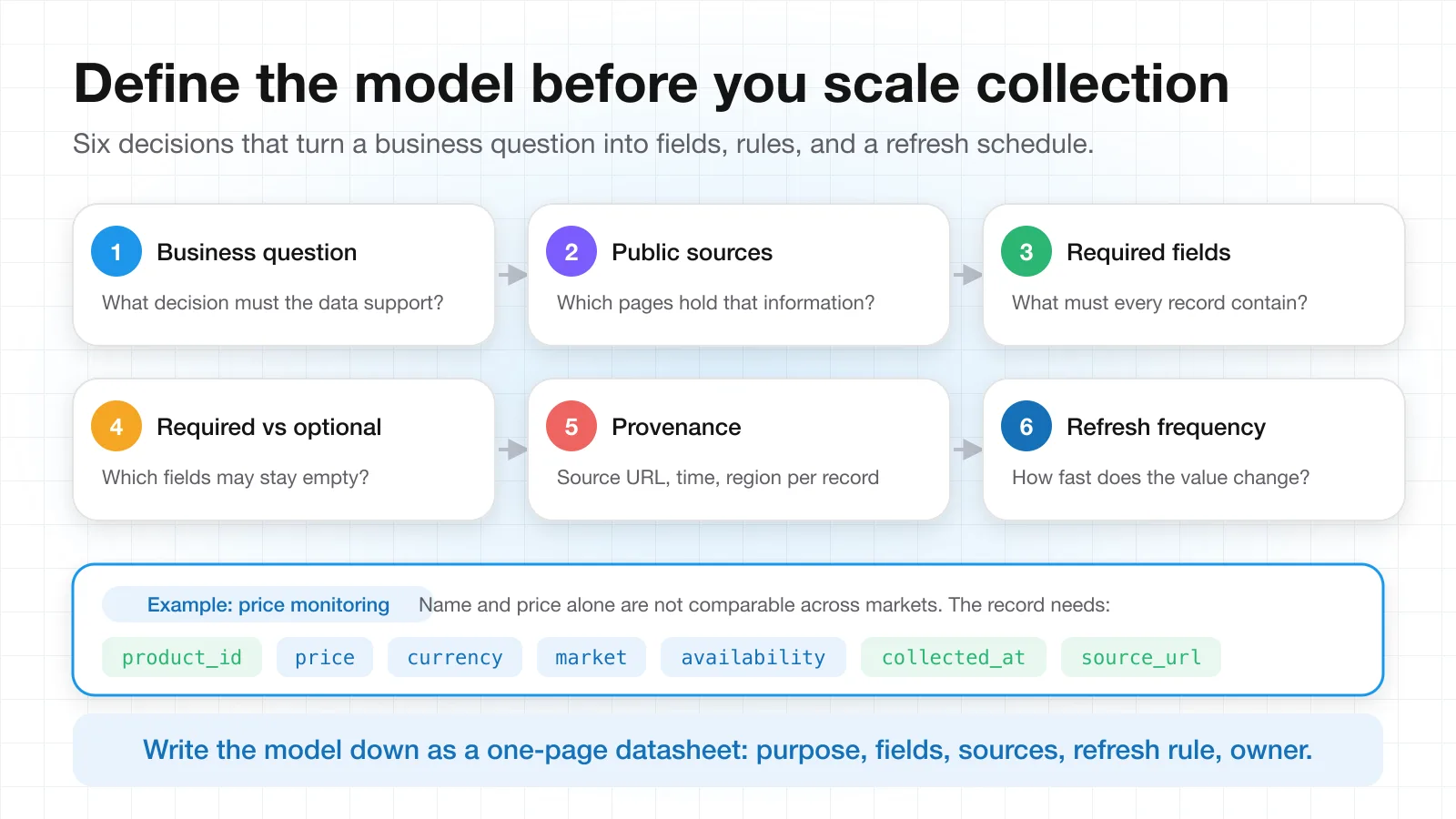
Consider competitor price monitoring. Product name and price are not enough if one website lists prices in euros and another in dollars. Currency, market, availability, a stable product identifier, and a timestamp are needed before the values can be compared reliably. The same principle applies to long-form research. If the goal is to understand how competitors describe a feature, preserving the full text may be more useful than splitting every sentence into separate fields.
Writing these decisions down is worth the time. The Datasheets for Datasets proposal from Gebru and colleagues recommends that every dataset carry a short document describing its motivation, composition, collection process, and recommended uses. A one-page datasheet for a scraped dataset answers most of the questions a new team member would otherwise ask the person who built it.
Build the Collection Layer Around the Model
Once the required fields are clear, the scraper can be designed around them. This is also where proxy infrastructure becomes part of data quality rather than a separate networking concern. Large collection jobs may involve parallel requests, regional sources, or repeated checks over time. If every request depends on one IP, rate limits or location differences can interrupt collection and leave gaps in the dataset.
Froxy can support this layer with rotating and sticky proxy sessions, geographic targeting, and a pool of network endpoints. Rotation suits independent page requests, while sticky sessions are useful when several related requests need to retain the same network identity.
Consistency matters more than changing IPs as often as possible. If a dataset compares several markets, the collection rules should define which region is used for each one. If records are refreshed daily, the same extraction and validation logic should run during every cycle. Proxy infrastructure does not replace request pacing, retries, or source-specific handling. Its role is to make the network layer easier to control so the rest of the pipeline can focus on extracting and processing information.
Collection rules should also cover what the team will not collect. Limiting the pipeline to publicly available pages, respecting each source's robots.txt and terms of use, pacing requests so that a source is not overloaded, and excluding personal data that the business question does not need are practical defaults. They keep the dataset defensible later and reduce the amount of material that has to be filtered out during cleaning.
Top Four Practical Ways to Structure Web Data
There is no single model that fits every enterprise dataset. The right choice depends on whether people need to compare values, group documents, explore relationships, or preserve long-form context.
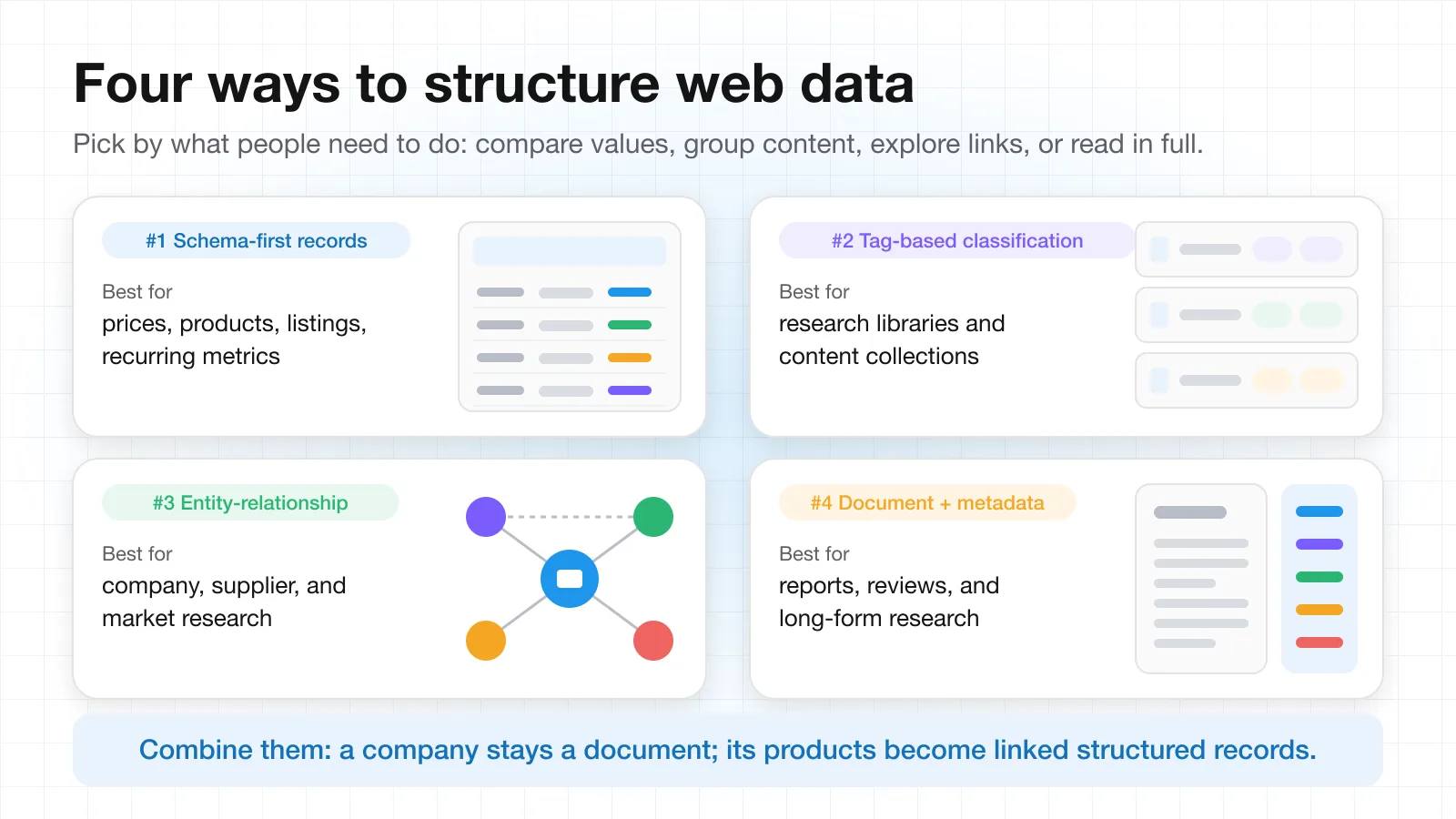
#1 Schema-First Records
Schema-first records work well when the same type of item appears many times. Each record follows a fixed set of fields, so products, listings, prices, or company entries can be filtered consistently.
An e-commerce record might contain product ID, name, brand, current price, currency, stock status, region, source, and collection date. The scraper maps different source labels into these standard fields. The main advantage is clarity. Analysts know what each column means and can compare thousands of records without repeating basic cleanup.
The limitation is rigidity. A new source may contain useful information that does not fit the existing fields. The schema then needs to change, and dependent reports may require an update. This method works best for recurring measurements where comparison matters more than preserving every detail from the original page.
#2 Tag-Based Classification
Tags are useful when content varies too much for a strict table but still needs consistent grouping. Research articles, reviews, market observations, and competitor content often fit this model. A document might receive tags for industry, topic, country, source type, and product category. Teams can then filter a large research collection without forcing every item into identical columns. The strength is flexibility. A new topic can be added without rebuilding the dataset.
The weakness is inconsistency. Tags lose value when different people use ecommerce, e-commerce, and online retail for the same idea. A controlled vocabulary is therefore essential. A smaller set of agreed terms usually works better than hundreds of overlapping labels. The purpose of tagging is to make information easier to find, not to describe every possible nuance.
#3 Entity-Relationship Structure
Some projects are more interested in connections than isolated records. Competitive intelligence is a good example because one company may sell many products, operate in several markets, and work with multiple suppliers.
An entity-relationship model stores the main objects once and connects them. A company can be linked to products, markets, people, categories, or other organizations without repeating all company details in every row. This makes relationship-based questions easier to answer. A team can identify which suppliers work with several competitors or which products belong to the same market category.
The trade-off is setup effort. Teams need to agree on the entities and relationships before the model becomes useful. For a small dataset, that work may be heavier than a simple table. For larger research projects, however, the model can reduce duplication and reveal connections that are difficult to see in flat records.
#4 Documents With Structured Metadata
Not all useful web data should be broken into rows. Long reviews, articles, reports, company descriptions, and policy pages often lose context when divided too aggressively. A document-based method keeps the original text together and adds structured metadata around it. That metadata may include title, company, topic, region, publication date, source URL, collection date, and tags.
This is useful for enterprise research because people can still read the full material while filtering the collection by known fields. It can also support later search or analysis without removing the original context. The limitation appears when teams need numerical comparison. A document is harder to aggregate than a price table, so this method often works best alongside another structured model.
Clean and Validate Before Sharing
A well-designed schema does not guarantee reliable information. Web sources use different conventions, and extraction can still produce duplicates, missing values, or inconsistent units.
Normalize Values Before Comparison
Normalization turns different representations of the same information into one agreed format. Without it, a dataset may technically be complete but still produce misleading comparisons. A practical quality layer can include:
- normalize names and units — convert equivalent values into one agreed representation, such as the ISO 4217 code USD instead of mixing $, US dollars, and USD;
- standardize dates and locations — use one date style (ISO 8601, for example 2026-09-23) and consistent country, city, or region names;
- remove or merge duplicates — define which identifiers show that two records describe the same item;
- handle missing values explicitly — keep a defined empty value instead of inventing information;
- preserve provenance — retain the source URL, collection time, and region needed to trace a record back to its origin;
- validate critical fields — flag impossible prices, invalid dates, missing IDs, or other values that directly affect analysis.
These rules make data from different sources comparable without forcing people to clean it manually before every use. If some of the cleaning happens in a spreadsheet before the data reaches the workspace, a small set of reusable spreadsheet formulas for trimming, unit conversion, and duplicate detection keeps that step consistent between refresh cycles.
Validate Without Checking Every Row Manually
Validation does not mean that someone needs to inspect thousands of records one by one. Automated rules can detect values outside an expected range, required fields that are empty, malformed dates, or duplicate identifiers. Human review can then focus on exceptions rather than the whole dataset. This is especially useful when the collection runs regularly and new records arrive every day.
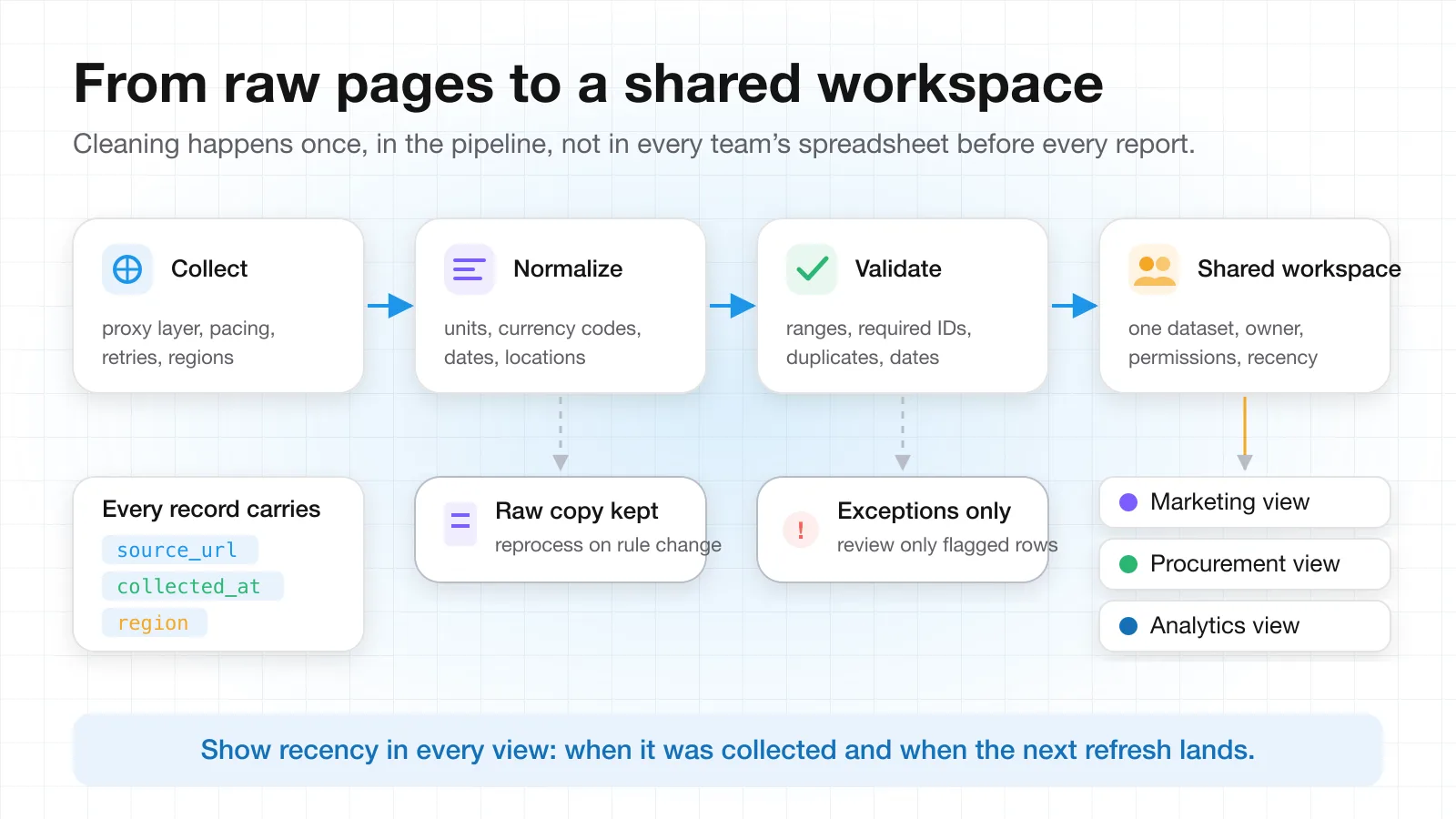
For important projects, keeping a raw copy separately from the cleaned dataset is also useful. If normalization rules change, the original material can be processed again without repeating the entire scraping job. Raw data also preserves context. A cleaned field may simply state that a product is unavailable, while the source page may distinguish between temporarily out of stock, discontinued, and unavailable in one region.
Move Structured Data Into a Shared Workspace
Cleaning the data is not the final step. The workspace still needs to present information in a way that different teams can use without creating competing copies. In practice this means treating the dataset as part of the organization's knowledge base: one maintained source with clear ownership, rather than a file that gets emailed around and edited in parallel.
Give Teams the Views They Actually Need
Marketing, procurement, and analytics may use the same underlying dataset for different purposes. Marketing may focus on competitor messaging, procurement on supplier information, while analysts track prices and changes over time. They do not need separate datasets if the workspace can provide filtered views of one maintained source.
The same principle applies to the type of content. Structured records may work best in tables or databases, while long research documents can remain intact with metadata attached. Relationships between entities can be exposed only where they help people understand the information. A shared workspace becomes more useful when it adapts the same data to different tasks instead of forcing every user into one view.
Workspaces that combine documents with database-style tables suit this pattern well. A company profile can live as a page, its scraped product records can live in a table on the same page, and each team can save the filter or sort it needs without touching the underlying rows.
Set Ownership, Permissions, and Refresh Rules
Someone needs to own the dataset. That team should know how often information is refreshed, which sources are active, and who is allowed to change field definitions. Permissions should reflect the same logic. Most users may only need to read or filter records, while a smaller group can edit values or modify the schema. Role-based access is the usual mechanism here, and the same principles that apply to securing a team knowledge base apply to a shared dataset: least privilege by default, a small group of editors, and an audit trail for schema changes.
Refresh rules are equally important. A dataset that mixes fresh prices with records collected six months ago can look complete while giving the wrong impression. Each shared view should therefore make recency clear. Users need to know when information was collected and when the next update is expected.
For organizations that cannot send scraped data to a third-party SaaS tool, a self-hosted enterprise knowledge base keeps the shared workspace inside the company's own infrastructure while still giving teams the documents, tables, and permissions described above.
Which Structuring Method Fits the Data?
The methods above solve different problems. Comparing them side by side makes the choice easier:
| Method | Best for | Main strength | Main limitation |
|---|---|---|---|
| Schema-first | prices, products, listings, recurring metrics | easy filtering and comparison | less flexible when sources change |
| Tag-based | research libraries and content collections | flexible classification | requires controlled tag vocabulary |
| Entity-relationship | company, supplier, and market research | captures connections between objects | needs more planning |
| Document + metadata | reports, reviews, and long-form research | preserves full context | harder for numerical comparison |
These approaches can also be combined. A company profile may remain a document with metadata, while its products are stored as structured records linked to the same company. The best design is usually the simplest one that answers the business question without losing information people will need later. Extra complexity makes sense only when it improves retrieval, comparison, or understanding.
Summary: From Raw Pages to Shared Knowledge
Useful enterprise data comes from a connected process. The team first defines what it needs, collects the relevant public information, maps it into a suitable model, validates important fields, and then gives users a workspace where the result can be searched and maintained.
The collection layer remains important because every later stage depends on receiving enough consistent source material. For recurring research across many pages or regions, proxy infrastructure can distribute requests, support location-specific collection, and reduce dependence on one network endpoint.
For teams building that kind of ongoing pipeline, Froxy offers web scraping proxies with rotating and sticky sessions, geographic targeting, and a large IP pool suitable for scalable collection. If multi-source or multi-region web data has become a regular input for enterprise research, it is worth considering as the proxy layer that supports collection before the information moves into processing and the shared workspace.
Frequently Asked Questions
What is the difference between structured and unstructured web data?
Structured web data follows a fixed set of fields, such as a product table with an ID, price, currency, and stock status in every row. Unstructured web data is content written for people to read, such as reviews, articles, or company descriptions, where the useful information is embedded in free text. Most scraped datasets contain both, which is why a document-plus-metadata model is often combined with a schema-first table.
Should I define the data model before or after scraping?
Before. Defining the fields, required values, provenance, and refresh frequency first keeps the scraper focused on what the business question needs and avoids collecting hundreds of fields that nobody uses. The model can still evolve, but changing it after millions of records exist is far more expensive than adjusting it during a pilot.
How do I keep scraped data from different sources comparable?
Normalize values before comparison: one currency code, one date format, one set of country and region names, and a rule that decides when two records are duplicates. Keep the source URL, collection time, and region with each record so that anyone can trace a value back to its origin, and run automated checks for out-of-range prices, missing IDs, and malformed dates.
Why keep a raw copy of scraped data if it has already been cleaned?
Because normalization rules change. If a team later decides to distinguish "temporarily out of stock" from "discontinued," the raw pages contain that nuance while the cleaned field may not. Reprocessing a raw copy is much cheaper than repeating the whole scraping job, and it preserves the context that a cleaned value can lose.
How do proxies affect the quality of scraped data?
They affect completeness and consistency rather than accuracy. If every request depends on a single IP, rate limits or regional differences can leave gaps in the dataset. Rotating and sticky proxy sessions with geographic targeting let a team define which region each market is collected from and keep the collection running on the same schedule, which is what makes recurring comparisons reliable.
Related Articles
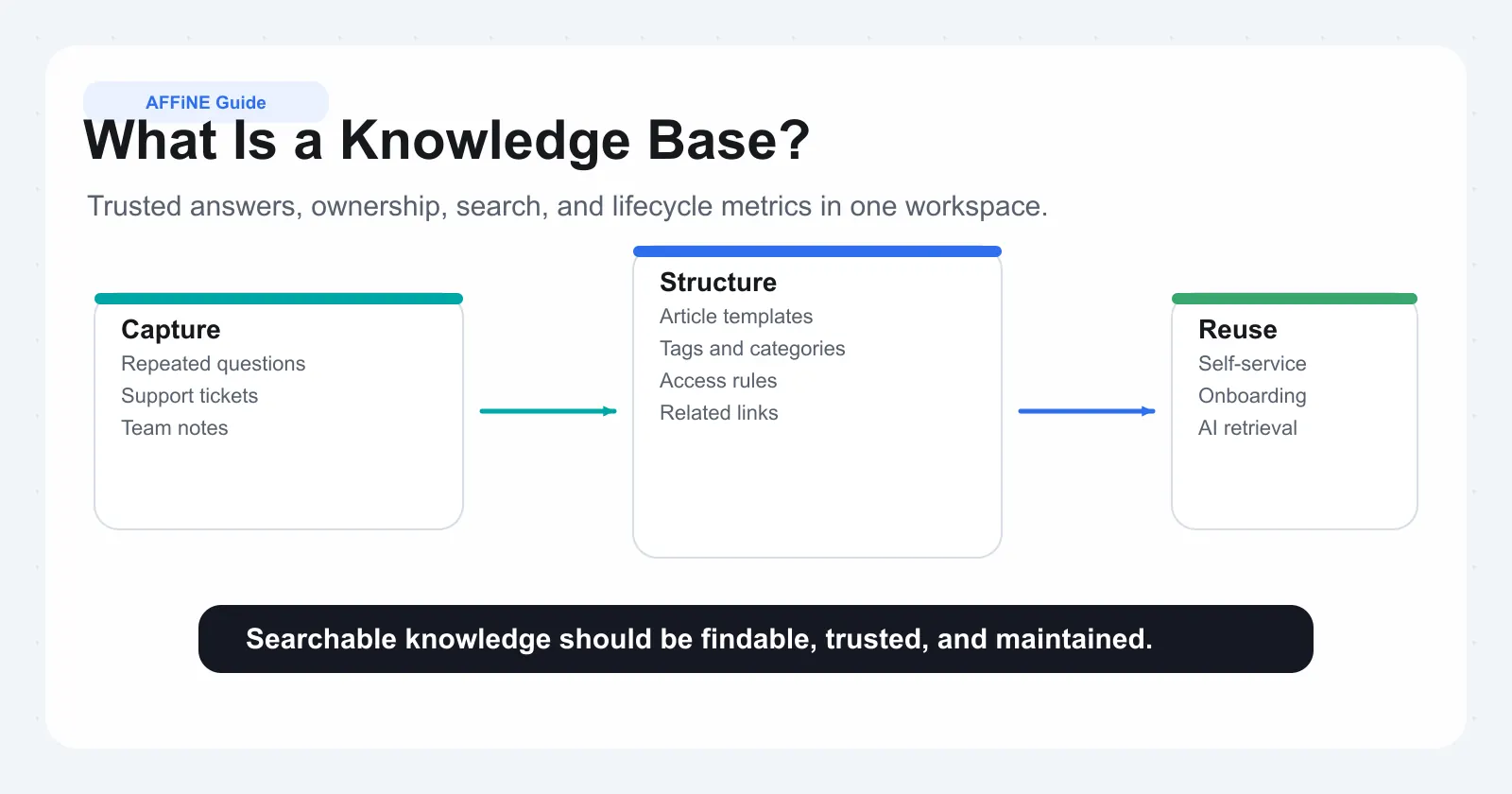
What Is a Knowledge Base? Definition & Examples
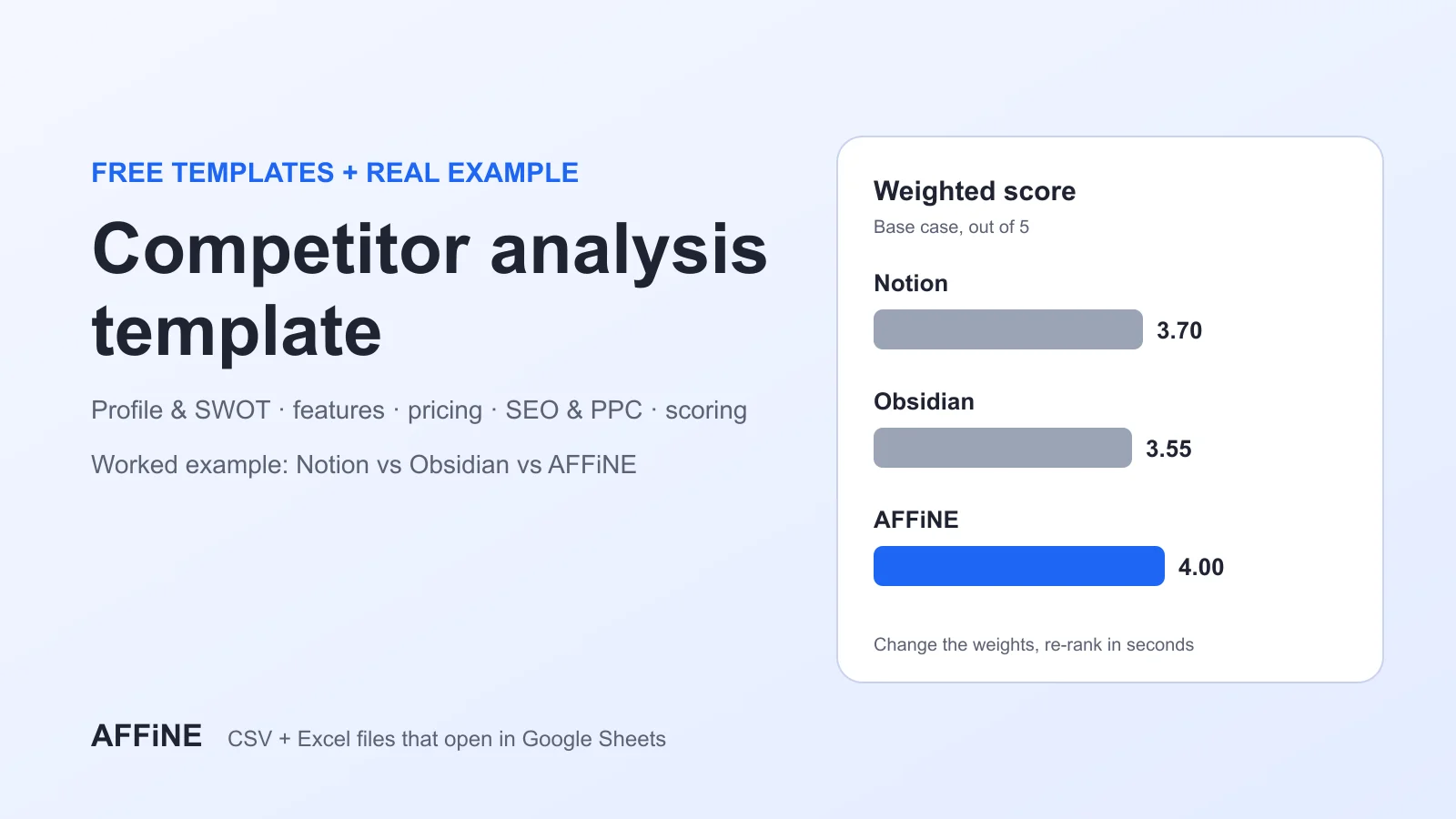
Competitor Analysis Template: 5 Free Sheets + Example
Self-Hosting Your Enterprise Knowledge Base: How Developers Can Deploy Secure SaaS Alternatives on Virtual Servers
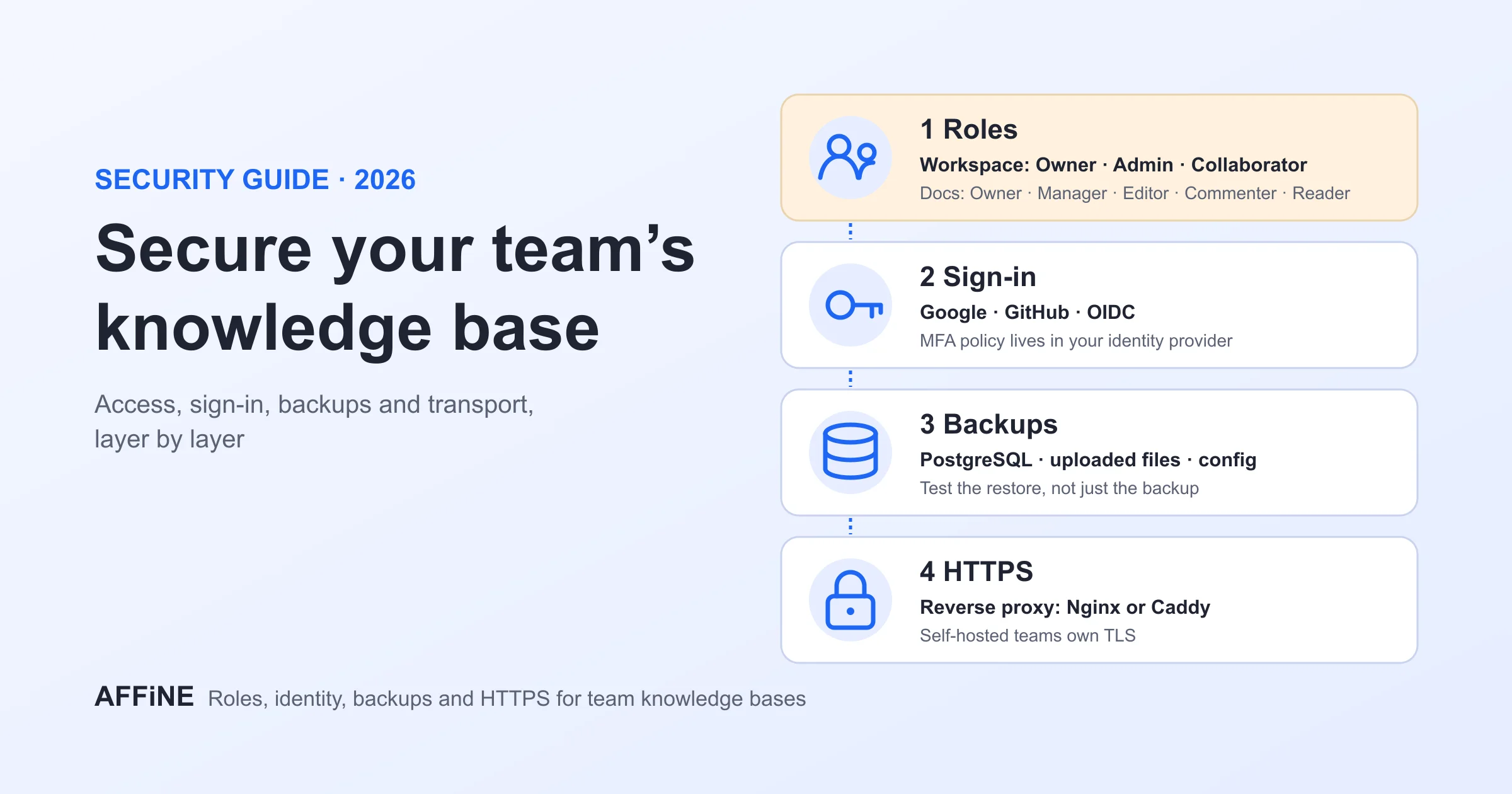
How to Secure Your Team Knowledge Base: IT Security Best Practices
