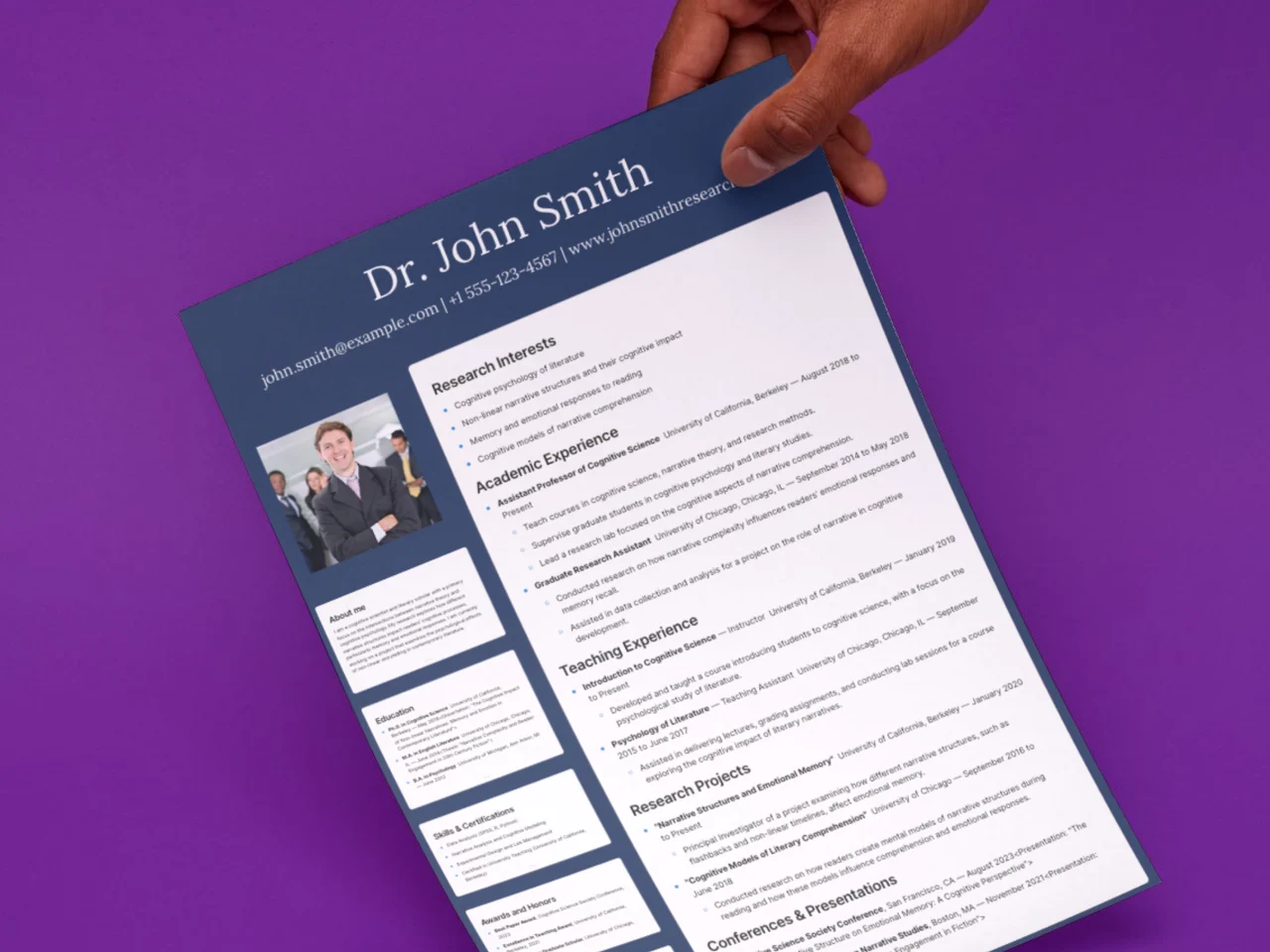
Free Academic CV Template for PhD & Research Careers
Free academic CV template covering education, publications, grants, teaching, and service. Duplicate, fill in each section, and export to PDF for applications.

Navigating the competitive academic job market requires a well-crafted curriculum vitae (CV) that showcases your achievements, expertise, and potential contributions. Our academic CV template provides a comprehensive structure to help you present your qualifications in a clear and compelling manner.
An academic CV serves as a crucial document in the pursuit of research, teaching, or administrative roles within the higher education sector. Unlike a standard résumé, an academic CV emphasizes your scholarly accomplishments, publications, and ongoing research activities, painting a detailed picture of your academic journey and potential.
Ensure your name, address, email, and other relevant contact details are prominently displayed.
List your academic degrees, institutions attended, and graduation dates in reverse chronological order.
Highlight any academic honors, awards, or distinctions you've received.
Meticulously document your research experience, including ongoing projects, publications (both peer-reviewed and non-peer-reviewed), conference presentations, and any patents or intellectual property.
Categorize your publications by type (e.g., journal articles, book chapters, conference proceedings) and provide complete bibliographic information.
Outline your teaching background, including courses taught, course development, and any teaching awards or recognition.
Describe your teaching philosophy and approach to student engagement and learning.
Detail your relevant work experience outside of academia, such as industry positions, consulting roles, or relevant internships.
Emphasize how these experiences have contributed to your academic and professional growth.
Showcase your involvement in academic or professional service, such as committee work, editorial roles, or community outreach.
Highlight any leadership positions or initiatives you've spearheaded.
List any specialized skills, software proficiencies, or certifications that are relevant to your academic and professional pursuits.
Provide the names and contact information of individuals who can speak to your qualifications and suitability for academic positions.
By following this comprehensive academic CV template, you can effectively present your academic achievements, research expertise, teaching abilities, and broader professional contributions, positioning yourself as a competitive candidate for the desired academic role.
Duplicate the template and fill in education first — degrees, institutions, and dissertation title in reverse-chronological order.
List publications in your field's citation style, grouped by type: peer-reviewed articles, chapters, conference papers.
Add grants, fellowships, and awards with amounts and dates — search committees scan for funded work.
Document teaching experience by course and role, then service: committees, reviewing, and outreach.
Export to PDF for each application, trimming sections to match what the position values.
A resume compresses your career to one or two pages; an academic CV expands it. It has no length limit and is organized around scholarly output — publications, grants, teaching, and service — because search committees evaluate the full record, not a summary.
Education, appointments, publications, grants and awards, teaching, service, and references are the core. Field conventions differ — humanities CVs often lead with teaching, lab sciences with publications and funding — so reorder sections to match your discipline.
As long as your record requires — early-career CVs often run two to four pages, senior ones far longer. What matters is that every line earns its place; committees notice padding faster than brevity.