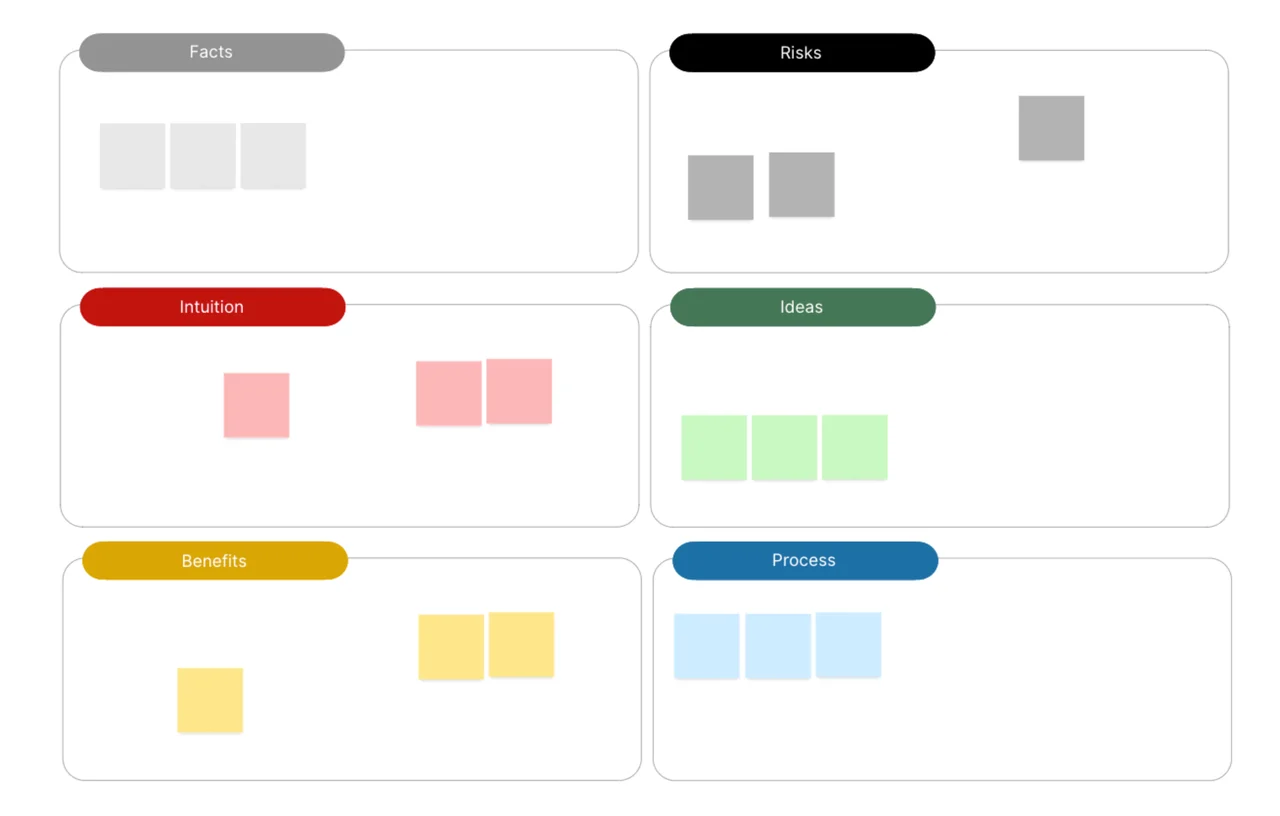
A six thinking hats template is a worksheet or board for running Edward de Bono's Six Thinking Hats method, where a group looks at one topic from six defined perspectives, one at a time. This AFFiNE template is an edgeless whiteboard with a space for each hat, so a facilitator can move the whole group through facts, feelings, risks, benefits, ideas, and process in order.
What's included in this template
- A space for the White Hat: facts, data, and information gaps.
- A space for the Red Hat: feelings, gut reactions, and intuition, with no need to justify them.
- A space for the Black Hat: risks, weaknesses, and reasons for caution.
- A space for the Yellow Hat: benefits, value, and best-case outcomes.
- A space for the Green Hat: new ideas, alternatives, and creative options.
- A space for the Blue Hat: the agenda, the order of hats, and the final summary and next steps.
The method comes from Edward de Bono's 1985 book Six Thinking Hats. See the Mindtools overview or the Wikipedia entry, which also notes that research evidence on its effectiveness is limited.
When to use a six thinking hats template
- Team decisions: choosing between options when discussions keep turning into arguments.
- Project reviews: checking a plan for risks and benefits before you commit to it.
- Workshops and classrooms: teaching structured, parallel thinking to students or new teams.
- Solo thinking: testing your own idea from angles you would usually skip.
How to use this six thinking hats template in AFFiNE
- Duplicate the template. Click "Use this template" to add the board to your AFFiNE workspace.
- Set the question under the Blue Hat. Write one clear decision or problem and the order you will use the hats in.
- Work through one hat at a time. Have everyone add sticky notes only to the current hat's space, with a short time limit.
- Keep comments in the right hat. Move notes that belong to another perspective instead of debating them.
- Summarize with the Blue Hat. Group the strongest points and write the decision and next steps.
Tips for running a Six Thinking Hats session
- Start with Blue, then White, so the group agrees on the question and the facts first.
- Keep the Red Hat short, about a minute, so people state feelings without long explanations.
- Use the Black Hat after the Yellow Hat when a team tends to shut ideas down early.
- Follow up with the design thinking template when the decision needs prototyping.
Frequently asked questions
What are the six thinking hats?
White for facts, Red for feelings, Black for caution, Yellow for benefits, Green for creativity, and Blue for managing the process.
Who created the Six Thinking Hats method?
Edward de Bono, a Maltese physician and writer on creative thinking, introduced it in his 1985 book Six Thinking Hats.
Which hat should you start with?
Most sessions start with the Blue Hat to set the goal and order, then the White Hat to establish the facts. There is no single required sequence.
Can you use six thinking hats alone?
Yes. Work through each hat yourself and write notes in each space. It is a quick way to check a personal decision for blind spots.
Find more creative thinking templates, try the SCAMPER technique template, or read critical thinking exercises for teams and students.