Business Case Template: How to Write One (With Example)
Free business case template with every section approvers expect, a worked example with NPV and payback, a step-by-step guide to writing one, and a checklist.

A business case is a short decision document that asks someone with budget authority to approve a change, and shows why that change is worth its cost compared with the realistic alternatives, including doing nothing. The template below gives you every section in the order approvers read it, a filled-in example with real arithmetic, and a checklist to run before you submit.
Short version
- Lead with the decision. The first screen should say what you want approved, how much it costs, and what it returns.
- Compare options, not just one idea. Include "do nothing" and at least one cheaper alternative, each with costs and benefits.
- Separate cash from capacity. Hours saved are not money saved unless they remove a cost or a planned hire.
- Name the assumption that could flip the answer, and show the value at which it does.
Published by AFFiNE, which makes a workspace for docs, whiteboards, and databases. Public-sector guidance cited here was checked on GOV.UK on October 28, 2026. The worked example is illustrative, not a customer case. Sources are listed at the end.
What is a business case?
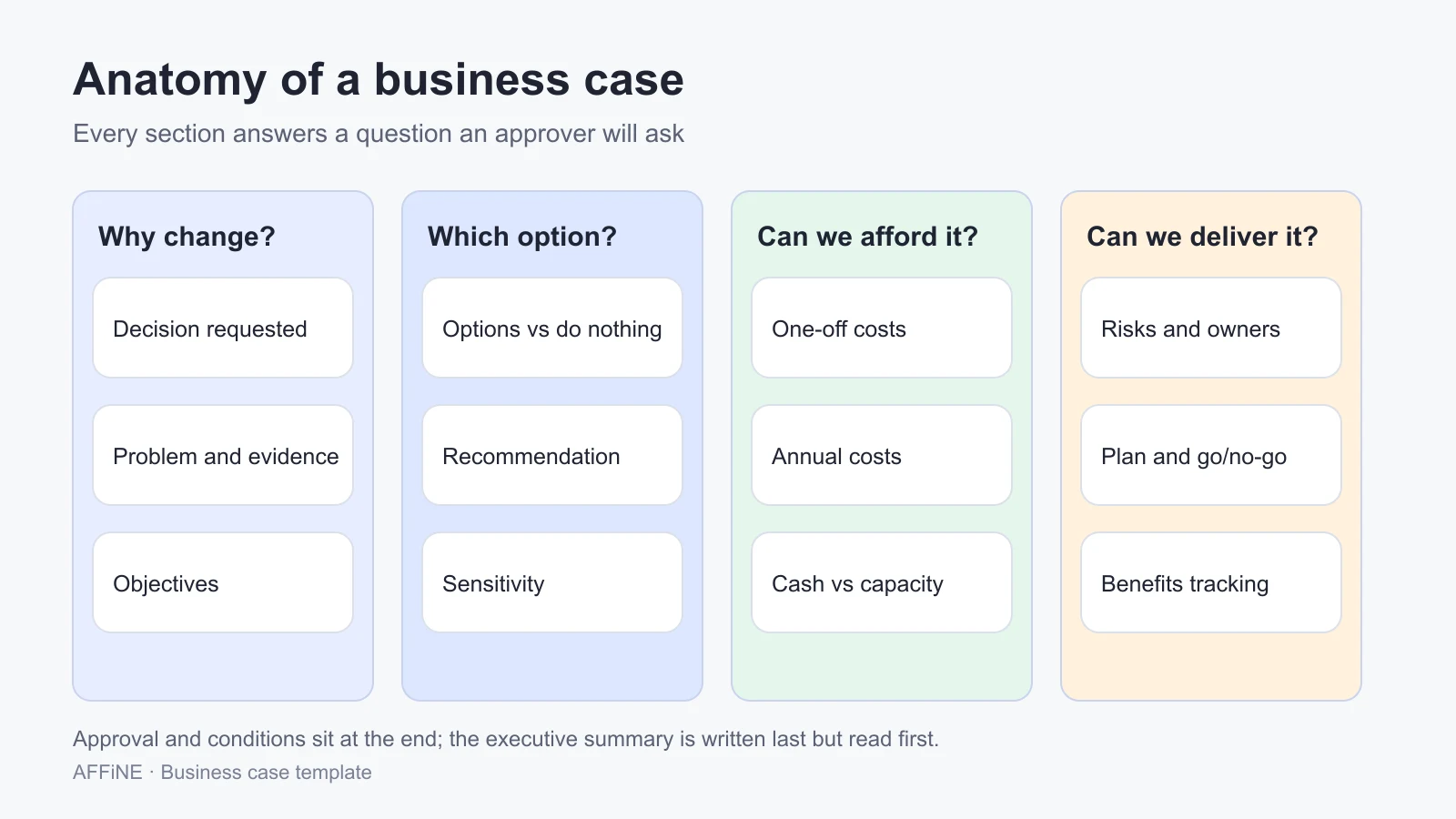
A business case is the document an organization uses to decide whether to fund a project, a purchase, or a change in how work is done. It is written before the money is committed, and it answers four questions in plain numbers:
- Why change? What problem or opportunity exists, and what it costs today.
- Which option? What the realistic alternatives are, and why one is better value than the others.
- Can we afford it? What it costs up front and every year, and where the money comes from.
- Can we deliver it? Who owns it, when it lands, what could go wrong, and how benefits will be checked.
The most detailed public standard is HM Treasury's Five Case Model, which UK government bodies use for spending proposals. Its 2026 guidance describes five "closely linked perspectives on the same proposal": the strategic case (why it is needed), the economic case (which option gives the best value), the commercial case (how suppliers are engaged), the financial case (whether it is affordable), and the management case (whether it is set up for successful delivery). You do not need to work in government to borrow that structure. The template in this guide uses the same logic in a shorter form for company projects.
Business case vs business plan vs project charter
These three documents are often confused, and approvers notice when one is dressed up as another.
| Business case | Business plan | Project charter | |
|---|---|---|---|
| Main question | Is this change worth funding? | How will the whole business make money? | Is this project authorized, and within what limits? |
| Scope | One project, purchase, or change | The whole company or a new venture | One approved project |
| Audience | Budget owner, sponsor, steering group | Investors, lenders, founders | Sponsor, project team, stakeholders |
| When written | Before funding is committed | At founding or when raising money | After the funding decision, before kickoff |
| Typical length | 1 to 10 pages | 15 to 40 pages | 1 to 2 pages |
The business case comes first. Once it is approved, the project charter records the authorized goal, scope, and budget, and links back to the case rather than copying it.
What to include in a business case template
Every section in the template below exists because an approver will ask the question it answers. If a section does not apply, say so in one line rather than deleting it, so readers know you considered it.
| Section | Question it answers | Common mistake |
|---|---|---|
| Decision requested | What exactly are you asking for? | Burying the ask on page four |
| Executive summary | Can I decide from one screen? | Background instead of the recommendation |
| Problem and case for change | Why act now? | Adjectives ("inefficient") instead of numbers |
| Objectives | How will we know it worked? | Goals with no baseline or date |
| Options considered | What else could we do? | Only one option, or a straw-man alternative |
| Recommended option | Why this one? | No conditions under which you would change your mind |
| Costs and benefits | What does it cost and return each year? | Counting freed hours as cash |
| Assumptions and sensitivity | What if the numbers are wrong? | Single-point estimates with no range |
| Risks | What could stop delivery or benefits? | Risks with no owner |
| Implementation plan | When, and who? | No go or no-go checkpoint |
| Benefits tracking | Who checks the result later? | No review date after go-live |
| Approval | Who decided, and on what conditions? | Approval by email that nobody can find |
HM Treasury's guidance also asks for an explicit adjustment for optimism bias, the tendency of project teams to underestimate costs and overestimate benefits. In a company business case, the practical version is the sensitivity section: show what happens if your riskiest assumption is only half right.
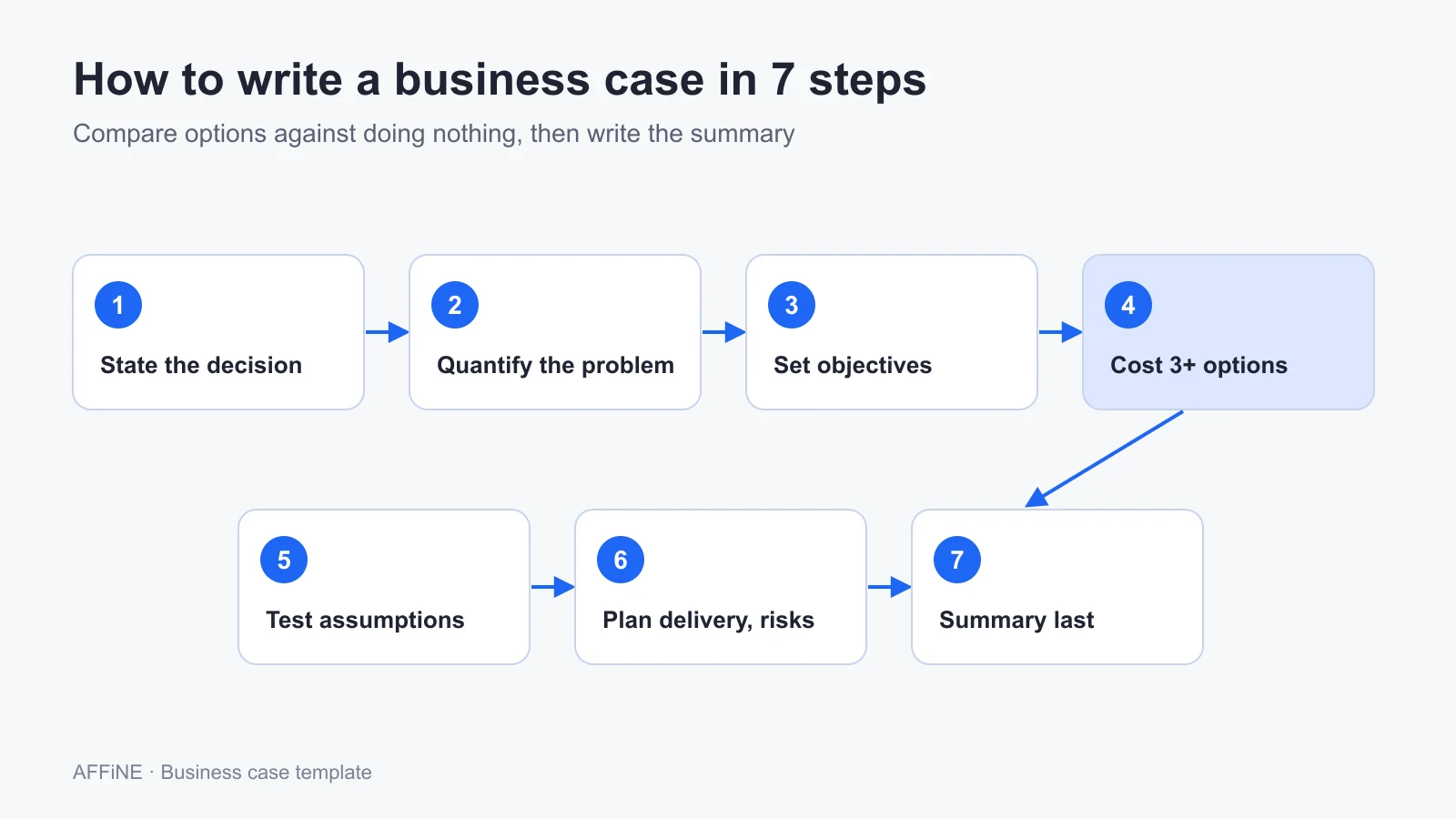
How to write a business case
1. State the decision you need
Write one sentence naming the option, the amount, and the date you need a decision. Find out who can actually approve that amount and what format they expect before you write anything else.
2. Quantify the problem with evidence
Measure the current situation in numbers someone else can check, such as hours, error rates, fees, or lost revenue, and note the source and date of each number. Cost what happens if nothing changes.
3. Set measurable objectives
Turn the problem into two to four objectives, each with a measure, a baseline, a target, and a date. Write down what is out of scope so the case cannot grow during review.
4. List and cost at least three options
Always include doing nothing, a low-cost minimum option, and your preferred option. For each, estimate one-off costs, annual costs, and annual benefits, and calculate a payback period and a net present value over the same time period.
5. Test the assumptions that could change the answer
Find the assumption the result depends on most, such as adoption rate or time saved, and recalculate with a pessimistic value. Report the break-even value at which your recommendation stops being the best option.
6. Plan delivery, risks, and benefits tracking
Add milestones with owners and a go or no-go checkpoint, a risk table with likelihood, impact, mitigation, and owner, and a date when someone will check whether the benefits arrived.
7. Write the executive summary last and get early review
Summarize the problem, recommendation, cost, benefit, biggest risk, and decision requested on one screen. Ask finance to check the numbers and the sponsor to read the draft before it goes to the approvers.
Business case example: automating invoice processing
This filled-in example shows how the sections fit together. It is an illustrative scenario with round numbers, not a customer case, and the costs are not quotes from any vendor.
Decision requested: Approve Option C, an accounts payable (AP) automation tool, for a $40,000 one-off implementation and $36,000 a year, subject to a 60-day pilot gate. Decision needed by the end of the quarter.
Problem. A four-person AP team processes 2,400 supplier invoices a month by hand. A two-week time sample found 12 minutes of handling per invoice, which is 5,760 hours a year. At a loaded cost of $45 an hour, that is $259,200 a year. Late payments cost a further $18,000 a year in fees, so doing nothing costs $277,200 a year.
Objectives.
| Objective | Measure | Baseline | Target | By when |
|---|---|---|---|---|
| Cut handling time | Minutes per invoice (monthly sample) | 12 | 4 | 6 months after go-live |
| Pay on time | Late payment fees per year | $18,000 | Under $5,000 | 12 months after go-live |
| Absorb growth without hiring | AP headcount at 3,000 invoices a month | 5 planned | 4 | 12 months after go-live |
Options. All figures use a 3-year period and an 8% discount rate, the illustrative company's hurdle rate.
| Option | One-off cost | Annual running cost | Annual saving vs do nothing | Payback | 3-year NPV |
|---|---|---|---|---|---|
| A. Do nothing | $0 | $277,200 | $0 | n/a | $0 |
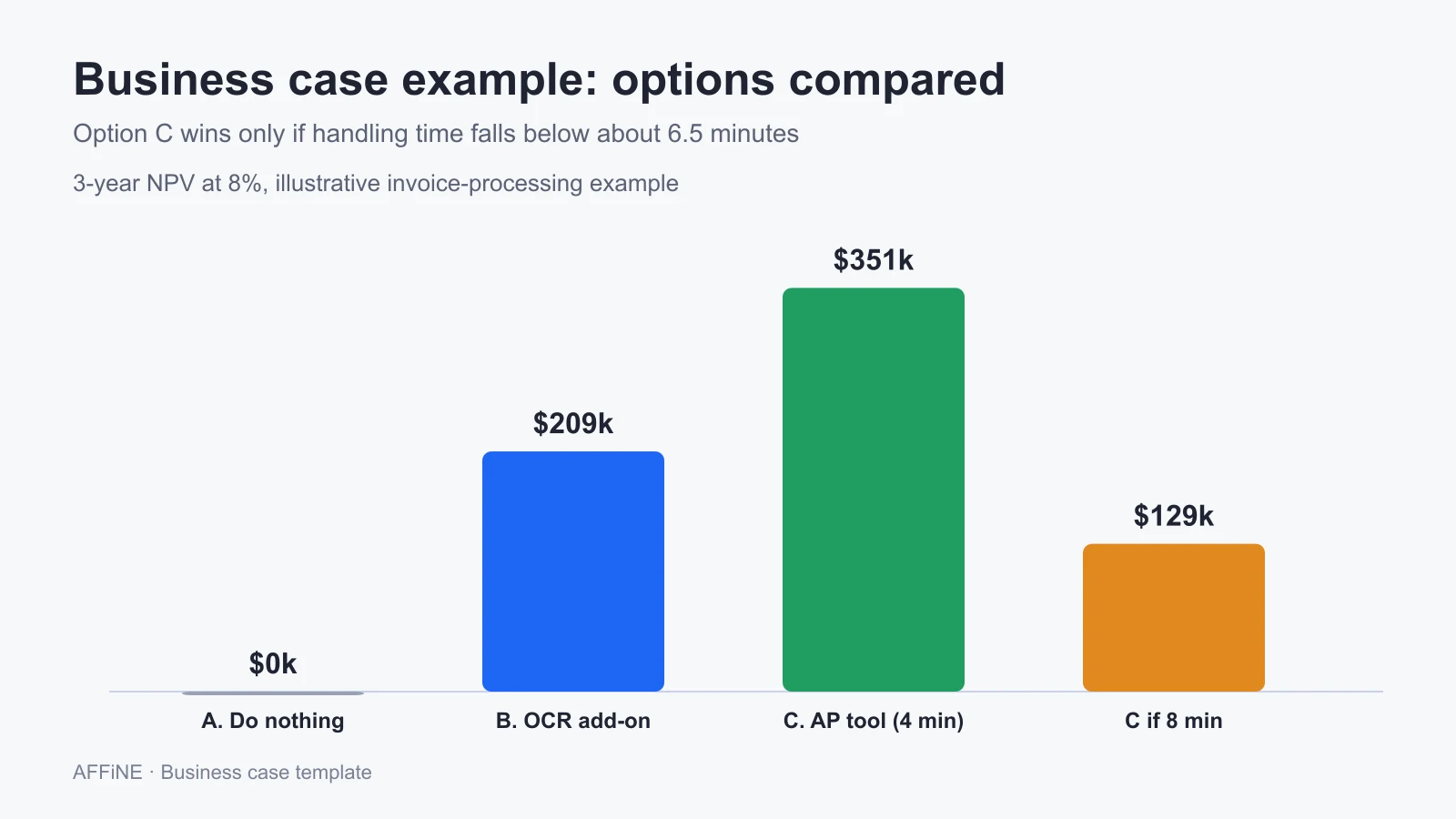
| B. OCR add-on to current accounting software (8 min per invoice) | $6,000 | $193,800 | $83,400 | 0.9 months | $208,930 |
| C. AP automation tool (4 min per invoice) | $40,000 | $125,400 | $151,800 | 3.2 months | $351,203 |
Annual running cost is staff time plus late fees plus the subscription. For Option C: 1,920 hours at $45 ($86,400), plus $3,000 in fees, plus a $36,000 subscription, which equals $125,400. Net present value is the annual saving multiplied by 2.577 (the sum of the 8% discount factors for years 1 to 3), minus the one-off cost.
If you need the cost side in more depth, with discount factors, a benefit-cost ratio, and a sensitivity table, our cost-benefit analysis template walks through one full example.
Sensitivity. Option C wins only if people actually use it. If handling time falls to 6 minutes instead of 4, the NPV drops to $239,873, still ahead of Option B. If it falls only to 8 minutes, the NPV is $128,542, and Option B becomes the better choice. The break-even point is about 6.5 minutes per invoice.
Cash vs capacity. Most of the saving is staff time. It only becomes cash if the team stops paying overtime or does not make the fifth hire it planned for next year. The example therefore ties the third objective to that hire, and the pilot gate checks it.
Recommendation. Approve Option C with a 60-day pilot on one supplier group. Continue only if the pilot shows 6 minutes per invoice or less. If it does not, fall back to Option B, which costs little and still pays back in under a month.
Top risks.
| Risk | Likelihood | Impact | Mitigation | Owner |
|---|---|---|---|---|
| Suppliers keep sending paper or unusual formats | Medium | High | Start the pilot with the 20 largest suppliers, who send 60% of invoices | AP lead |
| Integration with the accounting system takes longer than planned | Medium | Medium | Fixed-price implementation and a go-live checkpoint | IT manager |
| Team reverts to manual handling | Low | High | Weekly time sample for the first 8 weeks | Finance director |
Notice what made this case honest: the "do nothing" cost is calculated, the cheaper option is real, and the recommendation states exactly when it should be reversed.
Use the template
Prefer a ready-made doc? Open the business case template in AFFiNE and duplicate it into your workspace, or copy the block below into any editor.
Copy the block below into a doc, then replace each bracketed placeholder. Keep the section order: approvers read top to bottom and often stop after the executive summary.
# Business Case: [Project name]

| Field | Value |
| --- | --- |
| Sponsor | [Name, role, budget authority] |
| Author | [Name, team] |
| Decision needed by | [Date] |
| Decision requested | [Approve option X for $Y and Z months] |
| Version and status | [v0.1 draft / in review / approved / rejected] |

## 1. Executive summary

- **Problem:** [One sentence, with one number.]
- **Recommendation:** [The option you want approved.]
- **Cost:** [One-off cost and annual cost.]
- **Benefit:** [Annual benefit and 3-year net present value.]
- **Biggest risk:** [The one thing most likely to make this fail.]
- **Decision requested:** [What, from whom, by when.]

## 2. Problem and case for change

[Describe the current situation, who it affects, and what happens if nothing changes. Use evidence, not adjectives.]

| Metric | Today | Source | Date measured |
| --- | --- | --- | --- |
| [Metric] | [Value] | [System, report, or sample] | [Date] |
| [Metric] | [Value] | [Source] | [Date] |

## 3. Objectives

| Objective | Measure | Baseline | Target | By when |
| --- | --- | --- | --- | --- |
| [What should change] | [How you will measure it] | [Today] | [Goal] | [Date] |
| [Objective] | [Measure] | [Baseline] | [Target] | [Date] |

**Out of scope:** [What this case does not cover.]

## 4. Options considered

Always include "do nothing" as Option A so every other option is compared against it.

| Option | Description | One-off cost | Annual cost | Annual benefit vs do nothing | 3-year NPV | Main risk |
| --- | --- | --- | --- | --- | --- | --- |
| A. Do nothing | [Current process continues] | $0 | [Cost] | $0 | $0 | [Risk of staying put] |
| B. [Do minimum] | [Description] | [Cost] | [Cost] | [Benefit] | [NPV] | [Risk] |
| C. [Preferred] | [Description] | [Cost] | [Cost] | [Benefit] | [NPV] | [Risk] |

**Discount rate and period:** [For example, 8% over 3 years. Ask finance for the rate your organization uses.]

## 5. Recommended option

[Which option, why it beats the others, and the conditions under which you would change your recommendation.]

## 6. Costs and benefits

| Item | Type | Year 0 | Year 1 | Year 2 | Year 3 |
| --- | --- | --- | --- | --- | --- |
| [Implementation] | One-off cost | [Amount] | | | |
| [Subscription or staff] | Recurring cost | | [Amount] | [Amount] | [Amount] |
| [Benefit] | Cash benefit | | [Amount] | [Amount] | [Amount] |
| [Benefit] | Capacity benefit (hours, not cash) | | [Amount] | [Amount] | [Amount] |

## 7. Assumptions and sensitivity

| Assumption | Value used | Source | If it is wrong |
| --- | --- | --- | --- |
| [Assumption] | [Value] | [Source] | [What happens to NPV] |
| [Assumption] | [Value] | [Source] | [Effect] |

**Break-even point:** [The value of the riskiest assumption at which the recommendation stops being the best option.]

## 8. Risks

| Risk | Likelihood | Impact | Mitigation | Owner |
| --- | --- | --- | --- | --- |
| [Risk] | [Low / Medium / High] | [Low / Medium / High] | [Action] | [Name] |
| [Risk] | [Likelihood] | [Impact] | [Action] | [Name] |

## 9. Implementation plan

| Milestone | Date | Owner | Go or no-go check |
| --- | --- | --- | --- |
| [Milestone] | [Date] | [Name] | [What must be true to continue] |
| [Milestone] | [Date] | [Name] | [Check] |

## 10. Benefits tracking

| Benefit | Measure | Baseline | Target | Review date | Owner |
| --- | --- | --- | --- | --- | --- |
| [Benefit] | [Measure] | [Baseline] | [Target] | [Date] | [Name] |

## 11. Approval

| Approver | Role | Decision | Date | Conditions |
| --- | --- | --- | --- | --- |
| [Name] | [Role] | [Approved / Rejected / Deferred] | [Date] | [Any conditions] |

## Before you submit

- [ ] The executive summary fits on one screen and states the decision requested.
- [ ] "Do nothing" is costed, not just listed.
- [ ] Every number has a source and a date.
- [ ] Cash benefits and capacity benefits are shown separately.
- [ ] The riskiest assumption has a break-even value.
- [ ] Finance has checked the discount rate and cost figures.
- [ ] The sponsor has read the draft before it goes to the approvers.
Tips approvers will notice
- Match the case to the size of the decision. A $5,000 tool needs one page. HM Treasury's guidance applies the same idea, which it calls proportionality: effort should match the cost and risk of the proposal.
- Show your sources. "A two-week time sample found 12 minutes per invoice" is more convincing than "processing is slow."
- Use the organization's own numbers. Ask finance for the discount rate and the loaded hourly cost rather than inventing them.
- Pre-wire the decision. Walk the sponsor and finance through the draft before the formal meeting. Surprises in an approval meeting usually end in "come back next month."
- Keep one live version. Write the case in a shared doc with version and status at the top, so approvers comment on the same copy instead of three email attachments.
Writing a business case in AFFiNE
AFFiNE works well for drafting and reviewing a business case as a team. A page holds the narrative and tables, and every page also has an Edgeless whiteboard mode for sketching the options or the current process before you write it up. Database blocks with table and Kanban views can hold the risk register or the benefits tracker, and doc properties can record the status, owner, and decision date. You can link the approved case from the project charter and the project plan so there is one source.
AFFiNE is not a financial modeling tool. For a case with complex cash flows, build the model in a spreadsheet, have finance check it, and paste the summary table into the doc. AFFiNE runs as a cloud service or self-hosted; see pricing for current plans.
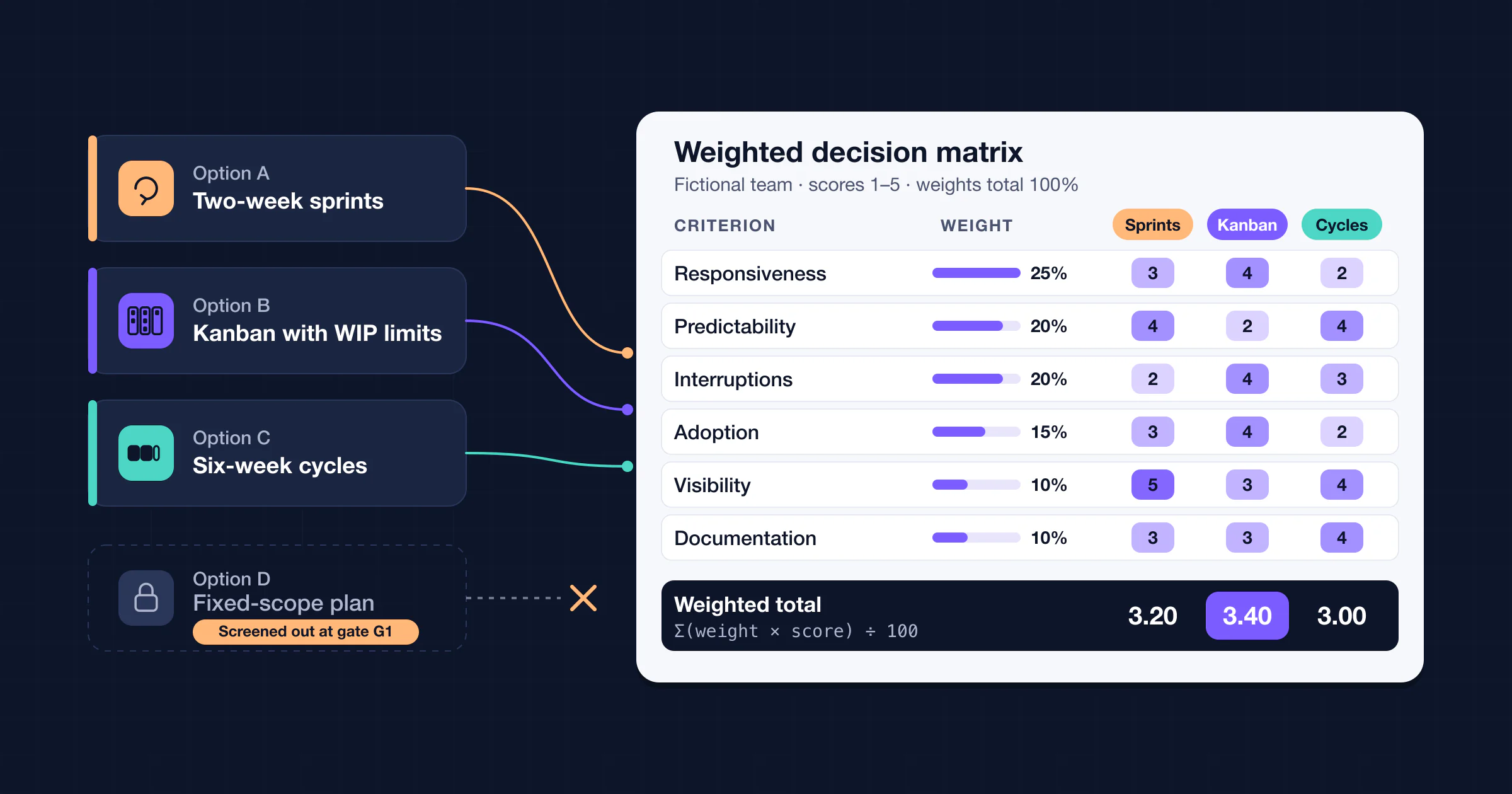
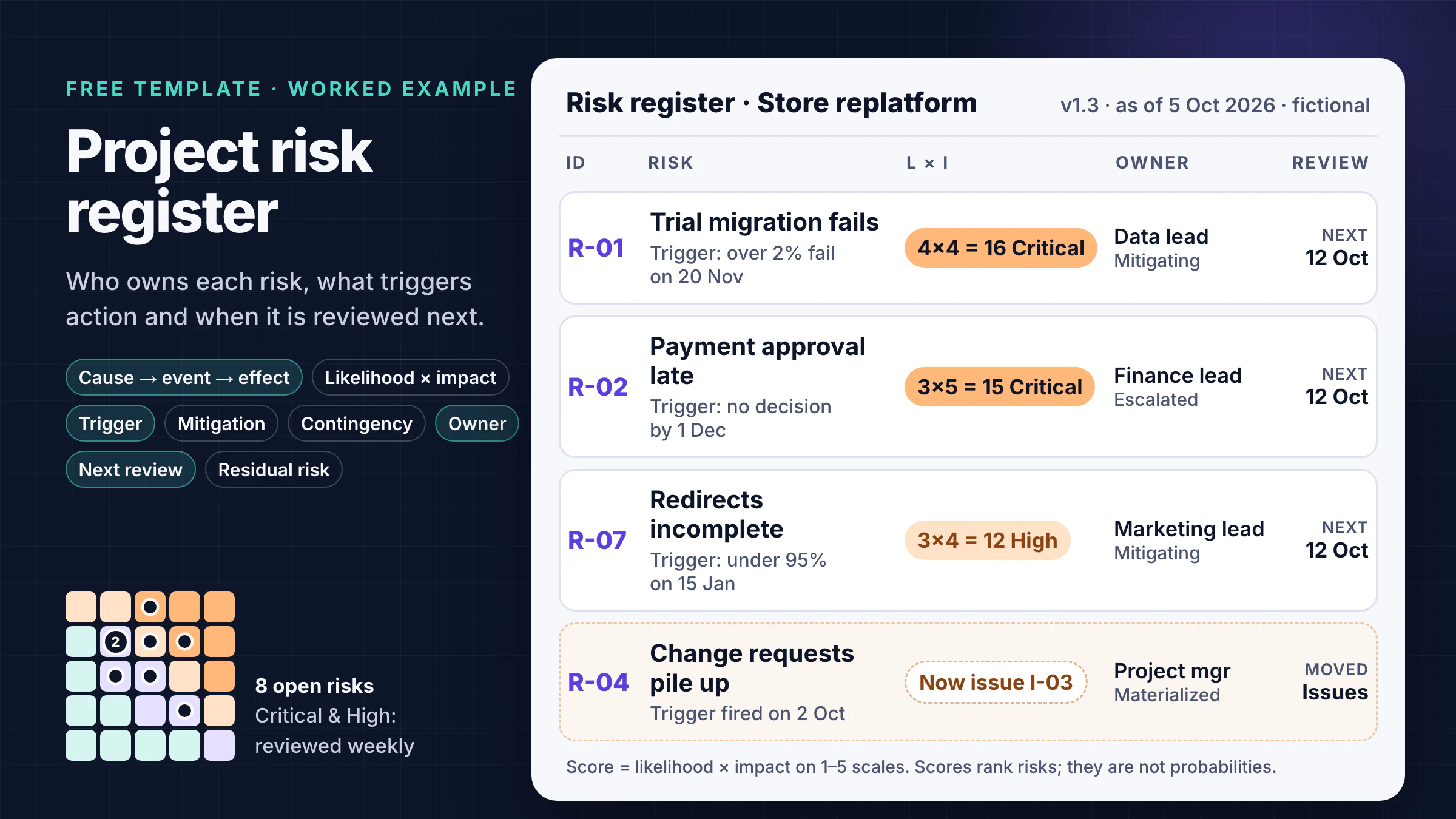
For related decisions, a decision matrix helps compare options on criteria other than money, a risk register expands the risk table, and a SWOT analysis can feed the strategic section.
FAQ
What is a business case?
A business case is a decision document that asks someone with budget authority to approve a project or purchase. It explains the problem, compares realistic options including doing nothing, shows costs, benefits, and risks for each, and recommends one option with a plan for delivering it.
What is the difference between a business case and a business plan?
A business case justifies one project, purchase, or change inside an existing organization. A business plan describes how a whole company or new venture will make money, and is usually written for investors or lenders.
How long should a business case be?
Long enough to support the decision and no longer. A small purchase can be justified on one page, while a large investment may need ten or more pages with appendices. The executive summary should always fit on one screen.
Who writes and approves a business case?
The person who wants the change usually writes it, often a project manager, team lead, or analyst, with input from finance. A sponsor champions it, and the budget owner or a steering group approves it.
What are the five cases in a business case?
In HM Treasury's Five Case Model, they are the strategic case, the economic case, the commercial case, the financial case, and the management case. Together they show that a proposal is needed, offers the best value, can be bought sensibly, is affordable, and can be delivered.
Should a business case include a do-nothing option?
Yes. Doing nothing is the baseline every other option is measured against, and it is rarely free. Costing it shows approvers what the current situation already costs and makes the savings of every other option credible.
Sources and editorial notes
- HM Treasury, Guidance on developing business cases for projects and programmes (2026), Chapter 2 (The Five Case Model) and Chapter 8 (longlist, shortlist, and optimism bias). Accessed October 28, 2026.
- HM Treasury, The Green Book (2026), the UK government's guidance on appraising costs, benefits, and risks of options. Accessed October 28, 2026.
- SERP review of the top results for "business case template," "how to write a business case," and "business case example" (Atlassian, Notion, Asana, Smartsheet, HubSpot, Salesforce, and others) on October 28, 2026, used to identify gaps rather than as factual sources.
How this guide was prepared: AFFiNE wrote this article in October 2026. The section list follows the structure of HM Treasury's Five Case Model, shortened for company use. The invoice processing example is an illustrative scenario with round numbers that we built to show the arithmetic; it is not a customer case or a vendor quote, and the 8% discount rate is an assumption. AFFiNE makes a workspace product, so we have an interest in where you write your business case; the template works in any editor. AI tools assisted with research and drafting, and the AFFiNE team reviewed and edited the content.