Lean Canvas: Free Template, Example, and How It Differs From the Business Model Canvas
What a lean canvas is, the standard 9-box layout, a fully filled example, how it differs from the Business Model Canvas, and a free copyable template.

A lean canvas is a one-page business model for a new product or startup. It splits an idea into nine boxes (problem, customer segments, unique value proposition, solution, channels, revenue streams, cost structure, key metrics, and unfair advantage) so you can see which assumptions are riskiest and test those first. Ash Maurya created it in 2010 by adapting Alexander Osterwalder's Business Model Canvas, and he recommends sketching the first version in about 20 minutes.
This guide shows the standard layout, what goes in each box, a fully filled lean canvas example, how it differs from the Business Model Canvas, and a copyable lean canvas template you can paste into any doc or whiteboard.
Short version
- Use a lean canvas when the idea is new and the biggest risk is building something nobody wants. It starts from the customer's problem.
- Use a Business Model Canvas when the business already exists or depends on partners, resources, and operations you need to map.
- Fill it fast, then test it. A lean canvas is a list of guesses. The value comes from ranking the riskiest box and running an experiment against it.
Published by AFFiNE, which makes a docs and whiteboard workspace where you can build a lean canvas. The origin, box names, and layout in this guide were checked against Ash Maurya's own articles and Strategyzer's Business Model Canvas page on October 28, 2026. Sources are listed at the end.
What is a lean canvas?
The lean canvas is a one-page alternative to a business plan, built for situations where most of what you know is still a guess. Maurya describes it as a tool that "helps you deconstruct an idea into key assumptions." Instead of a 30-page document with five-year forecasts, you write a few words in each of nine boxes and treat every entry as a hypothesis.
Three things make it useful in practice:
- It starts with the problem. The Business Model Canvas has no Problem box. The lean canvas puts the customer's top one to three problems next to the customers who have them.
- It forces brevity. Maurya's guidance is that a one-page canvas is "not about using smaller fonts but fewer words." If you cannot say it in a box, you do not understand it yet.
- It is meant to change. Date each version. When an interview or experiment disproves a box, you redraw the canvas rather than defend it.
Where the lean canvas came from
Maurya first read Osterwalder's Business Model Generation in May 2010. In August 2010 he published his adaptation in a blog post titled "How I Document My Business Model Hypotheses," and the canvas later became a core part of his book Running Lean. In his own words, the lean canvas "is an adaptation of Alexander Osterwalder's Business Model Canvas - optimized for the Lean Startup methodology." He kept the original layout on purpose so the work would still be attributed to Osterwalder's canvas.
The Lean Canvas PDF distributed by LEANSTACK carries a Creative Commons Attribution-Share Alike 3.0 Unported license notice, which is why you see it reproduced on so many tool sites. If you publish your own version, credit Ash Maurya and LEANSTACK, and check the license notice on the current LEANSTACK download before you rely on it.
The lean canvas layout
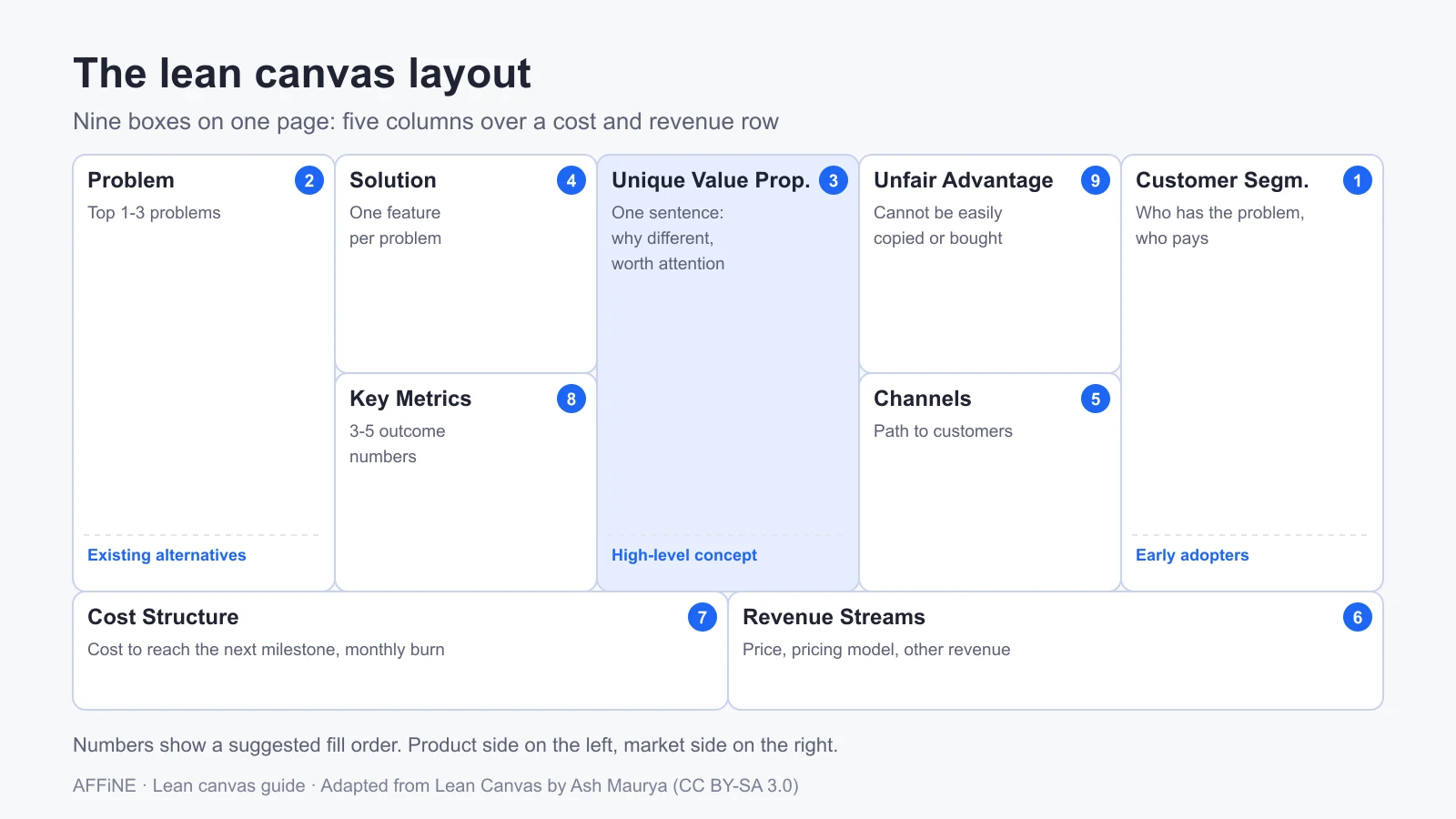
The standard lean canvas is a grid of five columns over a wide bottom row. The three tall columns (Problem, Unique Value Proposition, Customer Segments) span the full height of the top section. The two columns between them are split into a top and a bottom box. Cost Structure and Revenue Streams share the bottom row.
| Column | Top box | Bottom box |
|---|---|---|
| 1 (tall) | Problem, with Existing Alternatives at the foot | |
| 2 | Solution | Key Metrics |
| 3 (tall, center) | Unique Value Proposition, with High-Level Concept at the foot | |
| 4 | Unfair Advantage | Channels |
| 5 (tall) | Customer Segments, with Early Adopters at the foot | |
| Bottom row | Cost Structure (left half) | Revenue Streams (right half) |
The left side of the top section describes the product (problem, solution, metrics). The right side describes the market (advantage, channels, customers). The value proposition sits in the middle because it connects the two. The bottom row shows whether the model can make money.
Newer versions of the canvas from LEANSTACK also show Existing Alternatives, Early Adopters, and High-Level Concept as named sub-sections, which is why some sites now describe 12 blocks. The nine-box grid is the same.
What goes in each box
There is no single correct order. Maurya compares filling a canvas to a jigsaw puzzle and says to start with the box you understand best. If you are unsure, start with customers and problems, and leave Unfair Advantage for last. The numbers below follow that suggested order.
1. Customer Segments
Who has the problem, and who pays? Separate customers (people who pay) from users (people who use it but do not pay). Then name your early adopters: the specific subset who feel the problem most and will try an unfinished product. "Small businesses" is a segment. "Owners of independent restaurants with 10 to 40 hourly staff who build schedules in spreadsheets" is an early adopter.
2. Problem
List the top one to three problems those customers have. Underneath, write the existing alternatives: how they solve the problem today. The alternative is often not a direct competitor. It is a spreadsheet, a group chat, a part-time assistant, or doing nothing.
3. Unique Value Proposition
One clear sentence that says why your product is different and worth attention, tied to the number-one problem. Maurya suggests writing it so it could be the headline of your landing page, focusing on the outcome rather than the feature. Add a high-level concept if it helps, an "X for Y" analogy such as "Airbnb for parking spaces."
4. Solution
The smallest set of features that address each problem, usually one per problem. Maurya made this box deliberately small because founders tend to fall in love with their first solution. Treat it as a placeholder until the problems are confirmed.
5. Channels
Your path to customers. Early on, any channel that puts you in front of potential customers counts, including direct outreach and interviews. Later you need channels that can scale, such as content, partners, paid search, or sales.
6. Revenue Streams
How you make money and what you charge. Write a real price, even if you are not sure. Maurya argues that price is part of the product and that deferring the pricing question is a mistake.
7. Cost Structure
What it costs to reach your next milestone, not a five-year forecast. Include the cost to build and launch the minimum viable product, customer acquisition costs, and the monthly burn: salaries, hosting, and tools.
8. Key Metrics
The three to five numbers that tell you whether the model works. Prefer outcomes (weekly active schedules, paying accounts, churn) over outputs (features shipped, posts published).
9. Unfair Advantage
Something that "cannot be easily copied or bought," in the words of Jason Cohen, whom Maurya quotes. Passion, features, and being first are not unfair advantages. Insider knowledge, an existing community, proprietary data, or network effects might be. It is normal for this box to be empty on day one.
Lean canvas example: a scheduling app for independent restaurants
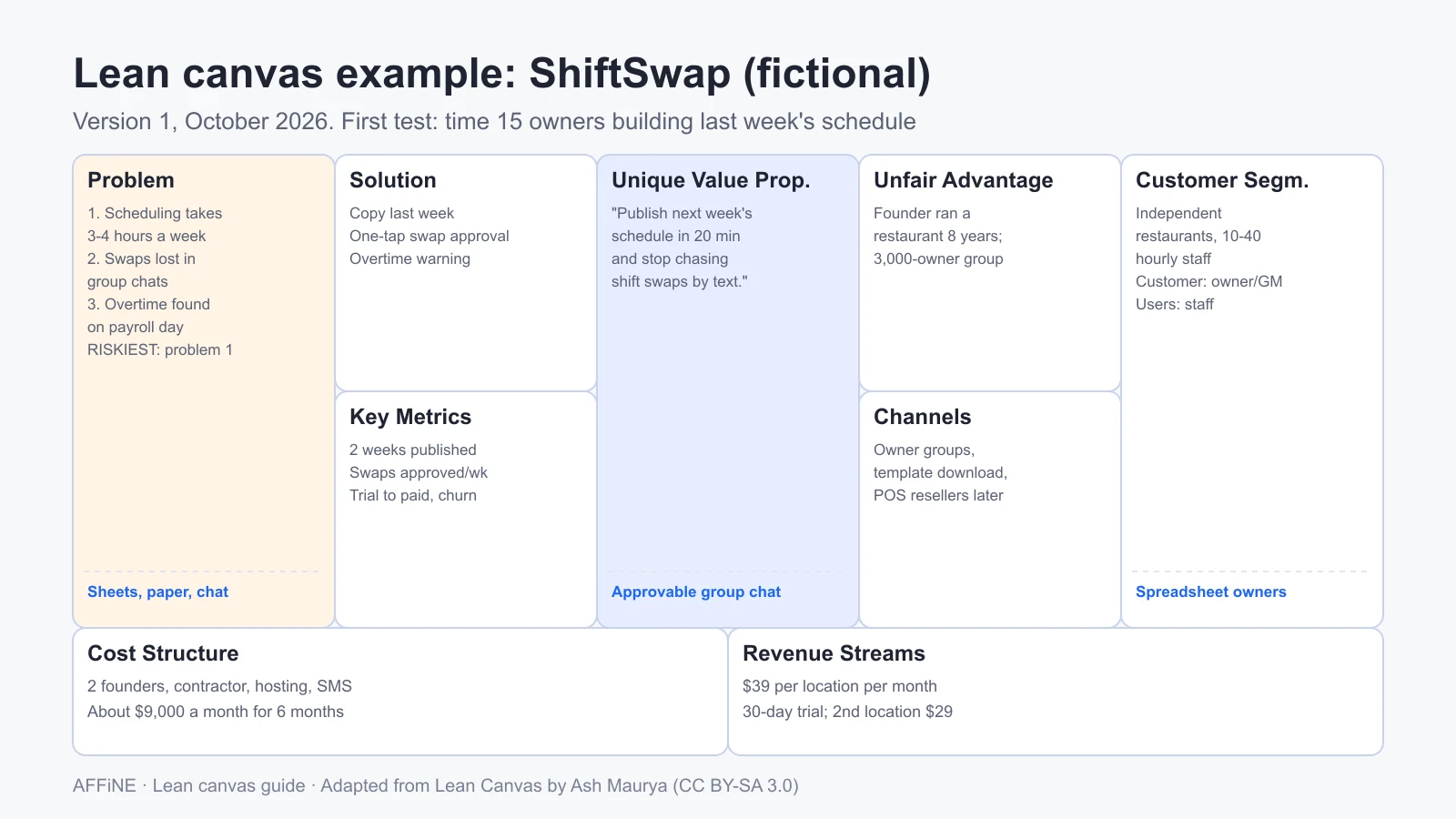
Here is a fully filled lean canvas for a fictional product we call ShiftSwap. It is an illustrative example built for this guide, not a real company or customer case. We chose a plain, small-business idea on purpose, because canvases of famous companies like Uber or Airbnb are usually written after the fact and hide the guesswork.
| Box | ShiftSwap (version 1, October 2026) |
|---|---|
| Customer Segments | Independent restaurants and cafes with 10 to 40 hourly staff. Customer: the owner or general manager. Users: staff. Early adopters: owner-operators who still build schedules in a spreadsheet and approve shift swaps by text message. |
| Problem | 1. Building next week's schedule takes 3 to 4 hours. 2. Last-minute swaps happen in group chats, so the manager does not know who is actually coming. 3. Overtime surprises show up only on payroll day. Existing alternatives: spreadsheets, paper schedules, group chats, and full workforce suites that feel too heavy for one location. |
| Unique Value Proposition | "Publish next week's schedule in 20 minutes and stop chasing shift swaps by text." High-level concept: a group chat for shift swaps that the manager can actually approve. |
| Solution | 1. Copy last week's schedule and adjust. 2. Swap requests that staff accept and the manager approves in one tap. 3. Overtime warning before the schedule is published. |
| Channels | Free trial from a schedule template download, local restaurant owner groups, point-of-sale reseller referrals later. Start with 20 interviews from owner groups. |
| Revenue Streams | $39 per location per month, 30-day free trial. Second location at $29. |
| Cost Structure | Two founders, part-time contractor, hosting and SMS fees. About $9,000 a month to reach 50 paying locations in six months. |
| Key Metrics | Locations that publish a schedule two weeks in a row, swap requests approved per week, trial-to-paid conversion, monthly churn. |
| Unfair Advantage | One founder ran a restaurant for eight years and has a 3,000-member owner community. Weak today; needs to grow into a template library or reseller network. |
What the example teaches
The canvas is useful because it shows where the plan is weakest. For ShiftSwap, the riskiest box is Problem 1. If owners do not actually spend three to four hours on scheduling, the value proposition, price, and channels all fall apart. That points to the first test: interview 15 early adopters and ask them to walk through how they built last week's schedule, timing each step. The test is cheap, and its result can change every other box.
Notice also what is not on the canvas: a feature list, a five-year revenue chart, or partners. Those come later, if the core problem holds. Once the canvas survives a few tests, a startup one pager is a good format for turning it into a pitch.
Lean canvas vs Business Model Canvas
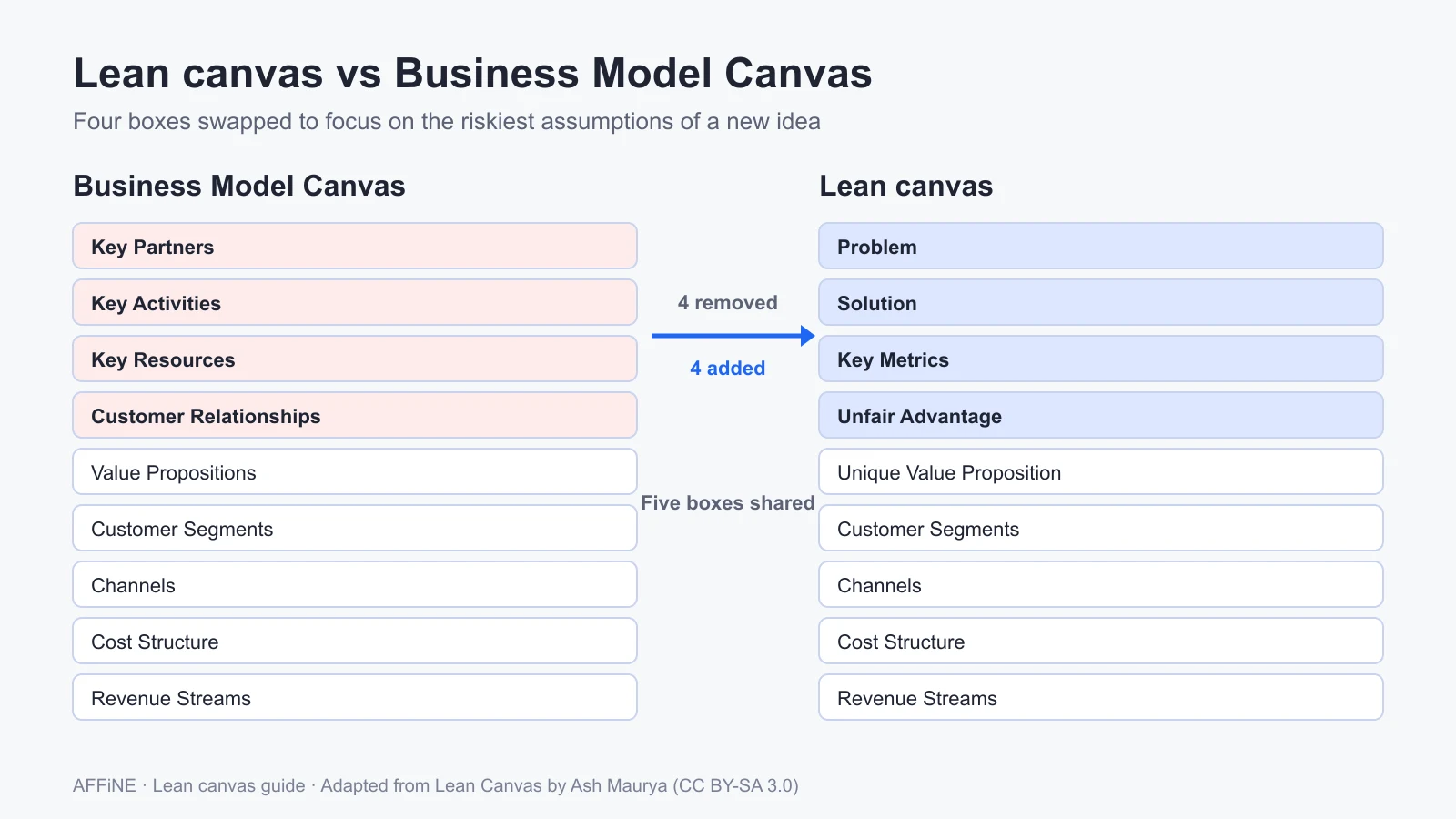
Both canvases use the same nine-box frame. The Business Model Canvas, created by Alexander Osterwalder and popularized in Business Model Generation with Yves Pigneur, describes how a business creates, delivers, and captures value. The lean canvas swaps four boxes to focus on what is riskiest for a new idea.
| Lean canvas | Business Model Canvas | |
|---|---|---|
| Created by | Ash Maurya, 2010 | Alexander Osterwalder, with Yves Pigneur |
| Best for | New products and startups looking for problem-solution fit | Existing businesses, new units in established companies, partner-heavy models |
| Starting point | The customer's problem | The value you create and the operations that deliver it |
| Unique boxes | Problem, Solution, Key Metrics, Unfair Advantage | Key Partners, Key Activities, Key Resources, Customer Relationships |
| Shared boxes | Customer Segments, Value Proposition (called Unique Value Proposition), Channels, Revenue Streams, Cost Structure | Same five |
| Main question | What is the riskiest assumption, and how do we test it? | How do the parts of this business depend on each other? |
| Typical failure | Treating the guesses as facts and never testing them | Describing a model in detail without checking whether customers want it |
Maurya explains each swap in his own post on the topic:
- Key Partners was removed because, for an unknown startup with an untested product, chasing partners early can be a form of waste. Maurya called this the hardest box to remove and noted that capital-heavy or regulated products may need partners from day one. Problem took its place, because building the wrong product is the most common way startups waste time and money.
- Key Activities and Key Resources were dropped because he found them "outside-in": they help outsiders understand a company but rarely hold the biggest risks early. Activities can be derived from the Solution box later.
- Customer Relationships folded into Channels, because he recommends starting every product with direct customer contact through interviews.
- Key Metrics and Unfair Advantage were added because choosing the wrong metric, or having no defense against copycats, are early risks the original canvas did not show.
Which one should you use?
Use a lean canvas if you are testing a new idea, applying to an accelerator, or deciding whether to build at all. Use a Business Model Canvas if the business is running, or if success depends on partners, supply chains, or regulated resources, such as hardware, healthcare, or energy. Many teams use both in sequence: a lean canvas until the problem and early adopters are validated, then a Business Model Canvas once partners and operations become the real risk. If you also need to describe your offer in more depth, a value proposition canvas zooms into one customer segment, and a SWOT analysis helps once you have competitors and a market position to assess.
How to fill out a lean canvas
1. Pick one product and one customer segment
Write one canvas per business model. If your idea has two very different customer groups, such as buyers and sellers in a marketplace, either mark each group with its own color on the same canvas or sketch two canvases.
2. Set a timer for 20 minutes and work alone first
Each person on the team sketches a canvas on their own, then the team compares and merges them. This avoids groupthink and shows where people disagree, which is usually where the risk is.
3. Fill customer segments and problems first
Name the early adopters, the top one to three problems, and the existing alternatives. Leave any box blank if you do not know. A blank box is useful information.
4. Write the value proposition, solution, channels, and pricing
Keep the value proposition to one sentence tied to the number-one problem. List one solution feature per problem, and write a real price in Revenue Streams.
5. Finish with costs, key metrics, and unfair advantage
Estimate the cost to reach your next milestone, pick three to five outcome metrics, and be honest in Unfair Advantage. Empty is better than "passion" or "first mover."
6. Rank the riskiest box and plan one test
Mark the assumption that would sink the model if it were wrong, write one cheap test for it, such as customer interviews or a landing page with a price, and date the canvas. Update it after every test.
Use the template
Copy the lean canvas template below into any doc, note, or whiteboard, or open the ready-made Lean Canvas template in AFFiNE to get the nine-box grid on a whiteboard. Each box has a short prompt; replace the prompts with your own words and keep each box to a few lines.
LEAN CANVAS
Product: ______________      Version: 1      Date: ____-__-__      Author: ______

PROBLEM
Top 1-3 problems:
1.
2.
3.
Existing alternatives (how they solve it today):

CUSTOMER SEGMENTS
Target customers (who pays):
Users (if different):
Early adopters (who feels the problem most, right now):

UNIQUE VALUE PROPOSITION
One sentence: why you are different and worth attention:
High-level concept (X for Y):

SOLUTION
One feature per problem:
1.
2.
3.

CHANNELS
Path to customers now:
Path to customers at scale:

REVENUE STREAMS
Price and pricing model:
Other revenue:

COST STRUCTURE
Cost to reach the next milestone:
Monthly burn:

KEY METRICS
3-5 outcome numbers:

UNFAIR ADVANTAGE
Something that cannot be easily copied or bought (blank is fine):

RISKIEST ASSUMPTION AND NEXT TEST
Riskiest box:
Test:
Pass/fail threshold:
Test date:

Lean Canvas is adapted from the Business Model Canvas (Strategyzer) and created by Ash Maurya (LEANSTACK). CC BY-SA 3.0.
If you want the grid instead of a list, draw five columns and a bottom row on a whiteboard and paste each section into its box. The order of the list above matches the suggested fill order, not the grid positions.
Building a lean canvas in AFFiNE
AFFiNE gives every doc two modes: Page mode for writing and Edgeless mode, an infinite whiteboard. A lean canvas works well in Edgeless mode: draw the grid with shapes or frames, put each box's text in a note, and drag sticky notes between boxes as assumptions change. Because the same doc also has Page mode, you can keep interview notes and test results next to the canvas instead of in another tool. Frames can also be shown one at a time in presentation mode, which is handy when you walk an advisor through the canvas.
Honest limits: AFFiNE does not have a dedicated lean canvas app with scoring, guided coaching, or investor-ready exports. If you want a tool that critiques your canvas or tracks experiments against it, LEANSTACK's own tools are built for that. If your team already works in Miro or FigJam, their lean canvas templates are fine; the method matters more than the tool.
Common mistakes
- Writing the canvas for investors instead of for learning. A polished canvas with no blank boxes usually hides untested guesses.
- Starting from the solution. If the Solution box is the most detailed, the problem has probably not been checked.
- Too broad a customer segment. "Everyone who works" is not a segment. Name the early adopters.
- Never updating it. A canvas from six months ago that nobody has changed is a business plan with smaller fonts.
- Listing features as unfair advantages. Features can be copied. Leave the box blank until you have something that cannot be.
FAQ
What is a lean canvas?
A lean canvas is a one-page business model for new products and startups. It has nine boxes: problem, customer segments, unique value proposition, solution, channels, revenue streams, cost structure, key metrics, and unfair advantage. Ash Maurya adapted it from the Business Model Canvas in 2010 to help founders find and test their riskiest assumptions.
What is the difference between a lean canvas and a business model canvas?
Both use a nine-box layout. The lean canvas replaces Key Partners, Key Activities, Key Resources, and Customer Relationships with Problem, Solution, Key Metrics, and Unfair Advantage. The lean canvas is built for testing new ideas, while the Business Model Canvas is better for describing businesses that already run or depend on partners.
What order should you fill out a lean canvas in?
There is no required order. Ash Maurya suggests starting with the box you understand best. If you are unsure, start with customer segments and problems, then the unique value proposition, solution, channels, revenue streams, cost structure, and key metrics, and leave unfair advantage for last.
How long should a lean canvas take?
Ash Maurya recommends sketching the first version in about 20 minutes. The goal is a quick snapshot of your current assumptions, not a finished plan. You then refine it after customer interviews and experiments.
Is the lean canvas free to use?
Generally, yes. The Lean Canvas PDF distributed by LEANSTACK carries a Creative Commons Attribution-Share Alike 3.0 license notice, so you can use and adapt it if you credit Ash Maurya and LEANSTACK and share your version under the same license. Check the notice on the current download before publishing.
Can you use a lean canvas for an existing business?
You can, for a new product line or a new market inside an existing company. For describing a business that already runs, the Business Model Canvas usually fits better, because it covers partners, activities, resources, and customer relationships.
Sources and editorial notes
- Ash Maurya, What is a Lean Canvas?, for the definition, box guidance, the 20-minute rule, fill order, and the list of replaced boxes. Accessed October 28, 2026.
- Ash Maurya, Why Lean Canvas versus Business Model Canvas, for the 2010 timeline and the reasoning behind each swap. Accessed October 28, 2026.
- LEANSpark (LEANSTACK), Lean Canvas, which leanstack.com now redirects to, for the 12-block description and the replaced boxes. Accessed October 28, 2026.
- Strategyzer, The Business Model Canvas, for the nine blocks and the link to Business Model Generation. Accessed October 28, 2026.
- Wikimedia Commons, Lean Canvas file page, which reproduces the canvas with its CC BY-SA 3.0 Unported license notice (the same notice appears in the footer of the Lean Canvas PDF). Accessed October 28, 2026.
- SERP review of the top results for "lean canvas," "lean canvas vs business model canvas," and "lean canvas example" (Ash Maurya, Canva, Miro, FigJam, Railsware, Creately, and others) on October 28, 2026, used to find gaps rather than as factual sources.
How this guide was prepared: AFFiNE wrote this article in October 2026. The ShiftSwap canvas is a fictional example created for this guide, and the prices and costs in it are illustrative. The diagrams and the copyable template were made by AFFiNE and are adapted from the Lean Canvas under CC BY-SA 3.0. AFFiNE sells a workspace that can hold a lean canvas, so we have an interest in the tool choice; the method works the same in any whiteboard or on paper. AI tools assisted with research and drafting, and the AFFiNE team reviewed and edited the content.