Plot Diagram: Five Parts, Example, and Blank Worksheet
What is a plot diagram?
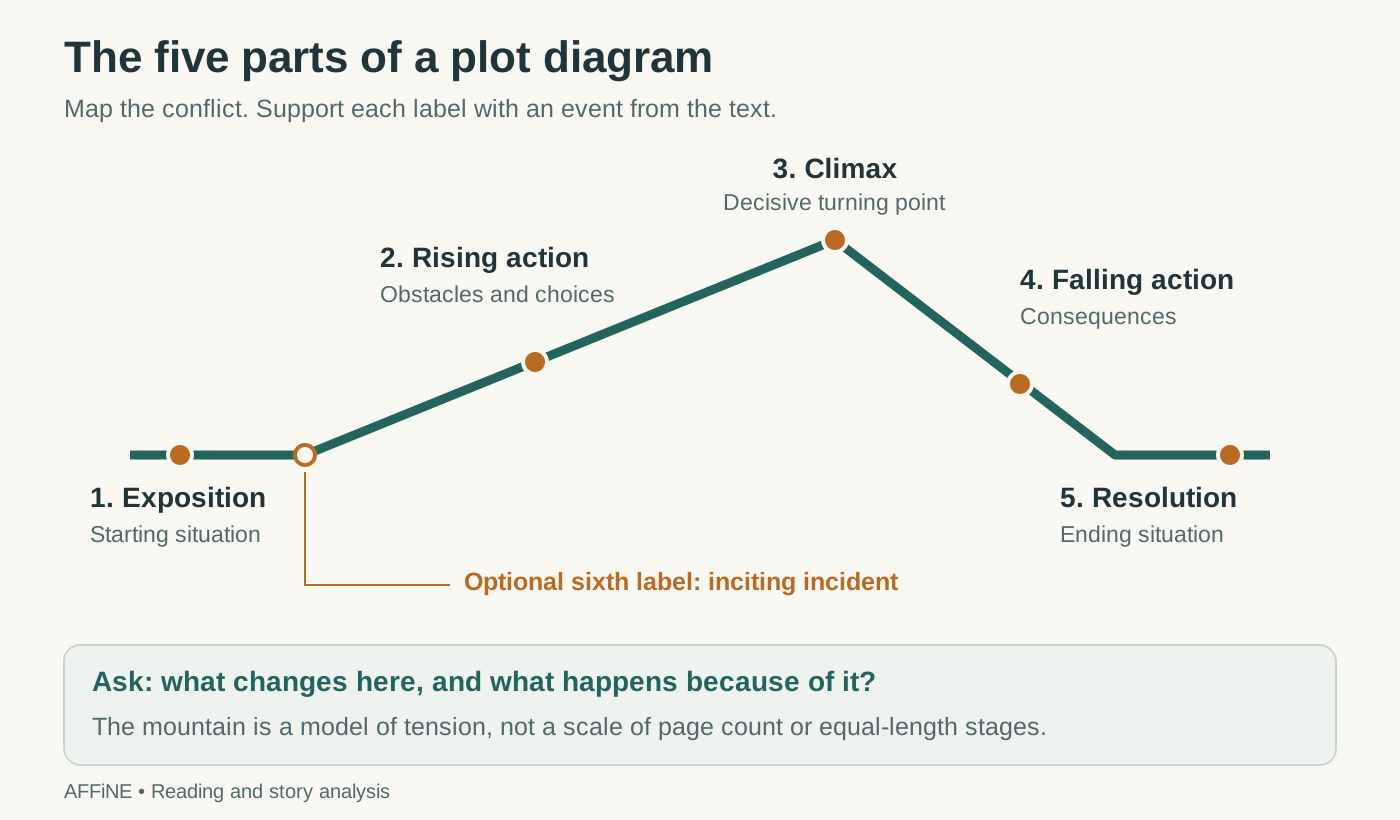
A plot diagram is a visual organizer that maps the main events of a story and shows how its central conflict develops. A common classroom version has five parts: exposition, rising action, climax, falling action, and resolution. Readers use it to explain a story; writers use it to plan or revise one.
The familiar mountain shape is a guide to narrative tension, not a measurement of page count. The highest point marks a decisive turn in the conflict. It does not have to happen halfway through the story, and a quiet realization can matter more than a dramatic fight.
This guide focuses on reading and classroom practice: learn the labels, work through a short story, then complete a blank plot diagram worksheet. For drafting and comparing narrative frameworks, see our companion plot structure guide for writers.
The five parts of a plot diagram
ReadWriteThink's plot diagram resource uses a triangular organizer to help readers and writers map story events. The table below turns each stage into a question you can answer with evidence from a text.
| Part | What it does | Question to answer | What to write on your diagram |
|---|---|---|---|
| Exposition | Establishes the situation, characters, and setting | Who wants what, and what is life like at the start? | A brief setup with only the details needed to understand the conflict |
| Rising action | Develops the conflict through obstacles and choices | What makes the goal harder to reach? | A few connected events, in their presented order |
| Climax | Marks a decisive turning point in the central conflict | Which choice, event, or discovery changes the outcome? | One specific moment and why it matters |
| Falling action | Shows consequences after the turning point | What happens because of the climax? | The immediate aftermath, even if it is very short |
| Resolution | Establishes the ending situation | What is settled, changed, or deliberately left open? | The final state of the conflict and characters |
Why do some worksheets have six or seven parts?
A six-part version often gives the inciting incident its own label between exposition and rising action. Some seven-part versions also separate a crisis or another turning point. There is no single seven-label list used by every teacher or writing guide. Follow the assignment's definitions, then explain how your chosen events fit them.
Conflict is the problem or struggle that connects the stages. It can begin during the exposition and continue through several sections, so it does not always fit neatly into one box.
The classroom plot mountain is often called Freytag's pyramid. Treat that name as a reference to a structural model, not proof that every story must have five equal sections. Circular stories, multiple viewpoints, and open endings may need a different shape or more than one diagram.
How to find the climax without guessing
Ask: After this moment, has the central conflict turned toward its outcome? Then check what the remaining scenes do. If the protagonist still faces the decisive obstacle, your chosen scene may belong to rising action. If the remaining scenes mainly show consequences, your choice is easier to defend.
“Most exciting scene” is a useful first guess, but it is not enough on its own. In a story about trust, an admission can be the climax even when an earlier chase is louder. Different interpretations can be reasonable if they identify the conflict clearly and cite the text.
How to make a plot diagram step by step
Step 1: Read the whole story and name the conflict
Finish the story before labeling its climax. Write one sentence stating what the main character wants and what prevents it. For an assignment, record the story title, author, and edition so you can identify your evidence later.
Step 2: Select the events that change the situation
List a small set of important events in the order the reader encounters them. Keep events that change a goal, obstacle, decision, or outcome. Leave out descriptive details unless they explain one of those changes.
Step 3: Place the turning point and the ending
Choose the event that decisively changes the central conflict and label it climax. Write the final situation under resolution. Add the immediate consequences between them as falling action; do not invent extra events to fill the space.
Step 4: Add the setup, rising action, and evidence
Fill in the exposition and the events leading toward the climax. Add a page, paragraph, chapter, or timestamp reference beside each choice. Explain connections with because or therefore so the diagram shows cause and effect rather than just a list.
Step 5: Check your labels against the story
Read your diagram from beginning to end. Check that the conflict develops, the climax changes it, and the ending matches the text. If another interpretation is plausible, note why you chose this one and follow your teacher's terminology.
For a younger reader, begin with three boxes: beginning, middle, end. Ask what the character wants, what goes wrong, and how things finish. Add the five literary labels after the child can explain those connections.
Plot diagram example: The Gift of the Magi
Spoiler note: this example discusses the ending of O. Henry's short story. Read the original text of The Gift of the Magi first if you want to discover the twist yourself.
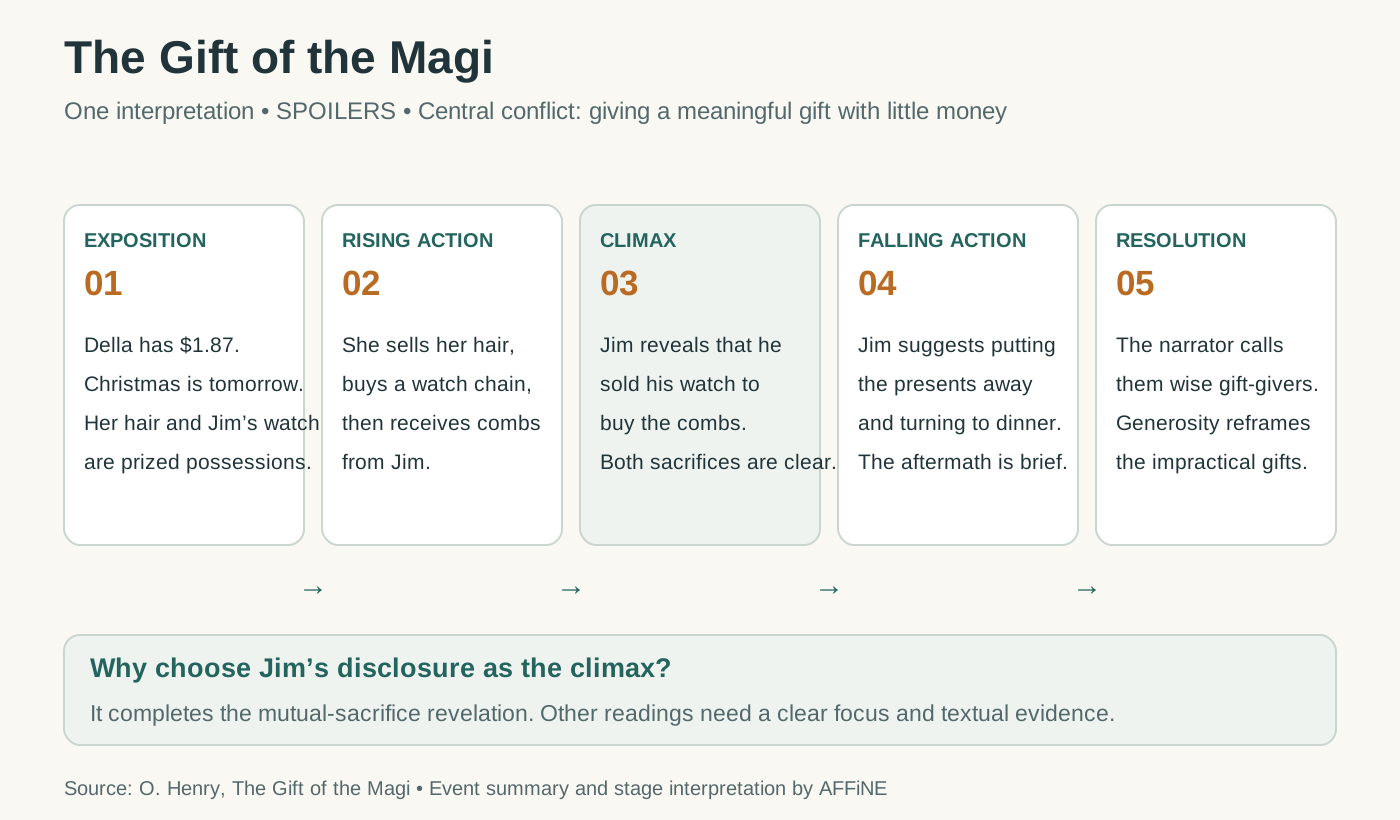
The table presents one defensible interpretation, centered on Della's wish to give Jim a meaningful Christmas present despite having little money. The events were checked against the linked text. The stage assignments are analysis, not labels supplied by O. Henry.
| Stage | Event in the story | Why this placement works |
|---|---|---|
| Exposition | Della has $1.87 on Christmas Eve; she and Jim have little money. Her hair and his watch are treasured possessions. | Establishes the gift problem and what each person can sacrifice. |
| Inciting incident, if required | Della's savings are insufficient for the present she wants to buy. | Identifies the pressure that drives her decision; it overlaps with the opening setup. |
| Rising action | Della sells her hair for $20, buys a $21 watch chain, and waits anxiously for Jim. He returns and gives her combs. | Her solution creates a new complication: the combs cannot be used as intended now. |
| Climax | Jim reveals that he sold his watch to buy the combs. | Completes the mutual-sacrifice revelation and changes the meaning of both gifts. |
| Falling action | Jim suggests putting the presents away and turning to dinner. | Shows the immediate response; this beat is compressed into the same passage as the revelation. |
| Resolution | The narrator calls the couple wise gift-givers. | Reframes the ending around generosity rather than the gifts' practical use. |
Why not label the haircut as the climax?
Selling her hair is a major decision, and it can be a turning point in an analysis focused on Della's personal sacrifice. In the reading above, however, the central revelation remains unresolved: neither Della nor the reader yet knows why Jim reacts as he does or how he bought his gift. Labeling his disclosure as the climax captures the completed irony of the exchange.
A strong classroom answer states its focus and supports it. It does not merely insist that one scene is the only possible climax. Notice also that the story does not show a long future in which the couple recover their possessions; adding that to the resolution would invent an event.
Blank plot diagram template
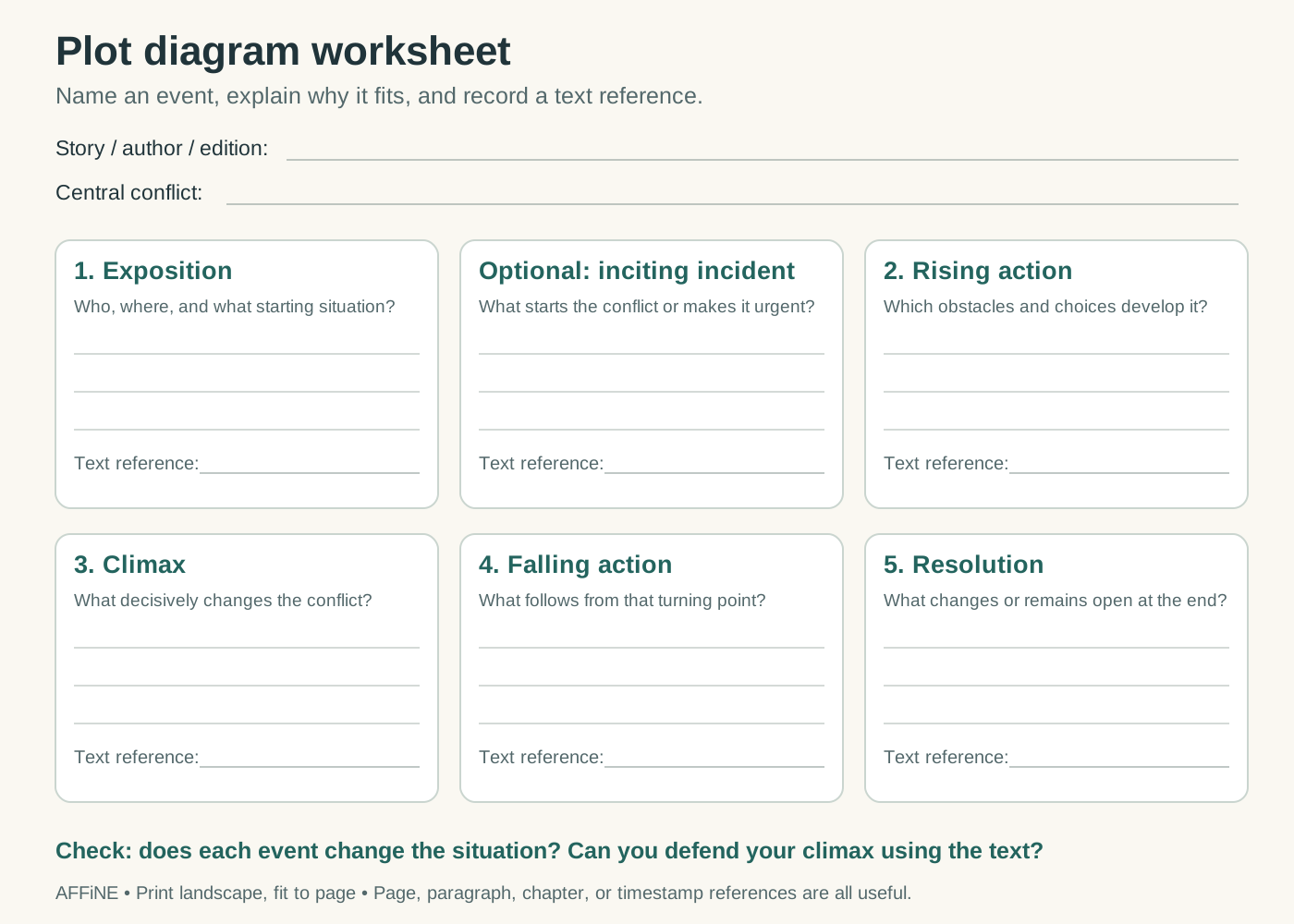
Use this original worksheet for a short story, a chapter, or a complete film. Define the scope first: a single episode and an entire series will usually need different event selections.
Open the printable plot diagram worksheet. Print it in landscape orientation using your browser's fit-to-page option, or copy the prompts below into a document. The worksheet is an SVG image, so its lines and labels stay sharp when enlarged.
| Field | Prompt to copy |
|---|---|
| Story and scope | Title, author, edition, and the chapter, episode, or complete work being analyzed |
| Central conflict | The character wants ___, but ___ prevents it. |
| Exposition | The story begins with ___; this matters because ___. |
| Inciting incident, optional | The problem starts or becomes urgent when ___. |
| Rising action | Because ___ happens, the character ___; therefore ___. |
| Climax | The conflict turns when ___; after this, ___. |
| Falling action | The immediate consequence is ___. |
| Resolution | By the end, ___ has changed; ___ remains open. |
| Evidence | Page, paragraph, chapter, or timestamp: ___. |
Try it before checking the example: fill the worksheet using only the story. Compare your climax and resolution with the table above. Where they differ, return to the relevant passage and explain your reasoning in two sentences. The explanation is more useful than matching a shape perfectly.
Choosing a paper or digital plot diagram
| Format | Choose it when | Watch for |
|---|---|---|
| Printed worksheet | You want to annotate a text or complete a classroom exercise by hand | Leave enough room for evidence, not just labels |
| Document table | You need typed answers and citations for an assignment | Keep each event short enough to compare across rows |
| Digital canvas | You want to move events, connect causes, or compare interpretations | A large board can become hard to read; group related notes |
| Storyboard | You need to turn the plot into scenes or shots | Scene order and camera details do not replace conflict analysis |
Organize the exercise in AFFiNE
The AFFiNE Storyboard Template provides a starting point for organizing scenes, characters, locations, and actions. Adapt it by adding a plot-stage label and an evidence field to each relevant scene. It is a storyboard template, so you will need to add those plot-specific prompts yourself.
Use a document for your written explanation and Edgeless for arranging event cards and connections. Place the climax first, connect the events that lead to it, then keep your evidence beside each card. When you move from analysis to planning scenes, these storyboard examples show how a scene-based format differs from a plot overview.
A simple worksheet is sufficient for a short assignment. A digital board becomes useful when you need to revise the sequence or keep multiple interpretations beside the source notes.
Common plot diagram mistakes and how to fix them
| Mistake | Why it weakens the diagram | Better approach |
|---|---|---|
| Summarizing every scene | Important changes disappear among minor details | Keep events that alter the goal, obstacle, or outcome |
| Calling the first problem the climax | Confuses the start of conflict with its decisive turn | Separate the inciting incident from the later turning point |
| Choosing the loudest scene | Excitement does not necessarily resolve the main conflict | Explain what changes because of the scene |
| Forcing equal lengths | Some stories end immediately after the climax | Allow brief or overlapping final stages |
| Treating a theme as an event | “Love is valuable” does not identify what happened | Name the action or revelation, then explain its meaning |
| Mixing plot lines | A subplot's resolution may not resolve the main conflict | Name one conflict per diagram, or use clearly labeled parallel tracks |
For a film, cite timestamps from the version you watched. For a series, state whether you are mapping an episode, season, or complete narrative. For a story with flashbacks, distinguish presentation order from event chronology; use two rows if the difference is central to your analysis. Open endings can leave a question unresolved without making the diagram incomplete.
A literary plot diagram is also different from a data chart. If you are mapping numerical observations rather than story events, use a scatter plot guide or a box plot explanation.
Plot diagram FAQ
What are the five parts of a plot diagram?
The five common parts are exposition, rising action, climax, falling action, and resolution. They show the starting situation, development of the conflict, decisive turning point, consequences, and ending. The sections do not need to be equal in length.
What are the six stages of a plot diagram?
A common six-stage version uses exposition, inciting incident, rising action, climax, falling action, and resolution. It separates the event that starts the main conflict from the rest of the setup. Use your assignment's labels if they differ.
What is the difference between an inciting incident and a climax?
The inciting incident starts the main conflict or makes it urgent. The climax is a later decisive turn that changes its outcome. One creates the problem the story follows; the other brings that problem toward its result.
How do you identify the climax of a story?
Identify the central conflict, then find the choice, event, or discovery that decisively changes it. Check whether the remaining scenes mainly show consequences. Support your choice with a text reference rather than relying only on which scene feels most exciting.
Is a plot diagram the same as a story map?
A plot diagram focuses on the sequence and development of the conflict. A story map is a broader organizer that may also include characters, setting, themes, and other details. The two can overlap, depending on the worksheet's design.
Can a story have more than one climax?
A story can have major turning points in several plot lines or episodes. For a single classroom diagram, state which conflict you are following and choose its decisive turning point. Use separate diagrams when combining those arcs would obscure their different outcomes.
Where can I get a blank plot diagram template?
This guide includes a printable SVG worksheet and a table of prompts you can copy into a document. Open the worksheet link in the blank template section and print it in landscape orientation. It includes the five common parts plus an optional inciting-incident field.
How do you explain a plot diagram to a child?
Start with beginning, middle, and end. Ask who the story is about, what problem they face, what they do, and how things finish. Once those connections are clear, introduce exposition, rising action, climax, falling action, and resolution using the same story.
Sources and example notes
- ReadWriteThink: Plot Diagram — an educational reference for using a triangular plot organizer.
- O. Henry: The Gift of the Magi — the primary text used to check the example's events and gift amounts.
- AFFiNE Storyboard Template — the scene-planning resource described in the digital workflow.
The worksheet and diagrams were created for this guide. The literary example is an interpretation supported by the linked story, not a universal answer key. Follow your teacher's rubric when its terminology or scope differs.