75 Soft Challenge Rules (2026): Free PDF Tracker & 75 Hard
What changed (Nov 12, 2026): Renamed the rules and tracker sections, added a dated comparison of 75 Soft rule versions by source and a sourced origin section, corrected the 75 Hard restart-rule citation, and aligned tracker instructions with the PDF and CSV column names.
Updated November 12, 2026. This guide compares published challenge rules with public-health guidance and includes an original tracker. It is an editorial planning resource, not a tested health intervention or personalized medical plan.
The 75 Soft Challenge is a flexible, 75-day habit experiment. The most widely cited version asks you to eat well, do one 45-minute movement session a day with one active-recovery day each week, drink 3 liters of water, and read 10 pages of any book daily. Unlike 75 Hard, it does not normally require a restart after one miss. Versions differ from source to source, so the most useful first step is to write down your safe version of each rule before Day 1.
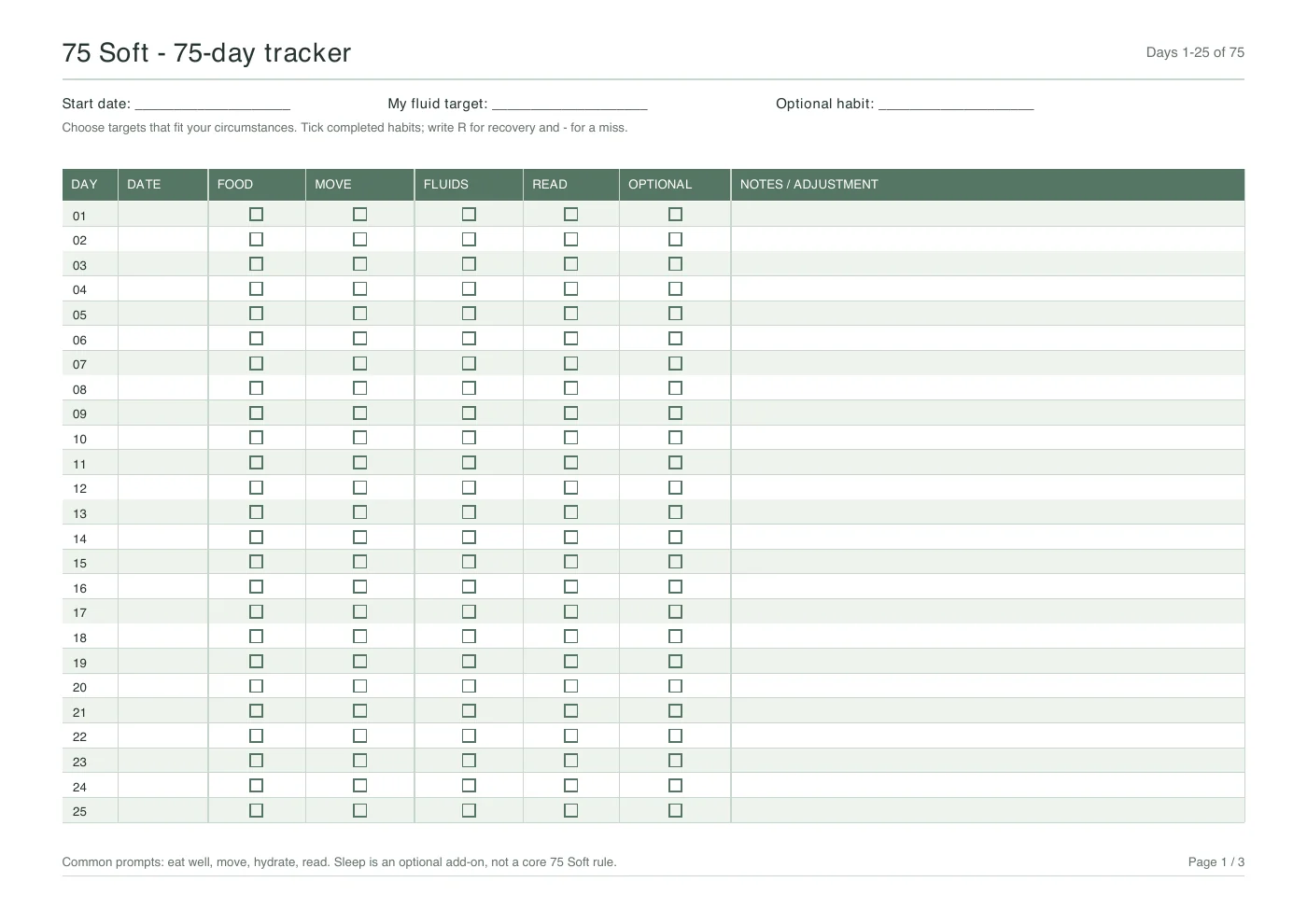
Need a place to start? Download our original three-page printable 75 Soft tracker (PDF) or editable 75-row tracker (CSV). Both cover the four common habits, an optional fifth habit, a date column, notes for adjustments, and every day from 1 through 75. No account is required.
75 Soft Challenge rules: the four common rules
The four-rule version below matches Cleveland Clinic's explanation (published November 13, 2023). Treat it as the familiar version, not as an official medical recommendation or a rulebook everyone agrees on.
| Common 75 Soft prompt | What the familiar version says | Define this before you start |
|---|---|---|
| Eat well | Make healthy food choices; avoid alcohol except at social occasions | Write a positive, repeatable food plan. Not drinking alcohol at all is always a valid choice. |
| Move | One 45-minute session daily, with one active-recovery day per week | Choose activities and a lower-intensity recovery option that fit your current ability. |
| Drink water | 3 liters daily | Set an individualized fluid goal if the popular number is unsuitable; record the goal you actually chose. |
| Read | 10 pages of any book daily | Decide whether paper and ebooks count; if you use audio, record it as your own modification. |
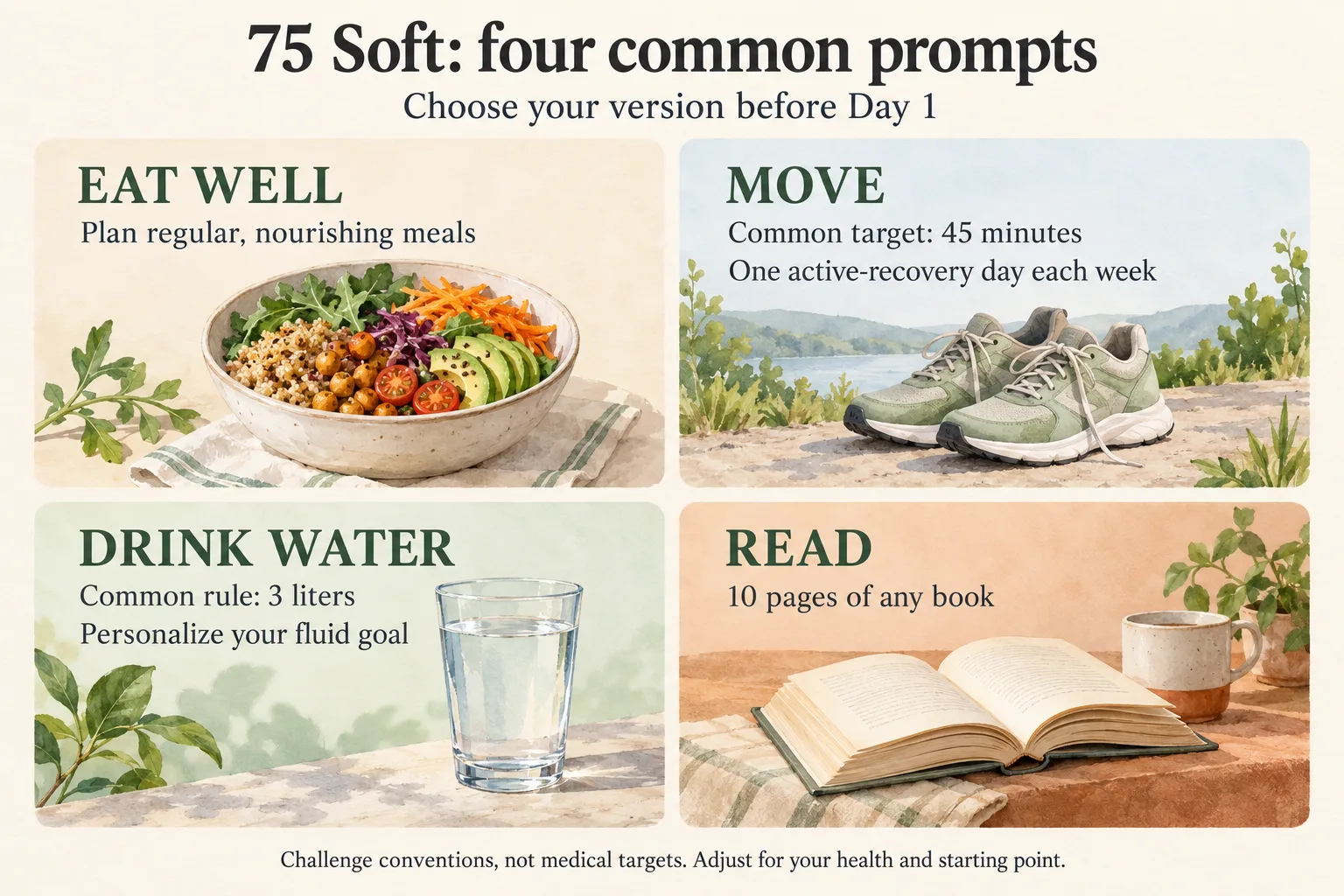
Prefer paper? The free 75 Soft PDF tracker prints these four prompts at the foot of every page, next to 75 numbered days.
Sleep is a worthwhile optional addition, not a standard rule. CDC guidance says most adults need at least seven hours. Add a sleep field if it supports your routine, but do not treat it as part of the four-rule version. Progress photos, weigh-ins, calorie targets, and a rigid restart are not required by the common version either.
Does "soft" mean anything goes?
No. Decide what a completed day means ahead of time, then record what actually happened. For example, "eat well" might mean planning regular meals with a range of foods rather than banning a category. "Move" might mean a walk, cycling, swimming, or a strength session, with gentle movement on the recovery day. A change made because you are ill, injured, or following clinical advice is an adjustment, not a moral failure.
Who created the 75 Soft Challenge, and why do the rules vary?
The 75 Soft Challenge is a gentler, social-media adaptation of Andy Frisella's 75 Hard program, and there is no single official source for it. TODAY reports that the challenge is widely credited to Stephen Gallagher, an Irish fitness creator who described it in a 2021 TikTok video as 75 Hard for people without time for two workouts a day. Glamour UK says an earlier version appeared in 2019 on the lifestyle site The Pohhu Experience. Because the idea spread through social media, publishers wrote down slightly different rules:
| Source (date) | Movement | Water | Reading | Also includes |
|---|---|---|---|---|
| Cleveland Clinic (Nov 2023) | 45 minutes daily, one active-recovery day a week | 3 liters | 10 pages of any book | Alcohol only at social occasions; no restart penalty |
| WebMD (medically reviewed, Jul 2025) | 45 minutes; its FAQ says walking and yoga count | 3 liters | 10 pages of anything except your phone | Photo on Day 1 and Day 75; alcohol only at social occasions |
| 75soft.com (commercial site selling trackers and an ebook) | 30 minutes, four times a week | Half your body weight in ounces | Read or listen for 10 minutes | Mindful food choices 90% of the time; meditate 5+ minutes; photo on Day 1 and Day 75 |
| INTEGRIS Health (Jun 2025) | 45 minutes, four times a week | — | 10 pages of nonfiction | Three alcoholic drinks a week or fewer |
None of these versions is "correct." Pick one, adjust it for your health and schedule, and write the final rules on your tracker so you are not changing them from memory.
75 Soft vs. 75 Hard vs. 75 Medium
75 Hard's creator publishes a defined program: a chosen diet with no alcohol or cheat meals, two 45-minute workouts each day done at least three hours apart with one outdoors, one gallon of plain water, 10 pages of nonfiction (audiobooks do not count), and a daily progress photo. If you miss anything, the official FAQ says you start over on Day 1. 75 Soft keeps the 75-day frame but relaxes the volume and the restart policy. 75 Medium has no single consistent rule set; if that label interests you, compare the exact rules in our 75 Medium guide rather than assuming it means one particular plan.
| Decision point | 75 Soft, common version | 75 Hard, creator's rules |
|---|---|---|
| Movement | One 45-minute session; one weekly active-recovery day | Two 45-minute sessions daily, at least 3 hours apart, one outdoors |
| Food and alcohol | Flexible "eat well" prompt; social exception is common | Chosen diet, no cheat meals or alcohol |
| Water | Commonly 3 liters, but personalize for safety | One gallon of plain water |
| Reading | 10 pages of any book | 10 pages of nonfiction; audiobooks do not count |
| Photo and missed day | No daily photo or automatic restart | Daily photo; restart on Day 1 after a miss |
This compares published challenge instructions. It is not a recommendation that either regimen is safe for everyone. For someone who is just starting to exercise, even the Soft version's 45-minute daily target can be too much at first.
Is 75 Soft healthy? Put the challenge next to the evidence
A challenge number is not a health threshold. U.S. physical-activity guidance recommends 150–300 minutes of moderate-intensity aerobic activity per week plus muscle-strengthening activity on at least two days for adults. For people who are currently inactive, the guidelines recommend starting with small amounts of activity and working up over time. Six 45-minute sessions add up to 270 minutes before the recovery day, but total session time is not the same as moderate-intensity aerobic time. The challenge is therefore not automatically a beginner plan. Adapt the duration and intensity to your starting point, and do not push through illness or injury.
The water rule needs similar care. The National Academies' adequate-intake figures are about 2.7 liters of total water a day for adult women and 3.7 liters for adult men; total includes water from food and all beverages. They are population reference values, not instructions to drink that much plain water. The popular 75 Soft "3 liters" is a challenge convention, not a universal target. Needs vary with climate, activity, diet, and health, and people with chronic kidney disease may need to limit fluids. Follow a clinician's fluid plan if you have one.
Food rules should support nourishment rather than punishment. If a fixed checklist increases guilt about eating or pushes you to exercise through fatigue or injury, change the rules or stop the challenge. The National Eating Disorders Association lists exercising despite injury and intense distress when unable to exercise as planned among the warning signs of excessive exercise. People managing an eating disorder, pregnancy, a medical condition, or a return from injury should discuss material diet, fluid, or exercise changes with a qualified professional.
Build your version before Day 1: a rule card you can copy
Write the following at the top of your tracker. The examples are specific enough to review, yet flexible enough for real life:
My 75 Soft rule card
Version I'm following: ______ (for example, Cleveland Clinic's four rules).
Food: I will plan regular meals and include a mix of nourishing foods; I will not label one meal a failed day.
Movement: I will aim for a 45-minute session on suitable days, use one gentle recovery day each week, and adjust for health and current fitness.
Fluids: My personal target is ______, based on my circumstances or clinical advice.
Reading: I will read 10 pages of ______; my chosen format is ______.
Optional habit: ______. A missed item is logged and reviewed; it does not reset my calendar.
If you want a structured weekly activity mix, use a workout plan template to alternate easier and harder days, or log sessions, water, and sleep on one page with AFFiNE's fitness planner template. For an entirely different habit set, our habit tracker template guide explains how to choose fields and keep a log readable.
Example week: vary effort instead of repeating seven hard days
| Day | Movement example | What to note |
|---|---|---|
| Monday | Comfortable walk | Energy before and after |
| Tuesday | Strength session at an appropriate level | Muscle groups and effort |
| Wednesday | Easy cycling or walking | Whether recovery feels adequate |
| Thursday | Strength or mobility session | Any pain that calls for an adjustment |
| Friday | Brisk walk or another enjoyable activity | Schedule friction |
| Saturday | Longer easy walk, if suitable | Hydration and weather |
| Sunday | Gentle active recovery, or rest if health requires it | One change for next week |
This is an illustrative schedule, not a prescribed training program. If you are starting from inactivity, do shorter sessions and build up instead of forcing the 45-minute label. On a sick or injured day, rest can be the sound choice even when a tracker says "move."
How to track 75 Soft: free printable PDF and CSV tracker
The printable PDF has three A4 landscape pages with 25 days per page, plus spaces for your start date, fluid target, and optional habit. Its columns are Day, Date, Food, Move, Fluids, Read, Optional, and Notes / Adjustment. The CSV has one header row and 75 numbered rows with the columns Day, Date, Food, Movement, Fluids, Reading, Optional habit, and Notes or adjustment. The PDF is blank for handwriting; the CSV opens in any spreadsheet app. Neither file fills in dates or calculates health targets for you.
- Write a start date and your rule card. Day 1 is the first date you record; Day 75 is start date plus 74 calendar days. For example, October 2, 2026 through December 15, 2026 is 75 days inclusive.
- Fill the date column. Use one row per calendar day, including weekends and recovery days.
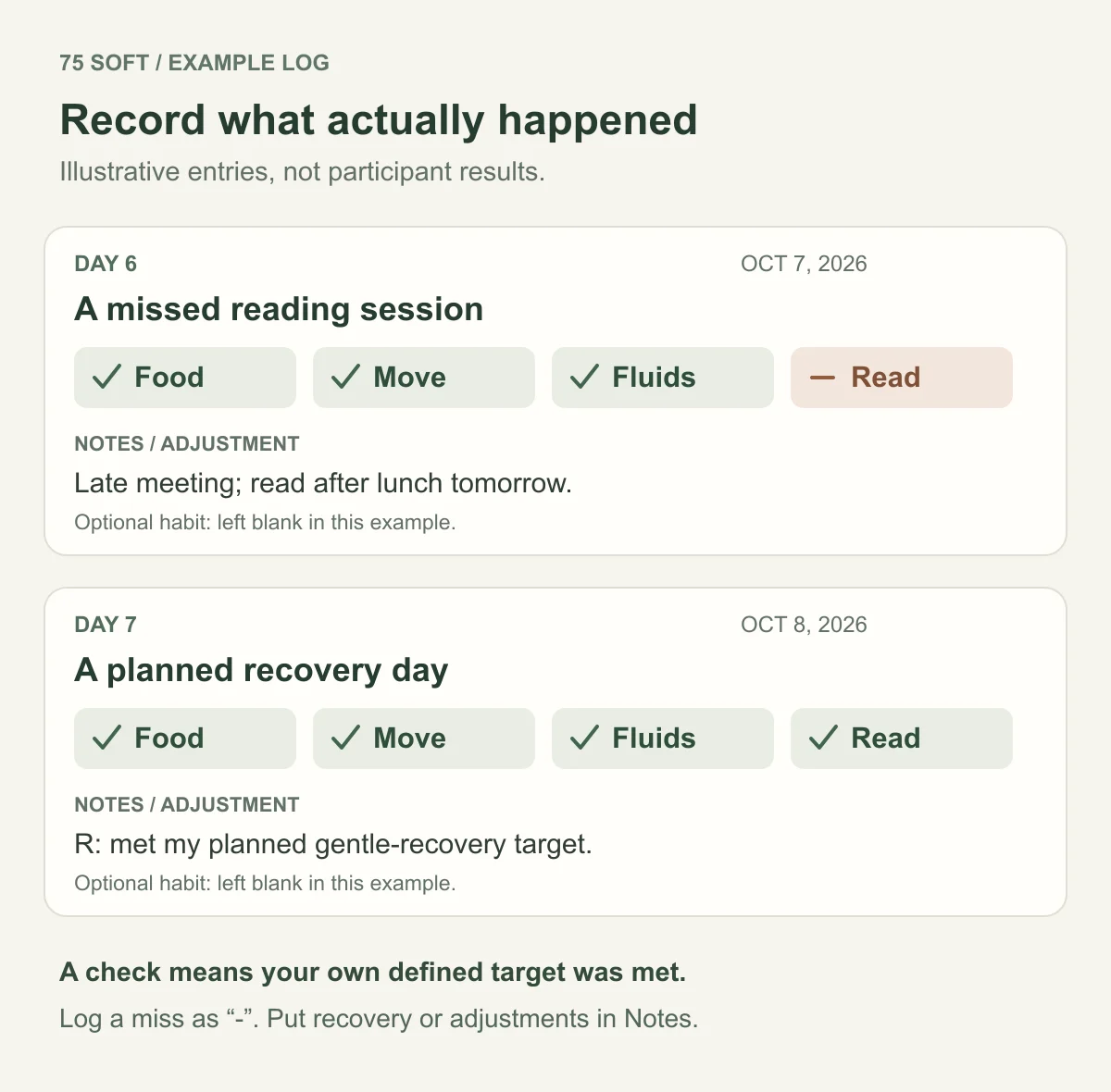
- Mark each habit with the same legend every day. Tick a box when you met your own defined target, write
Rfor a planned recovery day, and write-for a miss. You can putRin the Move cell or in Notes; choose one place and stick to it. Never add a tick just to protect a streak. - Review every seven days. Look for an overloaded movement schedule, a fluid target you cannot comfortably follow, or reading time that cuts into sleep. Change the plan deliberately and date the change in Notes.
You can also adapt the layout in AFFiNE's habit tracker template or compare habit-tracking apps. The downloads above are standalone files; they do not require AFFiNE and are not a native import format for any app.
What if you miss a day or need to change a rule?
The common 75 Soft approach lets you continue without a Day 1 reset. Keep the calendar honest: mark the missed item, write one cause, and choose the next manageable action. A missed reading session might mean moving the book to lunch; a missed workout might reveal that the time block conflicts with childcare. If you are ill or injured, recovering matters more than completing a challenge box.
Changing a target midstream is reasonable when new information makes the old one unsuitable. Record what changed and why, then use the updated target from that date forward. Do not relabel the first weeks as perfect after the fact. An honest record is more useful than an unbroken streak.
For example, if a gentle walk meets your planned recovery-day target, mark Move with R (or tick Move and write "R — planned recovery" in Notes). If you miss reading, put - under Read and note one adjustment for tomorrow.
What should happen on Day 76?
Review the 75 rows and choose one habit to keep, one to adapt, and one rule to drop if it added stress without helping. Look at sleep, energy, enjoyment, and whether the plan fits normal work and family life. The challenge ends after 75 calendar days; a lasting routine can be simpler. If a defined review date would help, set the next small target with a SMART goal template.
Frequently asked questions
How many rules does 75 Soft have?
The widely cited version has four: eat well, move once daily with a weekly active-recovery day, drink 3 liters, and read 10 pages. Other published versions add meditation, photos, or alcohol limits, or change the workout schedule. Sleep is a useful optional habit, but it is not part of the four-rule version described by Cleveland Clinic.
Who created the 75 Soft Challenge?
No single creator is documented by a primary source. TODAY reports it is widely credited to Stephen Gallagher's 2021 TikTok video, while Glamour UK points to a 2019 version on The Pohhu Experience. It began as a gentler alternative to Andy Frisella's 75 Hard.
Can you drink alcohol on 75 Soft?
In the common version, you avoid alcohol except at social occasions. Some versions set a weekly limit instead, such as INTEGRIS Health's three drinks a week or fewer. Choosing not to drink at all is always within the rules.
Do I have to drink exactly 3 liters of plain water?
No. Three liters is a popular challenge rule, not a universal medical requirement. The National Academies' figures refer to total water from food and beverages, which is a different measure. Use a suitable personal goal and follow any clinician guidance.
Does a rest day count?
The familiar version includes one active-recovery day each week. Gentle activity can be appropriate, but illness or injury may call for actual rest. Decide how you will record that before it happens.
Does an audiobook count as the 10 pages?
The commonly described rule says 10 pages of any book. If you want to use an audiobook, set a time-based listening goal as your own modification and record it clearly; it is not literally ten pages. Some versions, such as 75soft.com's, explicitly allow listening.
Do I restart if I miss one day?
Usually no. Log the miss and continue to Day 75. The restart rule belongs to 75 Hard's published instructions, not the common 75 Soft approach.
Is 75 Soft a weight-loss program?
It is a social-media habit challenge, not a validated treatment or a guaranteed weight-loss method. You can do it without weigh-ins, progress photos, or calorie restrictions. Choose habits that suit your circumstances and get professional advice for clinical goals.
When is Day 75 if I start today?
Count the start date as Day 1, then add 74 days to find Day 75. Write those dates into the PDF or CSV so travel and weekends do not shift your count.
Sources and editorial method
On November 12, 2026 we checked the common rules against Cleveland Clinic, compared other published versions from WebMD, 75soft.com and its worksheet, and INTEGRIS Health, and checked origin claims in TODAY and Glamour UK. 75 Hard rules come from its creator's program page and FAQ. Health context comes from HHS activity guidance, the National Academies' water reference, NIDDK, NEDA, and CDC sleep guidance. The tracker was created for this article and checked as a three-page PDF and a 75-row CSV. The hero image and four-prompt overview are AI-generated editorial illustrations; the blank tracker preview is a render of the downloadable PDF; the completed-entry graphic is an original editorial example, not participant data. We did not clinically test the challenge, and we do not claim that 75 days builds a lasting habit for everyone.