Your Domain Data Is Your Moat: Why We Build AFFiNE Privacy-First
Models and compute are becoming easy to get. Your company's domain knowledge is not. Here is why we think it is your moat, how it leaks through everyday AI use, and how AFFiNE is built to keep it yours.

In the AI era, a company's most lasting advantage is not the model it uses. Models are becoming widely available, and compute can be rented by the hour. What no competitor can rent is what your company knows: its domain knowledge and the data behind it. We build AFFiNE on that belief, which is why it stays privacy-first, local-first, open source, and self-hostable.
By Vincent Chen, CEO of AFFiNE. This is AFFiNE's point of view, and AFFiNE makes one of the workspaces it discusses, so read it as a vendor statement. Facts about AFFiNE features were checked against our documentation on November 16, 2026.
On this page: key takeaways, what domain data is, data, compute, and people, is data really a moat, how domain data leaks, what privacy-first means at AFFiNE, why open source and self-hosting, what we have not built yet, a checklist, and FAQ.
Key takeaways
- We believe the value of most companies will increasingly come from three things: domain data, compute, and people. Compute can be rented and people can be hired. Domain data is the part that compounds and the part that is hardest to replace.
- For a company that does not build AI models, losing control of its domain data is hard to measure. Once copies leave your control, you cannot take them back.
- In daily AI use, domain data leaves through four main paths: model training, secondary copies kept by vendors, breaches along the vendor chain, and personal AI accounts outside company control.
- AFFiNE answers this with local-first storage, a no-training commitment in our terms, inspectable code, self-hosting, and AI that you can turn off or route to models you choose.
- We are working toward a complete privacy-first AI stack built as open-source software. Some of it is not finished, and we say where.
What we mean by domain data
Domain data is everything your company has learned about its own work that is not public. It is less about volume and more about specificity: the details that explain how your business actually runs.
| Type of domain knowledge | Examples | Where it usually lives |
|---|---|---|
| Decisions and their reasons | Why a product was cut, why a market was entered, what a past experiment showed | Meeting notes, memos, decision logs |
| How work gets done | Processes, playbooks, onboarding guides, checklists | Wikis and knowledge bases |
| Customer knowledge | Objections, pricing exceptions, support patterns, account history | CRM notes, support docs, call summaries |
| Product and technical design | Specs, architecture diagrams, roadmaps, source code | Docs, whiteboards, repositories |
| Commercial terms | Pricing models, margins, supplier terms, negotiation history | Spreadsheets, contracts, finance notes |
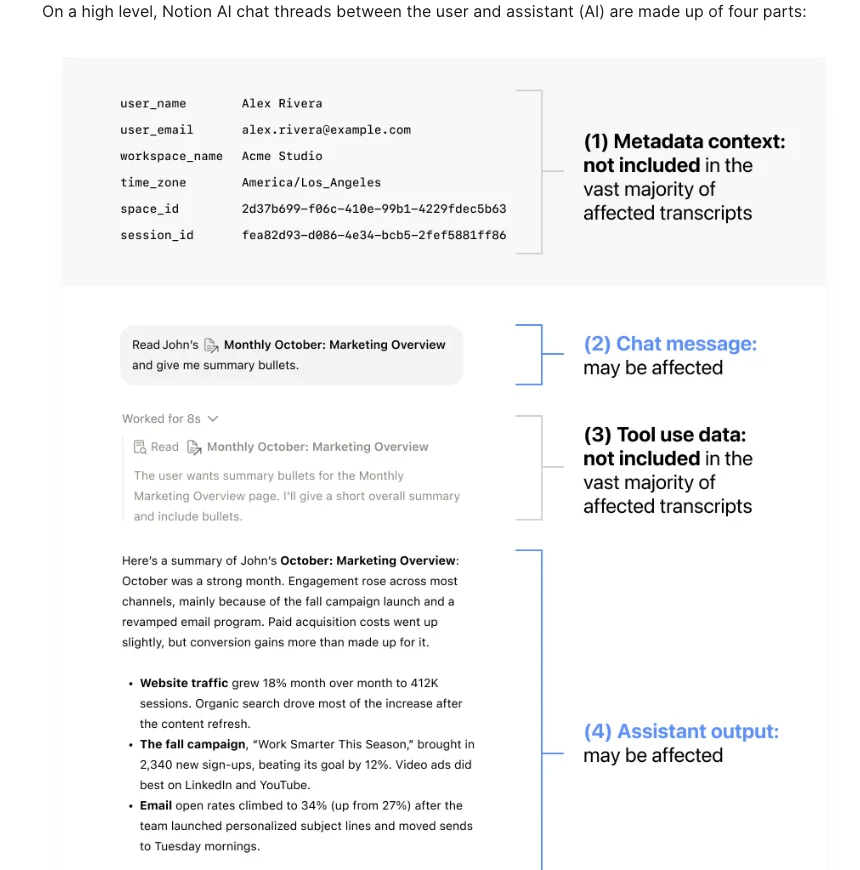
More and more of this knowledge now also lives in a fifth place: the prompts people type into AI tools and the answers those tools return. An AI chat about a pricing change contains the pricing change.
Data, compute, and people
Here is the model we use to think about where a company's value sits as AI spreads.
| Factor | Can you buy it? | How it leaves | How you keep it |
|---|---|---|---|
| Compute | Yes, from any cloud, and prices keep changing | It does not need to leave; you rent more | Contracts and budgets |
| People | You can hire, but good people are scarce | They resign, and take what they know with them | Culture, pay, and written knowledge they leave behind |
| Domain data | No. Only your company can produce it | Copies spread to tools, vendors, and models | Storage, access, and vendor choices you control |
Two points follow from this table.
First, domain data and people are linked. When knowledge is written down in a shared workspace, it stays with the company when a person moves on. That is a strong reason to keep a good knowledge base, and a strong reason to care where that knowledge base lives.
Second, AI makes domain data more valuable, not less. A general model knows what everyone knows. It becomes useful for your work only when it gets your context: your specs, your customers, your history. The more work AI does, the more your context is worth, to you and to anyone who can collect it.
Is data really a moat?
The idea has fair critics. In The Empty Promise of Data Moats, Martin Casado and Peter Lauten of Andreessen Horowitz argue that most "data network effects" are really data scale effects, and that having lots of data does not by itself make a business defensible.
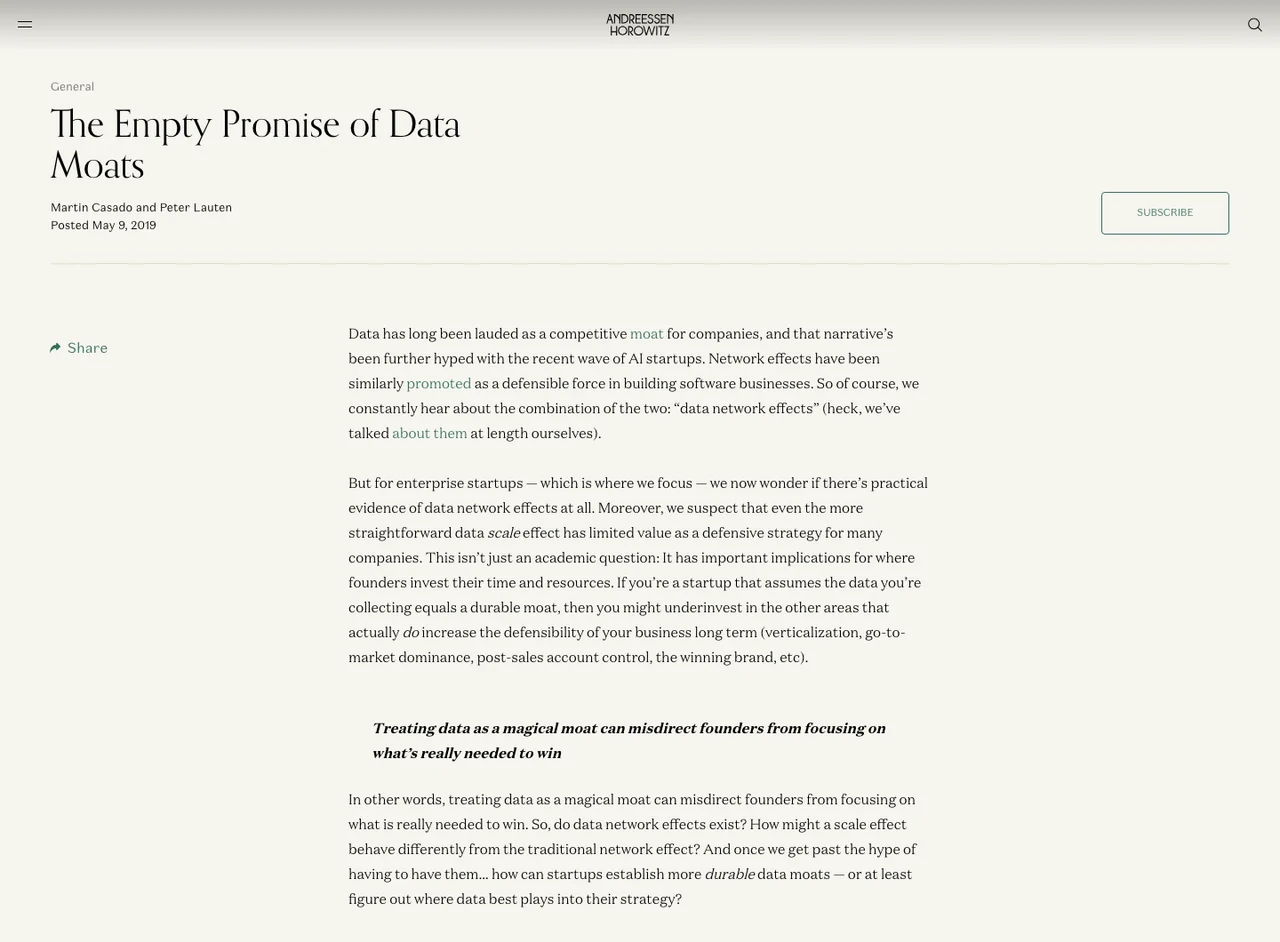
We agree, and that is the distinction we draw. Volume is not the moat. Generic data at scale gets cheaper every year, and large model companies will always have more of it. The moat is the specific, private knowledge that only your company has and that gives an AI system the context to do your work well. That kind of data does not need to be large to be valuable. It does need to stay yours.
How domain data leaks in the AI era
Most companies do not lose domain data in one dramatic event. They lose control of it gradually, through ordinary AI use.
1. Training
If a vendor's terms allow it to train on your content, your knowledge can shape a model that other companies, including competitors, also use. Read the terms, not only the marketing page, and check whether the rules differ between free, team, and enterprise plans.
2. Secondary copies
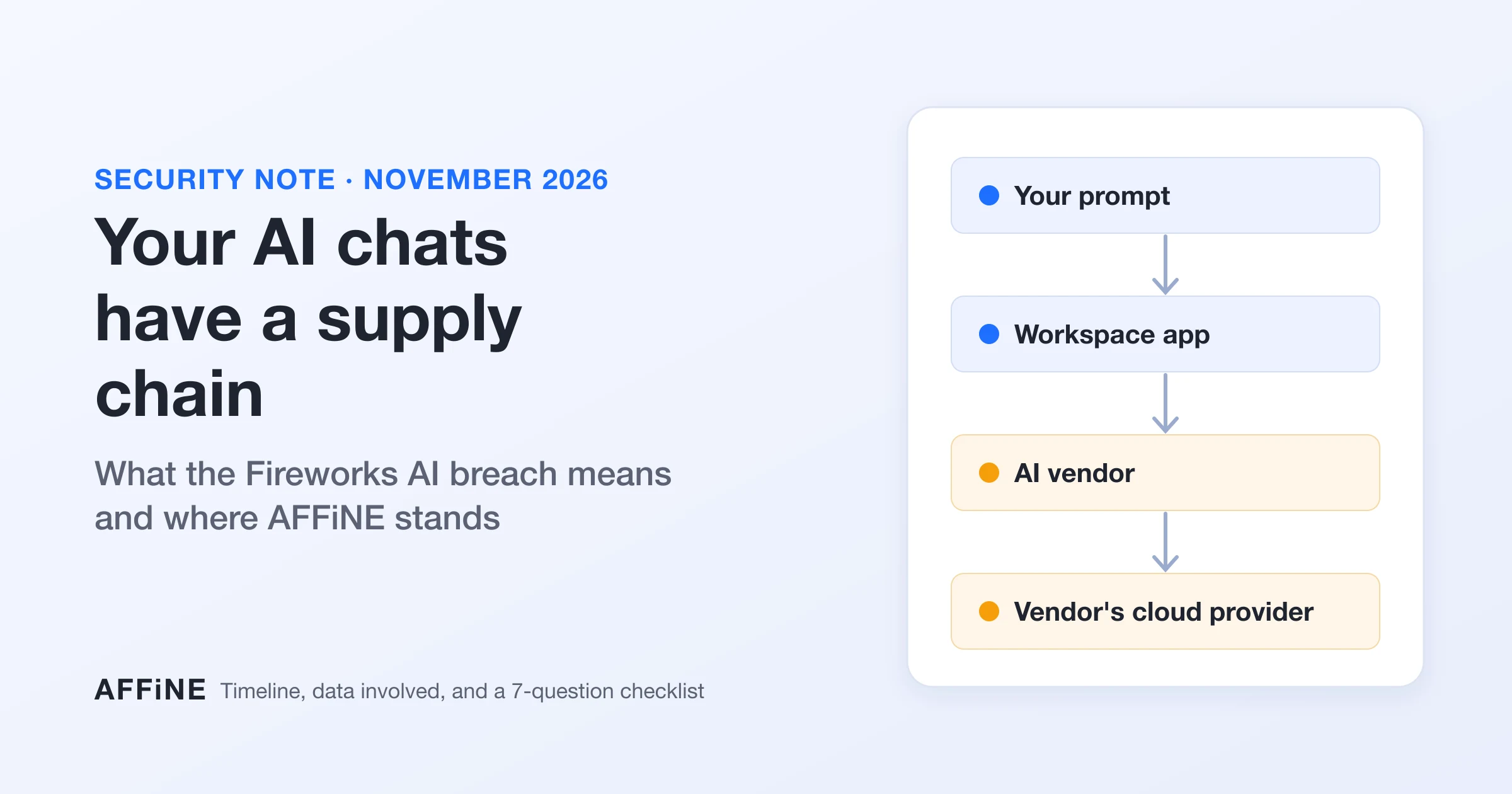
The answer to a prompt is only the first use of it. Analytics, evaluations, and classification jobs can each create a stored copy, often with another vendor and different retention rules. In November 2026, Notion AI chat transcripts were exposed through a breach at Fireworks AI, a vendor that had received copies for an analytics feature. Our analysis of the Fireworks AI breach walks through that chain.
3. Breaches along the chain
Every vendor that holds a copy is a place an attacker can reach. AI platforms are now a direct target: Wiz counted at least nine AI developer platforms that disclosed security incidents in October 2026.
4. Personal accounts and shadow AI
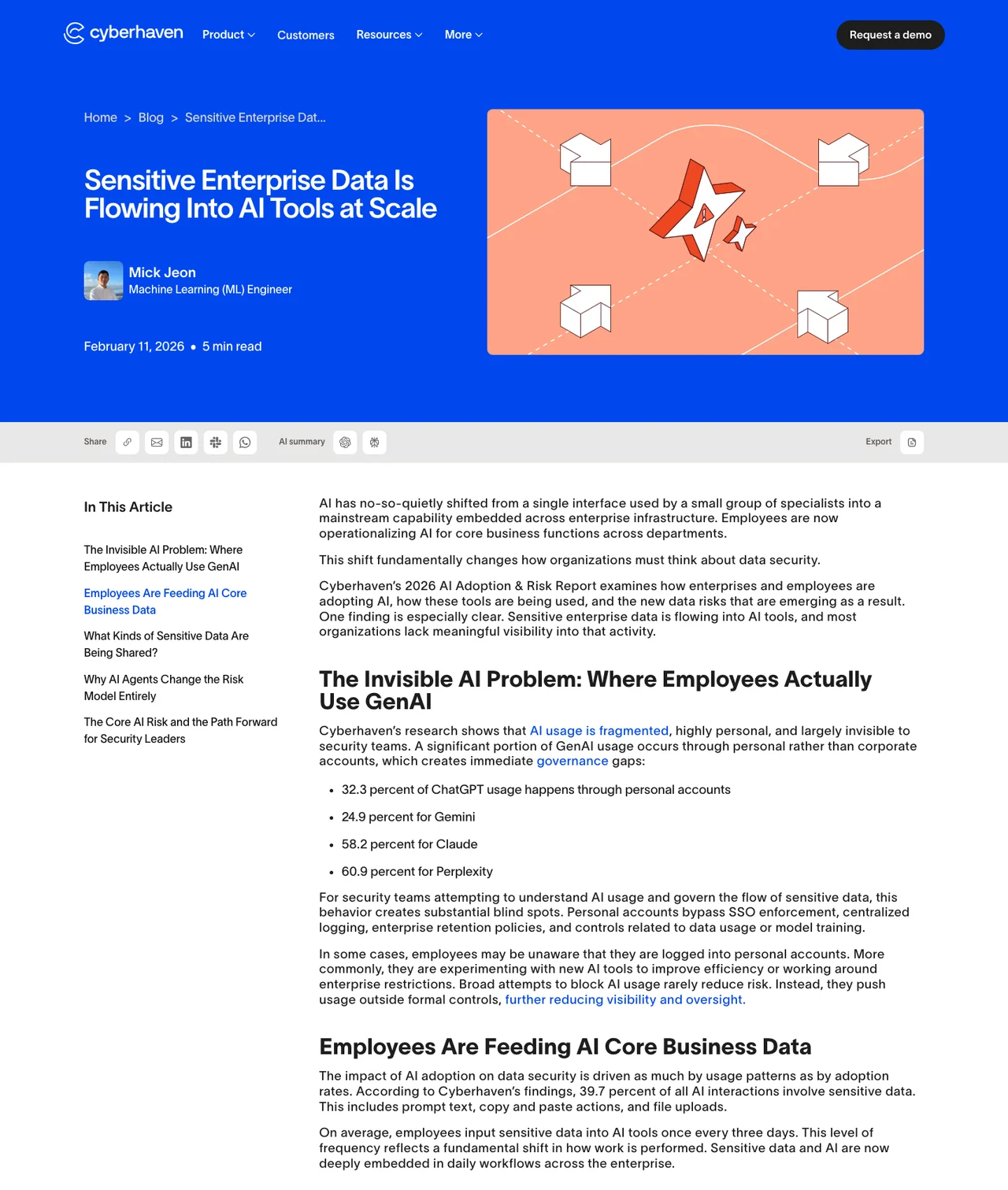
Employees use AI because it helps them work, and they often use personal accounts to do it. Cyberhaven's 2026 AI Adoption and Risk Report found that 39.7% of AI interactions involve sensitive data, that employees enter sensitive data into AI tools about once every three days on average, and that 32.3% of ChatGPT use happens through personal accounts. In 2023, Samsung restricted generative AI tools for staff after employees uploaded sensitive code to ChatGPT.
Why the cost is hard to measure
For an AI model company, data is raw material. For most other companies, it is the business itself. A leaked password can be rotated. A leaked customer list can be reported. But years of hard-won knowledge about how to do the work well cannot be recalled once it has spread, and the loss rarely shows up on an invoice. It shows up later, when a competitor or a general-purpose AI product can do what used to set you apart.
What privacy-first means at AFFiNE
Privacy-first is easy to write on a website. Here is what it means in our product and our terms today.
- Local-first storage. Docs, whiteboards, and databases start on your device. Syncing a workspace to AFFiNE Cloud or to a server you run is your choice. Our local-first guide explains how this works offline.
- No training on your content. Our Terms say we do not use your AFFiNE AI inputs, AI outputs, or workspace content to train or fine-tune any model, ours or a third party's, and that we do not permit our model providers to train on that content.
- AI is optional. You can use AFFiNE without AI. On a self-hosted server, admins can turn AI off for the whole server or for individual workspaces.
- A short, documented chain. When you use AFFiNE Cloud AI, the content you submit for AI processing goes to third-party model providers to generate a response, as our Privacy Policy describes. We do not claim hosted AI is free of risk, ours included. We do commit to keeping that chain short and written down.
Why open source and self-hosting matter
A privacy promise is easier to trust when you can check it and when you do not have to rely on it. Open source lets you check. Self-hosting means you do not have to rely on it.
| Question | Typical hosted AI workspace | Self-hosted AFFiNE |
|---|---|---|
| Where does workspace data live? | On the vendor's cloud | On devices and servers you control |
| Can your team read the code? | Usually not | Yes. The editor and most client code are MIT-licensed, and the server is source-available under the AFFiNE EE license |
| Which model sees your prompts? | The vendor's chosen providers | None, your own provider keys, or an OpenAI-compatible endpoint your organization operates, if your admin allows it |
| How do AI agents reach your docs? | Varies by vendor | Through the AFFiNE MCP server, with workspace-scoped credentials you can revoke, read-only by default |
| What if the vendor changes direction? | You depend on its roadmap and export tools | Your data and the server stay with you |
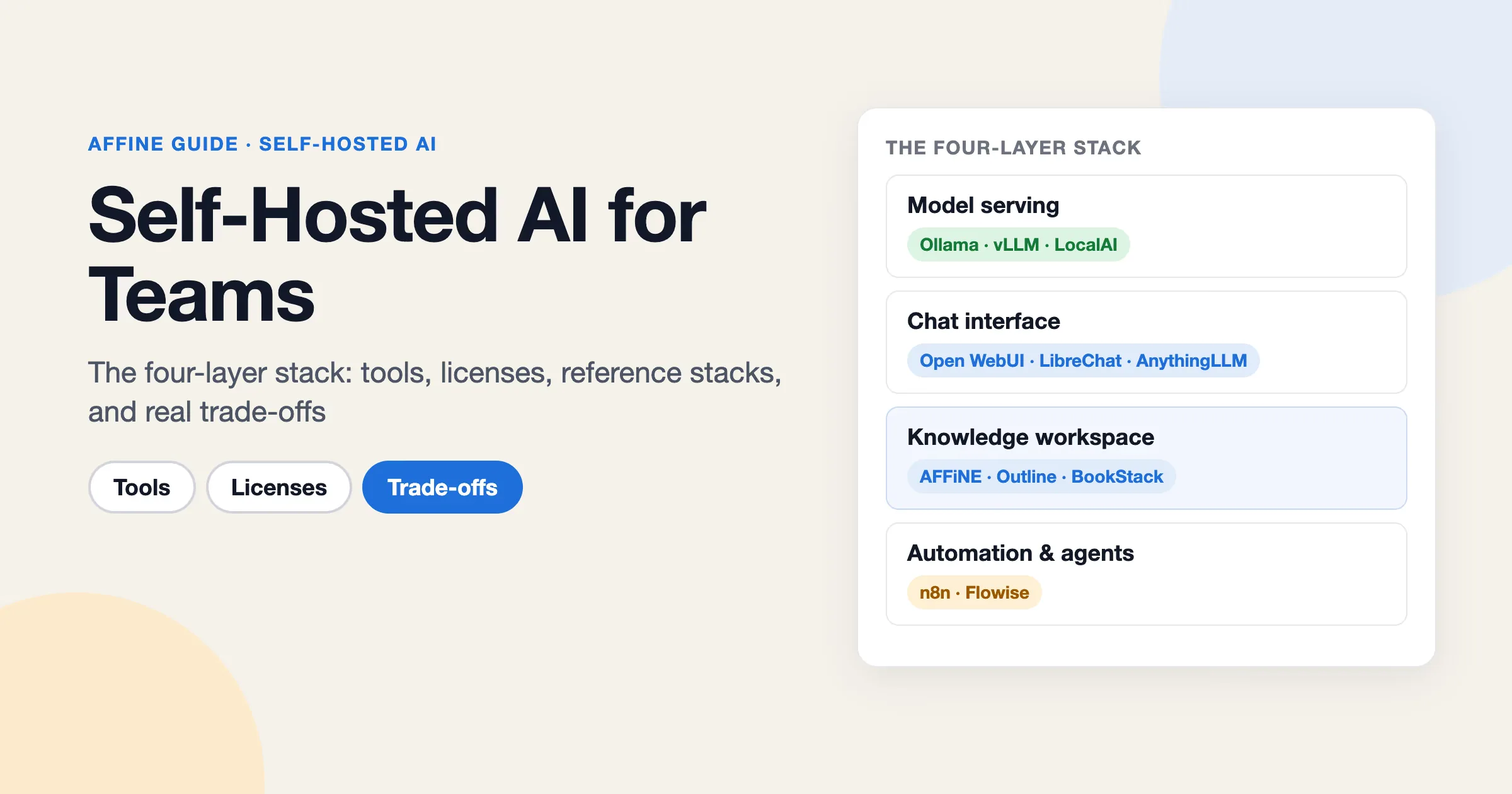
You can self-host AFFiNE on your own infrastructure. Self-hosting is free for up to 10 members per workspace; larger teams need a paid Team License. For the wider picture, from model serving to chat front ends, see our guide to self-hosted AI.
This combination is why more business teams come to AFFiNE for internal knowledge bases and private AI. They want the benefits of AI without handing their domain knowledge to a chain they cannot see. The AFFiNE project has more than 70,000 stars on GitHub as of November 2026.
What we have not built yet
Our goal is a complete privacy-first AI stack built as open-source software: a workspace where your knowledge lives, AI features you can point at the models you choose, and agent access under your control. We are not there yet, and you should know the limits before you plan around them.
- AFFiNE does not run models itself. AI features need a provider or an endpoint you connect.
- Native local model support is not shipped. It is an open community request. Today, the route to a model you host is an OpenAI-compatible endpoint that your admin allows.
- Feature coverage varies. Bring-your-own-key (BYOK) support is experimental, and AI features can behave differently across providers and self-hosted models. Test the features you plan to rely on.
A checklist for protecting your domain data
Whatever tools you choose, these steps help keep your company's knowledge yours.
- Map where your knowledge lives. List the tools that hold decisions, processes, customer knowledge, designs, and commercial terms, including AI tools.
- Read the AI terms of each tool. Confirm in writing that your content is not used for training, and check which plan the promise applies to.
- Ask about secondary uses. Find out whether prompts are reused for analytics, evaluations, or insights, and who stores those copies.
- Give people an approved option. Blocking AI tends to push use into personal accounts. A sanctioned tool with clear rules is safer.
- Keep the core in a workspace you control. Put your most valuable knowledge where you decide on storage, backups, access, and which models can see it.
- Plan your exit. Make sure you can export everything in a usable format, or run the software yourself.
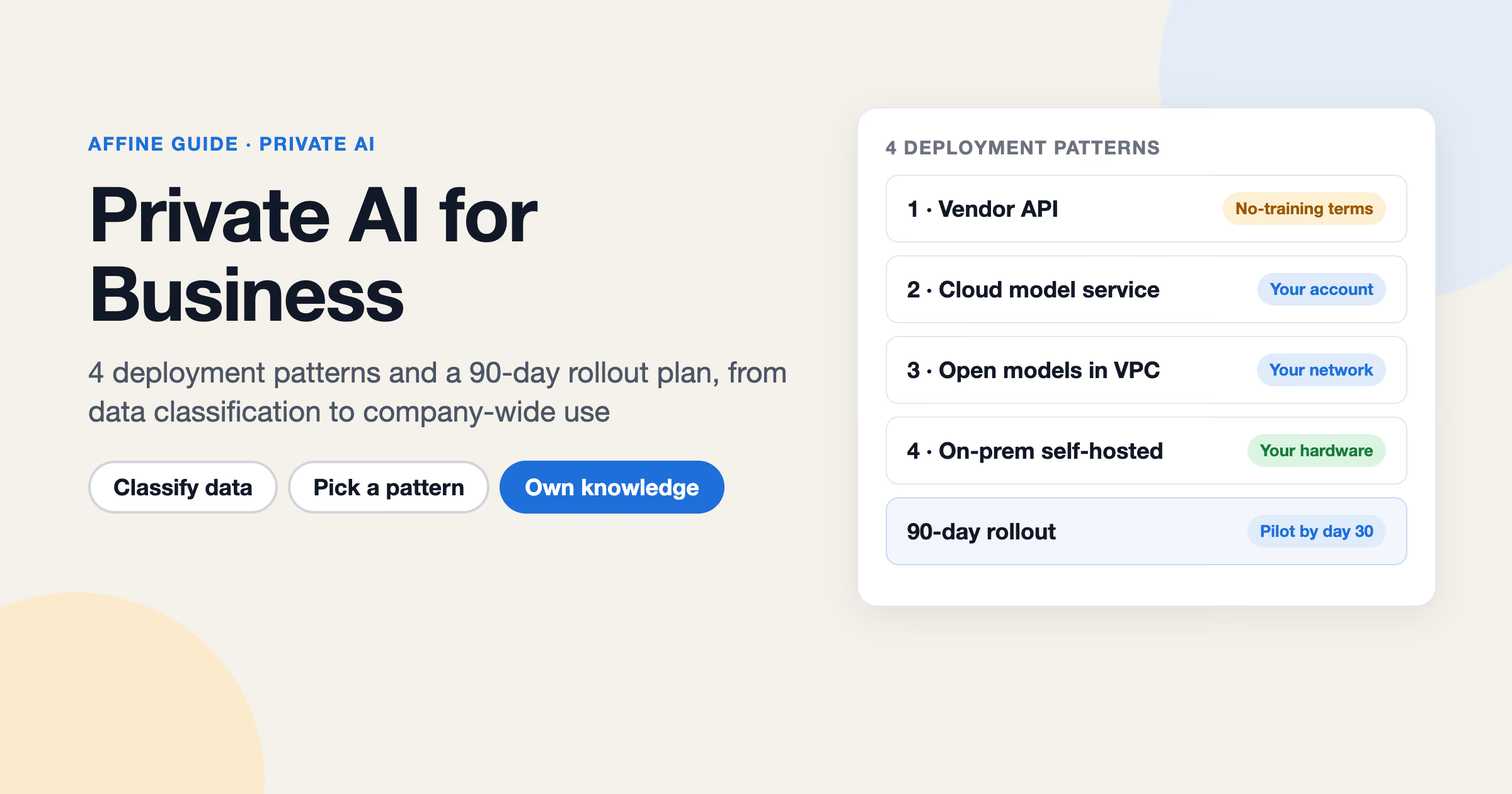
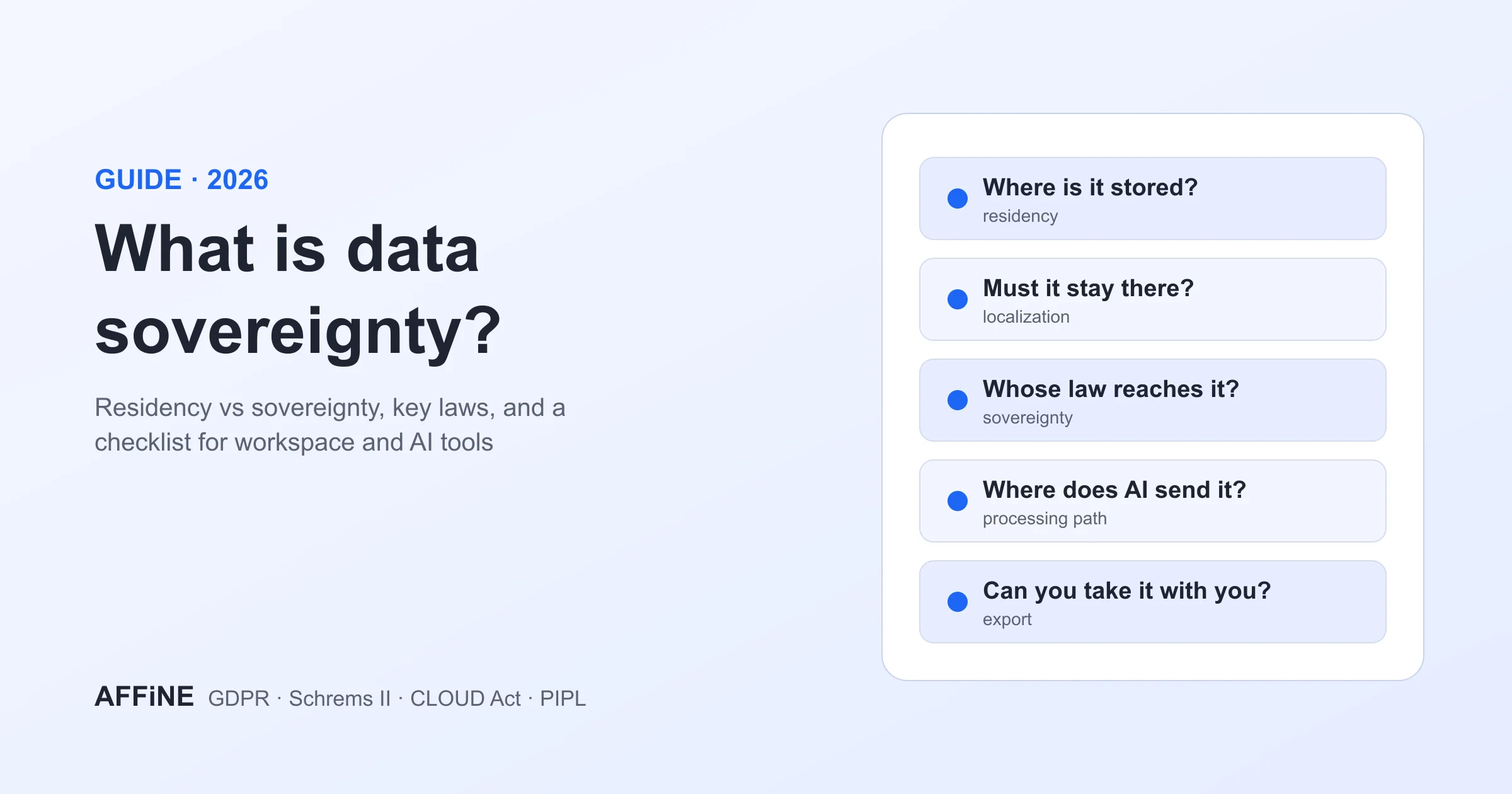
For a rollout plan, see private AI for business. For the legal side of where data lives, see what data sovereignty means.
Frequently asked questions
What is a data moat?
A data moat is a competitive advantage that comes from data competitors cannot easily get. We think the durable version is not a large volume of generic data but specific, private domain knowledge that only your company has.
Why does domain data matter more as AI improves?
General models know what is public. They become useful for your work only when they get your context, such as your specs, customers, and history. As AI does more work, that private context becomes a larger share of what sets a company apart.
Does AFFiNE train AI models on my data?
No. Our Terms state that we do not use your AFFiNE AI inputs, AI outputs, or workspace content to train or fine-tune any model, and that we do not permit our model providers to train on that content.
Is AFFiNE open source?
The editor and most client code are MIT-licensed. The server is source-available under the AFFiNE EE license. Self-hosting is free for up to 10 members per workspace, and larger teams need a paid Team License.
Can I use AFFiNE with a model my company hosts?
On a self-hosted server, an admin can allow OpenAI-compatible custom endpoints, which can point to a model your organization operates. AFFiNE does not run models itself, native local model support is not shipped, and feature coverage depends on the model, so test the features you need.
Can I use AFFiNE without AI?
Yes. AI features are optional. On a self-hosted server, admins can turn AI off for the whole server or for individual workspaces.
Sources
- Martin Casado and Peter Lauten, Andreessen Horowitz, The Empty Promise of Data Moats, 2019.
- Cyberhaven, Sensitive Enterprise Data Is Flowing Into AI Tools at Scale, from the 2026 AI Adoption and Risk Report, February 2026.
- Bloomberg, Samsung Bans ChatGPT, Google Bard, Other Generative AI Use by Staff After Leak, May 2, 2023.
- Wiz, Black October for AI developer platforms.
- AFFiNE, Terms and Privacy Policy.
- AFFiNE, Team License documentation.