Your AI Chats Have a Supply Chain: The Fireworks AI Breach and Where AFFiNE Stands
Notion AI chat transcripts were exposed through a breach at Fireworks AI. Here is what the official notices say, why it matters for any AI tool, and where AFFiNE stands.

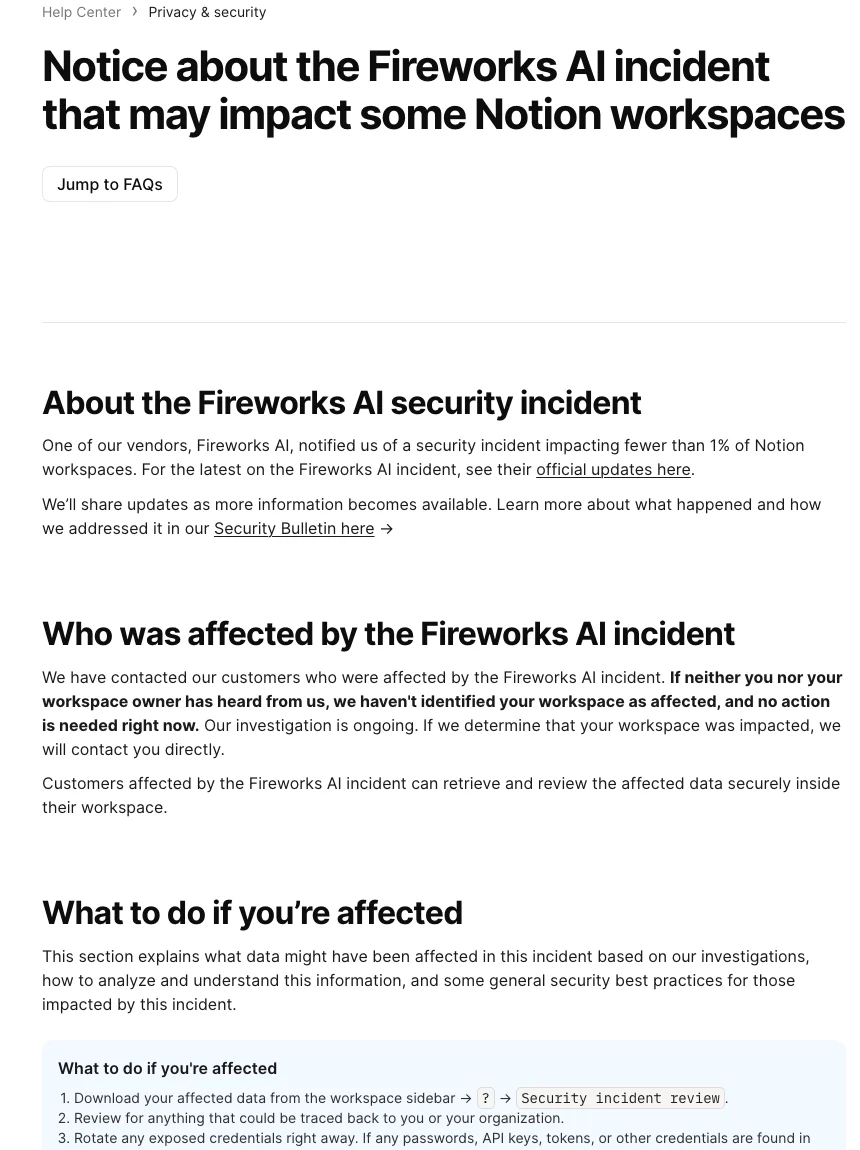
In November 2026, Notion told some customers that Notion AI chat transcripts had been exposed in a breach at Fireworks AI, an AI infrastructure company Notion used as a vendor. Notion's own systems were not breached. For every team that uses AI at work, the lesson is the same: the chat box is the front end of a supply chain, and each link in that chain can hold a copy of what you type.
This post summarizes what Fireworks AI and Notion have disclosed, explains why the incident matters beyond one product, and sets out where AFFiNE stands, including a change we made to our AI terms on November 16, 2026.
By Vincent Chen, CEO of AFFiNE. AFFiNE makes a workspace that competes with Notion, so read the section about AFFiNE as a vendor statement. Incident details come from the official notices published by Fireworks AI and Notion, which we checked and captured as screenshots on November 16, 2026. Both investigations are ongoing, and details may change.
On this page: key takeaways, timeline, what data was involved, why it matters, where AFFiNE stands, why we build AFFiNE this way, questions to ask any AI workspace, what to do now, and FAQ.
Key takeaways
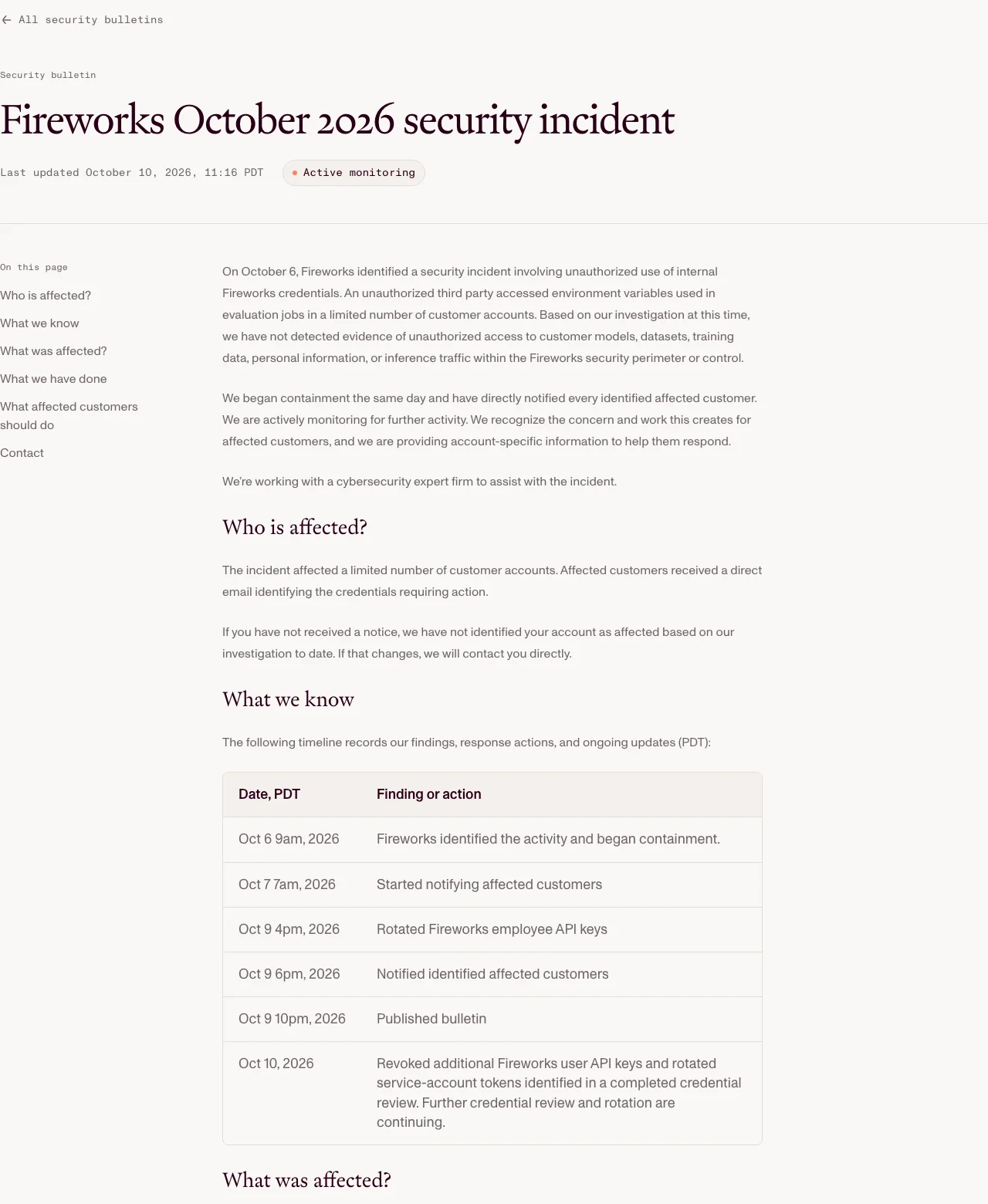
- Attackers reached Fireworks AI through a third-party cloud provider and accessed some stored customer data. That data included Notion AI chat transcripts that Notion had sent to Fireworks for a usage analytics feature called Insights.
- Notion says fewer than 1% of its workspaces may be affected. Most affected transcripts lack the metadata that links a chat to a person or workspace, but they contain the full text of what users typed and what the AI replied.
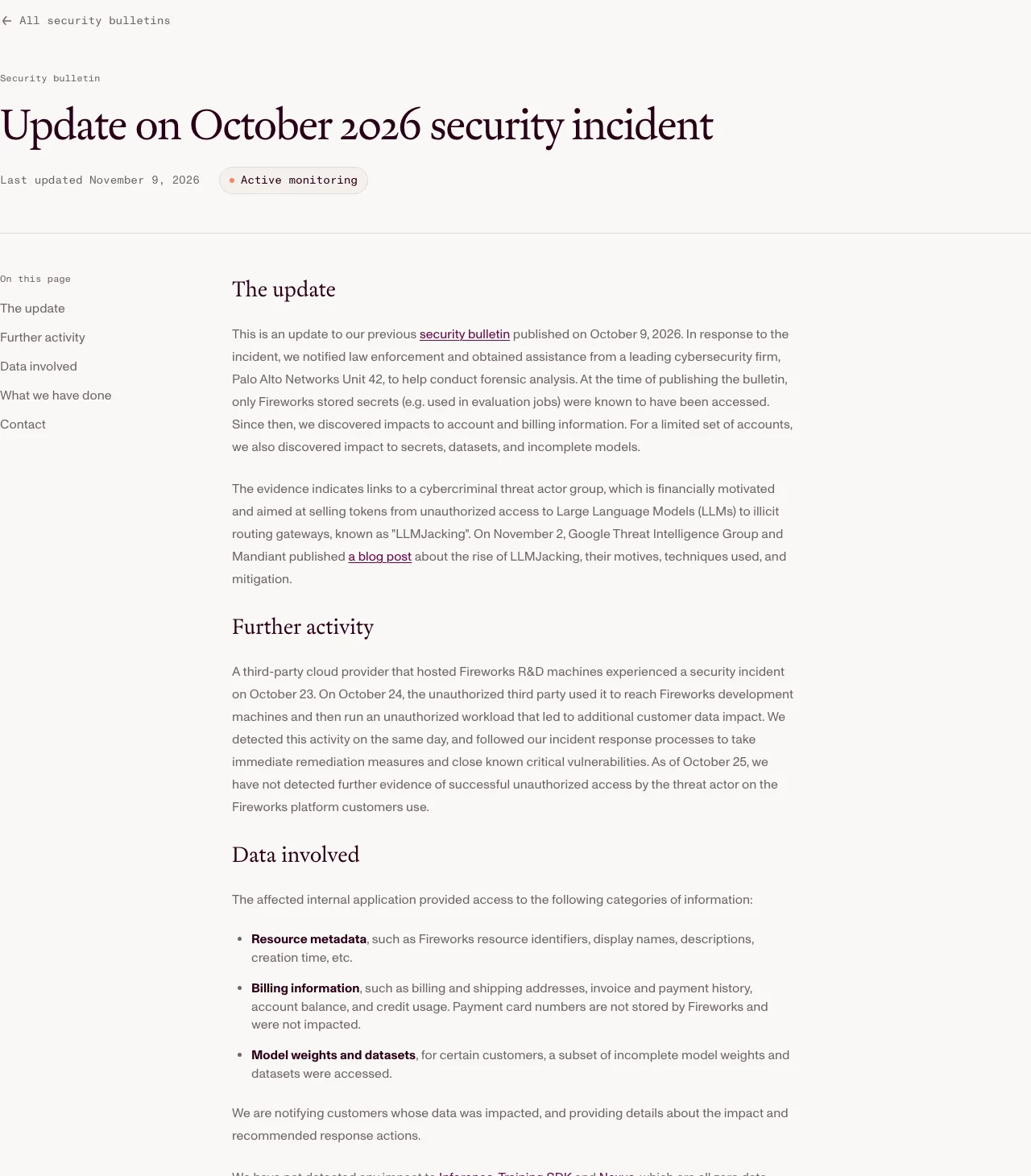
- Fireworks says its zero-data-retention products, including live inference, were not affected. The exposed Notion data was a copy sent to Fireworks after the chat, for analytics.
- AFFiNE does not use Fireworks AI, and we have not been notified of any impact on AFFiNE users.
- We have updated AFFiNE's AI terms to state plainly that we do not use your AI inputs, AI outputs, or workspace content to train any model.
- We believe domain data is one of a company's most lasting assets. That is why AFFiNE is privacy-first, local-first, open source, and self-hostable, with AI you can turn off or route to models you choose.
What happened: a timeline
| Date (2026) | What happened | Source |
|---|---|---|
| October 6 | Fireworks detects unauthorized use of internal credentials. Environment variables, including API keys and tokens stored as secrets, are captured in some customer accounts. | Fireworks bulletin |
| October 23 to 24 | A third-party cloud provider that hosted Fireworks R&D machines is breached. The attacker uses it to reach Fireworks development machines and run an unauthorized workload that affects more customer data. | Fireworks update |
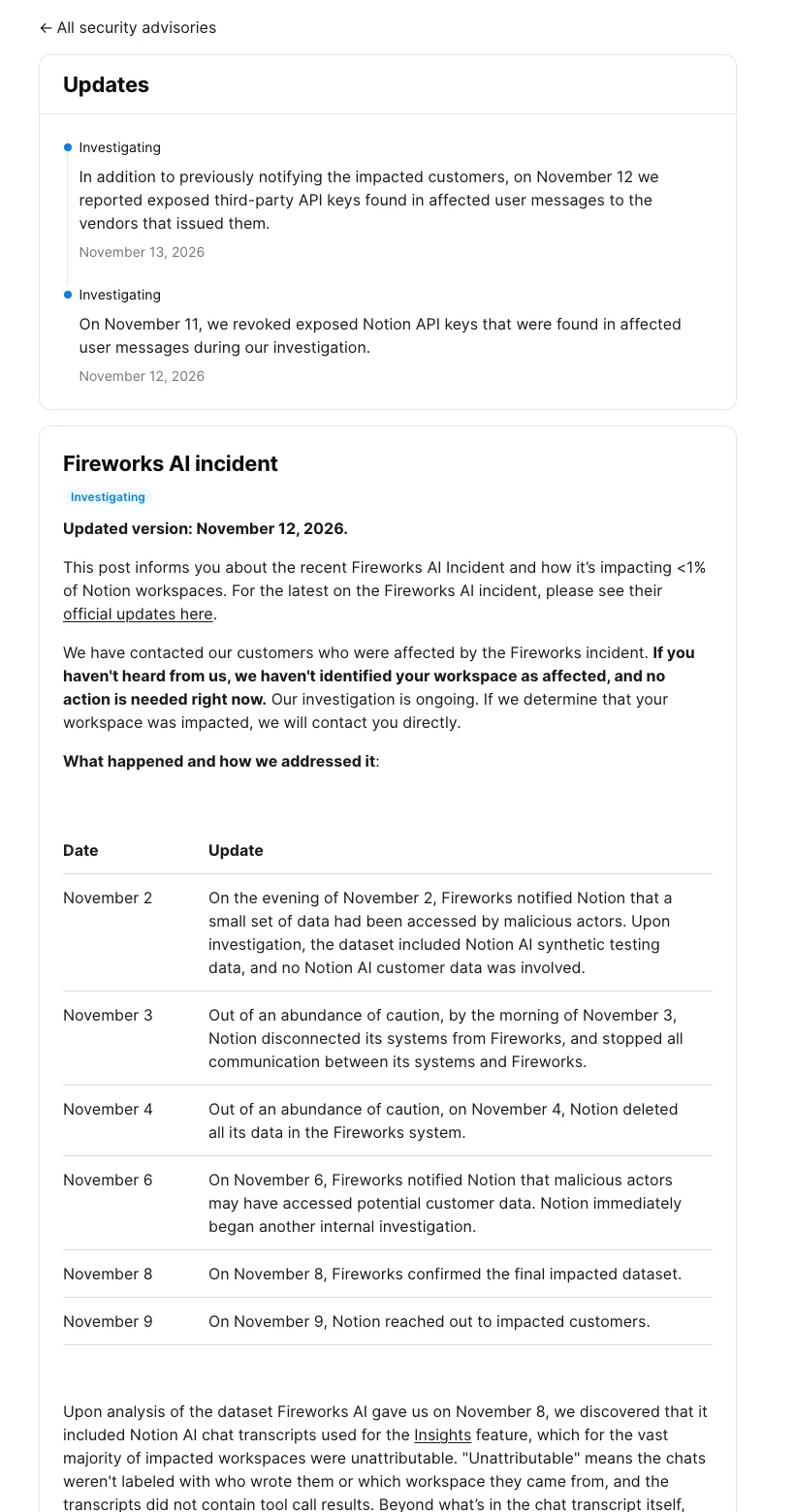
| November 2 | Fireworks tells Notion that a small set of data was accessed. Notion finds that it was synthetic test data and that no Notion AI customer data was involved. | Notion advisory |
| November 3 | Notion disconnects its systems from Fireworks and stops all communication between the two. | Notion advisory |
| November 4 | Notion deletes all of its data in the Fireworks system. | Notion advisory |
| November 6 | Fireworks tells Notion that attackers may have accessed potential customer data. Notion opens another internal investigation. | Notion advisory |
| November 8 | Fireworks confirms the final affected dataset. Notion finds that it includes Notion AI chat transcripts used for the Insights feature. | Notion advisory |
| November 9 | Notion contacts affected customers. The same day, Fireworks reports that billing information was accessed and, for a limited set of accounts, secrets, datasets, and incomplete model weights. It links the attackers to a financially motivated "LLMjacking" group. | Notion advisory, Fireworks update |
| November 11 | Notion revokes Notion API keys it found in affected chat messages. | Notion advisory |
| November 12 | Notion reports exposed third-party API keys found in affected messages to the vendors that issued them. | Notion advisory |
What data was involved
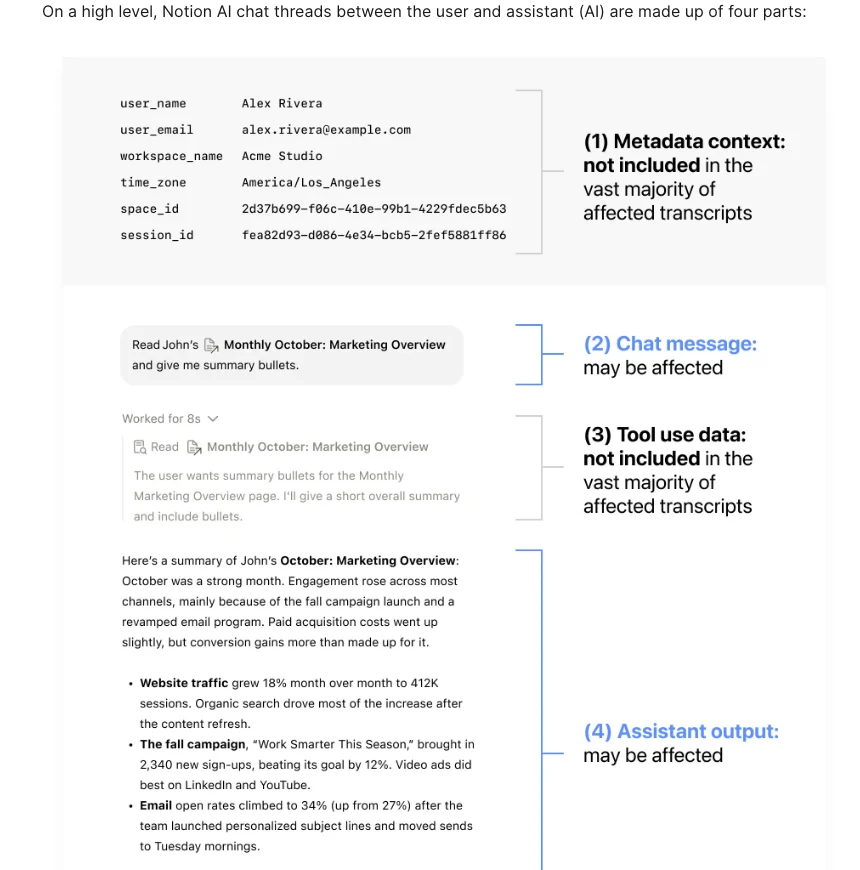
Notion's help center article splits a Notion AI chat into four parts and explains which parts were affected:
| Part of the chat | In the affected data? |
|---|---|
| Metadata added automatically, such as your name, email, or workspace details | Missing from the vast majority of affected transcripts. Notion calls these transcripts "unattributable." |
| Your chat messages | Yes, in full, including any names, email addresses, API tokens, or other details you typed. Text you had selected on the current page may also be included. |
| The assistant's tool use, such as web searches, pages read, or database queries | Not included for the vast majority of affected transcripts. |
| The assistant's replies | Yes, in full. Replies can include fragments of pages or databases the assistant used. |
Notion says the rest of a page's content, chat attachments such as spreadsheets and images, and AI Meeting Notes data were not affected, unless that content was typed into a chat message or quoted in a reply. Chats were typically sent to Fireworks within a day of the conversation.
Notion also gave affected customers a copy of the exposed data inside their workspace, and on some plans added annotations that flag likely credentials and personal data. That is a good practice, and we think every vendor should follow it.
Why this matters beyond one vendor
Notion moved quickly: it cut its connection to Fireworks, contacted affected customers, and published detailed guidance. The incident is still worth studying, because the weak points sit in places most teams never review.
1. The chain is longer than the app
Your prompt went to Notion. Notion sent a copy to Fireworks. Fireworks ran development machines on a third-party cloud provider. The attacker got in at that third link, two steps away from the product people actually used. A security review of an app is only as good as your view of the vendors behind it.
2. Secondary uses create extra copies
The exposed transcripts were not live chat traffic. They were copies sent afterward so Notion could classify AI usage for its Insights feature. Every analytics job, evaluation run, or classification pipeline that reuses prompts is another place your words are stored, often with a different vendor and different retention rules.
3. "Zero data retention" has a scope
Fireworks says its inference, Training SDK, and Nexus products are zero data retention by default and were not affected. The impact came through stored data, such as datasets, secrets, and model weights. A retention promise is only useful when you know which features it covers.
4. AI platforms are now a target
Fireworks says the attackers wanted to sell stolen access to large language models through illicit routing gateways, a practice known as LLMjacking. Fireworks was not alone: Wiz counted at least nine AI developer platforms that disclosed security incidents in October 2026.
Where AFFiNE stands
We do not use Fireworks AI. We have not been notified of any impact on AFFiNE users from this incident.
We changed our AI terms. Until this week, the AI section of our Terms included a general sentence saying we may use data from AFFiNE AI to improve our models. That sentence conflicted with our Privacy Policy, which says data sent to our AI providers is not retained for model training. We removed it. The terms now say that we do not use your AFFiNE AI inputs, AI outputs, or workspace content to train or fine-tune any model, ours or a third party's, and that we do not permit our model providers to train on that content.
Your documents start on your device. AFFiNE is local-first. Docs and whiteboards are stored on your device, and syncing a workspace to AFFiNE Cloud or to a server you run is your choice.
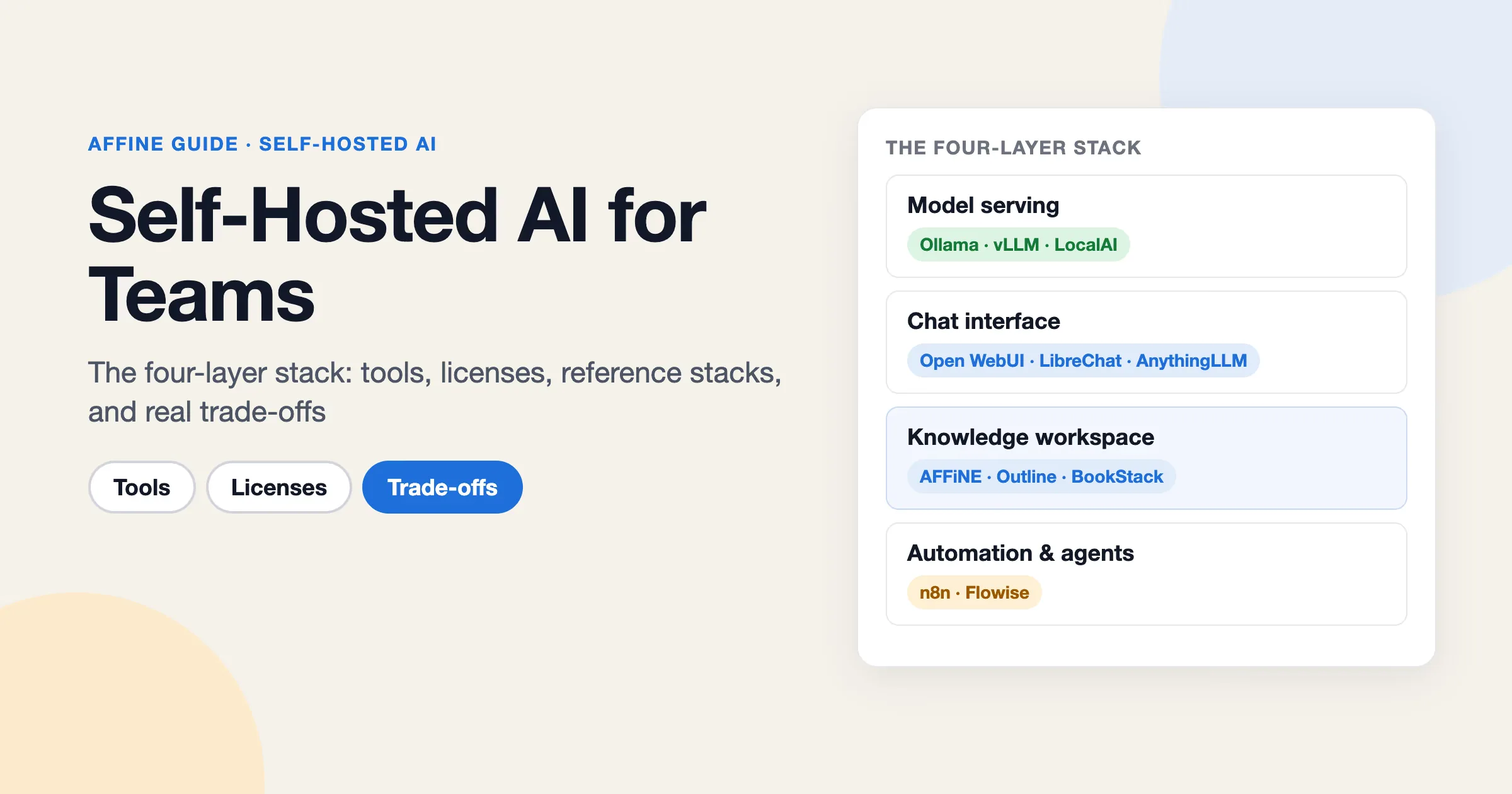
AI is optional, and on a self-hosted server you choose the chain. If you self-host AFFiNE, admins can turn AI off for the whole server or for individual workspaces, and can allow OpenAI-compatible endpoints. Workspace owners can also add their own provider keys (BYOK, experimental). Your team decides which model providers, if any, see your prompts.
What we will not claim. AFFiNE Cloud AI sends the content you submit for AI processing to third-party model providers, as our Privacy Policy describes. No hosted AI feature is free of risk, ours included. What we can offer is a short, documented chain, a no-training commitment written into our terms, and the option to turn AI off or route it yourself.
Why we build AFFiNE this way
The Fireworks incident is one example of a larger question every company now faces: who ends up holding your company's knowledge once AI is part of daily work?
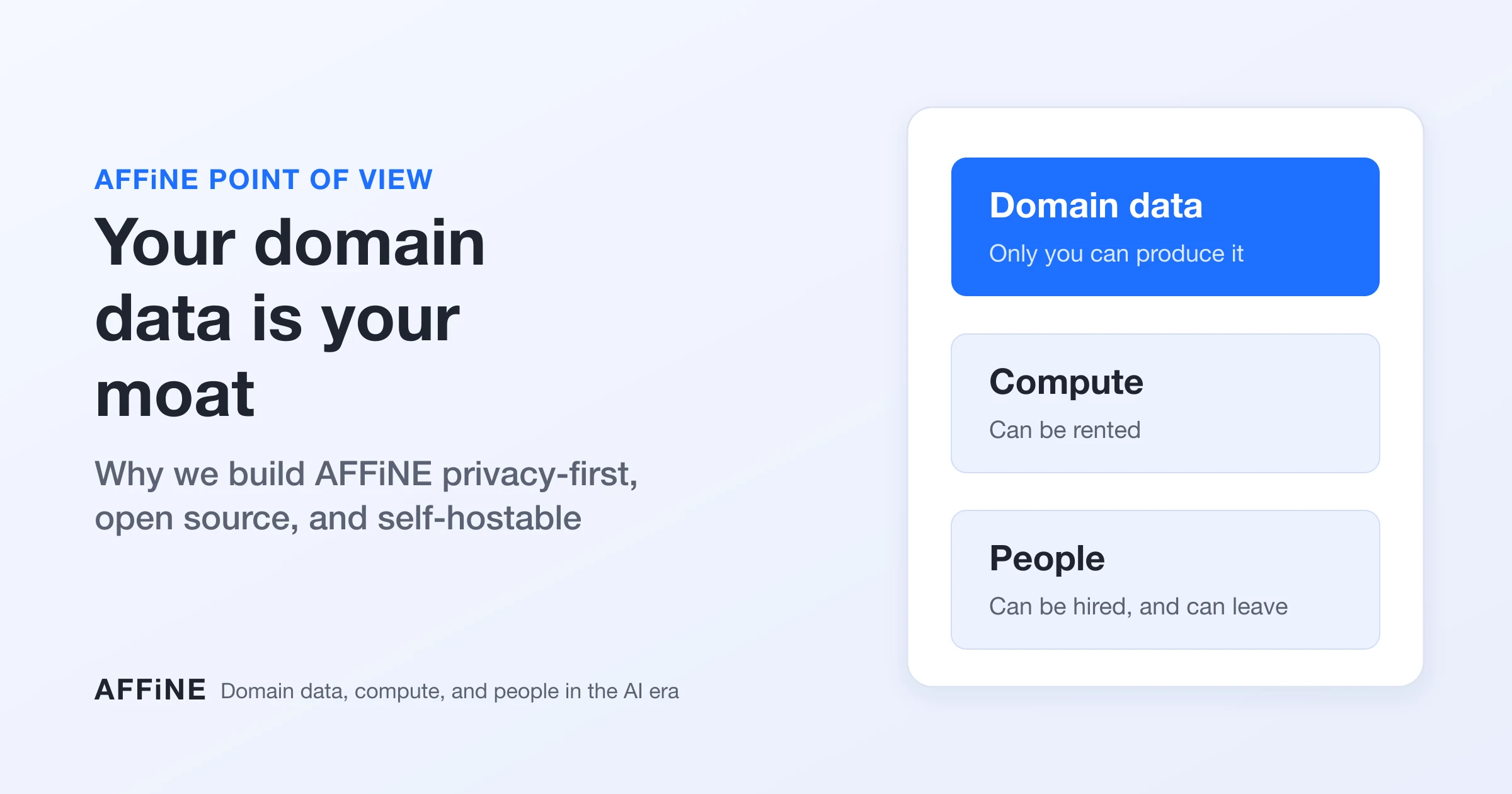
We believe the value of most companies will increasingly come from three things: domain data, compute, and people. Compute can be rented and people can be hired. What a competitor cannot rent is what your company has learned over years, and much of it now passes through AI tools. For an AI model company, data is raw material. For most other companies, it is the business itself, and once copies leave your control you cannot take them back.
That is why AFFiNE stays privacy-first:
- Local-first storage. Docs and whiteboards start on your device, and syncing to AFFiNE Cloud or your own server is your choice.
- No training on your content. Our Terms rule out using your AI inputs, AI outputs, or workspace content to train or fine-tune any model.
- Code you can inspect. AFFiNE's editor and most client code are MIT-licensed, and the server is source-available under the AFFiNE EE license.
- Infrastructure you control. You can self-host AFFiNE. Self-hosting is free for up to 10 members per workspace; larger teams need a paid Team License.
- AI you route. On your own server, AI can stay off, use your own provider keys, or call an OpenAI-compatible endpoint your organization operates.
We are working toward a complete privacy-first AI stack built as open-source software. Not all of it is finished: AFFiNE does not run models itself, and native local model support is still an open community request. We explain the full view, including what we have not built yet, in Your domain data is your moat.
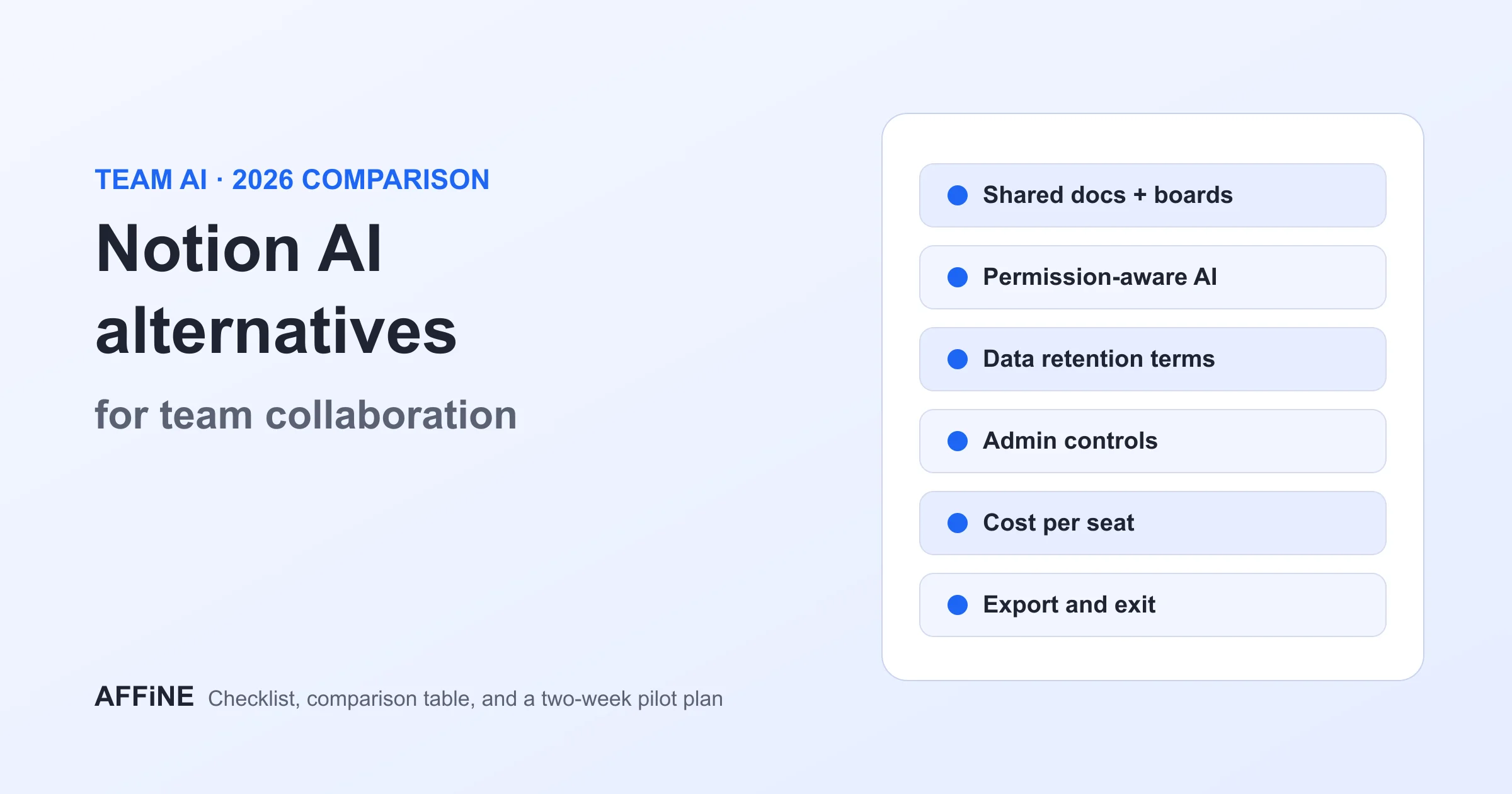
Seven questions to ask about any AI workspace
Use these questions for AFFiNE, Notion, or any other tool, and ask for the answers in writing.
- Who receives my prompts and AI replies? Ask for the list of AI subprocessors and the infrastructure providers behind them.
- Is my AI data reused after the answer is returned? Analytics, insights, evaluations, and batch jobs can each create a stored copy.
- Where are those copies stored, and for how long? Retention often differs by feature and by plan.
- What does "zero data retention" cover on my plan? Check which features are included and which are not.
- Is training on my data ruled out in the terms? A help center article is useful, but the contract is what binds the vendor.
- Can an admin turn AI off or choose the model endpoint? That includes an endpoint your own organization runs.
- If a vendor is breached, what will I get? Look for direct notice, a timeline, and a copy of the affected data.
What to do now
If you use Notion AI, follow Notion's guidance. Notion says that if neither you nor your workspace owner has heard from it, it has not identified your workspace as affected. If you were affected, download the data from the workspace sidebar under ? and then Security incident review, rotate any credentials you find, and watch for phishing that uses names or details from your chats.
For every team using AI at work:
- Never paste passwords, API keys, or tokens into an AI chat, in any tool. Keep them in a secrets manager.
- Keep a short register of the AI features your team uses and the vendors behind each one.
- Turn off AI features you do not use, especially analytics or insight features that reuse prompts.
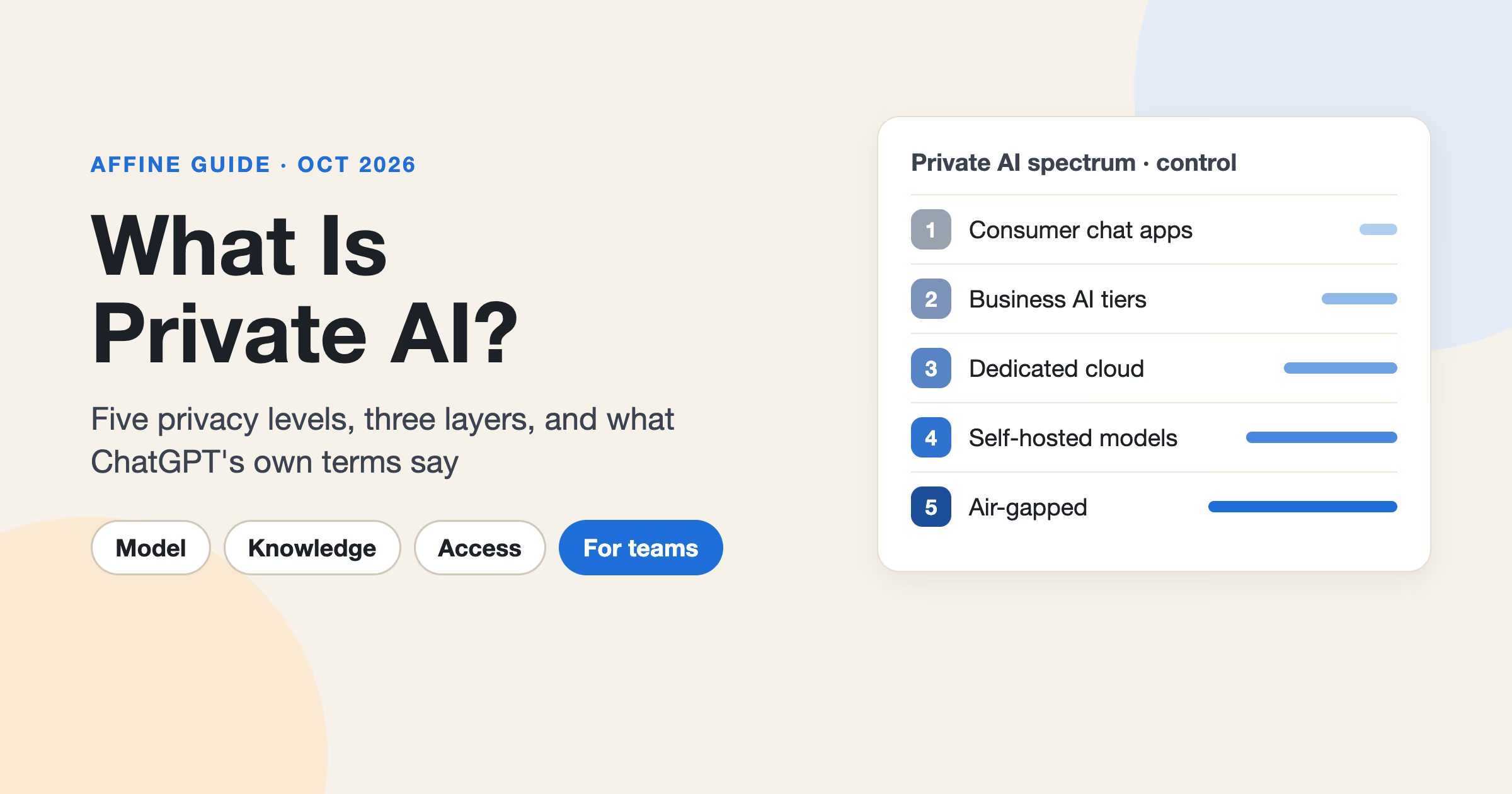
- Keep your knowledge base where you control storage, backups, and access. Our guide to private AI explains the options, from business AI plans to self-hosted AI.
Frequently asked questions
Was Notion hacked?
No. According to Notion and Fireworks AI, attackers breached Fireworks AI, reaching it through a third-party cloud provider. The exposed data was Notion AI chat transcripts that Notion had sent to Fireworks for its Insights feature.
How many Notion workspaces were affected?
Notion says fewer than 1% of workspaces may be affected and that it contacted affected customers directly. If neither you nor your workspace owner heard from Notion, it has not identified your workspace as affected.
What is LLMjacking?
LLMjacking is the theft of access to large language models, usually through stolen cloud credentials or API keys, so that attackers can resell that access. Fireworks says the evidence links this incident to a group that sells such access through illicit routing gateways.
Was AFFiNE affected by the Fireworks AI incident?
No. AFFiNE does not use Fireworks AI, and we have not been notified of any impact on AFFiNE users.
Does AFFiNE train AI models on my data?
No. Our Terms state that we do not use your AFFiNE AI inputs, AI outputs, or workspace content to train or fine-tune any model, and that we do not permit our model providers to train on that content.
Can I use AFFiNE without AI?
Yes. AI features in AFFiNE are optional. On a self-hosted AFFiNE server, admins can turn AI off for the whole server or for individual workspaces.
Sources
- Fireworks AI, October 2026 security incident, October 9, 2026.
- Fireworks AI, Update on October 2026 security incident, November 9, 2026.
- Notion, Fireworks AI incident security advisory, updated November 12, 2026.
- Notion, About the Fireworks AI security incident, help center.
- TechCrunch, Cyberattack on Fireworks AI allowed hackers to access Notion customers' chat transcripts, November 12, 2026.
- VentureBeat, Attackers breached the Fireworks AI storage where Notion AI chats sat outside zero data retention, November 11, 2026.
- Wiz, Black October for AI developer platforms.