What Is Data Sovereignty? Residency, Laws, and Business Checklist
Data sovereignty explained for business: residency vs localization vs sovereignty, GDPR, Schrems II, the CLOUD Act and PIPL, plus a workspace and AI tool checklist.

Data sovereignty is the idea that data is subject to the laws of every jurisdiction with authority over it: where it is stored, where the people it describes are, and where the company holding it is based. For a company, it comes down to three questions about every document, chat log, and AI prompt: where is it stored, whose laws reach it, and who can access it without your approval.
The term is often used as a synonym for data residency. They are not the same. Data can sit in a Frankfurt data center and still be reachable through a foreign government's legal process if the provider is subject to that government's laws. This guide explains the difference, summarizes the laws that create most sovereignty questions for business teams, and gives a practical checklist for choosing documentation, knowledge base, and AI tools.
At a glance
- Data residency is a fact about location: the data is stored in a named country or region.
- Data localization is a legal rule that data must stay in a country, sometimes with no transfer allowed.
- Data sovereignty is about legal control: which laws apply and who can compel access, wherever the servers are.
- For workspace tools, check five things: hosting location, the provider's home jurisdiction, where AI requests go, who holds keys and admin rights, and whether you can export everything.
Published by AFFiNE, which makes a workspace product discussed in this article. Legal sources were read on official EU, US, and Chinese government, legislature, or court websites, and the legal status described here is as of October 27, 2026. This article was written and reviewed by the AFFiNE team; it has not been reviewed by a lawyer. It is general information, not legal advice. Ask qualified counsel in each relevant jurisdiction about your specific transfers and obligations.
Data sovereignty vs data residency vs data localization
The three terms describe different things. Mixing them up is the most common reason teams buy a "European region" and still fail a customer's security review.
| Term | Question it answers | Who sets it | Example |
|---|---|---|---|
| Data residency | Where is the data physically stored and processed? | Usually the company or the customer contract | "All workspace data is stored in the EU region." |
| Data localization | Must the data stay inside a country by law? | A government | China's PIPL requires certain operators to store personal information inside China |
| Data sovereignty | Whose laws govern the data, and who can compel access to it? | Laws of every country with a claim to the data or the provider | A US provider can be ordered to disclose data it controls, even if it is stored abroad |
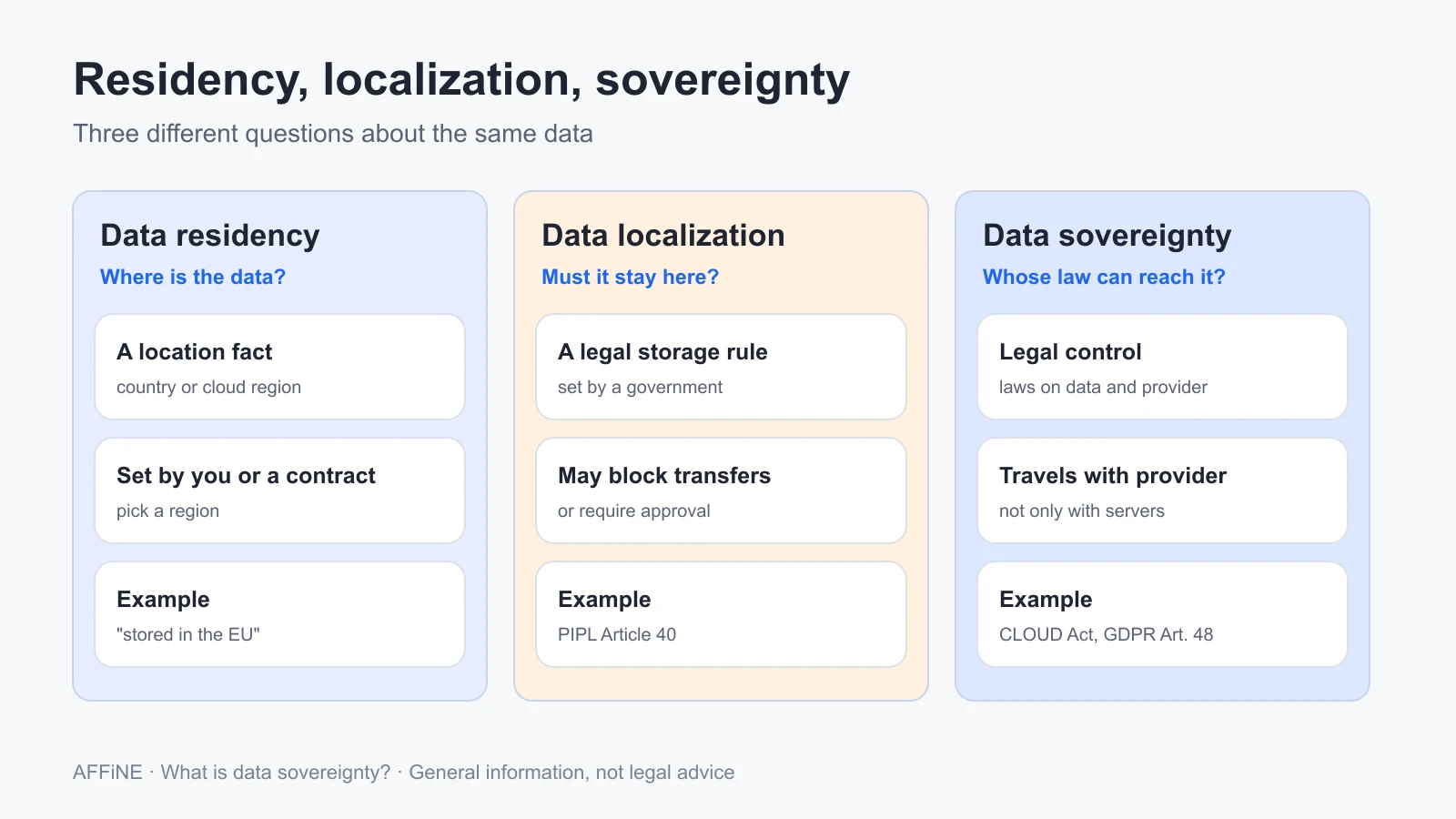
A simple way to remember it: residency is a map pin, localization is a fence, and sovereignty is the question of who holds the keys to the gate. You can choose residency by picking a region. You cannot choose sovereignty by picking a region alone, because the provider's own legal obligations travel with it.
Why data sovereignty matters for company documents and AI
Most writing on this topic comes from cloud infrastructure vendors and focuses on databases and storage buckets. For most teams, the bigger exposure is everyday collaboration content: meeting notes, contracts, product specs, customer research, HR documents, and the prompts people paste into AI tools.
This content has three properties that make sovereignty harder:
- It is unstructured. Personal data, trade secrets, and regulated information end up mixed together in the same page. You cannot easily classify a meeting note the way you classify a database column.
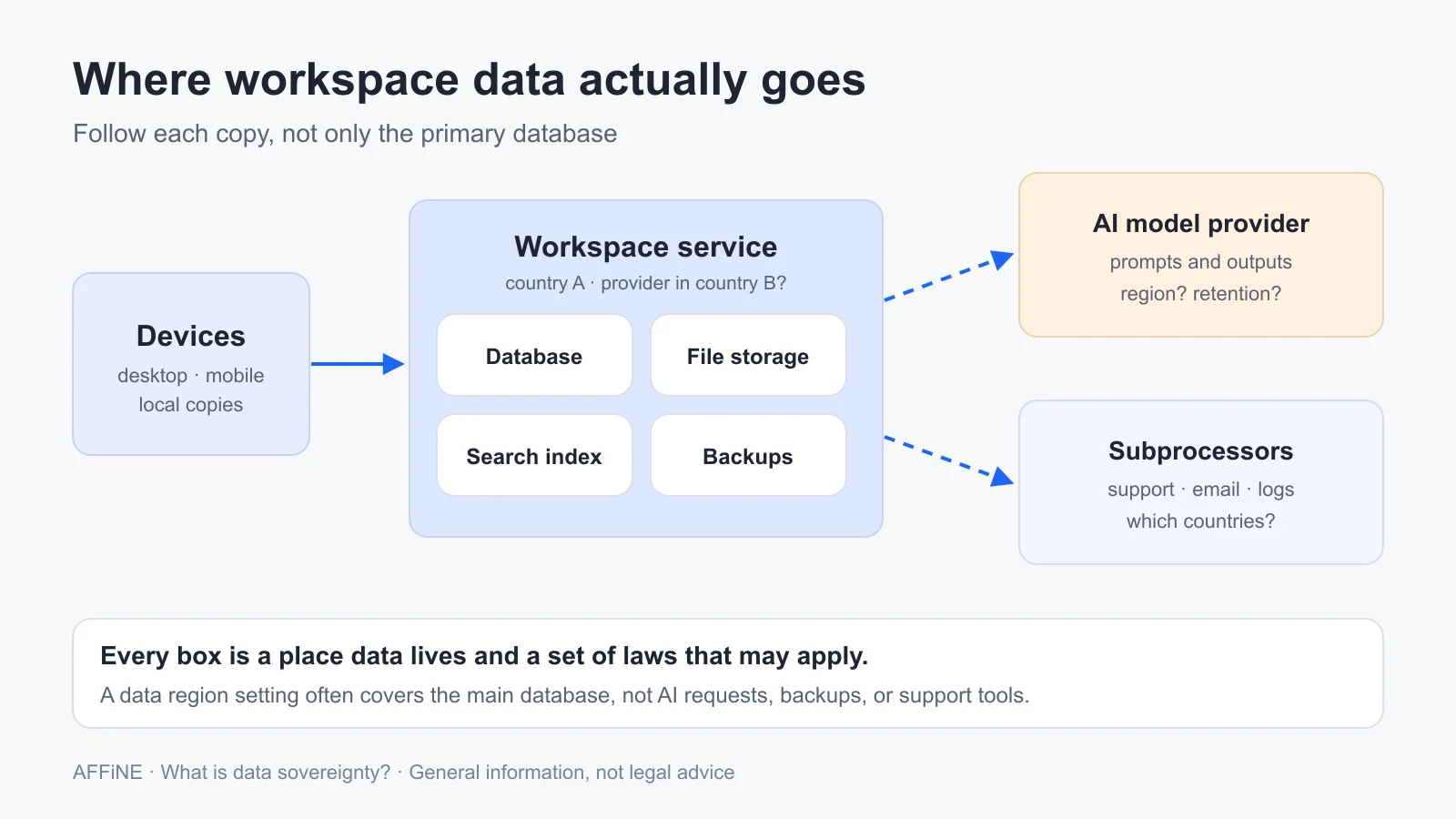
- It moves. A single document can be synced to laptops and phones, indexed for search, cached by a collaboration server, and sent to an AI model for a summary.
- AI adds a second processing path. Hosting the workspace in your preferred region does not mean AI processing happens there. When a user clicks "summarize," the text may go to a model provider in another country under that provider's terms.
The practical consequence is that a sovereignty review for a workspace tool has to follow the data through every path, not just the primary database.
Key laws behind data sovereignty
The laws below are the ones business teams run into most often when they choose a collaboration or AI tool. This is a summary, not a full survey. Many other countries have their own transfer or localization rules, and sector rules (for example in finance, health, or public procurement) can add more.
EU: GDPR rules on international transfers
The General Data Protection Regulation applies to processing of personal data in the context of an EU establishment, whether or not the processing happens in the EU, and to non-EU companies that offer goods or services to people in the EU or monitor their behavior (GDPR Article 3). In other words, moving servers outside the EU does not take you outside the GDPR. Note that the GDPR covers personal data. Trade secrets and other non-personal company data are governed by other laws and by your contracts.
Chapter V controls transfers out of the EU. Article 44 says any transfer to a third country may only take place if the conditions in that chapter are met. The main routes are an adequacy decision by the European Commission (Article 45), appropriate safeguards such as standard contractual clauses (Article 46) or binding corporate rules (Article 47), and narrow derogations for specific situations (Article 49).
Article 48 deals directly with foreign disclosure orders. It says a foreign court judgment or administrative decision requiring a company to transfer or disclose personal data may only be recognized or enforced if it is based on an international agreement, such as a mutual legal assistance treaty. This is where EU law and foreign disclosure laws can pull in different directions.
EU-US: Schrems II and the Data Privacy Framework
On July 16, 2020, the Court of Justice of the EU ruled in Case C-311/18, known as Schrems II. It invalidated the EU-US Privacy Shield adequacy decision. It held that the Commission's standard contractual clauses remained valid, but companies relying on them must check whether the law of the destination country allows the promised level of protection to be met in practice (CJEU press release No 91/20).
On July 10, 2023, the European Commission adopted a new adequacy decision for the EU-US Data Privacy Framework. Personal data can flow from the EU to US companies that participate in the framework. The Commission says the decision followed a 2022 US Executive Order and Department of Justice regulation that added safeguards on signals intelligence and a redress mechanism (European Commission, EU-US data transfers).
On September 3, 2025, the EU General Court dismissed a challenge to that decision in Case T-553/23, Latombe v Commission (judgment on EUR-Lex). An appeal, Case C-703/25 P, was filed with the Court of Justice on October 31, 2025 (notice on EUR-Lex). When we checked on October 27, 2026, the Court of Justice had not yet ruled on that appeal.
A second source of uncertainty comes from the US. On June 29, 2026, the US Supreme Court held in Trump v. Slaughter that statutory limits on the President's power to remove Federal Trade Commission commissioners are unconstitutional (Congressional Research Service summary). The FTC enforces companies' Data Privacy Framework commitments. On July 31, 2026, the European Data Protection Board wrote to the European Commission, noting that independent supervisory authorities are a key element of an adequacy assessment under GDPR Article 45(2)(b) (EDPB letter). Neither event suspends the adequacy decision. It stays in force unless the Commission amends, suspends, or repeals it, or the Court of Justice annuls it.
The framework is in force, but its long-term future depends on the courts and on the Commission's review. Two practical points follow: check that a US vendor is actually certified under the framework, and keep a fallback transfer mechanism in your contracts.
US: the CLOUD Act
The Clarifying Lawful Overseas Use of Data Act of 2018 added section 2713 to Title 18 of the US Code. It requires providers of electronic communication or remote computing services to preserve, back up, or disclose data within their "possession, custody, or control" when US law requires it, "regardless of whether such communication, record, or other information is located within or outside of the United States" (18 U.S.C. § 2713). The US Department of Justice also uses the act to make executive agreements with other countries on cross-border access to electronic evidence (DOJ CLOUD Act resources).
For a buyer, the point is narrow but important. If your workspace provider is subject to US jurisdiction and controls your data, choosing an EU or Asian storage region does not, by itself, remove the possibility of a lawful US order. The same logic applies in reverse to providers subject to other countries' disclosure laws. How often such orders happen, and what legal challenges a provider can raise, are questions for the provider's transparency report and your counsel.
China: the Personal Information Protection Law
China's Personal Information Protection Law (PIPL) took effect in 2021 (official English translation, National People's Congress). Article 38 says a company that needs to provide personal information outside China must meet one of several conditions: pass a security assessment by the Cyberspace Administration of China (CAC), obtain personal information protection certification, sign the CAC's standard contract with the overseas recipient, or meet other conditions set by law. Article 39 requires telling individuals about the overseas recipient and obtaining their separate consent.
Article 40 is a localization rule. Critical information infrastructure operators, and companies that handle personal information above volumes set by the CAC, must store personal information they collect or generate in China, and need a security assessment before sending it abroad. The CAC's Provisions on Promoting and Regulating Cross-Border Data Flows, in force since March 22, 2024, set the current thresholds. For companies that are not critical information infrastructure operators, counted from January 1 of each year:
- fewer than 100,000 people's non-sensitive personal information sent abroad is exempt from the three mechanisms (Article 5);
- 100,000 to under 1 million people's non-sensitive personal information, or fewer than 10,000 people's sensitive personal information, needs the standard contract or certification (Article 8);
- 1 million or more people's non-sensitive personal information, 10,000 or more people's sensitive personal information, or any important data needs a CAC security assessment (Article 7).
The provisions also exempt some transfers regardless of volume, such as those needed to perform a contract with the individual or for cross-border HR management, and they let free trade zones publish their own negative lists. Notice and separate consent duties under the PIPL still apply (Article 10). These rules change often, so confirm the current version with counsel before you plan a transfer.
What these laws mean together
None of these laws says "never use a foreign cloud." They say that location, transfer mechanism, and the provider's legal exposure all matter, and that you must be able to show your reasoning. For collaboration tools, that usually means documenting:
- where workspace content, files, backups, and search indexes are stored;
- which countries' laws apply to the provider and each subprocessor;
- which transfer mechanism covers each cross-border flow, including AI requests;
- what you would do if that mechanism were struck down.
Ways to get more control over your workspace data
There is no single sovereign setup. Most teams choose from four options, each with different trade-offs.
| Option | What you control | What you still depend on | Effort | Suits |
|---|---|---|---|---|
| SaaS with a chosen data region | Storage region, through settings or contract | The provider's jurisdiction, subprocessors, and AI routing | Low | Teams whose main need is residency |
| SaaS from a provider based in your jurisdiction | Region and provider jurisdiction | The provider's subprocessors and AI providers | Low | Teams worried about foreign disclosure orders |
| Self-hosted on infrastructure you choose | Server location, admin access, backups, network | The software vendor for updates and licenses; your hosting provider's jurisdiction | Medium to high | Teams that need strong control and can operate a service |
| Self-hosted on your own hardware or a local-first app | Almost everything, including offline use | Your own operations and security | High | Regulated or air-gapped environments, small sensitive teams |
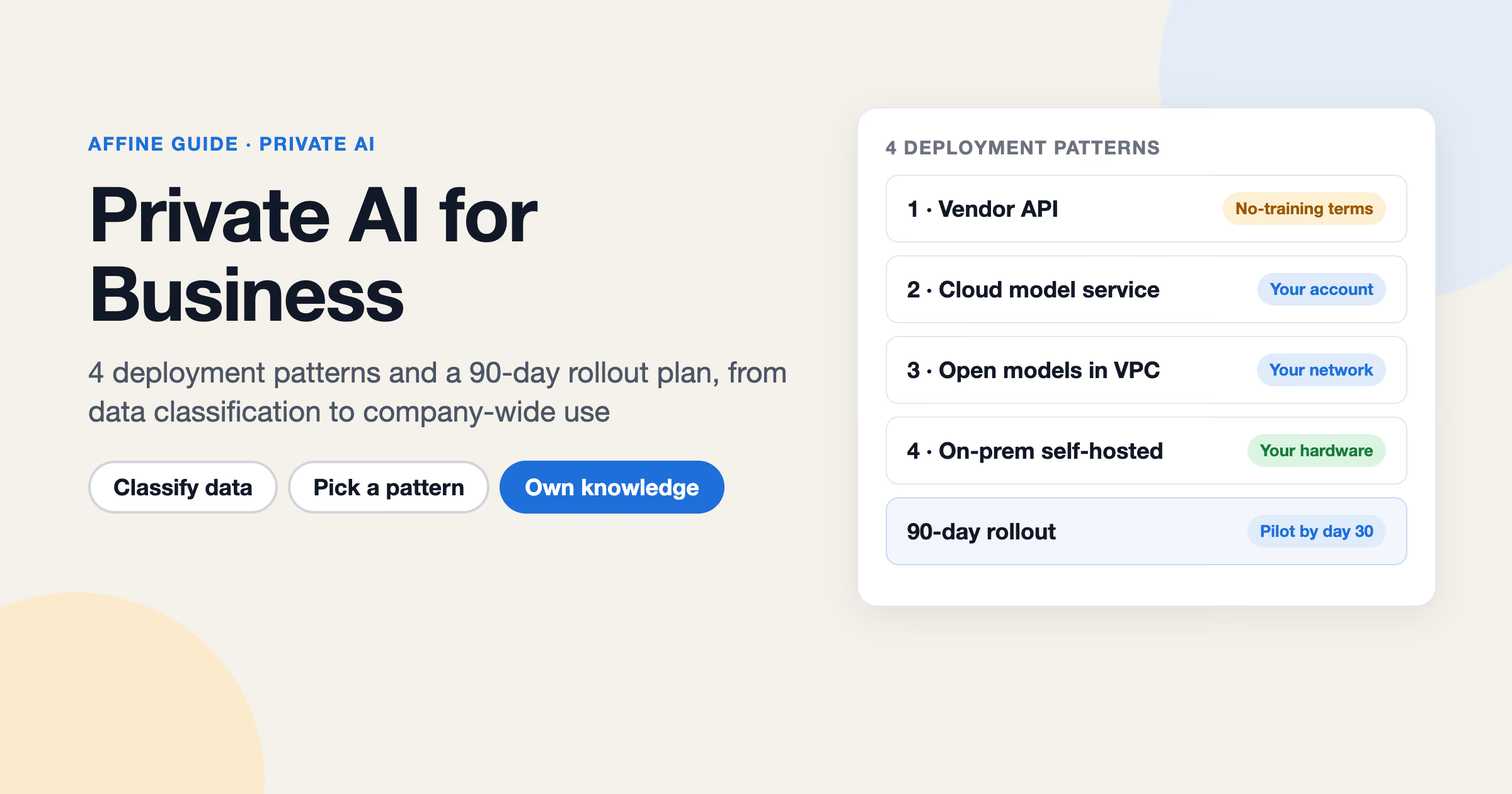
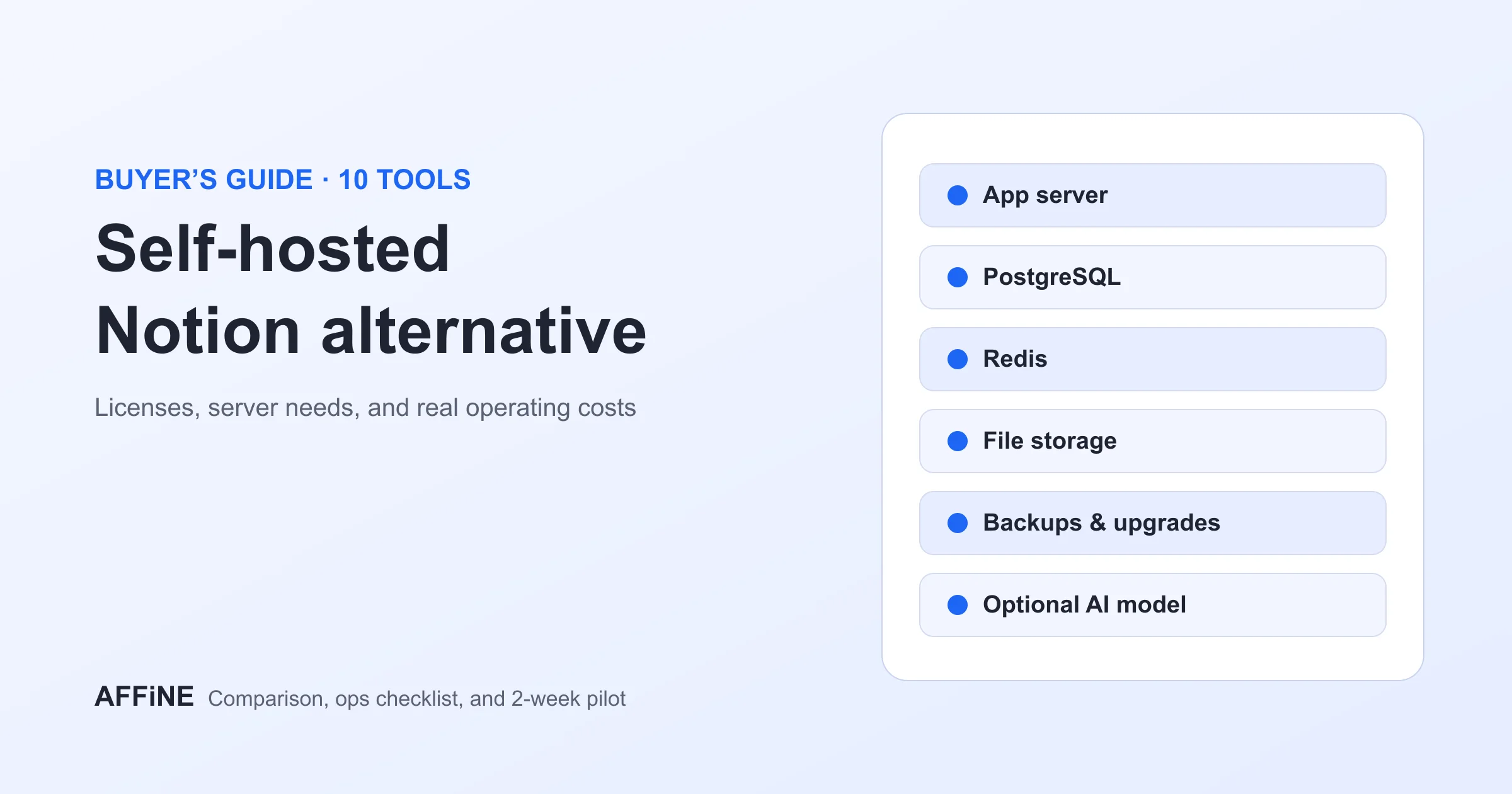
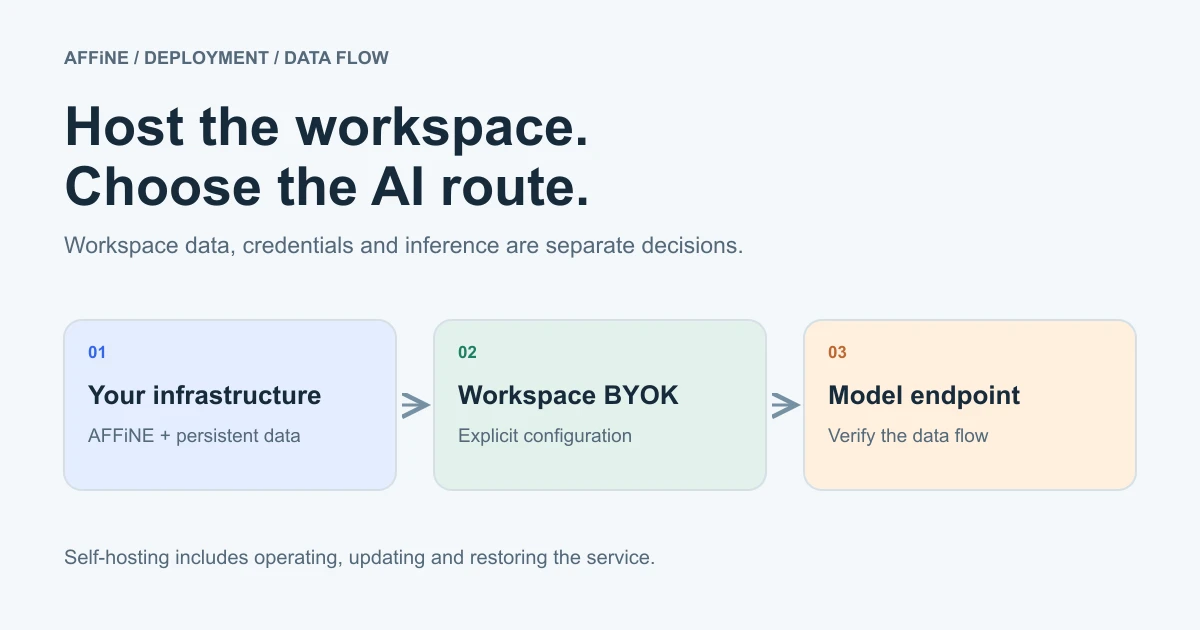
Self-hosting is not automatically sovereign. If you run the software on a US hyperscaler's EU region, the hosting provider's legal exposure still applies to the machines. If your self-hosted app sends AI requests to an external model, the text leaves your environment. The self-hosted Notion alternative guide covers what running a workspace server actually involves, and the self-hosted AI workspace guide maps where data and AI requests go in an AFFiNE deployment. For the model side, see how to build a self-hosted AI stack, including when running your own model endpoint is worth the work.
Checklist: choosing a workspace tool for data sovereignty
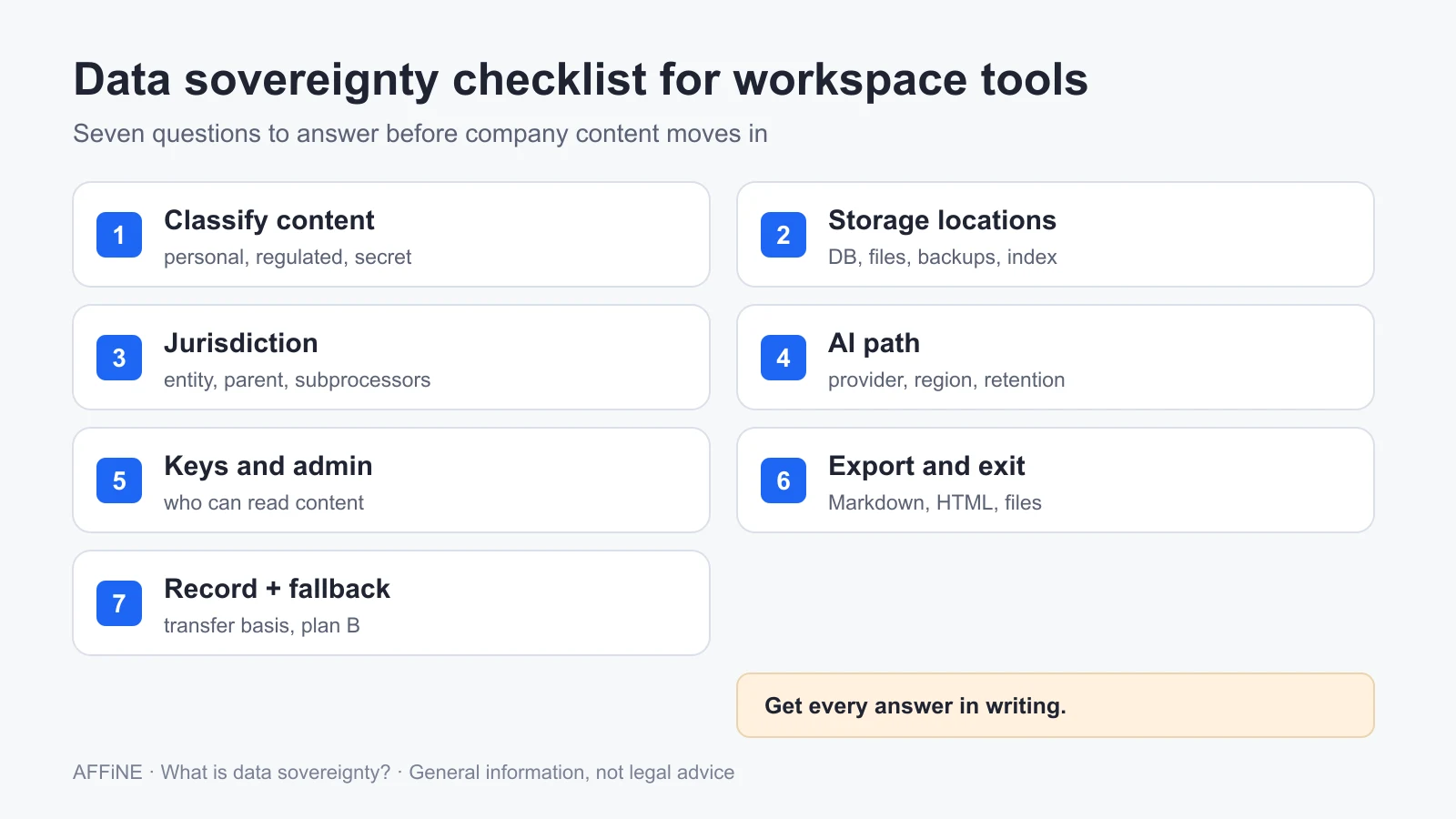
Use these steps when you evaluate a docs, wiki, knowledge base, or AI tool. Ask vendors for written answers and keep them with your records of processing.
Classify the content you will put in the tool
List the content types the tool will hold, such as meeting notes, customer records, HR files, source code, or contracts. Mark which ones contain personal data, regulated data, or trade secrets. A tool that is fine for public marketing drafts may be wrong for HR investigations.
Confirm where every copy is stored
Ask where the primary database, uploaded files, backups, search indexes, logs, and caches are stored. A data region setting often covers the main database but not backups or support tooling. Ask whether the region can be pinned in the contract.
Identify the provider's jurisdiction and subprocessors
Find the legal entity you contract with, its parent company, and the countries its subprocessors operate in. Ask whether the provider can be compelled by a foreign government to disclose your data, how it handles such requests, and whether it publishes a transparency report.
Trace the AI processing path
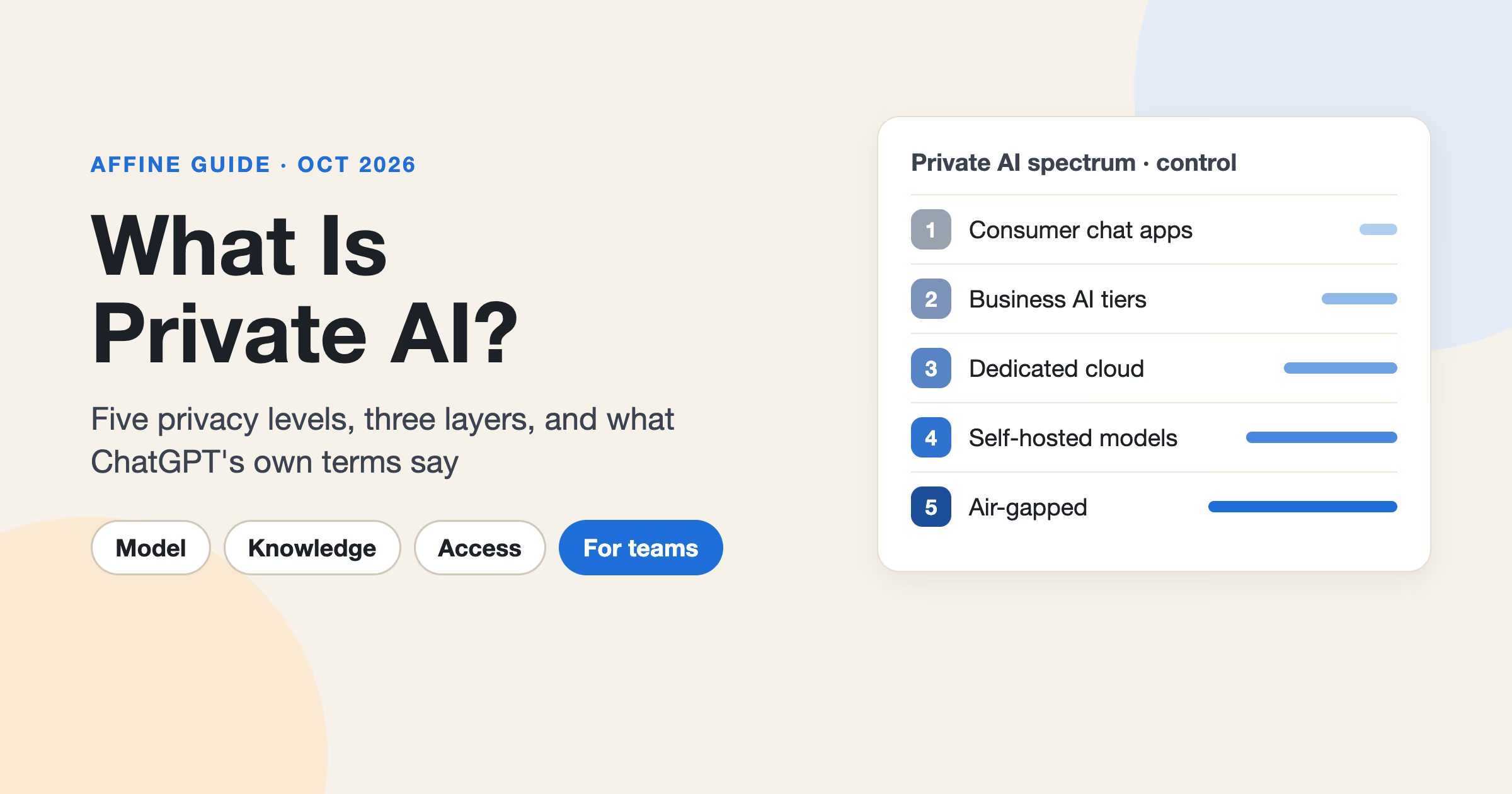
For every AI feature, ask which model provider processes the request, in which region, how long prompts and outputs are kept, and whether they are used for training. Check whether administrators can turn AI off, choose the provider, or use a model endpoint you run. Our private AI for business guide has a fuller list of AI vendor questions.
Check who holds keys and admin access
Ask who manages encryption keys, whether provider staff can read workspace content, and how support access is granted and logged. If you self-host, decide who on your team holds server and database credentials.
Test export and exit before you commit
Export a sample workspace in an open format, such as Markdown or HTML, and confirm attachments come with it. Sovereignty includes the ability to leave. A tool you cannot export from keeps your data under its terms long after the contract ends.
Record the decision and a fallback
Write down the transfer mechanism you rely on for each flow, such as an adequacy decision, standard contractual clauses, or no transfer at all. Note the fallback if that mechanism changes, for example moving AI to a regional endpoint or moving the workspace to self-hosting.
Where AFFiNE fits, and where it does not
AFFiNE is a workspace for docs, whiteboards, and databases. It is relevant to data sovereignty because it can run in three ways: as AFFiNE Cloud, as local-first desktop apps, or self-hosted on a server you choose with the official Docker Compose setup.
What the documentation supports:
- Self-hosting on infrastructure you pick. You decide the country, hosting provider, and network. Self-host is free for up to 10 seats per workspace. Larger teams need the Team plan ($10 per seat per month billed annually) or an Installable License for networks that cannot reach AFFiNE's license service (self-host overview).
- AI routing you choose. Self-hosted AFFiNE uses workspace-level bring-your-own-key for OpenAI, Anthropic, Gemini, or FAL. A server administrator can allow OpenAI-compatible custom endpoints, and AI is optional: it can be disabled server-wide or per workspace (AI administration docs). Compatibility with a given local model is not guaranteed, so test it.
- Sign-in through your identity provider using OIDC, with MFA enforced at the IdP.
- Open export formats. Documents export to Markdown, HTML, PDF, and PNG.
Who should not choose AFFiNE for this reason:
- Teams that need a vendor to provide formal compliance certifications, SAML, or SCIM provisioning. AFFiNE does not offer these today.
- Teams that need a managed cloud contractually pinned to a specific country. Check AFFiNE Cloud's current terms and privacy policy before assuming any region. For the wider trade-off, see hosted vs self-hosted knowledge bases.
- Teams with no one to operate a server. Self-hosting moves control to you, and with it backups, upgrades, and incident response.
- Organizations that need a vendor-guaranteed fully local AI stack. Running a local model through a custom endpoint is possible, but you own the testing.
The licensing is open core. The editor and most client code are MIT-licensed, and the backend uses the AFFiNE Enterprise Edition license, so read the license file if licensing affects your sovereignty review.
Frequently asked questions
What is data sovereignty in simple terms?
Data sovereignty means data is governed by the laws of the places that have legal authority over it, including the country where it is stored and the countries whose laws apply to the provider. For a business, it is the question of whose rules apply to your data and who can be forced to hand it over.
What is the difference between data sovereignty and data residency?
Data residency is where data is physically stored. Data sovereignty is which laws govern the data and who can legally compel access. Data can reside in one country and still be subject to another country's laws if the provider falls under that country's jurisdiction.
Is data localization the same as data sovereignty?
No. Data localization is a legal requirement to keep certain data inside a country, such as the storage rule in Article 40 of China's PIPL. It is one tool governments use to assert sovereignty, but sovereignty also covers who can access data, wherever it is stored.
Does storing data in the EU satisfy the GDPR?
Not by itself. The GDPR applies based on who processes personal data and whose data it is, not only on where servers are. Transfers to support teams, subprocessors, or AI providers outside the EU still need a valid transfer mechanism under Chapter V.
Does the CLOUD Act apply to data stored outside the US?
Section 2713 of Title 18 says covered providers must comply with US disclosure obligations for data in their possession, custody, or control, regardless of whether it is located inside or outside the United States. Whether a specific provider is covered, and how it responds to orders, is a question for the provider and your lawyers.
Is self-hosting the best way to achieve data sovereignty?
It gives the most direct control over location and access, but it is not automatic. The hosting provider's jurisdiction, any external AI endpoint, and your own operations still matter. Self-hosting suits teams that can run a service. Others may be better served by a provider in their own jurisdiction with clear contracts.
Sources and editorial notes
- European Union, Regulation (EU) 2016/679 (GDPR), Articles 3, 44 to 49. Accessed October 27, 2026.
- Court of Justice of the EU, Press release No 91/20, Case C-311/18 (Schrems II), July 16, 2020. Accessed October 27, 2026.
- US Supreme Court, Trump v. Slaughter, No. 25-332, June 29, 2026, via the Congressional Research Service summary; European Data Protection Board, letter to Commissioner McGrath, July 31, 2026. Accessed October 27, 2026.
- European Commission, EU-US data transfers and Implementing Decision (EU) 2023/1795. Accessed October 27, 2026.
- General Court of the EU, Judgment in Case T-553/23, Latombe v Commission, September 3, 2025, and appeal notice C-703/25 P. Accessed October 27, 2026.
- United States Code, 18 U.S.C. § 2713, and US Department of Justice, CLOUD Act resources. Accessed October 27, 2026.
- National People's Congress of China, Personal Information Protection Law (English translation for reference), Articles 38 to 40, and Cyberspace Administration of China, Provisions on Promoting and Regulating Cross-Border Data Flows (Chinese), March 22, 2024. Accessed October 27, 2026.
- AFFiNE, Self-host documentation and AI administration. Accessed October 27, 2026.
How this guide was prepared: the AFFiNE team wrote this article in October 2026 from primary legal texts, official EU, US, and Chinese government pages, court records, and AFFiNE's own documentation. Each legal statement was checked against the source linked next to it. No lawyer reviewed the article. Legal summaries are simplified, are jurisdiction-specific, and may not reflect changes after October 27, 2026. This is not legal advice; consult qualified counsel before relying on it. AI tools assisted with research and drafting, and the AFFiNE team reviewed and edited the content.