Standard Operating Procedure (SOP) Template
Free standard operating procedure template for documenting repeatable workflows, owners, approval steps, revisions, and team training in AFFiNE.
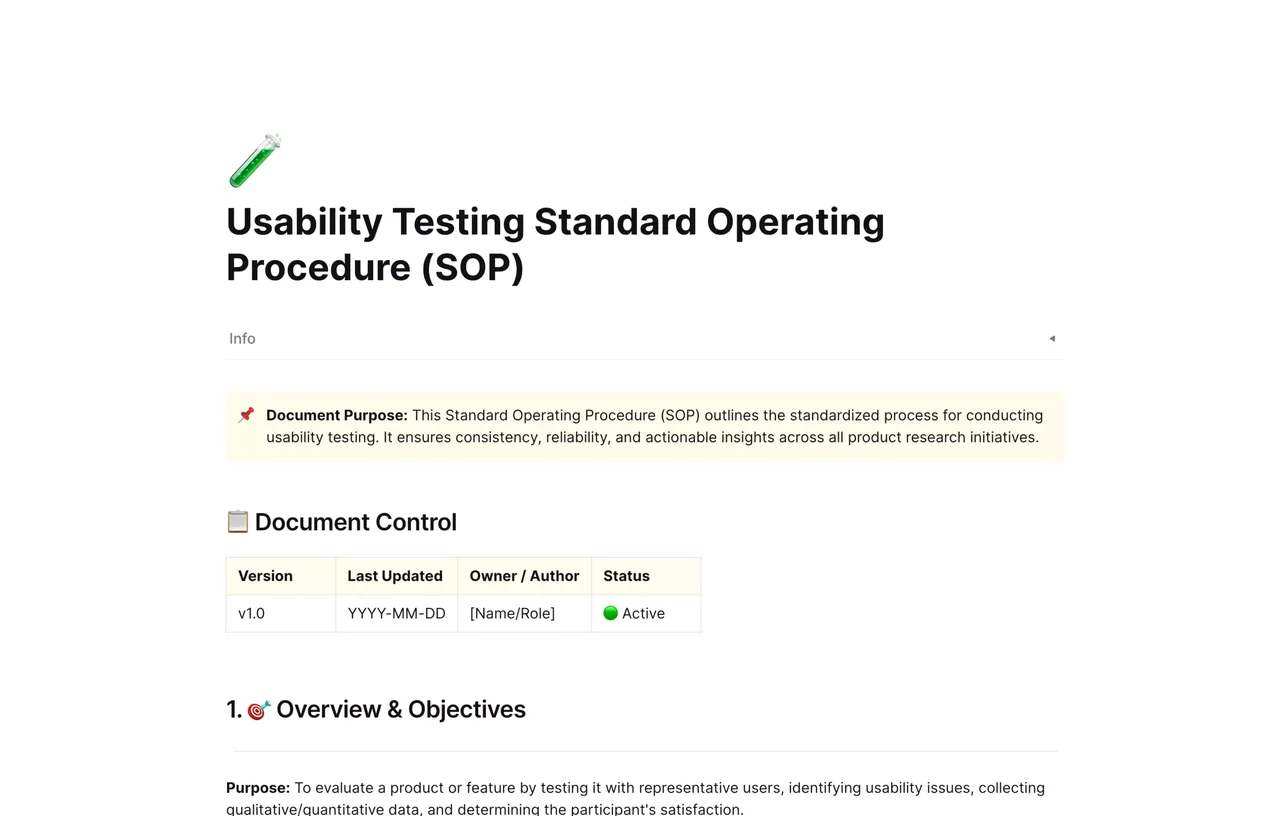
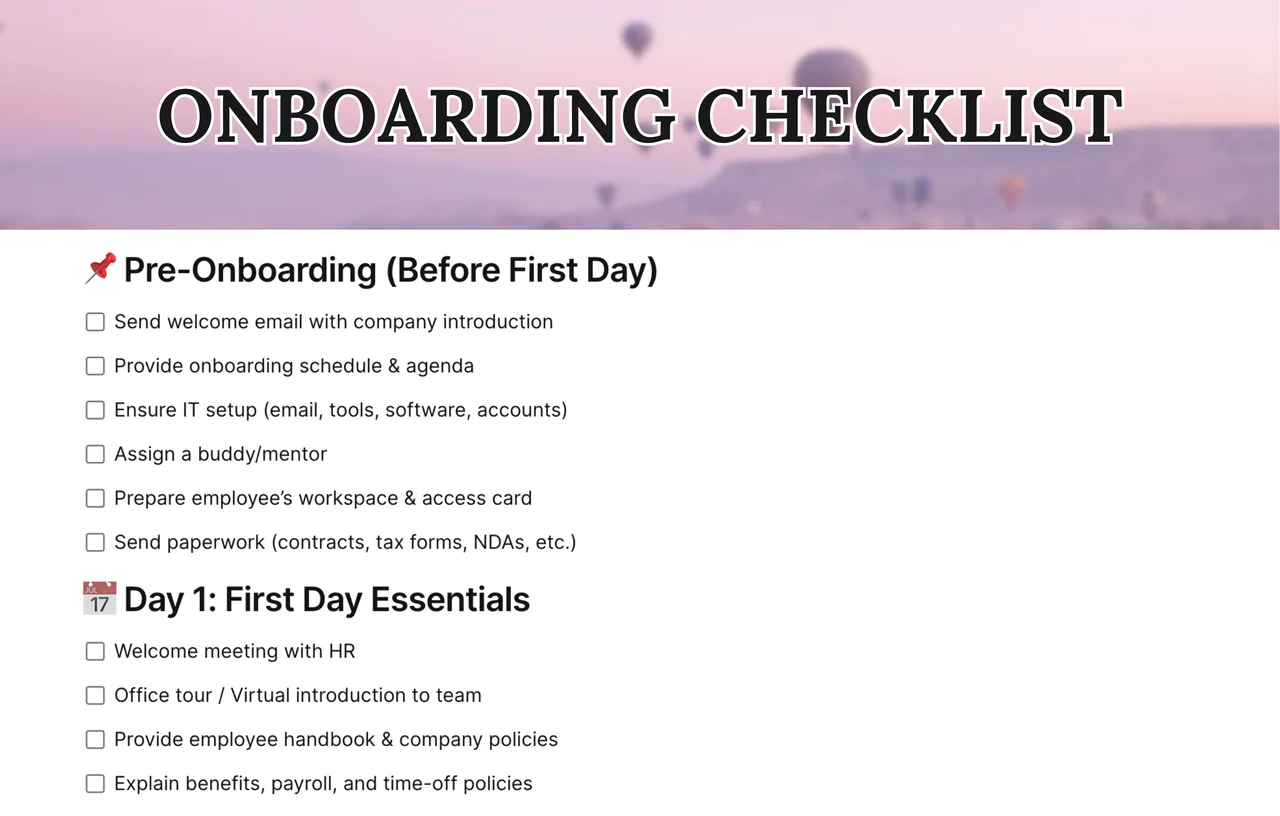
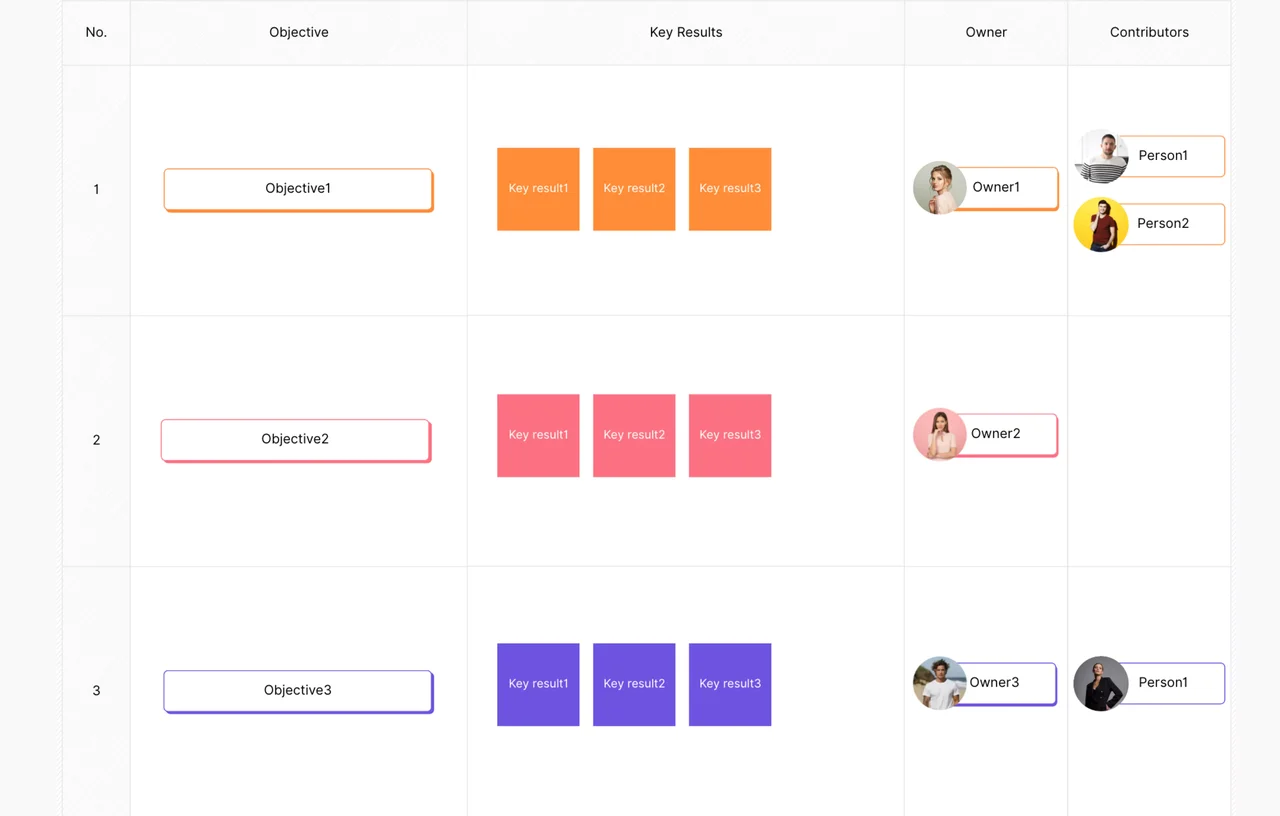
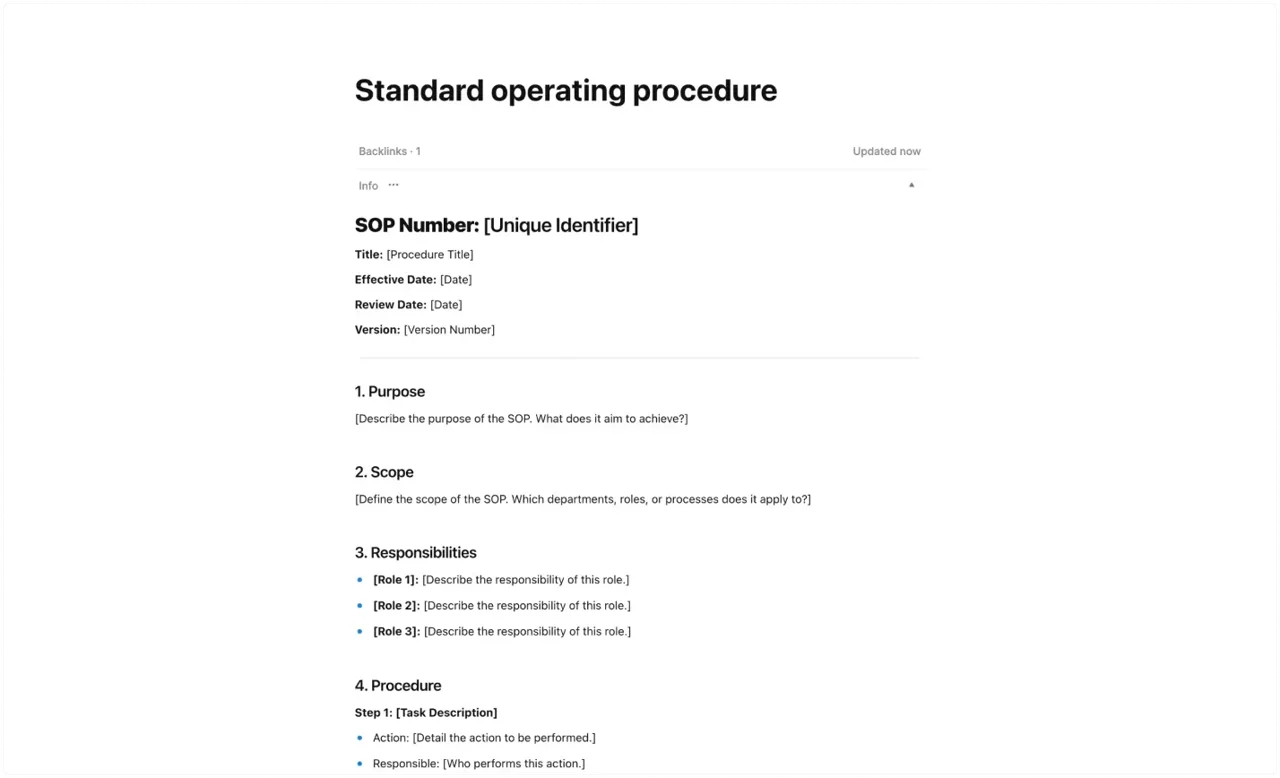
This free SOP template gives operations teams a usable structure for documenting one repeatable workflow. It includes fields for purpose, scope, owner, prerequisites, numbered steps, quality checks, approval, exceptions, and revision history. Duplicate it, name one recurring process, assign an owner, and write the steps that people actually perform before adding diagrams or policy detail.
Use it for customer support, onboarding, deployment, incident response, content publishing, equipment handling, or any process where a missed handoff creates avoidable work. The template is a documentation framework—not proof that a process is compliant or effective—so the people who perform and govern the work still need to test and approve it.
A practical SOP template should help a reader perform the task without guessing. Use the structure below as a starting point, then remove anything that does not apply to your workflow:
Purpose: Why the procedure exists and what risk or outcome it controls.
Scope: Which teams, tools, systems, customers, or situations the SOP covers.
Owner: The person or team responsible for keeping the SOP accurate.
Inputs and prerequisites: Access, documents, approvals, materials, or data needed before the work starts.
Step-by-step procedure: The actual repeatable workflow, written in the order a user should perform it.
Quality checks: What must be verified before the task is considered complete.
Exceptions and escalation: What to do when the standard path does not work.
Revision history: Version, reviewer, approval date, and summary of changes.
An SOP becomes trustworthy when people know who approved it and when it was last reviewed. In AFFiNE, keep the procedure in Page Mode, add a review checklist at the top, and link the SOP to related docs such as onboarding guides, project plans, or incident reports.
A simple workflow is: draft the SOP, assign a process owner, have a subject-matter reviewer test the steps, record approval notes, then schedule a recurring review. When the process changes, duplicate the revision section before editing so the team can see what changed and why.
For visual workflows, use AFFiNE's whiteboard view to map decisions, handoffs, or system diagrams beside the written procedure. This is useful for onboarding, UX research, deployment, incident response, and cross-functional operations where a simple paragraph is not enough.
Use this template for any recurring process where consistency matters more than personal style. Good candidates include customer support escalation, software deployment, incident response, content publishing, new hire onboarding, equipment checkout, monthly finance close, UX research sessions, and quality assurance reviews.
The template is intentionally structured rather than decorative. If the process is simple, keep only purpose, owner, steps, and review date. If the process has risk, add approval rules, exceptions, audit evidence, and escalation paths. The point is not to make a long document; the point is to make the next correct action obvious.
In AFFiNE, SOPs can live next to diagrams and checklists instead of being isolated documents. A deployment SOP can link to release notes, a support SOP can link to a response checklist, and an onboarding SOP can link to training pages and team goals.
If you need a shorter SOP layout, compare this page with the universal business SOP template. For specialized process documentation, explore the Usability Testing SOP Template. You can also read our standard operating procedure template guide, SOP format guide, and step-by-step SOP writing guide.
This template helps organize process documentation. It does not guarantee legal, regulatory, security, or industry compliance by itself. Teams in regulated environments should have qualified reviewers confirm required controls, retention rules, approvals, and audit evidence.
Duplicate the template and name the procedure with a verb — for example, "Onboard a new support agent."
Fill in the header: owner, department, effective date, and review cycle.
Write the steps as short numbered actions, each with one screenshot or link where it helps.
Route the draft through the approval section and record sign-offs with dates.
Publish the SOP to your team workspace and set the next review date.
Most SOPs include purpose, scope, responsibilities, prerequisites, step-by-step instructions, quality checks, exceptions, revision history, and approval information.
At minimum, the process owner and someone who performs the work should review it. For regulated, security-sensitive, financial, or customer-facing processes, add the relevant compliance or leadership reviewer.
Yes. SOPs are useful for onboarding because they preserve institutional knowledge and reduce dependence on verbal handoffs. Link the SOP to onboarding checklists, training notes, and role-specific docs in AFFiNE.
Review critical SOPs whenever the process changes and on a recurring schedule. Quarterly or semiannual reviews work for fast-moving teams; annual reviews may be enough for stable processes.