How to Write an SOP: 8 Steps, 3 Examples & Free Template
To write an SOP, pick one recurring task, watch someone do it, and record who does each step, what proves the step is done, and what to do when something goes wrong. Then format it consistently, test it with a colleague who did not write it, get it approved, and set a review date. The eight steps below walk through each part, and three complete SOP examples show what the finished document looks like.
Need the blank file? Download the free SOP template in Word, PDF, or Markdown (no signup), or duplicate it into AFFiNE from the same page. For more layouts by team and format, compare the 8 free SOP templates.
This guide covers standard operating procedures for business processes, not academic statements of purpose.
What is an SOP?
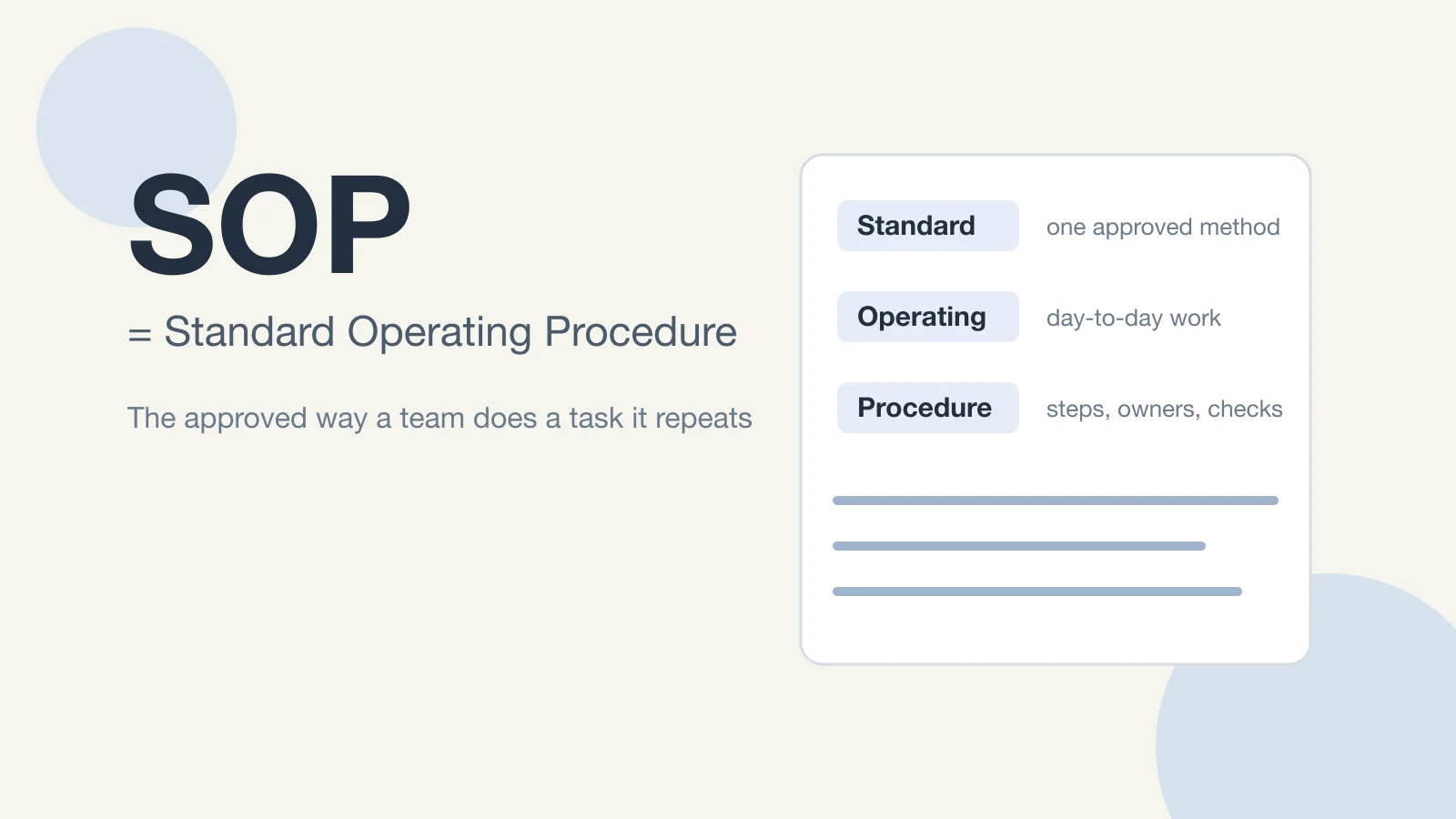
SOP stands for standard operating procedure. It is a written, approved set of steps for a task that a team repeats, such as onboarding a new hire, routing a support case, or issuing a refund. A good SOP says who does each step, in which order, what the finished result looks like, and what to do when the normal route does not work.
In business, an SOP turns one person's know-how into a shared process. Work depends less on whoever happens to be on shift, new staff get something concrete to learn from, and managers and auditors get a record of how the work is supposed to be done. An SOP describes the current approved method; when the method changes, the SOP changes with it. For a longer look at why companies invest in procedures, see what SOPs mean in business.
SOP vs policy vs work instruction vs checklist
| Document | Question it answers | Support example |
|---|---|---|
| Policy | What rule must we follow? | Which requests are eligible for escalation? |
| SOP | Who does what, in which order? | How does an agent route and hand off a case? |
| Work instruction | How do I carry out this specific action? | Which fields must I fill in on the escalation form? |
| Checklist | Have the required checks been completed? | Is the case summary attached and an owner assigned? |
Link these documents to each other so a policy change does not require rewriting the same rule in every SOP. When you need to capture a whole workflow across several teams before you write individual procedures, start with process documentation and split the result into SOPs.
How to write an SOP in 8 steps
Work through the steps in order. Record each answer in your SOP template as you go, so the finished document works the first time someone else follows it.
1. Identify the process and its outcome
Choose one recurring task and write its trigger and completion criteria before writing any steps. “Handle customer issues” is too broad. “Route a case to a specialist and verify acceptance” has a clear start and endpoint. Split unrelated outcomes into separate SOPs.
2. Gather information from a real run
Walk through the task with someone who performs it, and talk to the people who own each handoff. Review existing documents, tickets, and forms. Capture the actual inputs, screens, handoffs, and exceptions, and note the reader's required skills so the document gives enough detail without trying to replace training.
3. Break the work into steps with an owner and a result
List the actions in the order they happen. Give each one a responsible role, the tools or inputs it needs, and a result someone can check. Replace “process the request correctly” with a named action, its location, and the field or record that confirms success. Put safety or quality checks at the step where they apply.
4. Write the exception route
Document what happens when an input is missing, access fails, a decision is unclear, or the result does not match expectations. State when to stop, who can resolve the problem, and what permits the work to resume.
5. Format it so people can scan it
Use the same template, headings, and numbering for every SOP in your library. Pick the format that matches the work (see the format table below), keep each step to one action, and move long screen-by-screen detail into a linked work instruction.
6. Test and review the draft
Ask a colleague who has the required skills but did not write the draft to follow it. Record their questions, missing access, ambiguous decisions, and steps that needed a verbal explanation. Fix those points, then ask the process owner and the people who hand work in or out to review the revised draft for accuracy.
7. Approve, publish, and train the people who use it
Record the approval and effective date, identify the current copy, and archive superseded versions according to your document policy. Tell the people who perform the task where the SOP lives, and walk them through what changed.
8. Review and update it on a schedule
Set a review date based on the process's risk and how often it changes. Require an earlier review when a tool, owner, rule, or recurring failure changes, and record each review in the revision history even when nothing needs to change. As the library grows, merge duplicate procedures and retire ones nobody uses.
The US EPA's Guidance for Preparing Standard Operating Procedures (April 2007) discusses review by experienced personnel, testing by someone other than the writer, revision control, and access to current copies in sections 2.1–2.6. It is a useful document-design reference in its environmental quality context, not a universal compliance standard.
What sections should an SOP include?
Every SOP in this guide uses the same outline. The blank SOP template has these sections ready to fill in.
| Section | What to write | Why it matters |
|---|---|---|
| Document control | Title and ID, version, status, owner, approver, effective date, next review | Readers can tell whether they hold the current approved copy |
| Purpose and scope | The outcome, where the procedure starts and ends, what it excludes | Stops one SOP from quietly covering three processes |
| Trigger and prerequisites | The event that starts a run; required access, tools, inputs, and training | The reader can start without guessing |
| Roles | Who executes, who checks, who handles exceptions | Every step has someone accountable |
| Procedure steps | Numbered actions, each with an owner and evidence of completion | The core of the document |
| Exceptions and escalation | When to stop, whom to notify, and when work can resume | Problems get routed instead of improvised |
| Completion criteria and records | What must be true to close the task; where evidence is stored | “Done” means the same thing for everyone |
| Revision history | Version, date, change, approver | Shows what changed and who approved it |
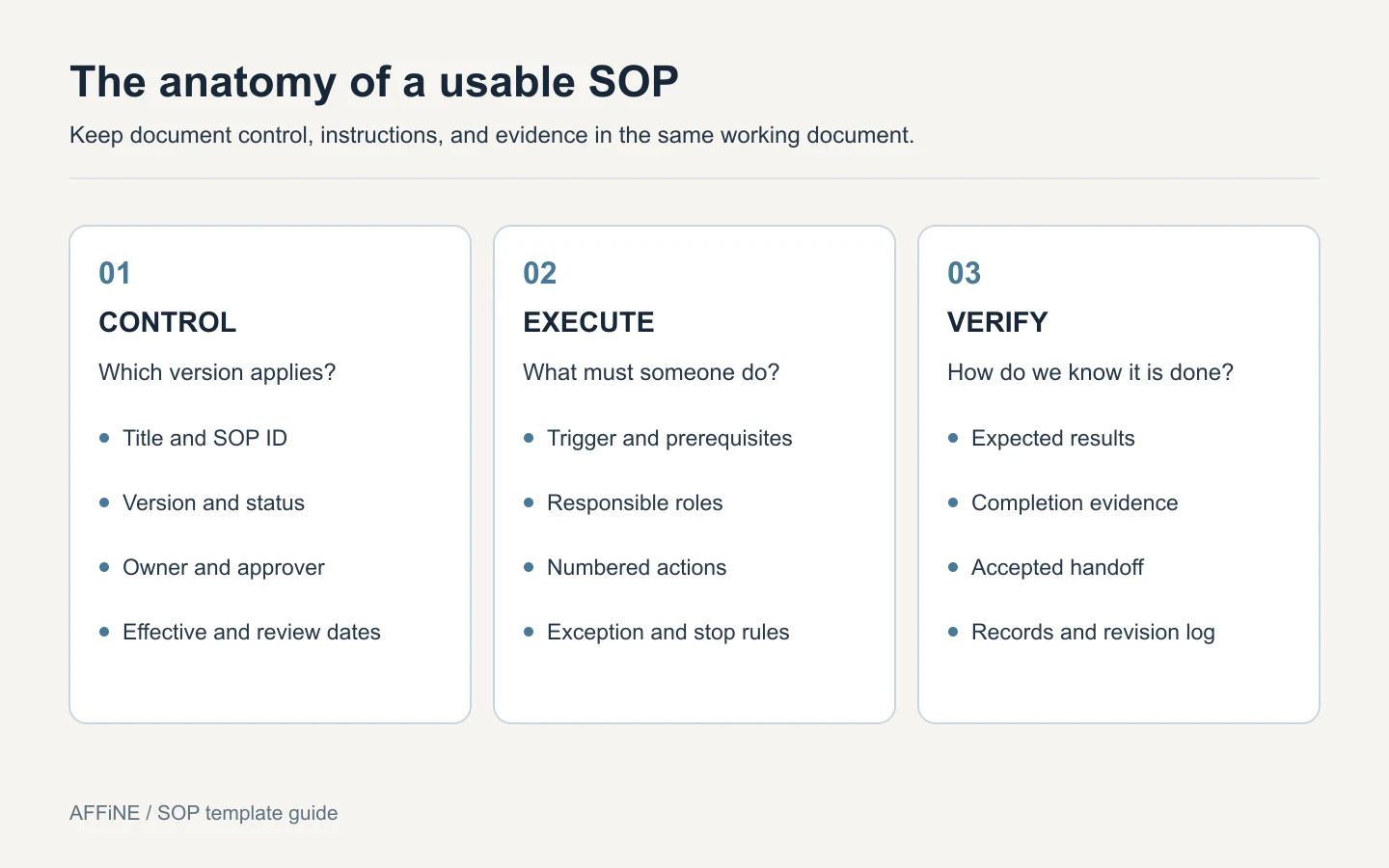
Figure: Pair the instructions with ownership and evidence so the next person can tell which procedure applies and when the work is complete.
Which SOP format should you use?
Choose the format by the decisions someone must make while doing the work. A linear task usually needs numbered steps. A task with conditional routes needs explicit branches. A checklist is useful for verification when the person already knows how to perform each action.
| Format | Use it when | Example | Keep this detail |
|---|---|---|---|
| Step-by-step | Actions follow one main sequence | Preparing a weekly report | Input and expected result for each step |
| Checklist | Trained staff need to confirm completion | Checking a room before an event | Pass criteria and a completion record |
| Hierarchical | Stages contain several detailed subtasks | Setting up a new employee's workspace | Numbered substeps and responsible roles |
| Flowchart | Different conditions lead to different actions | Routing a support escalation | Labeled decisions, stop points, and owners |
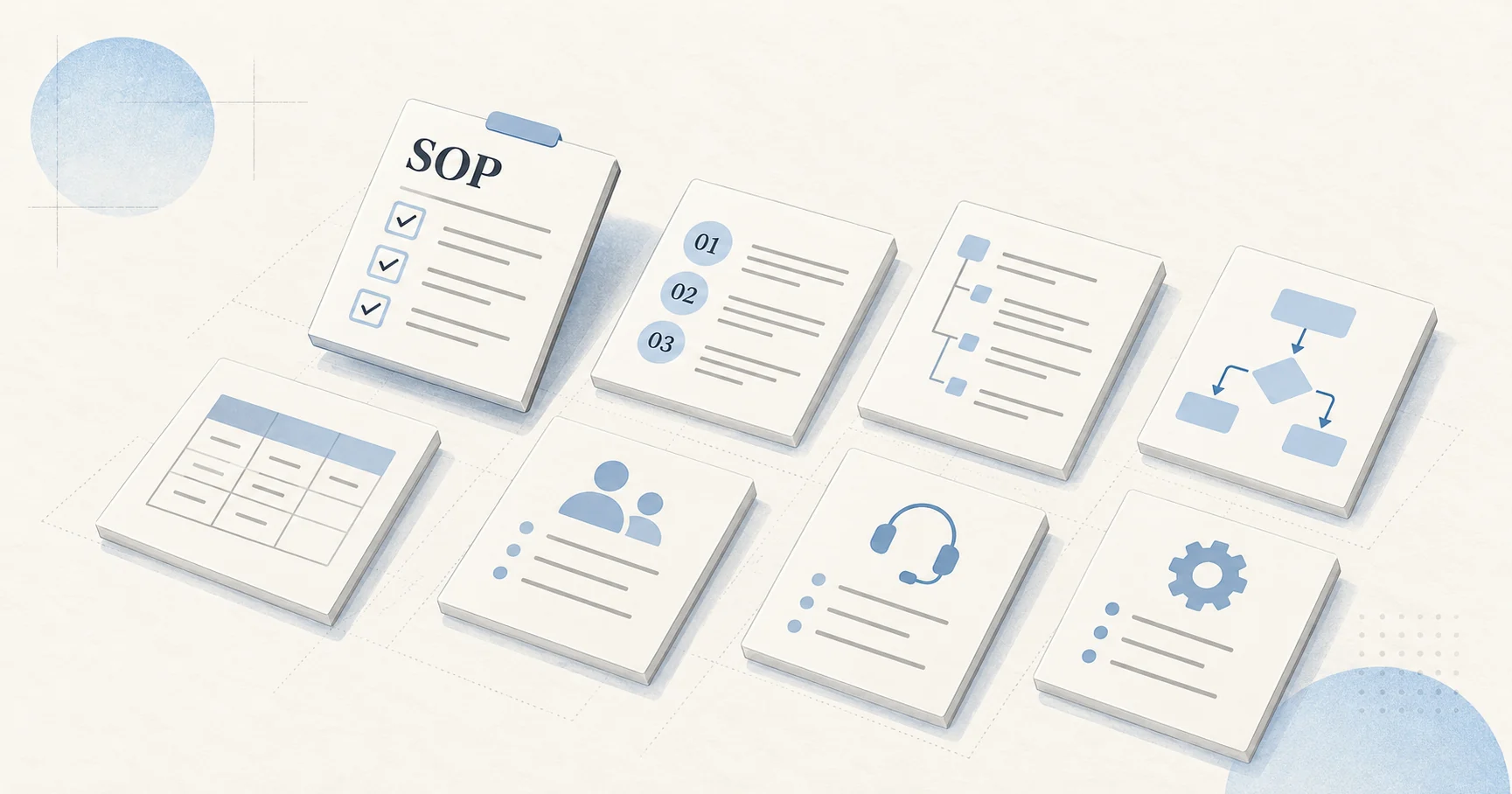
For a hierarchical SOP, nest steps such as 2.1 and 2.2 under the relevant stage. For a flowchart, keep the document-control block and attach the decision diagram with linked work instructions. The SOP template roundup shows each format applied to a different team.
SOP examples
The three examples below are illustrative examples written for this guide. They are not accounts of an AFFiNE customer or tested internal procedures. Each shows how the outline above becomes an executable workflow. Replace the roles, systems, and limits with your team's approved rules.
Example 1: customer-support escalation SOP
Document control and scope
- Title / ID: Route a support case to a specialist · SUP-001.
- Version / status: 1.0 example · Draft for adaptation.
- Owner / approver: Support Operations Lead / Support Manager.
- Purpose: Transfer a case with enough context for a specialist to act.
- Scope: Starts when an agent identifies a case they cannot resolve using approved guidance. Ends when a receiving owner accepts the handoff. Security incidents follow the separate incident-response procedure.
- Prerequisites: Access to the support queue, the approved routing matrix, the escalation form, and the incident procedure.
Steps and decision rules
| Step | Owner | Action | Evidence or pass condition |
|---|---|---|---|
| 1 | Support agent | Check whether the case meets a security-incident trigger. If it does, stop and use the incident procedure. | Classification and route recorded in the case |
| 2 | Support agent | Record the issue, product area, troubleshooting already done, and the unresolved question. | Case summary and relevant evidence attached |
| 3 | Support agent | Select the receiving queue from the routing matrix. If no route applies, ask the Support Lead to pick an owner. | Queue selected, or routing exception recorded |
| 4 | Receiving specialist | Review the summary and accept ownership, or return a specific request for missing information. | Named owner and acceptance recorded |
| 5 | Support agent | Tell the requester who owns the next step and when to expect an update. | Update logged in the case |
| 6 | Support agent | Verify ownership, next action, and next update time before closing the handoff task. | All three fields recorded; the case stays open until resolved |
Exception: If no specialist accepts the case within the approved escalation window, notify the Support Lead. Keep the case with the current owner until someone accepts it. Do not mark an unaccepted handoff complete.
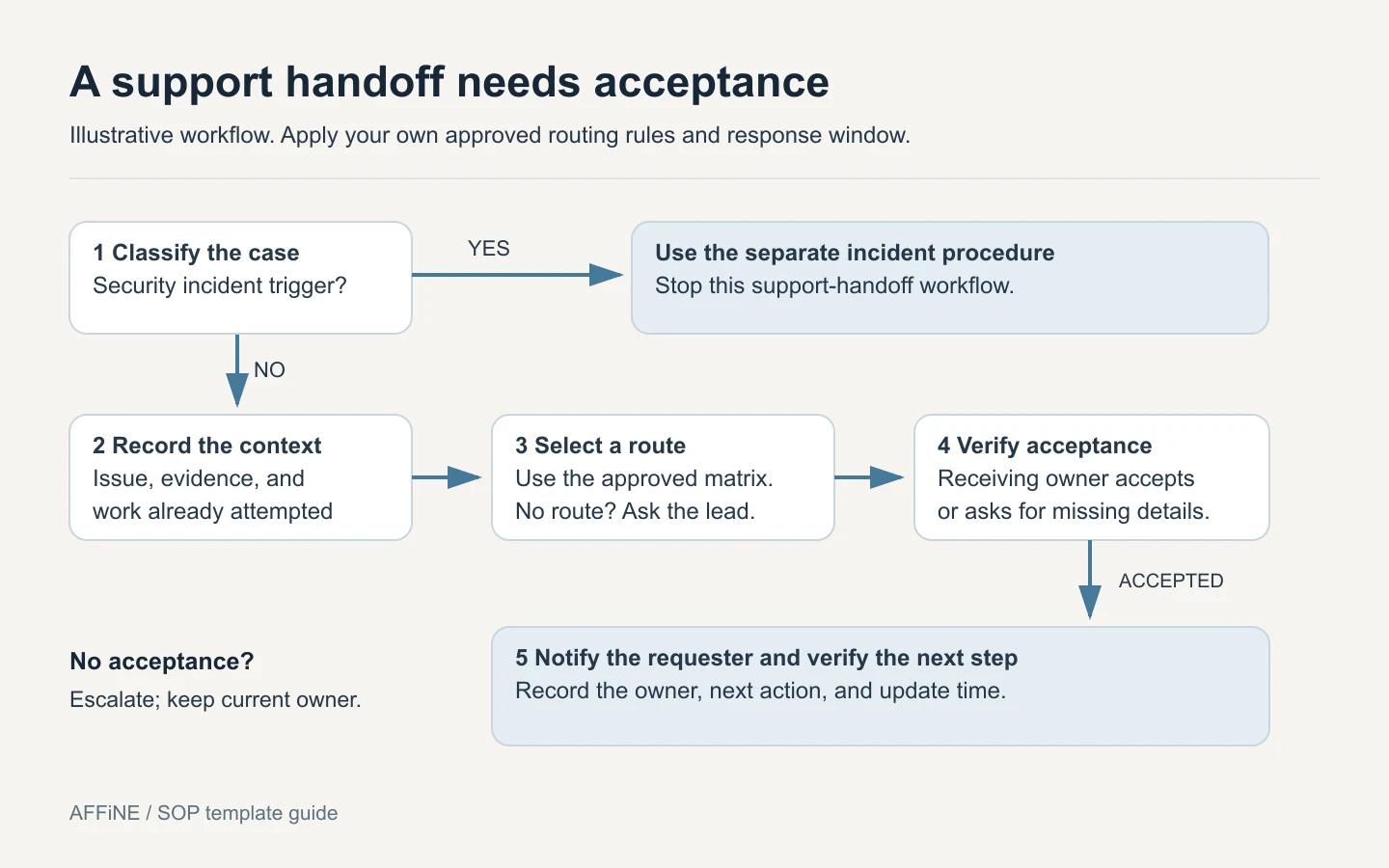
Figure: Acceptance is a required checkpoint. Selecting a receiving queue alone does not complete the handoff.
Example 2: new-employee day-one access SOP
Document control and scope
- Title / ID: Prepare day-one access for a new employee · HR-ONB-002.
- Version / status: 1.0 example · Draft for adaptation.
- Owner / approver: People Operations Lead / Head of People.
- Purpose: Make sure a new employee can sign in, reach the tools for their role, and start assigned training on their first day.
- Scope: Starts when a signed offer is recorded in the HR system. Ends when the new employee confirms access to every system on the role access list. Equipment purchasing and payroll setup follow separate procedures.
- Prerequisites: Signed offer, confirmed start date, a role access list approved by the hiring manager, and permission to submit access requests.
Steps and evidence
| Step | Owner | Action | Evidence or pass condition |
|---|---|---|---|
| 1 | People Ops coordinator | Create the employee record with legal name, start date, manager, and role. | Record saved with an employee ID |
| 2 | People Ops coordinator | Submit one access request based on the approved role access list. Request only the systems on that list. | Request ID added to the onboarding checklist |
| 3 | IT support | Create each account and set first-login credentials that must be changed on first use. | Every system on the list marked as created |
| 4 | Hiring manager | Confirm the day-one schedule and name an onboarding buddy. | Schedule and buddy recorded in the checklist |
| 5 | People Ops coordinator | Send the welcome message with sign-in instructions, the schedule, and a support contact before the agreed deadline. | Sent message logged in the employee record |
| 6 | New employee with IT support | On day one, sign in to each listed system and report any failure through the support channel. | Employee confirms access to every listed system |
Exception: If an account is not ready by the end of the working day before the start date, IT support notifies the hiring manager and the People Ops coordinator, and the manager adjusts the day-one schedule. Never share another person's credentials as a workaround.
Example 3: customer refund SOP
Document control and scope
- Title / ID: Approve and issue a customer refund · FIN-REF-003.
- Version / status: 1.0 example · Draft for adaptation.
- Owner / approver: Billing Operations Lead / Finance Manager.
- Purpose: Refund eligible customers once, to the original payment method, with an approval trail.
- Scope: Starts when a refund request reaches the billing queue. Ends when the refund is issued and the customer is notified. Chargebacks and disputed payments follow the dispute procedure.
- Prerequisites: The current refund policy, access to the billing system, and the approval limits set by Finance.
Steps and evidence
| Step | Owner | Action | Evidence or pass condition |
|---|---|---|---|
| 1 | Billing specialist | Find the original order and confirm the request falls inside the refund policy. If it does not, reply with the policy reason and stop. | Order ID and eligibility decision recorded |
| 2 | Billing specialist | Check that no refund or chargeback already exists for the same order. If a refund exists, stop. If a chargeback exists, move the case to the dispute procedure. | Duplicate check and outcome noted in the ticket |
| 3 | Billing specialist | Calculate the amount (full or partial) and attach the calculation. | Amount and basis recorded |
| 4 | Finance approver | Approve refunds above the specialist's limit. Below that limit, the billing specialist can approve the refund directly. | Approval recorded with name and date |
| 5 | Billing specialist | Issue the refund to the original payment method in the billing system. | Refund transaction ID saved to the ticket |
| 6 | Billing specialist | Email the customer the amount, method, and expected processing time, then close the ticket. | Sent message logged; ticket closed |
Exception: If the original payment method can no longer receive funds, do not refund to a different account on the customer's request alone. Escalate to the Finance approver, who decides the alternative and records the reason.
For longer, single-function examples on this blog, see the LinkedIn marketing SOP and the internet outage SOP.
Common SOP writing mistakes
| Mistake | What it looks like | Fix |
|---|---|---|
| Writing from memory | Steps describe how the task should work, not how it works | Observe a real run before drafting (step 2) |
| One SOP for everything | “Customer operations SOP” covers refunds, escalations, and onboarding | One trigger and one outcome per SOP |
| Vague verbs | “Handle,” “process,” “ensure” | Name the action, the system, and the record that proves it |
| No exception route | The SOP stops at the happy path | Add when to stop, whom to notify, and when to resume |
| No owner | Nobody updates it after the tool changes | Name the owner and set a review date |
| Copies everywhere | Old versions live in email and shared drives | Keep one approved copy and link to it |
A practical test before you release an SOP
Use this checklist during the trial run in step 6. These are editorial acceptance criteria, not an industry certification. If a check fails, revise the relevant section and test it again.
| Check | Pass condition | If it fails |
|---|---|---|
| Find the current version | Reader can identify the approved copy, version, and owner | Add document control and a stable link |
| Start without guessing | Inputs, access, training, and trigger are clear | Add prerequisites and scope exclusions |
| Execute each step | Reader can perform the action with the instructions given | Add a specific action or linked work instruction |
| Handle an exception | Reader knows when to stop and whom to contact | Add the exception and resumption rule |
| Verify completion | A recorded result proves the outcome and handoff | Add evidence and acceptance criteria |
| Maintain the procedure | Owner knows the next review date and change triggers | Assign ownership and update the revision log |
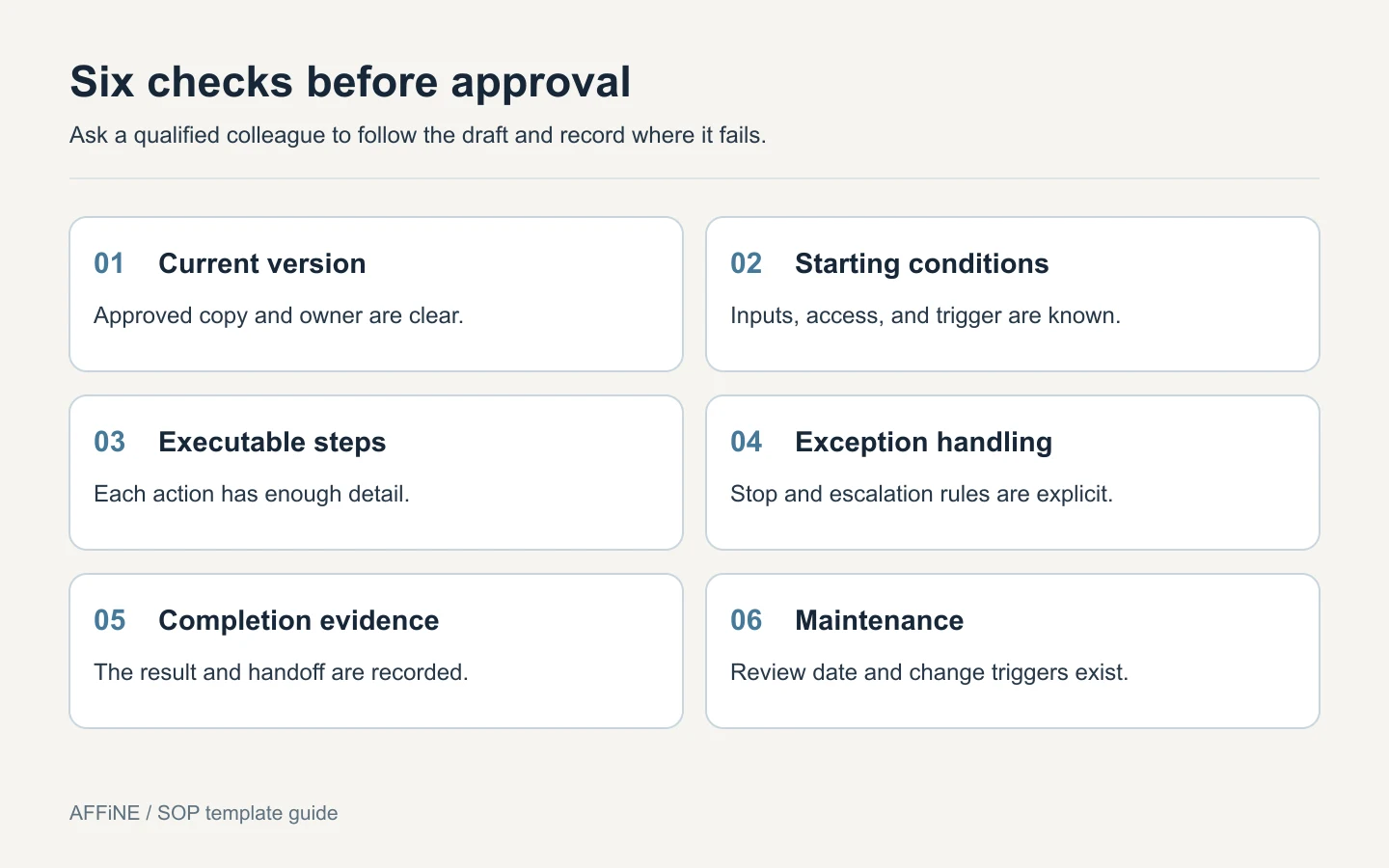
Figure: Test the procedure against observable conditions before marking it approved.
After adoption, track a few useful measures: trial runs that needed clarification, tasks returned because evidence was missing, and exceptions without a defined route. A shorter document alone does not show that the process improved.
Adapt the SOP to your team or industry
| Team or workflow | Add to the outline | Example proof of completion |
|---|---|---|
| Employee onboarding | Role-specific access, equipment owner, and training links | Access verified and required training recorded |
| Content publishing | Editorial approval, asset rights, preview checks, and rollback owner | Approved version is live at the intended URL |
| Customer support | Routing matrix, handoff acceptance, and escalation window | Receiving owner accepts the case |
| Inventory checks | Item identifiers, count method, and discrepancy route | Count recorded and discrepancies assigned |
| Manufacturing or laboratory work | Approved technical method, qualifications, hazards, and required records | Evidence specified by the approved local procedure |
For regulated or safety-critical work, have the responsible specialist define and approve the relevant controls. Completing a generic outline does not establish legal compliance, safe operation, or ISO certification.
Where to write and keep your SOPs
The best place for an SOP is where the team already looks for answers. A few common options:
| Tool type | Example | Good for | Watch for |
|---|---|---|---|
| Word processor | Microsoft Word, Google Docs | A first SOP or a controlled document you print or sign | Copies multiply; version control is manual |
| Docs and wiki workspace | AFFiNE, Notion, Confluence | A searchable SOP library with links between procedures | Someone still has to own reviews |
| Screen-capture guide tool | Scribe, Tango | Software tasks with many clicks | Screenshots go stale when the interface changes |
| Training platform | Trainual | Assigning SOPs to new hires and tracking completion | Paid plans only |
For a detailed comparison of features and free tiers, see our guide to SOP management software.
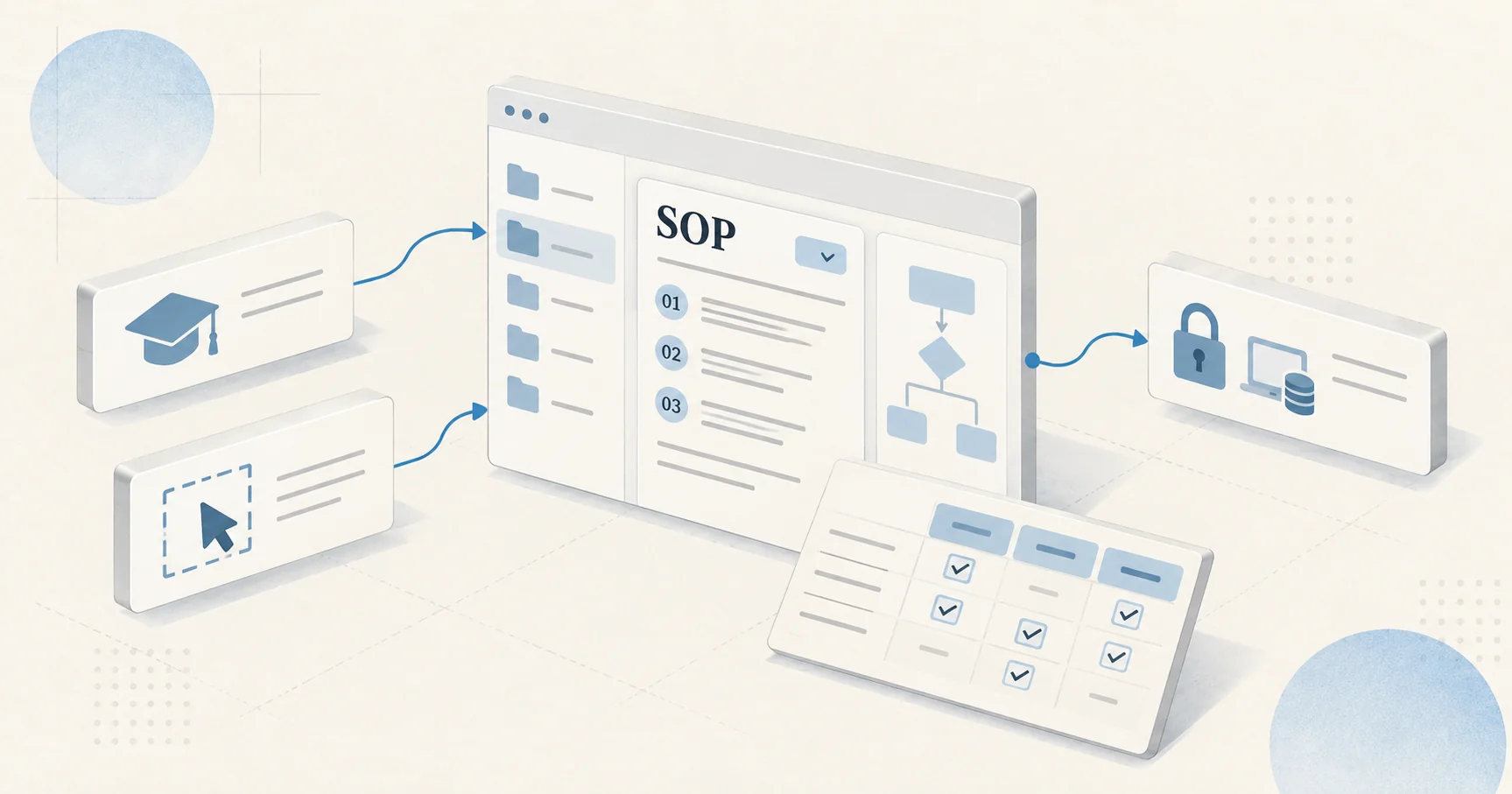
Disclosure: AFFiNE publishes this guide and is one of the options above. In AFFiNE you can keep the written procedure and its decision flowchart on the same page by switching between document and whiteboard modes, and link related SOPs together. The SOP template and downloads also work without AFFiNE.
Editorial note: The examples, diagrams, and release checklist on this page were prepared for this guide and are not presented as field-tested case studies. See our editorial policy.
Frequently asked questions about writing an SOP
How do you write an SOP?
Identify one recurring process and its outcome, gather information from a real run, and break the work into steps that each have an owner and a checkable result. Add an exception route, format it consistently, test it with a colleague, get approval, and schedule regular reviews.
What does SOP stand for in business?
SOP stands for standard operating procedure. In business it means an approved, written set of steps for a recurring task, including who does each step, how to check the result, and what to do when something goes wrong.
What is an example of an SOP?
A customer-support escalation SOP is a common example. It names the owner and approver, defines when the procedure starts and ends, lists each routing step with its owner and proof of completion, and says what to do when no specialist accepts the case. This guide also includes a new-employee access SOP and a customer refund SOP.
What are the main parts of an SOP?
Document control (title, ID, version, owner, approver, dates), purpose and scope, trigger and prerequisites, roles, numbered procedure steps with evidence of completion, exceptions and escalation, completion criteria and records, and revision history.
What is the best SOP format for a small business?
Start with a step-by-step format for a task with one main sequence. Use a checklist for checks that trained staff already understand, a hierarchical format for detailed subtasks, and a flowchart when conditions change the route. Keep ownership and completion criteria in every format.
How long should an SOP be?
As long as the task needs and no longer. Most single-task SOPs fit on one to three pages. If a document grows much longer, it usually covers more than one process, or it contains screen-by-screen detail that belongs in a linked work instruction.
What is the difference between an SOP and a checklist?
An SOP explains the scope, ownership, actions, decisions, and expected outcome of a process. A checklist records whether specified checks or actions were completed. A checklist can be part of an SOP, but it may not give enough instruction for someone unfamiliar with the task.
How often should an SOP be reviewed?
Set a review schedule based on the process's risk, how often it changes, and any applicable requirements. Review sooner when tools, owners, policies, or recurring exceptions change. Record the review even when nothing needs to change.
Can AI write an SOP for my team?
AI can help organize notes and draft clear steps, but it cannot establish that an undocumented workflow is correct or approved. Give it verified process inputs, check every action and exception with the process owner, remove invented requirements, and test the draft before release.