Cornell Notes Examples: 8 Filled-In Pages by Subject
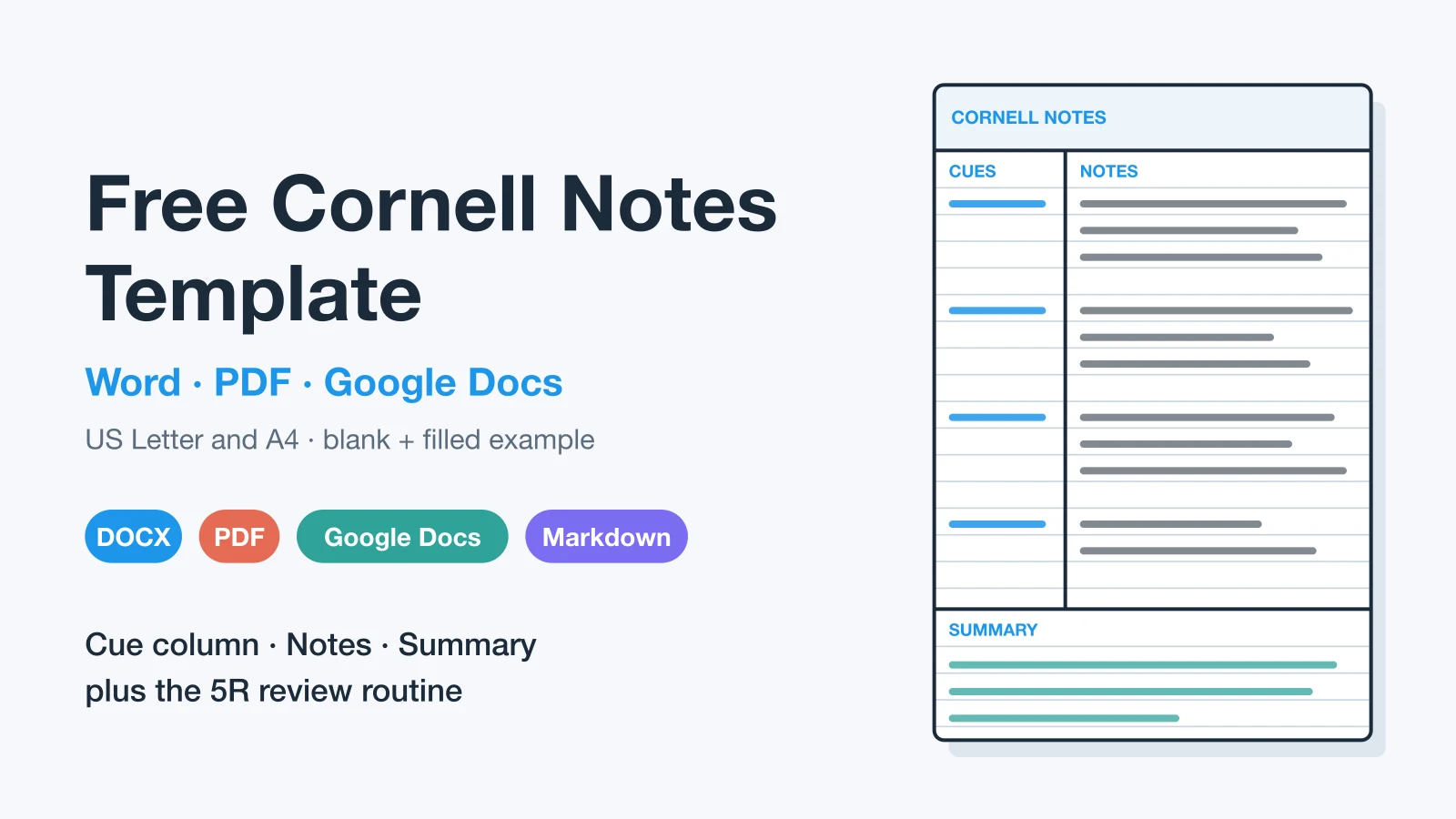
A Cornell notes example is a page split into three parts: a narrow cue column of questions on the left, a wider notes area on the right, and a two- or three-sentence summary at the bottom. Below are eight complete pages for chemistry, history, math, literature, Spanish, a lecture, an online course, and a work meeting, each with notes on why it works.
Download all 8 filled-in examples (PDF) · Get a blank Cornell notes template · See the before-and-after
All eight examples are fictional teaching examples written for this page. The facts inside them (chemistry, history, math, literature, Spanish grammar, and statistics) are real and were checked against the sources listed at the end.
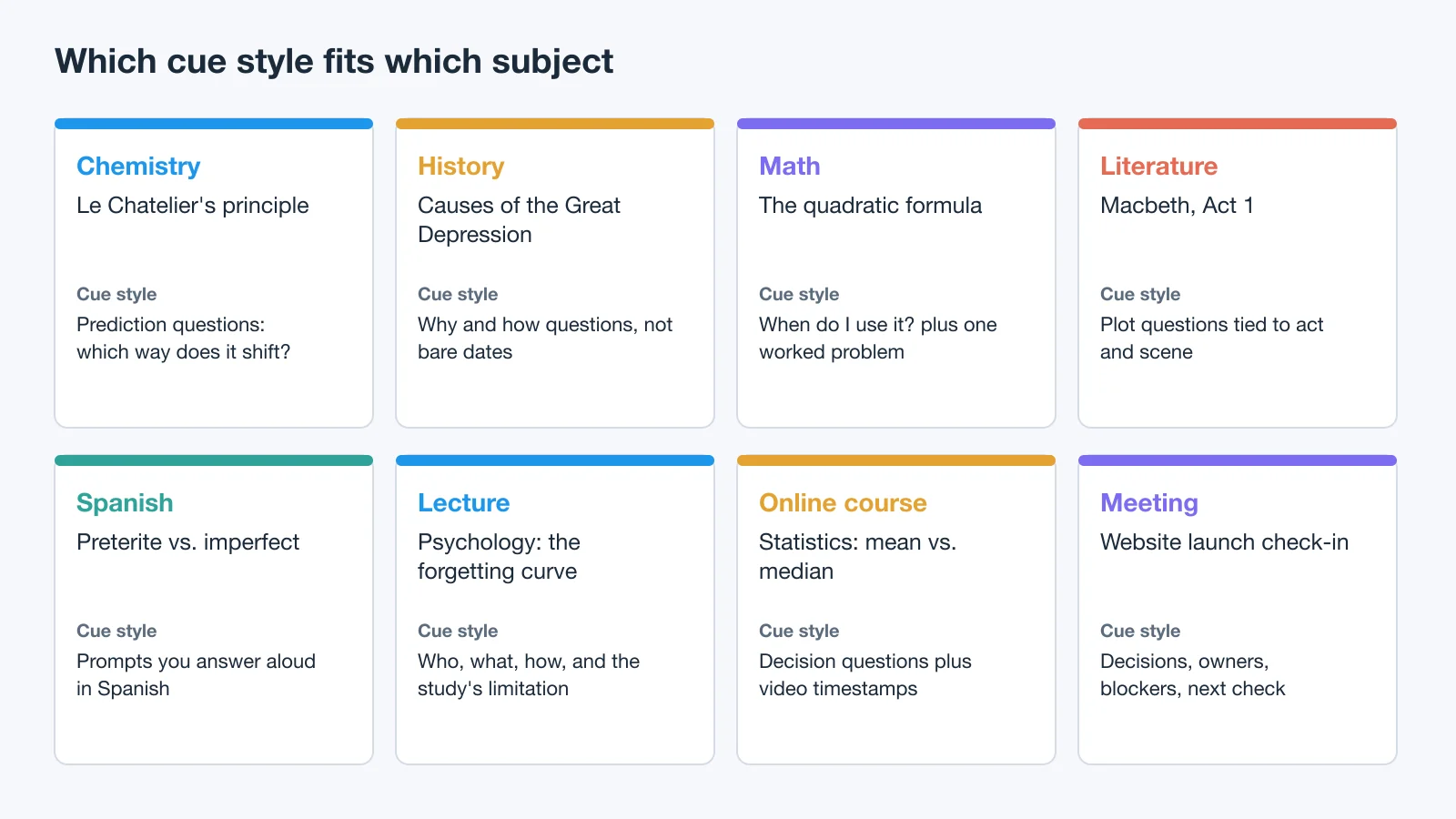
| Example | Cue style | Best for |
|---|---|---|
| Chemistry | Predictions | Science rules |
| History | Why and how | Essay classes |
| Math | When to use it | Problem sets |
| Literature | Act and scene | Close reading |
| Spanish | Say it aloud | Grammar rules |
| Lecture | Who, what, how | Studies, theory |
| Online course | Timestamps | Video lessons |
| Meeting | Owners, dates | Work |
What a Good Cornell Notes Example Has
The layout is the same on every page. What makes an example useful is what goes into each part, and when you write it.
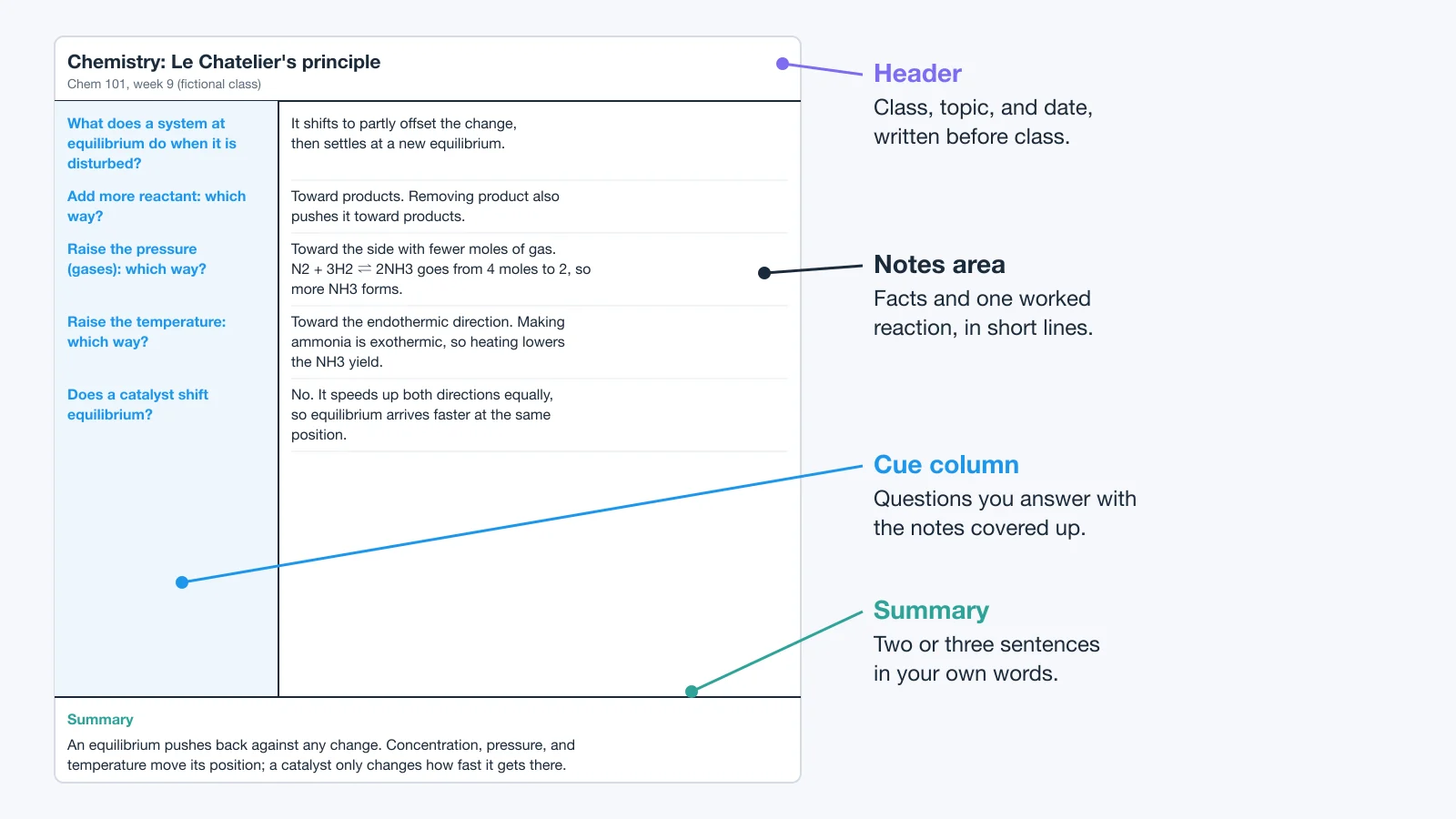
- Header: class, topic, and date, written before class starts.
- Notes area (about 70% of the width): short lines written during class. Facts, steps, examples, and quotes, not full sentences.
- Cue column (about 30%): written after class. Each cue is a question or prompt that the note beside it answers. Cover the notes and you can quiz yourself.
- Summary (the bottom strip): written the same day, in your own words, in two or three sentences.
The method comes from Walter Pauk at Cornell University, who described it in How to Study in College. The Cornell Learning Strategies Center still teaches the same three-part page. For exact column widths, Letter and A4 measurements, and the 5R steps (Record, Reduce, Recite, Reflect, Review), see our Cornell notes template guide. This page focuses on what a filled page looks like.
Cornell Notes Example for Chemistry
Chem 101, week 9 (fictional class)
| Cue | Notes |
|---|---|
| What does a system at equilibrium do when it is disturbed? | It shifts to partly offset the change, then settles at a new equilibrium. |
| Add more reactant: which way? | Toward products. Removing product also pushes it toward products. |
| Raise the pressure (gases): which way? | Toward the side with fewer moles of gas. N2 + 3H2 ⇌ 2NH3 goes from 4 moles to 2, so more NH3 forms. |
| Raise the temperature: which way? | Toward the endothermic direction. Making ammonia is exothermic, so heating lowers the NH3 yield. |
| Does a catalyst shift equilibrium? | No. It speeds up both directions equally, so equilibrium arrives faster at the same position. |
Summary: An equilibrium pushes back against any change. Concentration, pressure, and temperature move its position; a catalyst only changes how fast it gets there.
Why this page works:
- Every cue is a prediction you can test yourself on with the notes covered.
- One reaction (ammonia) is reused across rows, so you learn the rule and an example together.
- The summary contrasts what moves the equilibrium with what does not, which is the usual exam trap.
Cornell Notes Example for History
US History, unit 7 (fictional class)
| Cue | Notes |
|---|---|
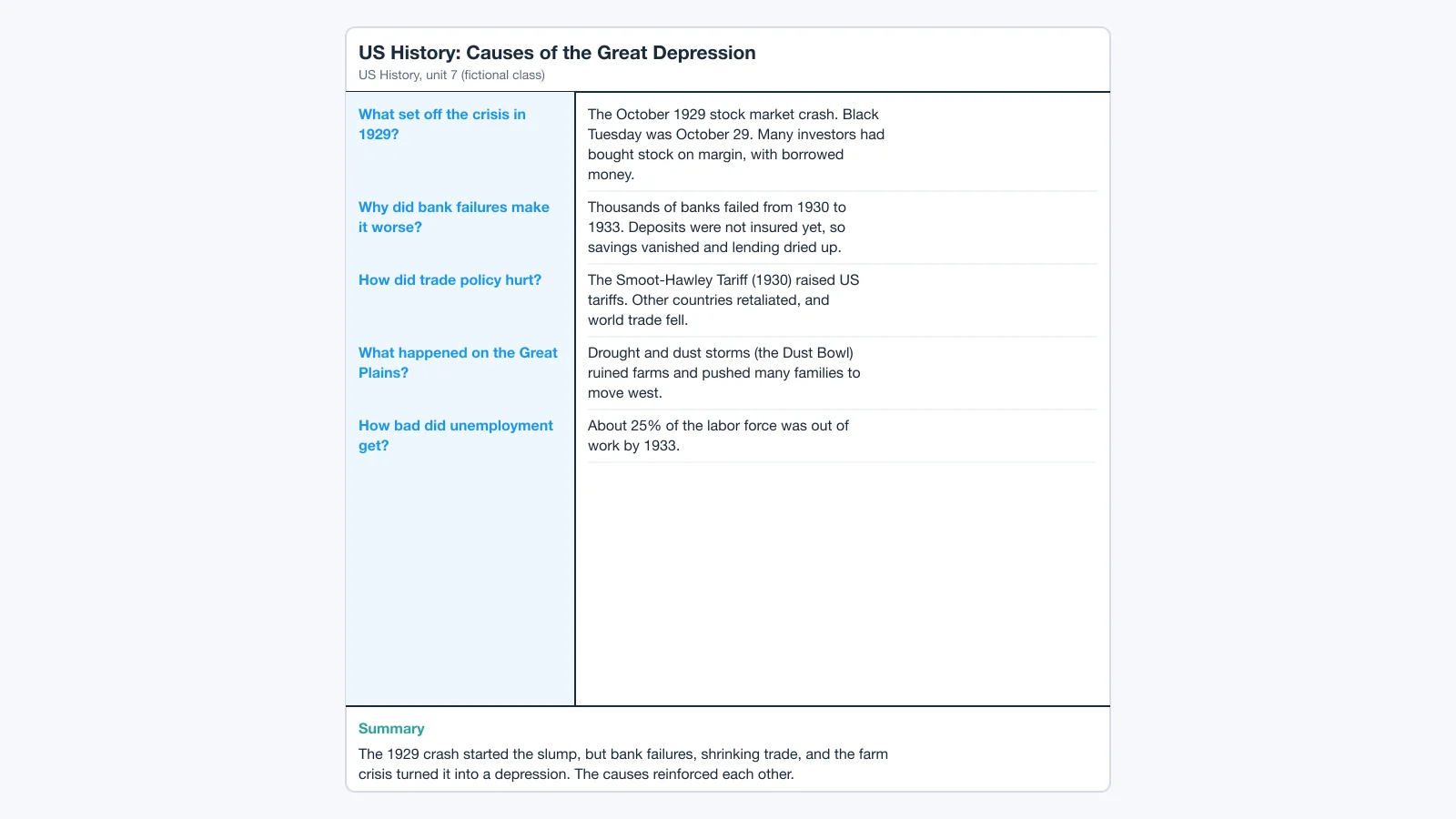
| What set off the crisis in 1929? | The October 1929 stock market crash. Black Tuesday was October 29. Many investors had bought stock on margin, with borrowed money. |
| Why did bank failures make it worse? | Thousands of banks failed from 1930 to 1933. Deposits were not insured yet, so savings vanished and lending dried up. |
| How did trade policy hurt? | The Smoot-Hawley Tariff (1930) raised US tariffs. Other countries retaliated, and world trade fell. |
| What happened on the Great Plains? | Drought and dust storms (the Dust Bowl) ruined farms and pushed many families to move west. |
| How bad did unemployment get? | About 25% of the labor force was out of work by 1933. |
Summary: The 1929 crash started the slump, but bank failures, shrinking trade, and the farm crisis turned it into a depression. The causes reinforced each other.
Why this page works:
- Cues ask why and how, so reviewing them rehearses the reasoning an essay question needs.
- Dates and numbers stay in the notes column as evidence, not as the cue.
- The summary is a thesis sentence you could open a short-answer response with.
Cornell Notes Example for Math
Algebra 1, unit 8 (fictional class)
| Cue | Notes |
|---|---|
| When do I use the quadratic formula? | For any equation in the form ax² + bx + c = 0 (a ≠ 0), especially when it does not factor easily. |
| What is the formula? | x = (−b ± √(b² − 4ac)) / 2a |
| What does the discriminant tell me? | b² − 4ac > 0: two real roots. Equal to 0: one real root. Less than 0: no real roots. |
| Worked example: x² − 5x + 6 = 0 | a = 1, b = −5, c = 6. Discriminant = 25 − 24 = 1. x = (5 ± 1) / 2, so x = 3 or x = 2. |
| How do I check the answer? | Substitute back: 9 − 15 + 6 = 0 and 4 − 10 + 6 = 0. Both roots work. |
Summary: Write the equation in standard form, find the discriminant to see how many real roots to expect, then apply the formula and check by substitution.
Why this page works:
- The notes hold one complete worked problem, which you re-solve during review instead of rereading.
- The "when do I use it?" cue trains the choice of method, not only the steps.
- The summary is the procedure in words, in the order you would do it on a test.
Cornell Notes Example for Literature
English 10 (fictional class)
| Cue | Notes |
|---|---|
| What do the witches predict? | Macbeth will be Thane of Cawdor and then king. Banquo will father kings but not be one (1.3). |
| How does the first prophecy come true? | Right after the witches vanish, Ross brings news that Duncan has named Macbeth Thane of Cawdor (1.3). |
| What is Macbeth's first reaction? | In an aside he admits to "horrible imaginings": he already pictures murder, and it frightens him (1.3). |
| How does Lady Macbeth see her husband? | She fears he is "too full o' th' milk of human kindness" to take the crown (1.5). |
| Theme to track | Ambition against conscience. The prophecy tempts; Macbeth's choices decide. |
Summary: Act 1 plants ambition: one prophecy comes true at once, which makes the rest feel possible. Macbeth hesitates and Lady Macbeth pushes. Track whether fate or choice drives the murders.
Why this page works:
- Each note carries an act and scene reference, so quotes can be found again for an essay.
- Short quotes sit in the notes; the cue asks what the quote shows.
- The last row names a theme to follow into Act 2, so the next page has a question waiting.
Cornell Notes Example for Language Learning
Spanish 2 (fictional class)
| Cue | Notes |
|---|---|
| When do I use the preterite? | Finished actions with a clear start or end: Ayer comí a las ocho. (Yesterday I ate at eight.) |
| When do I use the imperfect? | Ongoing, habitual, or background actions: De niño, jugaba al fútbol. (As a kid, I used to play soccer.) |
| Which tense for time, age, and description? | Imperfect: Eran las tres. Tenía diez años. (It was three. I was ten.) |
| Both tenses in one sentence? | The imperfect sets the scene and the preterite interrupts: Leía cuando sonó el teléfono. (I was reading when the phone rang.) |
| Trigger words | Preterite: ayer, una vez, de repente. Imperfect: siempre, todos los días, mientras. |
Summary: Preterite is a finished event on the timeline. Imperfect is the background or the habit. When one action interrupts another, the interrupted action takes the imperfect.
Why this page works:
- Every rule has an example sentence with a translation, so review means producing the sentence, not reciting the rule.
- Trigger words get their own row because they are the fastest way to pick a tense under time pressure.
- The summary is short enough to say from memory before a speaking test.
Cornell Notes Example for a Lecture
Psych 100, lecture 6 (fictional class)
| Cue | Notes |
|---|---|
| Who first measured forgetting? | Hermann Ebbinghaus, in his 1885 book on memory (Über das Gedächtnis). He was his own and only subject. |
| What did he memorize, and why? | Lists of nonsense syllables, to limit help from words he already knew. |
| How did he measure memory? | Savings: how much less time it took to relearn a list than to learn it the first time. |
| What shape is the curve? | Forgetting is fastest soon after learning, then slows down. |
| What slows forgetting? | Relearning after spaced intervals. Each relearning took less time than the one before. |
| Limitation | One subject and meaningless material. A 2015 replication found a similar curve. |
Summary: Memory drops fastest in the first hours and days after learning, so the first review matters most. The original method was narrow, but the curve's shape has been replicated.
Why this page works:
- A lecture page needs a limitation row: it keeps the claim honest and is a common exam question.
- The cues follow who, what, how, and result, which works for summarizing any study.
- The summary turns the finding into an action: review early.
This is why the first review matters most. The template guide has a 24-hour Cornell notes review routine built on the same idea.
Cornell Notes Example for an Online Course
Intro to statistics, module 2 (fictional online course)
| Cue | Notes |
|---|---|
| Mean or median for skewed data? | Median. One extreme value pulls the mean but barely moves the median. (video 03:10) |
| Worked example | Data: 2, 3, 3, 4, 18. Mean = 30 / 5 = 6. Median = 3. |
| Why is the mean higher here? | The outlier 18 drags it up. Four of the five values sit below the mean. |
| When is the mean the better choice? | Roughly symmetric data without outliers, or when you need the total (mean × count). (video 07:45) |
| Real-world use | Household income is usually reported as a median, because a few very high incomes would inflate the mean. |
Summary: Check the shape of the data first. With skew or outliers, report the median. With symmetric data, the mean works and keeps its link to the total.
Why this page works:
- Timestamps in the notes let you rewatch one explanation instead of the whole video.
- The worked example uses numbers small enough to recompute in your head during review.
- The cues are decisions (which measure?), which is what homework and quizzes ask.
Cornell Notes Example for a Work Meeting
Marketing team, weekly sync (fictional company)
| Cue | Notes |
|---|---|
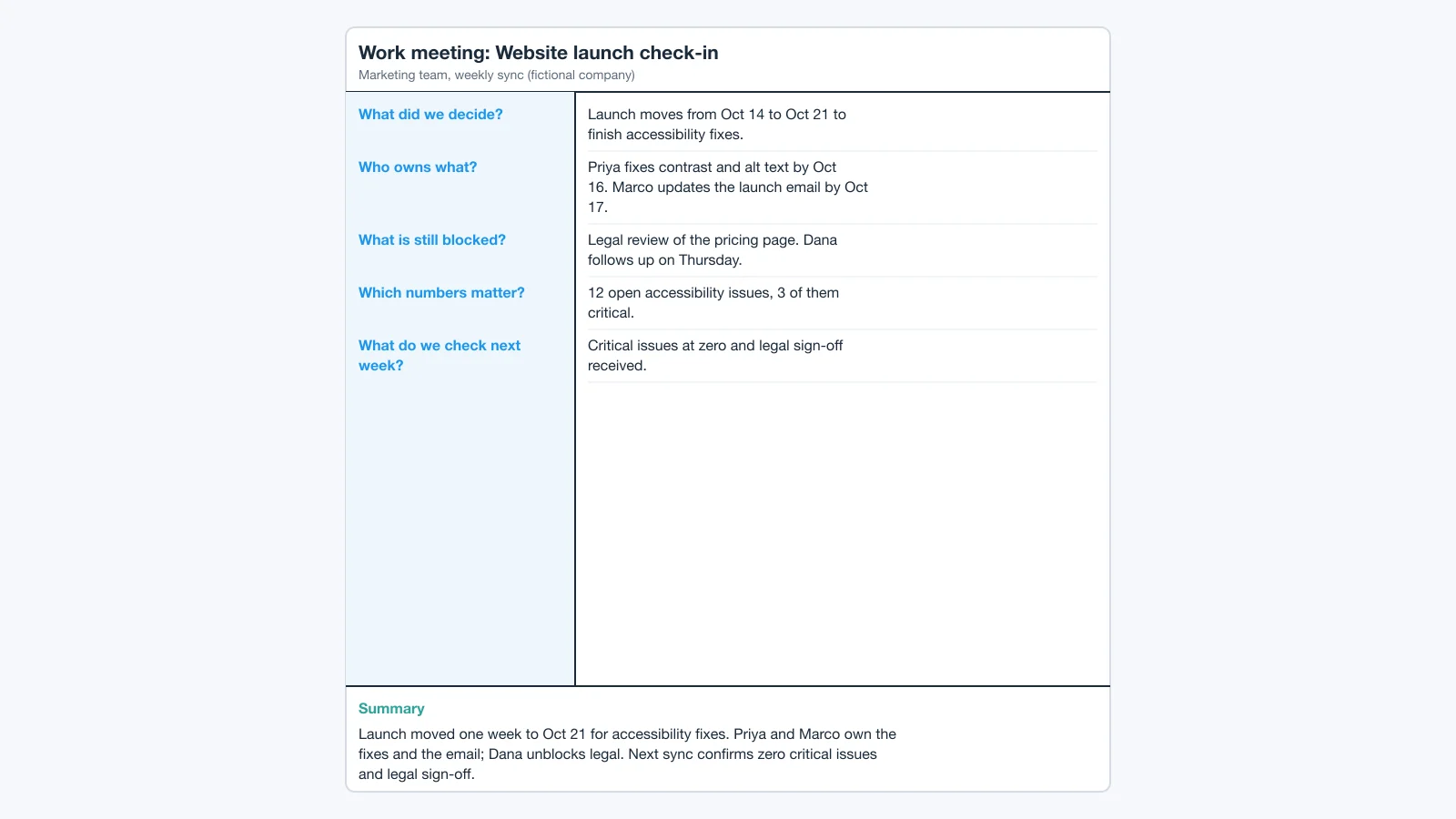
| What did we decide? | Launch moves from Oct 14 to Oct 21 to finish accessibility fixes. |
| Who owns what? | Priya fixes contrast and alt text by Oct 16. Marco updates the launch email by Oct 17. |
| What is still blocked? | Legal review of the pricing page. Dana follows up on Thursday. |
| Which numbers matter? | 12 open accessibility issues, 3 of them critical. |
| What do we check next week? | Critical issues at zero and legal sign-off received. |
Summary: Launch moved one week to Oct 21 for accessibility fixes. Priya and Marco own the fixes and the email; Dana unblocks legal. Next sync confirms zero critical issues and legal sign-off.
Why this page works:
- The cues are the same five questions every week, so the page doubles as a meeting checklist.
- Each owner has a name and a date in the notes, not just a task.
- The summary is the recap message you can paste into chat for anyone who missed the meeting.
Before and After: Turning Raw Notes Into a Cornell Page
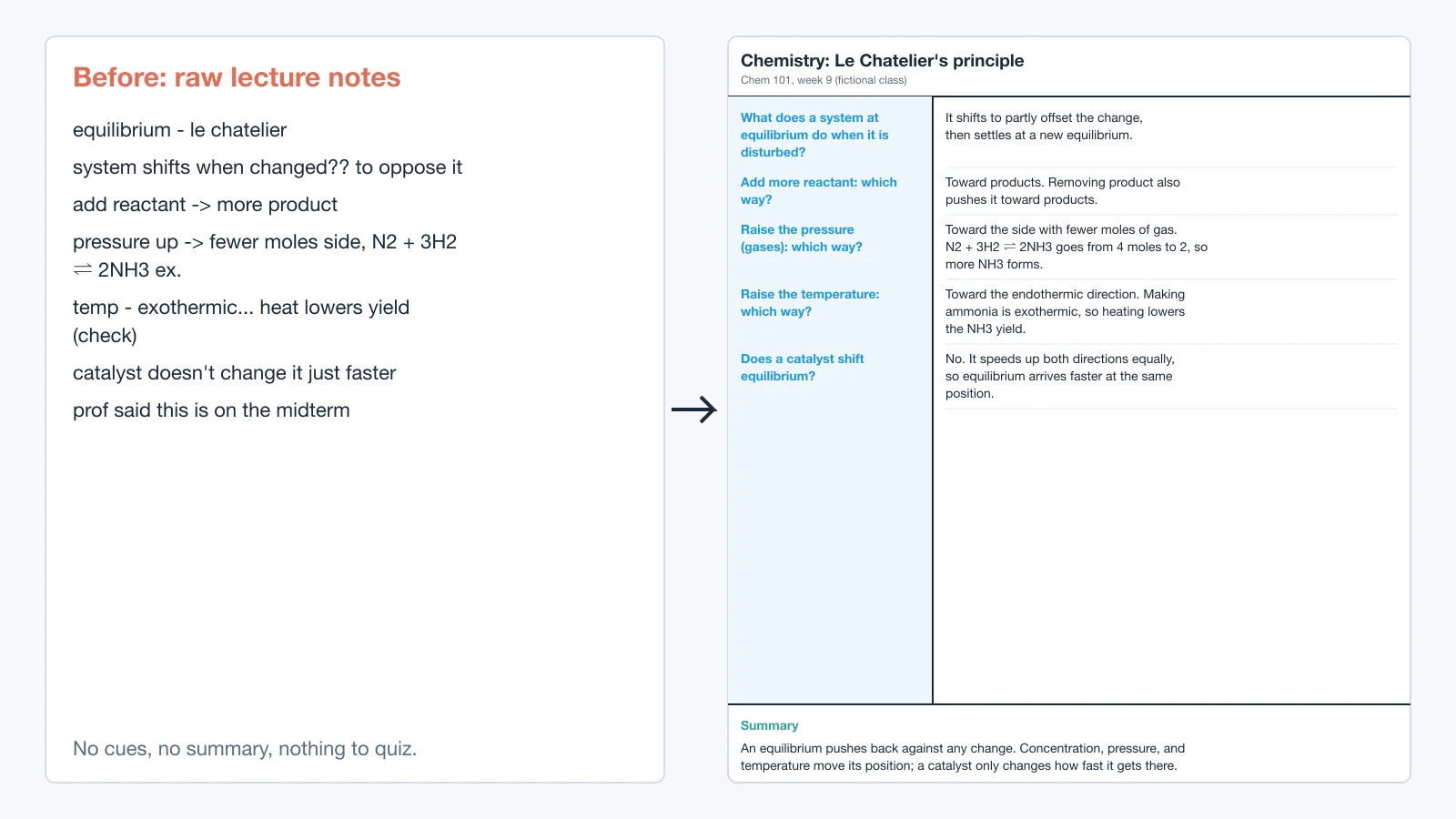
Most notes start as a fast list typed or scribbled during class. The chemistry page above began like this:
- equilibrium - le chatelier
- system shifts when changed?? to oppose it
- add reactant -> more product
- pressure up -> fewer moles side, N2 + 3H2 ⇌ 2NH3 ex.
- temp - exothermic... heat lowers yield (check)
- catalyst doesn't change it just faster
- prof said this is on the midterm
Nothing here is wrong, but there is nothing to quiz yourself on. Turning it into a Cornell page takes about ten minutes the same day:
- Clean up each line into one fact. Finish the half-sentences and fix the "(check)" item. Exothermic means heat lowers the yield, so the note is now a full statement.
- Write a cue for each fact. Ask the question the fact answers, such as "Raise the temperature: which way?"
- Drop what is not content. "On the midterm" goes on your study plan, not in the notes.
- Write the summary last. Cover the notes, read the cues, and write two sentences that connect them.
Common Mistakes in Cornell Notes Examples
- Cues that are just headings. "Pressure" is a label; "Raise the pressure: which way?" is a question you can be tested on. If a cue can't be answered, rewrite it.
- Copying the slide into the notes. Long sentences make the notes area hard to scan. Keep one idea per line.
- Skipping the summary. It is the part that forces you to connect the ideas. If you can't write two sentences, you don't understand the page yet.
- Filling the cue column during class. Cues written later work as a first review. Writing them in class turns them into more notes.
- One giant page per week. Start a new page for each class or meeting so every summary covers one topic.
Cues don't always have to be questions. Short prompts such as "Trigger words" or "Theme to track" work when the answer is a list. What matters is that each cue makes you recall the note beside it.
Printable Cornell Notes Examples and Templates
The filled-in examples PDF has all eight pages above, one per page, on US Letter paper (8.5 × 11 in). It is about 75 KB. It uses the same layout as our blank templates: a 2.25-inch cue column, a 5.25-inch notes area, and a 2-inch summary. On A4 paper, choose Fit to page when printing.
For a blank page to fill in yourself:
- Word, PDF, or Google Docs: download the blank Letter and A4 files from the free Cornell notes template guide.
- AFFiNE: start from the Cornell notes template or pick a style from the Cornell notes template gallery, including the visual Cornell method template for diagram-heavy subjects.
- Choosing an app: our comparison of the best apps for the Cornell method covers digital options, including handwriting apps.
Disclosure: AFFiNE publishes this blog. An AFFiNE page can hold the Cornell layout as a document, and the whiteboard mode lets you add a diagram beside the notes. Paper works just as well if you prefer to write by hand. For other ways to structure notes, see these note-taking methods.
Frequently Asked Questions
What is an example of Cornell notes?
A Cornell notes example is a filled-in page with three parts: questions in a narrow left-hand cue column, short notes in the wider right-hand column, and a two- or three-sentence summary at the bottom. For instance, a chemistry cue reads "Raise the temperature: which way?" and the note beside it answers it.
What do you write in the cue column of Cornell notes?
Write questions or short prompts that the notes beside them answer, such as "Why did bank failures make the Depression worse?" Add them after class, not during it. Then cover the notes column and answer each cue from memory to review.
How long should a Cornell notes summary be?
Two or three sentences is enough for one class or meeting. Write it in your own words, the same day, and make it connect the main ideas rather than list them. If you can't write it without looking, review the page again first.
Do Cornell notes cues have to be questions?
No. Questions work best for most subjects because they turn review into self-testing, but short prompts such as "Trigger words" or "Theme to track" are fine when the answer is a list. Each cue should make you recall the note next to it.
How do you use Cornell notes for math?
Put one fully worked problem in the notes area, step by step. In the cue column, write "When do I use this?" and the formula's name, and in the summary describe the method in words. During review, cover the notes and re-solve the problem instead of rereading it.
Sources and Editorial Notes
All eight Cornell pages are fictional teaching examples written by AFFiNE for this article. Class names, people, and dates in them are invented; the subject facts are real. The filled-in PDF was generated from the same text as the examples on this page and checked page by page after export (8 Letter pages). Sources checked in October 2026:
- Walter Pauk and Ross J. Q. Owens, How to Study in College, 11th ed., Wadsworth Cengage (first edition: Houghton Mifflin, 1962).
- Cornell University Learning Strategies Center, The Cornell Note-taking System.
- Chemistry: OpenStax, Chemistry 2e, 13.3 Shifting Equilibria: Le Châtelier's Principle.
- History: OpenStax, U.S. History, chapter 25: Brother, Can You Spare a Dime? The Great Depression, 1929–1932.
- Math: OpenStax, Intermediate Algebra 2e, 9.3 Solve Quadratic Equations Using the Quadratic Formula.
- Literature: William Shakespeare, Macbeth, Act 1, scenes 3 and 5 (Folger Shakespeare Library text).
- Psychology: Ebbinghaus, H. (1885/1913). Memory: A Contribution to Experimental Psychology (Classics in the History of Psychology); Murre, J. M. J., & Dros, J. (2015). Replication and analysis of Ebbinghaus' forgetting curve. PLOS ONE, 10(7). doi:10.1371/journal.pone.0120644
- Statistics: OpenStax, Introductory Statistics 2e, 2.6 Skewness and the Mean, Median, and Mode.