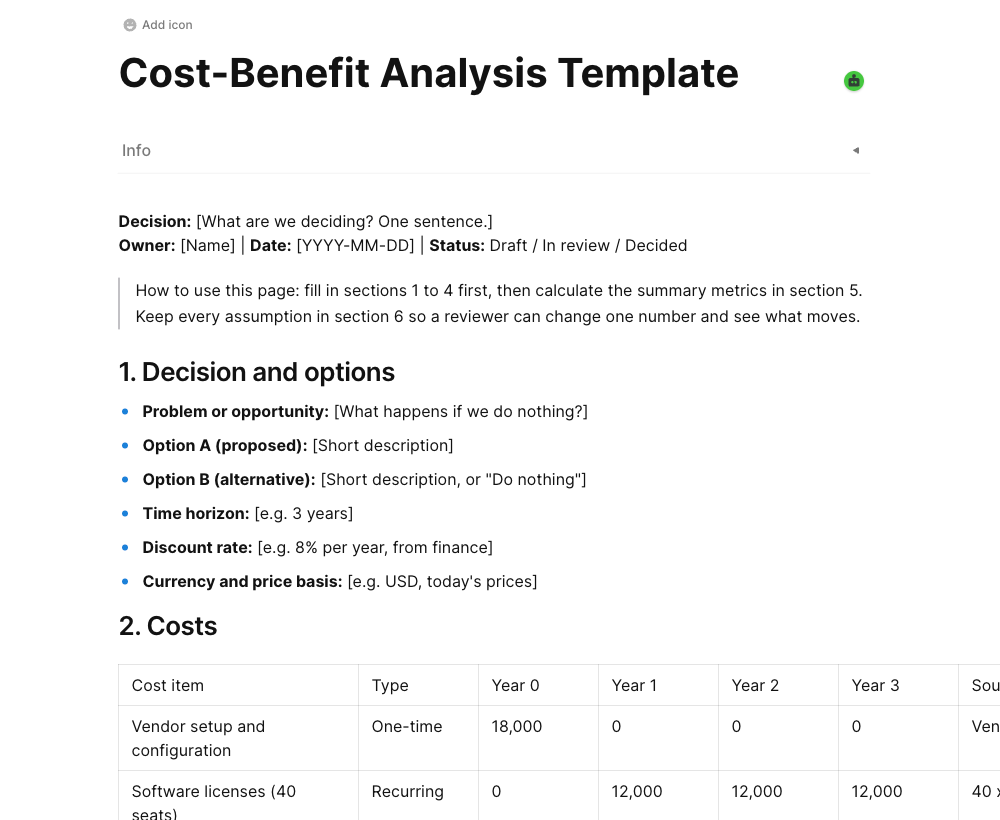
A cost-benefit analysis template is a structured page for deciding whether a project, purchase, or change is worth what it costs. This AFFiNE template gives you a decision header, a costs table and a benefits table by year, a net cash flow table with discount factors, a summary metrics table for net present value (NPV), benefit-cost ratio (BCR), and payback period, plus an assumptions list, a sensitivity check, and a sign-off checklist.
How to use this template
-
Write the decision and options. State the question in one sentence, list at least two options including "do nothing", and set the time horizon and discount rate before collecting numbers.
-
Fill the costs table. Add one-time and recurring costs in the year they happen, including people time such as training and admin. Note a source for each row.
-
Fill the benefits table. Add savings, revenue, and time saved with an owner for each estimate. Put benefits you cannot price in the intangibles list instead of guessing a number.
-
Discount and total. For each year, net cash flow = benefits - costs, present value = net cash flow x 1/(1+r)^t.
-
Calculate the summary metrics. NPV = present value of benefits - present value of costs. BCR = present value of benefits / present value of costs. Payback = years until cumulative net cash flow reaches zero.
-
Run the sensitivity check. Lower the benefits by 25% and raise setup costs by 50%, then find the break-even point.
-
Decide and sign off. Tick the checklist, write go, no go, or go with conditions, and record who approved it.
Example values
The example rows come from a worked example: a 40-person support team buying an automation tool for $30,000 upfront and $20,400 a year, saving $36,000 in Year 1 and $48,000 in Years 2 and 3. At 8%, NPV is $30,017, BCR is 1.36, and payback is 1.52 years. The full calculation is in our guide to the cost-benefit analysis template.
Tips
-
Use the same discount rate and horizon for every option.
-
Keep assumptions next to the numbers so reviewers can challenge one input at a time.
-
Treat NPV above 0 and BCR above 1 as a signal for discussion, not an automatic yes.